Grok Bot + TradingView is one of the MOST powerful AI trading setups I’ve ever used
You can literally turn Grok Bot into your personal trading assistant in minutes
It'll run premium indicators on live charts, conduct deep technical analysis & more
feed this before it’s gone:
One prompt in quantitative trading created more alpha than most Fortune 500 trading desks:
"Reverse Engineer Regime Strategy"
3 lanes. 9 validation gates. 0 live trading without paper-trading PASS.
Bookmark this.
paste this Jane Street style trading prompt into claude code.
it uses OpenAI Decisions API + agenkit[.]xyz to build e2e production system in one prompt.
you’re welcome. Bookmark now.
ex Goldman Sachs managers built a $400 BILLION fund & gave their ALPHA strategy in this research paper
i turned the whole paper into ONE prompt that builds the EXACT strategy
paste this prompt into Opus 5.5, you're welcome:
this f*cking debate on reddit went viral where quants started arguing about how they actually use ai in hedge funds.
one quant developer exactly shared his workflow in this discussion. 1k upvotes
he says "never outsource engineering judgement".
bookmark and read before this disappears.
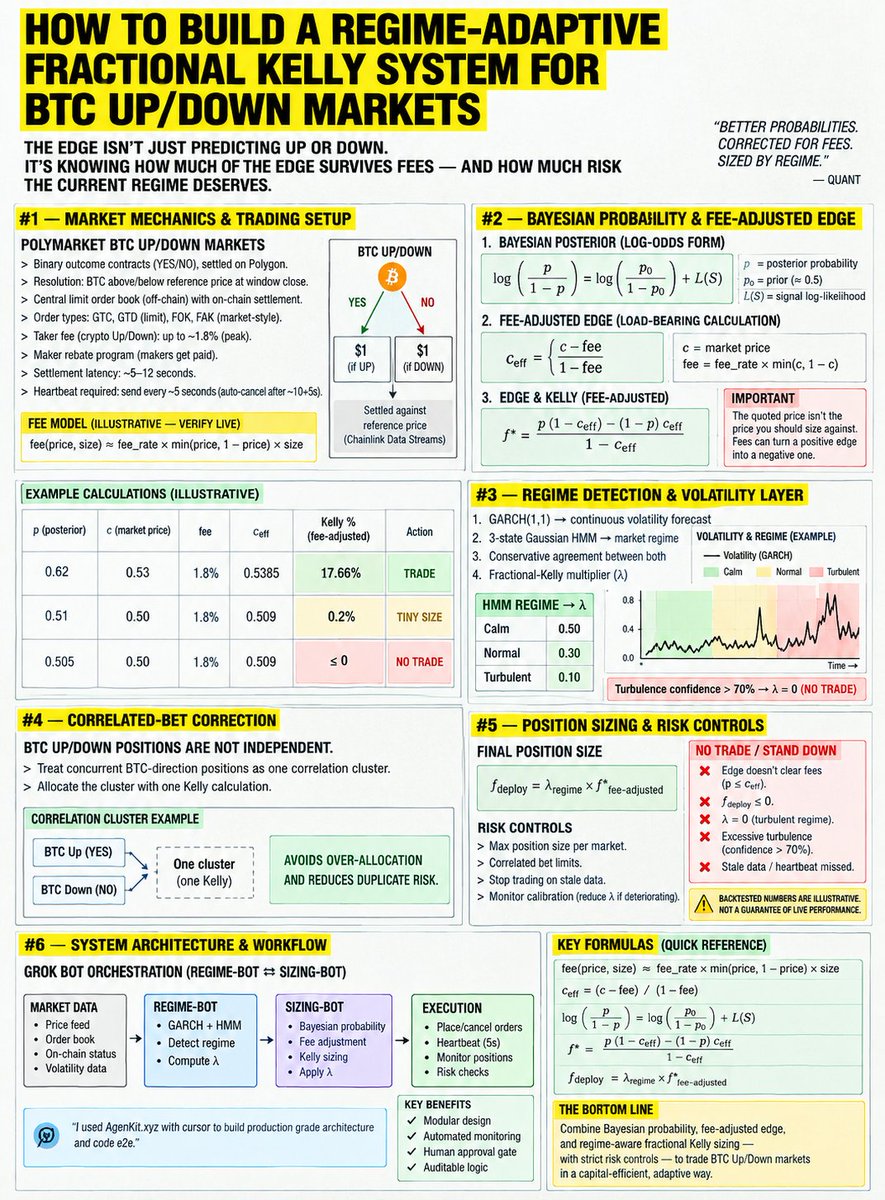
this Wall Street trader made $65k/month in btc up down markets using pure math.
he revealed how his "regime adaptive fractional kelly system" handled polymarket "fees" that created edge.
he also openly shared "all technical formulas" to understand his derived alpha.
Bookmark this rare valuable post.
GPT-6 Astra builds the MOST POWERFUL 24/7 trading agents
i wrote a 6-page research paper on exactly how to use GPT-6 Astra at its FULLEST potential to build mathematical trading strategies like hedge funds
along with COMPLETE CODEBASE
here is how you set it up:
1. the 4 mathematical trading models every hedge fund runs. Ornstein-Uhlenbeck stat arb, Avellaneda-Stoikov market making, Hawkes order flow, Heston volatility. exact formulas for each
2. the exact validation thresholds. Sharpe above 1.5, drawdown below 15%, hit rate above 55%, t-stat above 2.0, walk-forward across 5 years
3. why the math was never the wall. the wall was the 6 salary team at $1.8M annual cost per model. Astra covers every role
4. the AgenKit harness that installs 10 specialist agents inside Codex CLI with test-first builds and two-stage review gates
5. the 6 layer production architecture with Kelly-sized positions, 5% drawdown kill switches and delta-neutral hedging
6. the exact one-line prompt that ships a working mathematical model like hedge funds in one weekend
this is the EXACT system i have been running for the past 5 days & results are INCREDIBLE so far:
this quant paper is f*cking insane
it's basically the 9-step alpha pipeline hedge funds go through before they ever pull the trigger on a trade.
every step, every mathematical formula. solo trader can use.
feed it into Astra GPT-6 + Agenkit[.]xyz and you'll have a working prod grade trading system by tonight as shown in article by quant himself.
bookmark it before this thread gets buried.
GPT-6 Astra is the most powerful trading agent right now.
It gives you AGI-adjacent reasoning.
I've shown the exact way to use GPT-6 Astra at its HIGHEST benchmark.
You could literally build MOST complex trading models like hedge fund with it. https://t.co/VxsUknvnSu
GPT-6 Astra + TradingView builds the most powerful trading agents
i plugged this open source repo into my Astra stack & now my 24/7 trading bot works with real-time TradingView data
PREMIUM indicators without paying for a PRO account
here is how you can set it up:
1. clone the TradingView API repo (3.9k stars, github on top), one npm install gets you real-time feeds, premium indicators and replay mode
2. pipe the live data stream into the 300 agent monitoring layer, each sub-agent now pulls TradingView values on top of exchange APIs, 10x the signal coverage without extra cost
3. expose the indicator library as a tool to GPT-6 Astra. RSI, MACD, Ichimoku, Supertrend, plus any custom Pine Script indicator you can pull from TradingView, all callable natively
4. use the backtest endpoint to validate every hypothesis. Astra writes the strategy, converts to Pine Script, ships it, reads the result in seconds
5. connect the technical analysis endpoint to the Validation Bot. TradingView returns a buy/sell/neutral read across 26 indicators for any symbol, becomes a second opinion layer before capital moves
6. use replay mode to stress test across any timeframe. free, unlimited, works on premium data
7. telegram alerts now include chart snapshots alongside instrument, strategy, Sharpe, drawdown and Kelly sized position
EXACT system (in depth) which I am running with GPT-6 Astra is in the article below:
This is the exact validation framework my PM told me to "never put in writing" after my first month at a top-tier quant fund.
in this paper i have leaked "all secret sauce" that top tier traders use to build Monte Carlo Validation Gate in any regime with claude code + agenkit solo.
Bookmark before this gets lost in your feed.
Wall Street trader openly shared on reddit, how he used GPT-6 Astra powered with Agenkit to build alpha that's milking 18k/month.
he plans to scale his trading system to 100k/month.
his leaked trading system is simple, "Regime Detection → Agents → Verification → Execution"
Bookmark before it disappears.
GPT-6 Astra trading capabilities will scare you.
5 min. free. from wall street trader.
shows inside the explosion of ultra risky options trading on wall street.
Bookmark and then watch.
Sam Altman says, "You can build 10 trading agents in one evening with GPT-6 Astra. Each handles a task you've been doing manually every day.”
In just 25 minutes, he explains how one person now does the work an entire team used to spend a month on.
Bookmark before its lost.
How to become a quant from 0 to $650k/year (PLAYBOOK):
by the end, you'll know how to:
- build the exact math foundation top firms actually test
- ship real projects that separate you from every other applicant
- land your first credential and use it to climb the staircase
- crack interviews at Citadel, Jane Street and prop shops
btw i was quantitative backend developer at Liquid Hedge Fund based in Dubai for almost a year, building systematic trading strategies across perp dexes and prediction markets (right now on a break, working on my own projects)
everything below is what actually got me here, in the order it actually worked
here's the full 5-stage roadmap:
---------------
Stage 1 (year 0): build the math foundation in the correct order
the biggest mistake is starting with finance textbooks or trading blogs
you don't need to know markets. you need to know math that markets run on
how to build it:
> probability first - Blitzstein & Hwang, free PDF from Harvard. chapters 1 to 6. conditional thinking is the entire skill
> statistics second - Wasserman, All of Statistics. how to tell signal from noise
> linear algebra third - Strang MIT 18.06, free at > OpenCourseWare. eigenvalues reveal what actually matters
> convex optimization fourth - Boyd & Vandenberghe, free from Stanford. every portfolio problem reduces to this
> stochastic calculus last - Shreve Vol 1 and 2. this is where Black-Scholes comes from
your first year should feel painful, slow, non-linear
most people quit here. that's why the field pays what it pays
metric to watch: can you derive Ito's Lemma from scratch on a whiteboard?
mistake to avoid: skipping layers because they feel abstract
---------------
Stage 2 (year 1): read the papers and implement each one from scratch
this is where I separated from every other backend developer trying to get in
the 5 papers that shaped every quant desk on Wall Street:
> Avellaneda & Stoikov 2008 (market making)
> Engle & Granger 1987 (cointegration)
> Heston 1993 (stochastic volatility)
> Fama & French 2015 (five-factor model)
> Cohen, Malloy, Pomorski 2012 (insider clusters)
read all five. twice. then implement each from scratch in Python. no frameworks
language stack that actually ships:
> Python for research, backtesting and 90% of quant work. pandas, polars, pytorch, cvxpy, statsmodels
> Rust for new systematic infrastructure. this is what Hyperliquid, prediction market engines, and next-gen HFT stacks are built in
> Go for execution infrastructure. broker connectivity, microservices, low-latency APIs
> C++ only if you're targeting elite HFT engineering. Jane Street uses OCaml specifically for their trading stack
the mistake most self-taught quants make is picking one language and defending it, real desks run POLYGOT.
Python for research, Rust or Go for execution
what this gave me:
1: real understanding of how each model breaks
2: code on GitHub that recruiters actually respected
3: the ability to explain any of these in an interview without notes
Heston was the one that changed my thinking. once I understood why volatility itself follows a stochastic process, options started making sense
metric to watch: can you code Heston from a blank file in under 4 hours?
mistake to avoid: reading 20 papers superficially instead of 5 deeply (VERY IMP)
---------------
Stage 3 (year 2): ship 6 real projects with working backtests
this is where most aspiring quants die silently
the 6 projects that will land your first interview:
> pairs trading bot on 5 cointegrated equity pairs
> options pricing engine with Heston implementation
> Fama-French factor decomposition scanner
> insider cluster detector using SEC EDGAR
> mean reversion scanner for S&P 500
> cross-exchange arbitrage scanner for perp DEXs
every project needed:
- clean GitHub repo with a proper README
- working backtest with real historical data
- honest documentation of what failed and why
- one paragraph explaining the math in plain English
the honest documentation is what actually got me noticed. I wrote a section called "what broke" in every README. two recruiters told me later that was the reason they DM'd me
metric to watch: how many recruiters DM you after posting these
mistake to avoid: hiding the projects where the math didn't work
---------------
Stage 4 (year 3): first credential and the interview grind
credential path (what worked for me):
> cold emailed 40 PhD students. 3 responded. 1 took me on
> TA'd a quantitative finance course at a local university
> contributed to open-source quant libraries on GitHub
> the title didn't matter. having real technical work to talk about mattered
interview prep:
- the Green Book (Xinfeng Zhou). 200 real interview problems. spend 15 minutes attempting each before looking at hints
- QuantGuide(dot)io for probability puzzles at interview difficulty
- Brainstellar for brain teasers
- Zetamac for mental math. target 50+ correct per minute before applying
- LeetCode Blind 75 with focus on dynamic programming
the interview is a filter. it's not testing your knowledge, it's testing how you think under pressure with incomplete information
metric to watch: how quickly you can solve fresh problems out loud
mistake to avoid: memorizing solutions instead of understanding patterns
---------------
Stage 5 (year 3-4): compete publicly and climb the staircase
organic applications alone hit a ceiling. now you layer
public competitions:
> Jane Street Kaggle ($100K prize + direct recruiter visibility)
> WorldQuant BRAIN (paid alpha signals + institutional pipeline)
> Citadel Datathon (winners fast-tracked to interview rounds)
the staircase (this is the part nobody tells you):
1: research lab or startup first
2: mid-tier prop shop second
3: elite fund like Citadel, Jane Street, or Two Sigma third
nobody jumps directly from zero to Jane Street. everyone climbs
attempting the vertical jump and failing doesn't mean the field is closed. it means you tried to skip stairs
metric to watch: interview conversion rate at each tier
mistake to avoid: applying to elite firms first, getting rejected and giving up
---------------
CONCLUSION
most aspiring quants die between the math foundation and the first credential because they think they need one more course, one more book, one more year
the truth is: the first 3 stages are slow, painful and non-linear
but they build the foundation that makes stages 4 and 5 feel like gravity
start with probability. read the 5 papers. ship 6 projects. then apply
no MIT. no Stanford. no finance degree required
Citadel entry level pays $336K to $642K. Jane Street average $1.4M. 5-year top prop $800K to $1.2M
the information asymmetry keeping most people out isn't intelligence. it's not knowing what the path looks like.
COMPLETE SUMMARY BELOW:
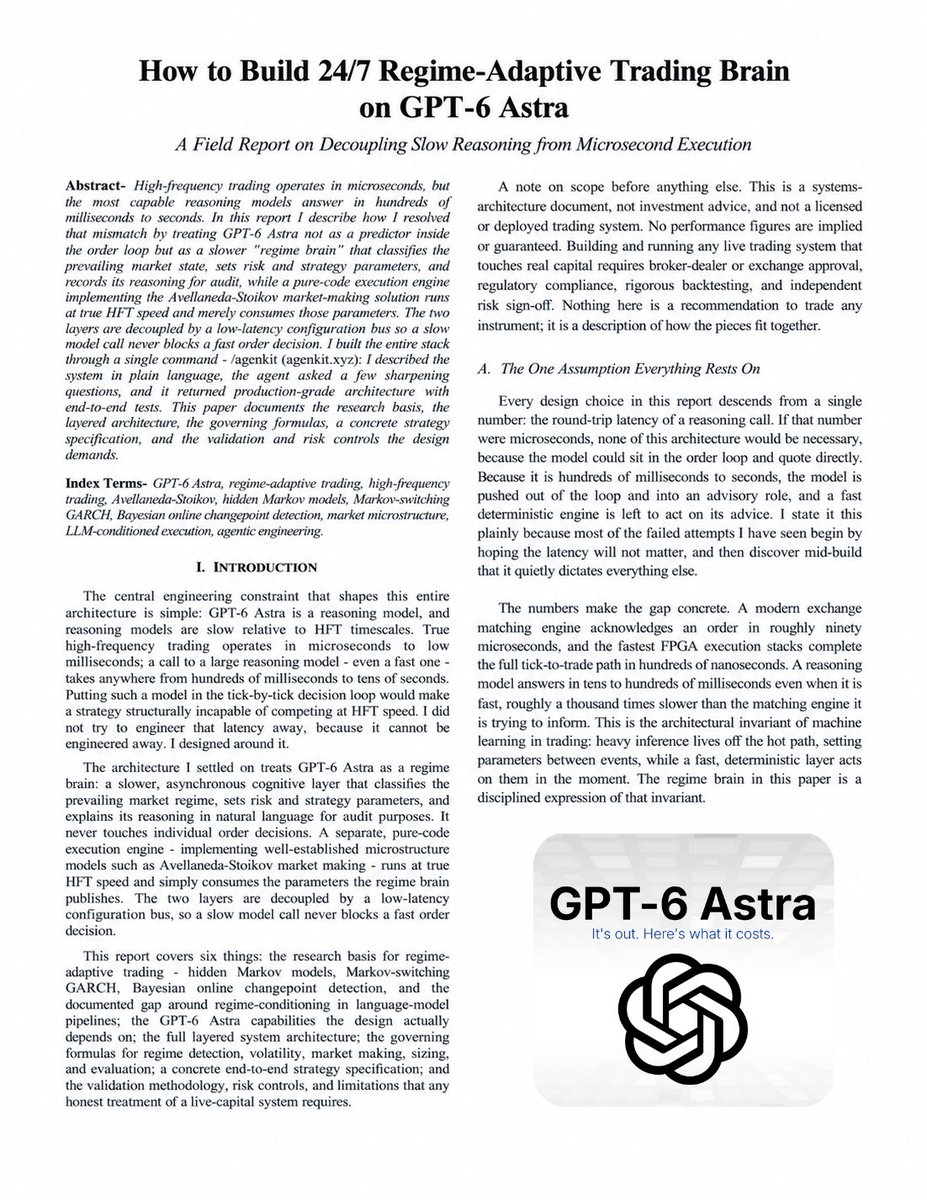
GPT-6 Astra can run a hedge fund's regime brain without ever touching the order loop.
I wrote a 7-page research paper on exactly how to build a regime-adaptive trading system on Astra GPT-6, with the full formulas and codebase using claude code + agenkit as solo.
every formula: reservation price, optimal spread, regime-scaled Kelly sizing, regime-conditional Sharpe
Bookmark before its lost.
GPT-6 Astra builds the most powerful trading agents
i wrote a 6-page research paper on exactly how to find profitable strategies 24/7 with Astra, along with the COMPLETE CODEBASE
here is how you set it up:
1. the 4 mispricing categories every hedge fund actually hunts (statistical arbitrage, volatility surface, factor decomposition, insider clusters) with the exact formulas for each
2. the 8 bot architecture that maps to every function of a real fund, one bot per role, with maker checker separation so nothing grades its own output
3. the 300 agent monitoring layer that watches order books, options flow, SEC filings, macro releases, and central bank X accounts in parallel
4. the hypothesis generator that reads filtered candidates and codes new strategies every night in Python, backtests them, and throws out anything below Sharpe 1.5
5. the exact validation thresholds every strategy has to pass before deployment. Sharpe above 1.5, drawdown below 15%, hit rate above 55%, t stat above 2.0
6. the Telegram alerts that ping your phone with instrument, strategy, confidence score, Sharpe, drawdown, action window, and Kelly sized position
this is the exact system I have been running for the past 3 days: