1/10 Meet the Fall '26 cohort of the Cardano Accelerator Program.
Eight ventures, two tracks, one focus: proving that a claim about origin, identity or data is true. We'll work with them all toward market and investment readiness.
Let’s take a look at the selected projects. 🧵
After months of work, this paper on tokenization is out.
Most compliant issuance still goes to EVM. We wrote this so the @Cardano path is visible too: CIP-0113, what it already allows, and what still has to be built before it can go to production.
@CNVArgentina sandbox is technology-neutral through 2027. The standard can be implemented today. Production still depends on finishing the independent audits, plus tooling and mainnet.
We started it together. @LucasMacchia2 joined as a Cardano Ambassador. @MauroAndreoliA and Alejandro Rodríguez Ariola did the legal analysis. @juanlazarte06 brought @blockenfy’s production criteria on live ERC-3643 issuances. Alejandro Ravasio reviewed the technical side with me. Academic input came from Professor Dr. Claudio J. Tessone (@UZH_en Blockchain Center).
CIP-0113 exists because of earlier work by Philip DiSarro, Jann Müller, Michele Nuzzi, Matteo Coppola Mazzetti, and Giovanni Giargulo.
Thanks to the Cardano Ambassador Program and the @Cardano_CF.
Comments and constructive criticism welcome.
Article here: https://t.co/a89UvVEESa
ICYMI: Every week, IO shares a roundup of the latest progress across the technical development stack. Missed this week? Catch up here 👇
https://t.co/kwKIHtjXLb
Lace 2.3.0 is here.
A little Lace refresh with a lot going on!
This update brings improvements across DApps, staking, governance, hardware wallets, balances, syncing & Midnight.
A few highlights:
• More reliable DApp connections
• Better staking pool & DRep browsing
• Improved Ledger, Trezor, Keystone & SeedSigner support
• More accurate balances & sync status
• Midnight sync & transaction improvements
• Portfolio sorting by value
• Fixes across sending, swapping and receiving
& that’s just the highlights...
Lace 2.3.0 is available now. Head to the blog for the full release notes & everything that’s changed:
https://t.co/gvzyGlr3mq
JUST IN: Cardano is now part of the official x402 SDK.
Any app or AI agent can pay for an API call in $ADA or any CNT over a web request. No account, no API key, no checkout page.
Every service already on x402 can switch Cardano on.
The agent economy just got a Cardano rail.
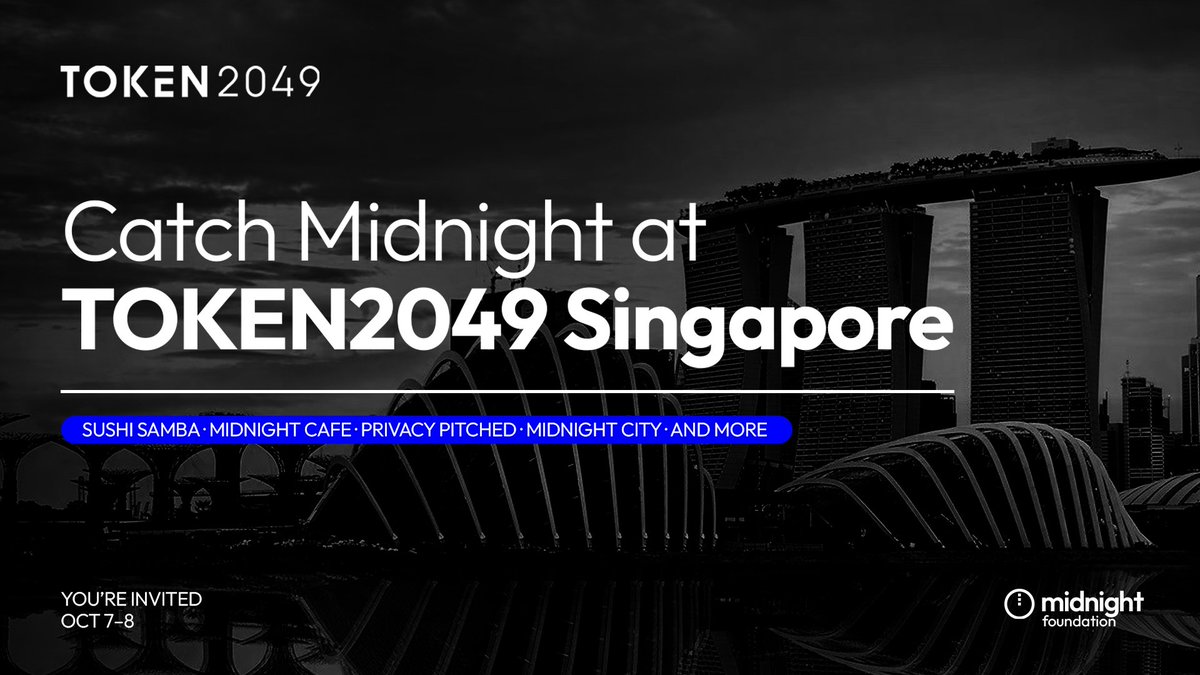
Singapore, we have plans. 🇸🇬
3 ways to experience Midnight.
2 @token2049 keynotes.
1 way to avoid FOMO.
Oct 7 👉 Enter the Night: https://t.co/S7ckmBmIxg
Oct 8 👉 Midnight Cafe: https://t.co/dXCsTLvVVt
Oct 8 👉 Privacy Pitched: https://t.co/2T4Q8bRcVQ
Register before it's too late.
ICYMI: How alternative node implementations strengthen network resilience and open Cardano to the Go ecosystem.
Watch the Developers Office Hour walkthrough with Chris Gianelloni on Dingo: https://t.co/ONicU0NdxS
NEW: Cardano $ADA founder Charles Hoskinson says crypto will "eat" AI over the next 5 to 10 years.
Hoskinson said: "Cryptocurrencies are going to eat AI because we solve all the hard problems that AI can’t solve."
He named payments, alignment, and data provenance as the gaps blockchains can fill.
Hoskinson said OpenAI and Anthropic will have to become profitable at scale, arguing individual models can make money but pre-training is what "kills them."
At the same time, he said the data-center buildout is unsustainable.
He argued spending cannot rise 10x every year because "there’s not enough electricity in the world to facilitate that."
Hoskinson compared the boom to 1990s fiber, when he said about 90% of newly laid cable sat dark and demand took roughly 10 years to catch up.
He expects "dark data centers," then a shift to local/edge models and distributed grid compute.
As examples, he cited Apple’s M5 Mac Studio targeting 400-500 billion parameter models with 512 GB of RAM, around a $20,000 price point today, and Nvidia Spark boxes at about $4,000.
He said the only coordinating layer for pooling GPUs, phones, and other devices into that grid is crypto.
Hoskinson also said he does not expect a US Clarity Act before 2029, and forecast about $10 trillion of assets and a billion new users on public blockchains by the end of 2030.
Crypto is trying to become the settlement and coordination layer for AI.
There are just 103 days until the EU's deforestation rules apply to importers of cocoa, coffee, and soy.
They'll need a supply chain record anyone can verify and no one can quietly rewrite.
That's where Cardano comes in: open, tamper-evident, built to last.
Smart contract deployment is soon going to be enabled on Midnight mainnet👀
Excited for private smart contracts! (incl. ability to mint private custom tokens)
Thanks to all the builders who helped get here
Daedalus 11.4.0 has arrived.
This focused maintenance release improves governance flows, corrects transaction export handling and refreshes the node and wallet components that power Daedalus.
Here is what changed. 🧵
How should Cardano split its 2027 treasury funds?
@Cardano will host a roundtable on treasury funding reform on Monday at 13:00 UTC. It comes ahead of the 2027 cycle for the net change limit, which caps how much $ADA can leave the treasury.
A DRep and speakers from the Cardano Foundation (@Cardano_CF) and Intersect will debate splitting funds into set domains, plus runway and delivery tracking. Past proposals will not be re-argued.
1/ NIGHT generates DUST.
DUST pays for transactions on Midnight.
But what if you never had to think about the mechanics? 🤔
That’s the idea behind abstraction.
And @GeroWallet is putting it into practice. 🧵
https://t.co/pmJR1gXH8c
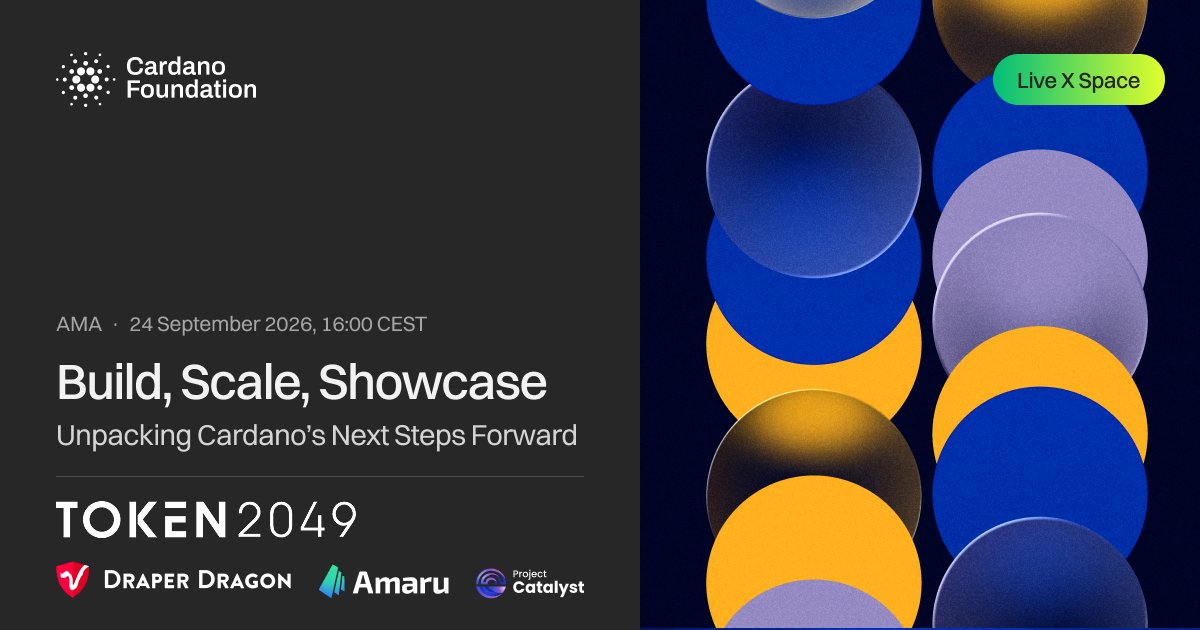
What's next for Cardano? Let's chat about it.
@TOKEN2049 week, the side events around it, node diversity, the Project Catalyst pilot and a wider ecosystem view.
We're hosting a live X Space on 24 September at 16:00 CEST to cover it all.
Got questions for us? Drop them below.
#Cardano founder Charles Hoskinson has argued that $ADA and $XRP should be treated as genuine commodities under U.S. crypto regulation.
Hoskinson made the remarks while explaining why the CLARITY Act failed to advance in the U.S. Senate. He focused on what he sees as a fundamental problem with the legislation’s proposed approach to classifying and regulating digital assets.
According to him, one of the fundamental problems was the attempt to treat a wide range of digital assets as commodities and place the CFTC at the center of crypto regulation.
He argued that securities and commodities have fundamentally different characteristics and therefore require different regulatory approaches. In his view, the SEC has a larger workforce and broader tools for disclosure and market oversight, while the CFTC traditionally operates as a principles-based commodities regulator.
However, Hoskinson’s criticism does not appear to be directed at the use of commodity regulation for crypto assets generally. Instead, he argued that lawmakers should first establish which digital assets genuinely qualify as commodities and which belong in a separate digital-security category.
He specifically identified Bitcoin, Cardano, and XRP as examples of crypto assets that he considers “truly commodities.”
https://t.co/GcvYLLFeqk