오늘 자 SK 최태원 회장의 블룸버그 인터뷰 내용을 정독했는데,
AI나 반도체 투자하시는 분들은 꼭 보셔야 할 역대급 인사이트가 많네요.
단순히 "HBM 잘 판다" 수준이 아니라 시장의 구조적 변화를 정확히 짚고 있습니다.
중요한 포인트들만 자���스럽게 풀어서 정리해드림.
먼저 SK하이닉스의 미국 ADR 상장 추진 소식.
이게 단순한 주식 거래 확대를 넘어 글로벌 자본을 당기고 미국 현지 탑티어 인재를 영입하기 위한(스톡옵션 활용) 전략적 교두보더라고요.
인터뷰에 나온 265억 달러(약 36조 원)가 거액 같지만,
최 회장은 SK의 전체 투자 스케일에 비하면 "지나치게 큰 수준은 아니다"라며 상당한 자신감을 보였습니다.
기술적으로 가장 소름 돋는 부분은 'KV 캐시(Key-Value Cache)' 수요 폭발을 예측한 점입니다.
과거엔 스마트폰 판매량 같은 '사람 수'에 따라 메모리가 늘어났다면,
이제는 인간이 안 써도 AI 에이전트들이 24시간 작동하며 데이터를 소모하죠.
특히 LLM 추론할 때 이전 문맥을 기억해두는 'KV 캐시' 때문에 메모리 대역폭과 용량 수요가 기하급수적으로 늘어납니다.
우리가 말하는 메모리 병목의 실체를 정확히 짚은 거죠.
지금 공급 부족이 어느 정도냐면,
하이닉스가 향후 5년간 생산 능력을 2배 늘릴 계획인데도 엔비디아나 빅테크 고객사들은 "그걸로 턱없이 부족하니 지금보다 5~6배는 더 달라"고 난리인 상황이랍니다.
HBM은 공정 난이도가 높아서 단기에 늘리기도 어렵고요.
최 회장은 이 쇼티지가 일시적 사이클이 아니라,
AGI(범용 인공지능)가 우리 사회에 완전히 정착할 때까지 장기 지속될 거라 내다봤습니다.
결국 SK의 종착지는 단순 HBM 제조사가 아닙니다.
이 강력한 하���웨어 주도권을 쥐고 AI 데이터센터(AIDC) 인프라, 자체 LLM 개발, 로봇·피지컬 AI, 헬스케어까지 AI 생태계 전반을 다 먹겠다는 'AI 풀스택' 로드맵을 대놓고 드러냈습니다.
판을 정말 크게 짜고 있네요.
마지막으로 요즘 핫한 'AI 거품론'에 대해서는, 일부 주가 과열은 있을지언정 "AI 기술 자체는 현실"이라고 선을 그었습니다.
기술이 발전하면서 토큰 비용(추론 비용)이 계속 낮아질 거고,
결국 전기나 인터넷처럼 누구나 일상적으로 쓰는 대중화 시대가 필연적으로 온다는 논리입니다.
단기 노이즈보다 이 거대한 공급 부족과 생태계 확장 흐름에 집중해야 할 때 같습니다.
-오선의 SAVE-
Andrej Karpathy stopped using AI to write code.
The co-founder of OpenAI. The man who built Tesla's Autopilot vision team from scratch. The person who coined the term "vibe coding."
In April 2026, he announced that a large fraction of his LLM token budget was no longer going into manipulating code, it was going into manipulating knowledge.
Then he published a single markdown file on GitHub explaining what he had built instead.
It got 17 million views. 13,000 GitHub stars. Dozens of community implementations within a week.
He called it the LLM Wiki. And the idea behind it is so simple it is almost embarrassing that nobody published it sooner.
Here is the problem it solves.
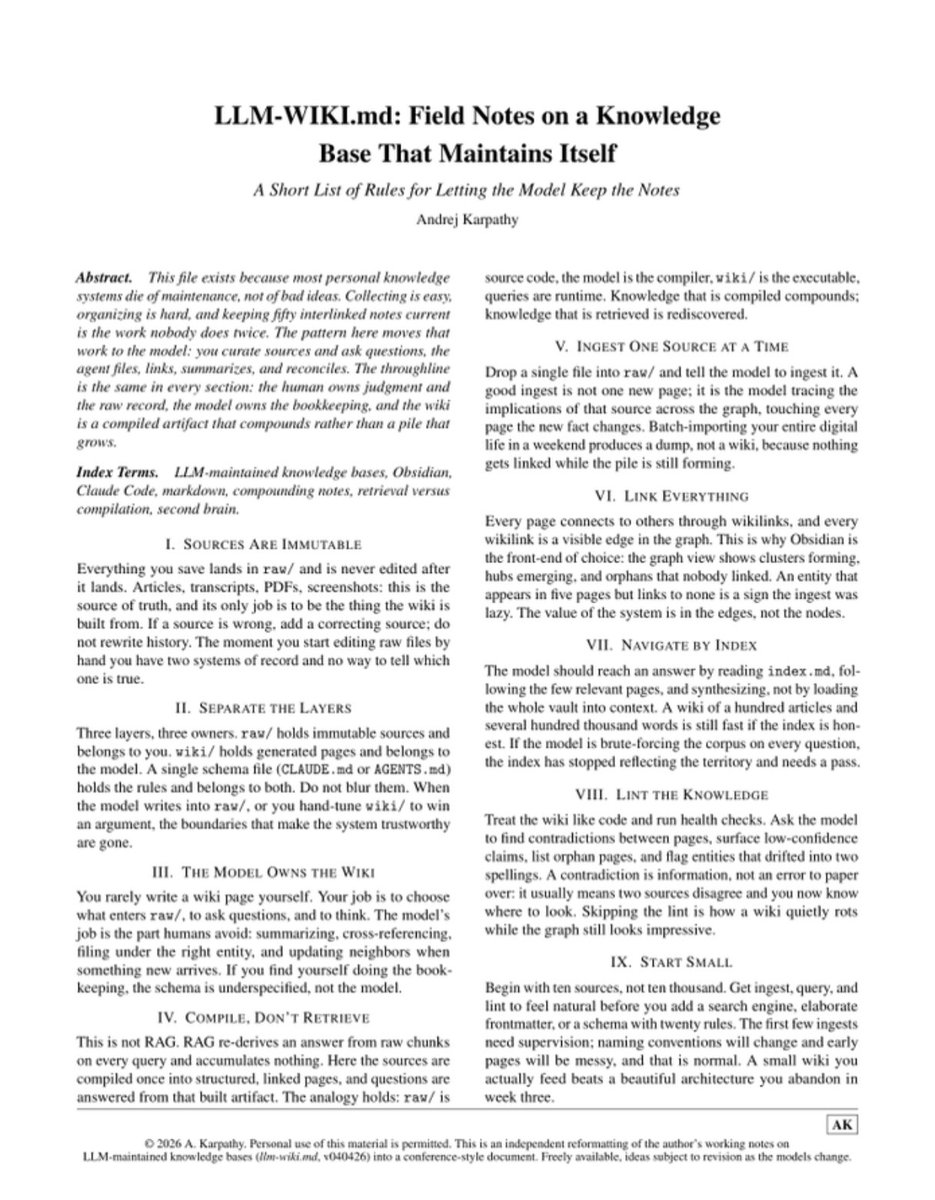
Most people's experience with LLMs and documents looks like RAG you upload a collection of files, the LLM retrieves relevant chunks at query time, and generates an answer. This works. But the LLM is rediscovering knowledge from scratch on every question. There is no accumulation. Ask a subtle question that requires synthesizing five documents, and the LLM has to find and piece together the relevant fragments every time. Nothing is built up.
NotebookLM works this way. ChatGPT file uploads work this way. Most RAG systems work this way.
Every session starts from zero. The AI never learns the territory. It just searches it again.
Karpathy's pattern is the opposite. Instead of retrieving from raw documents every time, the LLM builds and maintains a persistent, structured wiki — and answers questions from the compiled knowledge rather than the raw fragments.
Here is how the architecture works. Three layers.
**Layer 1 — Raw sources.** Your curated documents. Articles, papers, PDFs, meeting notes, screenshots. These are immutable — the LLM reads them but never modifies them. This is your source of truth. The moment you start editing raw files by hand, you have two systems of record and no way to tell which one is true.
**Layer 2 — The wiki.** A directory of LLM-generated markdown files. Summaries, entity pages, concept pages, comparisons, a master index, a chronological log. The LLM owns this layer entirely. It creates pages, updates them when new sources arrive, maintains cross-references, and keeps everything consistent. You read it. The LLM writes it.
**Layer 3 — The schema.** A CLAUDE.md or AGENTS.md file that tells the LLM how the wiki is structured, what conventions to follow, and what workflows to run. This is the config that turns a generic chatbot into a disciplined wiki maintainer.
Karpathy's phrase captures the whole thing: "Obsidian is the IDE. The LLM is the programmer. The wiki is the codebase."
Here is what happens when you drop a new source into the system.
You save an article into raw/. You tell the LLM to ingest it. The LLM reads the source, writes a summary page, updates the master index, creates or updates entity pages for every person, company, or concept mentioned, creates or updates concept pages for every idea, adds cross-references between related pages, and logs the ingest in the activity record.
A single source might touch 10 to 15 wiki pages. This is the bookkeeping that humans abandon — filing, cross-referencing, updating related entries, noting contradictions. The exact work that kills every personal knowledge system you have ever started.
The LLM does it tirelessly. Every time. Without forgetting.
Here is the key distinction from RAG.
RAG re-derives an answer from raw chunks on every query and accumulates nothing. The LLM Wiki compiles sources into structured, linked pages once — and questions are answered from that built artifact. The analogy: raw/ is source code, wiki/ is the compiled executable. Knowledge that is compiled is retrieved. Knowledge that is not is rediscovered from scratch.
And here is the rule Karpathy emphasizes most.
Lint the knowledge. Treat the wiki like code and run health checks. Ask the model to find contradictions between pages, surface low-confidence claims, list orphan pages, and flag entities that drifted into two spellings. A contradiction is information — it means two sources disagree and now you know where to look. Skipping the lint is how a wiki quietly rots while the graph still looks impressive.
Start small. Begin with ten sources, not ten thousand. Get ingest, query, and lint to feel natural before you add complexity. The first few ingests will be messy. Naming conventions will change. That is normal. A small wiki you actually use beats a beautiful architecture you abandon in week three.
The community response tells you how much this resonated.
Within a week of Karpathy's gist, the community produced dozens of implementations full Python agents, Obsidian integrations, wiki compilers, web interfaces. The pattern works with Claude Code, Codex, OpenCode, Gemini CLI, and any LLM agent that can read and write files.
You do not need any of them. The entire system works with nothing but an LLM agent and a file system. Paste the pattern into your CLAUDE.md and Claude Code becomes your wiki maintainer.
Here is why this matters more than another AI tool.
Every personal knowledge system you have ever tried Notion, Evernote, Roam, Obsidian, died the same way. Not because the tool was bad. Because the maintenance was unsustainable. The filing. The tagging. The cross-referencing. The updating when new information arrived. The bookkeeping that makes a knowledge base useful is the exact work nobody wants to do.
Karpathy's insight is that the bookkeeping is exactly what LLMs are good at. Tirelessly reading, summarizing, filing, linking, updating, and maintaining consistency — without getting bored, without forgetting, without deciding it is too tedious and abandoning the project in week four.
You curate sources and ask questions. The LLM does the bookkeeping. The wiki compounds over time every source you add and every question you ask makes it richer.
The tedious part of maintaining a knowledge base is not the reading or the thinking.
It is the bookkeeping.
And the bookkeeping just got automated.
Source: Andrej Karpathy · GitHub Gist · AI Builder Club · Vanja. io · MindStudio · April 2026
( Link in the comments)
“Loop engineering” is a hot buzzphrase after mentions of it by Boris Cherny (Claude Code’s creator) and Peter Steinberger (OpenClaw's creator) went viral on social media. Loops are now a key part of how we get AI agents to iterate at length to build software. In this letter, I’d like to share my 3 key loops, shown in the image below, for building 0-to-1 products. These loops guide not just how I build software, but also how I decide what software to build.
Agentic coding loop: Given a product specification and optionally a set of evals (that is, a dataset against which to measure performance), we can have an AI agent write code, test its work, and keep iterating until the code is bug-free and meets its specification. This idea of closing the loop took off around the end of last year, and it has been a game changer in enabling coding agents to work longer productively without human intervention. For example, over the weekend, I was building an app for my daughter to practice typing, and my coding agent could easily work for around an hour, using a web browser to check what it had built multiple times before getting back to me, without needing my intervention.
The engineering loop executes quickly. Every few minutes, the coding agent might build and test a new version of the software. I hear frequently from developers who are finding new ways to engineer more effective engineering loops. This is an active area of invention!
Developer feedback loop: In this loop, a developer examines the current product and steers the coding agent to improve it. Last year, a lot of developers (including me) were acting as the QA (quality assurance) function for our coding agents, manually finding bugs and then asking the agent to fix them. But with coding agents much more able to test their own code, the amount of time we need to spend on this function has decreased significantly. This allows us to make higher-level product decisions, such as what key features to offer, where the UI needs improvement, and so on.
The developer-feedback loop operates over time intervals between tens of minutes and hours — that's how frequently a developer might review a product and give feedback. In the case of the typing app, I changed my mind a few times about the visual design, what cat costumes she can unlock as she learns (she loves cats), and the user flow for a grown-up to log in and steer the child's learning experience.
When a developer has a clear vision for what to build, it is still a lot of work to translate that vision into a specification for a coding agent to implement. Further, after the developer has seen an implementation, they might update (or perhaps clarify) the spec to steer it toward what they want. If you find that the system repeatedly runs into certain problems, building a set of evals for the agent becomes useful.
AI-native teams are increasingly using AI to help shape product direction, for example, automating the gathering and analysis of usage data, summarizing written and verbal customer feedback, or carrying out competitive analysis. However, for pretty much all the products I’m involved in, I see humans as having a significant context advantage over current AI systems — we know a lot more than the AI system about the users and the context the product has to operate in — and thus humans play a critical role. Many people describe this human contribution as “taste,” but I prefer to think of it as humans having a context advantage, since that gives us a clearer path to helping AI systems get better. This also speaks to why this step can’t be automated: So long as the human knows something the AI does not, human-in-the-loop is needed to to inject that knowledge into the system.
External feedback loop: This includes a wide range of tactics like asking a few friends for feedback, launching to alpha testers, or putting the code into production with A/B testing. These tactics are usually slow, rarely taking less than hours and sometimes taking days or even weeks. This data informs the developer vision, which in turn continues to drive the detailed product spec, which in turn drives the coding agent.
With coding agents speeding up software development, more engineers are starting to play a partial product management role. For many engineers who are growing into this role, the hardest part is shaping the product vision and striking a balance between building (bridging the gap between vision and spec) and getting user feedback to evolve the vision. It is important to do both!
I will write more about how to do this in future posts, but for now, I find it encouraging that engineers are playing an expanded role (just as product managers and designers now do more engineering).
[Original text: The Batch]
As engineering, product, design, DS, etc. melt into a new kind of role, I was reflecting on what roles might look like in the future. For example, when I look at the Claude Code team I see what I think is five archetypes:
1. Prototyper: comes up with brand new ideas; churns out many ideas, most of which don't ship
2. Builder: quickly turns a prototype/idea into production-grade product/infra
3. Sweeper: cleans up the UI, simplifies the code and system, unships, optimizes performance
4. Grower: takes a product that has been built and iterates on it to improve Product-Market Fit
5. Maintainer: owns a mature system to make it secure, reliable, fast, and efficient as it scales
Many people span across 2 roles, and sometimes 3 roles. I also notice that these roles are not really tied to job function -- eg. across Anthropic, some designers match category 1, some 2, some 3; same for engineers, PM, DS.
A healthy team needs a mix of these, depending on the product:
- A product that is new and pre-PMF needs people that are strong at 1+2+3
- A product that is growing and has found PMF needs 2+3+4 and some 5
- A product that has strong PMF needs 3+4+5 and some 2
Maybe product roles of the future will look more like this, and less like the domain-specific roles of today?
$MU CEO, in effect:
"For > decade $AAPL has been buying our chips for $5, gluing it inside a metal box, & selling it to consumers for $99 upgrades & laughing at our attempts to get $7.
Now we're charging them $50 & they turned around & raised prices on their customers $250."
AI로 30분만에 홈페이지 만들고 건당 300만원 받는 96년생
돈벌쥐 영상에서 본 사례인데
해볼만 하다는 생각이 들었습니다
96년생인데
아임웹과 AI를 활용해서
기업, 병원, 펜션 홈페이지를 만들어 돈을 번다고 함
영상에서 말한 단가는
평균 200~300만 원
많게는 500만 원 이상도 받고
초보자는 포트폴리오가 없으니
처음엔 50만 원부터 시작해도 된다고 함
더 인상 깊었던 건
단순한 주문 접수형 홈페이지 하나를
30분도 안 걸��� 만들고
100만 원 넘게 받은 사례였음
방식은 생각보다 단순함
AI로 업종에 맞는 기획을 짜고
메인 카피, 서브 카피, 메뉴 구성, 컬러까지 뽑음
그다음 아임웹 템플릿에 넣고
고객이 준 사진이나 무료 이미지 사이트 자료를 활용해
홈페이지 형태로 만드는 구조
이 부업이 좋은 이유는
단가가 높다는 점 같음
쇼츠나 블로그는 조회수, 클릭, 광고 단가를 기다려야 하는데
홈페이지 제작은 한 건만 받아도 바로 현금이 큼
영상에서는 첫 달 순수익 260만 원
적게 벌 때 월 400만 원
많게는 월 1천만 원 이상도 벌었다고 함
물론 이걸 보고
“AI가 30분 만에 알아서 300만 원 벌어준다”
이렇게 보면 안 됨
진짜 돈이 붙는 지점은
홈페이지 제작보다 영업에 가까워 보였음
크몽에 상품을 올리고
아임웹 포트폴리오를 쌓고
인스타 릴스로 제작 사례를 보여주고
문의가 들어오면 상담해서 계약으로 바꾸는 것
결국 AI는 제작 시간을 줄여주는 도구고
돈은 고객 문제를 해결해줄 때 나오는 구조임
개인적으로 이 사례가 흥미로운 이유는
AI 부업 중에서도 결과물이 꽤 명확하다는 점임
영상
이미지
전자책은 팔릴지 안 팔릴지 애매한데
홈페이지는 사장님 입장에서
당장 필요한 사람이 있음
병원
펜션
청소업체
소상공인
프리랜서
학원
이런 곳은 여전히 홈페이지나 랜딩페이지가 필요함
AI를 잘 쓰는 사람보다
AI로 결과물을 납품할 수 있는 사람이 돈을 버는 시장 같음
앞으로 AI 부업을 볼 때도
“무슨 AI를 쓰냐”보다
이걸 누구한테 팔 수 있는지
그 사람이 왜 돈을 내야 하는지
납품 후 수정과 상담까지 감당 가능한지
이걸 봐야 알듯 함
이런쪽은 디자인을 잘하는 클로드를 사용하면 ��구나
홈페이지를 만들 수 있다고 봄 그리고 초보자라면
단가를 낮게 시작해서 경쟁력을 올리면 될 것 같음
그렇다고 절대 유료강의는 듣지마세요
안들어도 다 할수 있습니다.
출처: 유튜브 돈벌쥐
Last week a bug in his trading bot wiped out $200,000 in five days. Yesterday the same bot made $95,000 in 24 hours.
The difference between those two numbers is one thing: Claude Fable 5.
His wallet proof: https://t.co/RuY5lRbMXF
His old bot ran on a patchwork of scripts. One stale data feed slipped through, the bot kept averaging into a dead position, and by Friday the account was down $200K.
He was one losing day away from shutting it all off.
Then Fable 5 dropped. He didn't write new code - he swapped the brain and gave it one job: find what killed us.
It found the bug in minutes. Then it rebuilt the whole engine around two pieces of math.
One: the tail sniper. Polymarket prices every question as a single number - "BTC above $56,000 by June 10" selling at 0.2¢ means the market believes 0.2%.
Fable 5 doesn't see one number. It draws the entire probability landscape - and when its math puts that tail at 1.6%, the market is selling the trade at an eighth of its fair price.
One of those entries just paid x205. Bought for pennies, because the crowd called it impossible.
Two: the repetition engine. Every trade is a ball falling through eight volatility gates - news, liquidations, order flow. A fair coin is 0.50 per gate. His is tilted to 0.54. Four cents of edge, compounded through eight gates, drops 71% of everything into the green.
Now run that 5,721 times in 24 hours at ~$16 of edge per trade. That's the $95,000. Not one prediction. Math, repeated until it stops looking like luck.
The bug didn't change. The market didn't change. The brain did.
The bot's live again right now, stacking those $16 edges while you read this. Two clicks and every trade it takes lands in your wallet too: https://t.co/vbDZyVcfT3
Today we reduced headcount by 22%. The business is the strongest it's ever been. So I think it's important to be direct about what I'm seeing and why.
First, I made this decision and I own it. I did it because the way to operate at the highest level of productivity is changing, and to win the future, ClickUp needs to change with it.
Second, this wasn't about cutting costs. Most savings from this change will flow directly back into the people who stay. We'll be introducing million-dollar salary bands. If you create outsized impact using AI, you'll be paid outside of traditional bands.
Most importantly, I have the deepest gratitude for those affected. We're doing this from a position of strength specifically so we can take care of people properly. Everyone affected receives a package aimed at honoring their contributions and easing the transition.
I only see two options: wait for this to play out gradually in the market or be honest about what I'm seeing and act proactively.
THE 100X ORGANIZATION
The primary change is that we're restructuring around what I call 100x org. The goal is 100x output. The roles required to build at the highest level are fundamentally different than they were a year ago.
Incremental improvements to existing systems won't get us there. We need new ones. That means creating enough disruption to rebuild rather than iterate on what's already broken.
The common narrative is that AI makes everyone more productive. It doesn't. Many of the workflows of today, if left unchanged, create bottlenecks in AI systems.
These roles will evolve. But waiting for that to happen naturally means falling behind now.
The 100x org is actually heavily dependent on people - infinitely more than today. This is only possible with 10x people that have embraced and adopted new ways of working.
THE BUILDERS, AGENT MANAGERS, AND FRONT-LINERS
— THE BUILDERS: 10X ENGINEERS
I don't think most companies have internalized what's actually happening with AI in engineering. The common narrative is that AI makes all engineers more productive. That may be true in isolation, but at an organization level - that is the farthest thing from reality.
Here's what we've validated recently at ClickUp: the great engineers, the ones who can orchestrate, architect, and review, are becoming 100x engineers. They're not writing code. They're directing agents that write code. The skill is judgment.
AI makes the best engineers wildly more productive, and everyone else using AI slows these engineers down.
Think about it - the bottlenecks are (1) orchestration - telling AI what to do, and (2) reviewing - what AI did. Everything is leapfrogged and no longer needed.
So who do you want orchestrating and reviewing code?
And how do you want your best engineers to spend their time?
If your best engineers are spending time reviewing other people's code, then this is inherently an inefficient bottleneck. These engineers can review their agent's code much faster than reviewing human code.
The new world is about enabling your 10x engineers to become 100x.
The wrong strategy is to push every engineer to use infinite tokens. Companies doing this are celebrating 500% more pull requests. But customer outcomes don't match the volume of code being generated.
I call this the great reckoning of AI coding, and every company will face this soon if not already.
More code is just another bottleneck to the best engineers, and ultimately to your company's impact as well.
— THE BUILDERS: 10X PRODUCT MANAGERS
Product management and design roles are merging.
Designers that have customer focus, become more like product managers.
And product managers that have intuition for UX become more like designers.
The bottleneck of user research is gone. It takes us just one mention of an agent to kickoff research and analyze results.
The bottleneck of product <> design iteration is also gone. The product builder iterates on their own, along with agents and skills that ensure alignment with quality and strategy.
Also controversial today - I believe that the wrong strategy is to have your PMs shipping code - that just introduces another bottleneck that the best engineers will waste their time on.
To be clear, PMs should be coding but they should do this in a playground to iterate, validate, and scope. That code should not go to production.
Everything outside of managing systems, orchestrating AI, and reviewing output becomes a bottleneck.
That's why the other roles that are critical along with these are the systems managers (to reduce bottlenecks) along with a bottleneck you can't replace - customer meeting time.
— THE SYSTEM MANAGERS
Ironically, the people that automate their jobs with AI will always have a job. They become owners of the AI systems - agent managers. We have many examples of these people at ClickUp.
The underlying systems in which we operate are absolutely critical to get right. I think most companies are delusional to think they can iterate on existing systems and compete in this new world.
You must create enough disruption so that old systems are deprecated entirely. If there's any definition for 'AI native' that's what it is.
— THE FRONT-LINERS
In a world that will become saturated with AI communication, the human touch will matter more than anything to customers.
This is a bottleneck that you shouldn't replace - even when agents are high enough quality to do video meetings.
One-on-one meeting time with customers is something that shouldn't be automated. The systems around the meetings should be - so that front-liners spend nearly 100% of their time with customers.
REWARDING 100X IMPACT
In a world where companies are able to do so much more with less, where does that excess money go?
In our case, much of the savings in this new operating model will flow directly back to those that enabled it.
We must reward people that create productivity accordingly. This aligns incentives on both sides. Plus, in a world where your best people create 100x impact, you can't afford to lose them.
You should aim to retain these employees for decades. The context they have and their ability to efficiently orchestrate and review will be nearly impossible to replace.
Compensation bands of today should be thrown out the door. We're introducing $1 million cash/year salary bands with a path available to nearly everyone in the company if they produce 100x impact by creating or managing AI systems.
THE FUTURE
Nearly every company will make changes like these. The ones that do it proactively will define what comes next.
The future is not fewer people. It's different work, new roles, and better rewards for those who embrace it. We're already seeing entirely new roles emerge, like Agent Managers, that didn't exist a year ago.
ClickUp is positioning to lead this shift, not just internally, but for our customers too. I've never been more certain about where we're headed.
APRENDER CLAUDE AHORA ES COMO COMPRAR BITCOIN EN 2017.
LA MAYORÍA LO ENTENDERÁ DEMASIADO TARDE.
CREAR UN NEGOCIO DE UNA SOLA PERSONA Y FACTURAR $10K AL MES ESTÁ MÁS CERCA DE LO QUE IMAGINAS.
Aquí tienes 7 prompts para adelantarte al 99% de las personas en 2026:
Dreamina Seedance 2.0 is now live via BytePlus ModelArk API.
Turn text, images, and clips into cohesive videos — with consistent characters, controlled motion, and enterprise-ready quality, all in one workflow.
Go make it move: https://t.co/UBSiIdUnxz
Learn more: https://t.co/M5kFL3NfjD
#DreaminaSeedance #BytePlus #ByteDance #ModelArk #AIVideo #GenerativeAI
요즘 제 주변 개발자들도 비슷한 얘기들을 하는데..ㅠㅠ
대부분의 개발자들은 해고될거라 생각을 자연스럽게 한다고 ..
결국 개발업계도 프로 스포츠처럼 될듯 하네요.
(극소수의 돈 엄청 버는 개발자와 돈을 못버는 대부분의 일반인들로 양극화..ㅠㅠ)
--------------------------------------
나는 “페이스북 엔지니어”라는 타이틀이 매우 ��중받던 시절을 기억한다.
그건 문제 해결 능력이 뛰어나고, 최상급 기술력을 갖췄다는 의미였고, 심지어 아이비리그 상위 졸업생들이 의학 같은 더 “고귀한” 길 대신 페이스북 소프트웨어 엔지니어(SWE) 오퍼에 끌려간다는 우려까지 있었다.
그 사람들은 타이밍이 좋았던 거다. 나는 이 오퍼를 받기 위해, 그리고 여기서 1년 이상 버티기 위해 그들과 똑같이 열심히 일했는데도.
지금 이 회사는 그냥 절박한 H1B 비자 노동자들과, 삶도 없이 거의 씻지도 않는 사람들뿐이다.
우리는 서로 경쟁하고 있지만, 결국 모두 언젠가는 해고될 거라는 걸 알고 있다.
문제는 “될까?”가 아니라 “언제냐”다.
더 짜증나는 건, 높은 연봉(TC) 받는다는 얘기인데, 남부 베이(South Bay)에서 일주일만 살아봐라. 숨 쉬는 것조차 돈이 든다. 말도 안 되는 월세는 말할 것도 없고.
솔직히 그냥 해고당하고 길거리 어딘가에서 죽고 싶다.
나는 이 테크 업계도, 이 불공정한 세상도 이제 지쳤다.
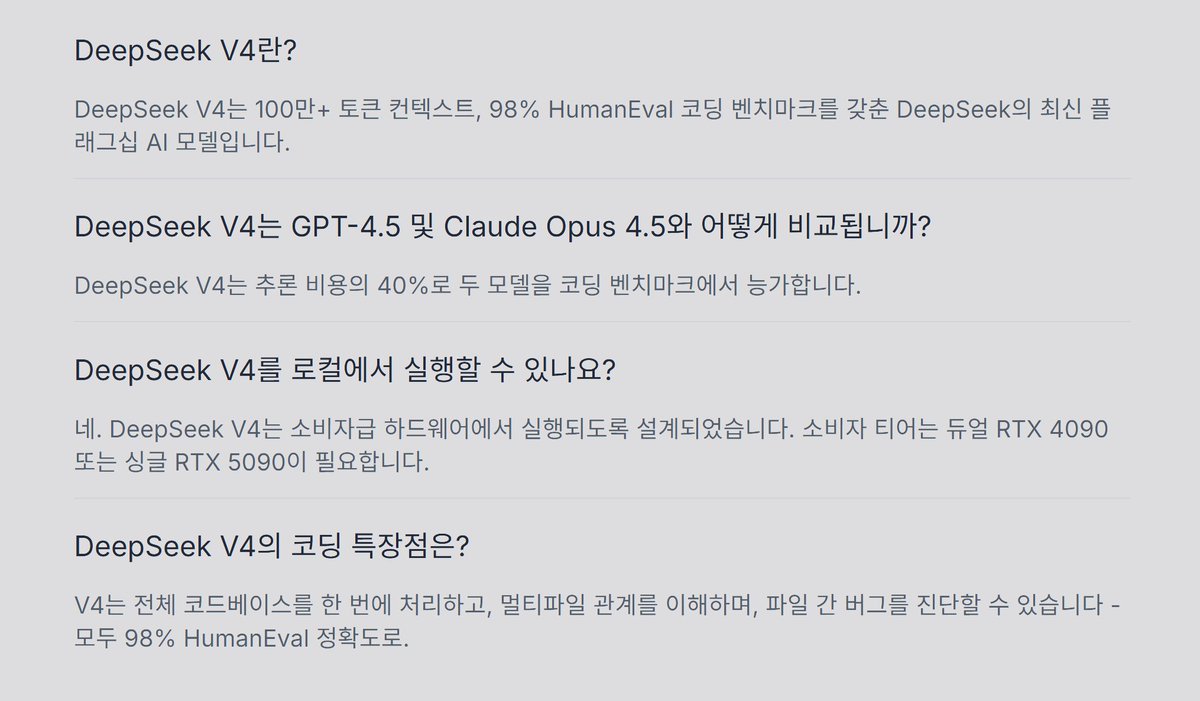
중국 딥시크 V4 런칭 전 카카오톡의 대량 Chatgpt Pro 덤핑이 의심되는 이유??
다음 주 중 중국이 딥시크 V4를 공개 예정
유출된 딥시크 V4 논문의 핵심은 'Engram(엔그램)' 메모리 기술
기존 AI가 긴 문서를 읽을 때마다 비싼 계산 비용을 지불했다면, V4는 이를 압축해 비용을 드라마틱하게 절감함
이게 어느 정도의 퍼포먼스를 보여줄 지 공개 되야 알 수 있겠지만 매우 저렴한 가격대비 성능을 나타낸다면 미국 AI 업체들에게 타격이 있을 듯 함
만약 DeepSeek v4 가 매우 잘나오는게 현실이 된다면 타 AI 플랫폼들의 구독료는 강제 하향 될수도 있다고 봄
📋 "오늘 Claude Code의 Todos를 Tasks로 업그레이드합니다"
Tasks = Claude Code가 더 복잡한 프로젝트를 추적하고 완료하며, 여러 세션이나 서브에이전트 간에 협업할 수 있도록 돕는 새로운 기본 요소
프로젝트의 복잡성을 체계적으로 관리, 서브에이전트를 활용한 병렬 작업.. 이런걸 가능하게 하는 것이 방향이라는걸 Claude Code팀은 알고 있네요.
아티클 아래에 슬쩍 언급하는 중요한 부분은 여러 세션이 단일 Task List에서 협업하도록 하는 방식이예요.
TaskList를 환경 변수로 설정하고 이렇게 Claude를 시작할 수 있습니다!
> CLAUDE_CODE_TASK_LIST_ID=groceries claude
Claude의 족쇄를 풀어 새로운 기능을 효과적으로 사용할 수 있도록 하는 것.
Opus 4.5는 더 오랫동안 자율적으로 실행되고 상태를 더 잘 추적할 수 있습니다.
그리고 Claude Code를 사용하여 더 긴 프로젝트를 완료하는 경우가 많았는데, 때로는 여러 서브에이전트, 컨텍스트 윈도우 또는 세션에 걸쳐 작업했습니다.
하지만 프로젝트는 더 복잡하고, 작업에는 의존성과 블로커가 있으며, 여러 세션에서 사용할 때 조율이 필요합니다.
그리고 Claude Code 팀은 더 긴 프로젝트에��� 작업할 수 있도록 Todos를 진화시켜야 한다는 걸 깨달았습니다!
Tasks = 프로젝트 전반의 많은 작업 조각들을 조율하기 위한 새로운 추상화.
Claude는 메타데이터에 저장되는 서로 간의 의존성을 가진 Tasks를 생성할 수 있으며, 이는 프로젝트가 실제로 작동하는 방식을 더 잘 반영합니다.
그리고 Tasks는 파일 시스템에 저장되어 여러 서브에이전트나 세션이 협업할 수 있습니다. 한 세션이 Task를 업데이트하면, 그 내용이 동일한 Task List에서 작업 중인 모든 세션에 브로드캐스트됩니다.
특히 서브에이전트를 시작할 때 유용합니다!
~/.claude/tasks 여기에 저장됨..! 이를 활용하여 작업 위에 추가 유틸리티를 구축할 수도 있습니다.
HUGE NEWS: Ollama just dropped “ollama launch” 🤯
You can now set up and run Claude Code, OpenCode, or Codex with a single command.
No environment variables. No config files.
100% free with local models.


![AndrewYNg's tweet photo. “Loop engineering” is a hot buzzphrase after mentions of it by Boris Cherny (Claude Code’s creator) and Peter Steinberger (OpenClaw's creator) went viral on social media. Loops are now a key part of how we get AI agents to iterate at length to build software. In this letter, I’d like to share my 3 key loops, shown in the image below, for building 0-to-1 products. These loops guide not just how I build software, but also how I decide what software to build.
Agentic coding loop: Given a product specification and optionally a set of evals (that is, a dataset against which to measure performance), we can have an AI agent write code, test its work, and keep iterating until the code is bug-free and meets its specification. This idea of closing the loop took off around the end of last year, and it has been a game changer in enabling coding agents to work longer productively without human intervention. For example, over the weekend, I was building an app for my daughter to practice typing, and my coding agent could easily work for around an hour, using a web browser to check what it had built multiple times before getting back to me, without needing my intervention.
The engineering loop executes quickly. Every few minutes, the coding agent might build and test a new version of the software. I hear frequently from developers who are finding new ways to engineer more effective engineering loops. This is an active area of invention!
Developer feedback loop: In this loop, a developer examines the current product and steers the coding agent to improve it. Last year, a lot of developers (including me) were acting as the QA (quality assurance) function for our coding agents, manually finding bugs and then asking the agent to fix them. But with coding agents much more able to test their own code, the amount of time we need to spend on this function has decreased significantly. This allows us to make higher-level product decisions, such as what key features to offer, where the UI needs improvement, and so on.
The developer-feedback loop operates over time intervals between tens of minutes and hours — that's how frequently a developer might review a product and give feedback. In the case of the typing app, I changed my mind a few times about the visual design, what cat costumes she can unlock as she learns (she loves cats), and the user flow for a grown-up to log in and steer the child's learning experience.
When a developer has a clear vision for what to build, it is still a lot of work to translate that vision into a specification for a coding agent to implement. Further, after the developer has seen an implementation, they might update (or perhaps clarify) the spec to steer it toward what they want. If you find that the system repeatedly runs into certain problems, building a set of evals for the agent becomes useful.
AI-native teams are increasingly using AI to help shape product direction, for example, automating the gathering and analysis of usage data, summarizing written and verbal customer feedback, or carrying out competitive analysis. However, for pretty much all the products I’m involved in, I see humans as having a significant context advantage over current AI systems — we know a lot more than the AI system about the users and the context the product has to operate in — and thus humans play a critical role. Many people describe this human contribution as “taste,” but I prefer to think of it as humans having a context advantage, since that gives us a clearer path to helping AI systems get better. This also speaks to why this step can’t be automated: So long as the human knows something the AI does not, human-in-the-loop is needed to to inject that knowledge into the system.
External feedback loop: This includes a wide range of tactics like asking a few friends for feedback, launching to alpha testers, or putting the code into production with A/B testing. These tactics are usually slow, rarely taking less than hours and sometimes taking days or even weeks. This data informs the developer vision, which in turn continues to drive the detailed product spec, which in turn drives the coding agent.
With coding agents speeding up software development, more engineers are starting to play a partial product management role. For many engineers who are growing into this role, the hardest part is shaping the product vision and striking a balance between building (bridging the gap between vision and spec) and getting user feedback to evolve the vision. It is important to do both!
I will write more about how to do this in future posts, but for now, I find it encouraging that engineers are playing an expanded role (just as product managers and designers now do more engineering).
[Original text: The Batch]](https://pbs.twimg.com/media/HMEtxp3bsAARJdi.jpg)