Polymarket was paying $50k/day to market makers at one point. Now it's $0.025 per $100 traded. That collapse tells you everything about why prediction markets are still in beta:
https://t.co/eW1By1aZjI
The businesses getting the most out of AI right now aren't tech companies.
They’re plumbers, agency owners, dentists, Etsy sellers.
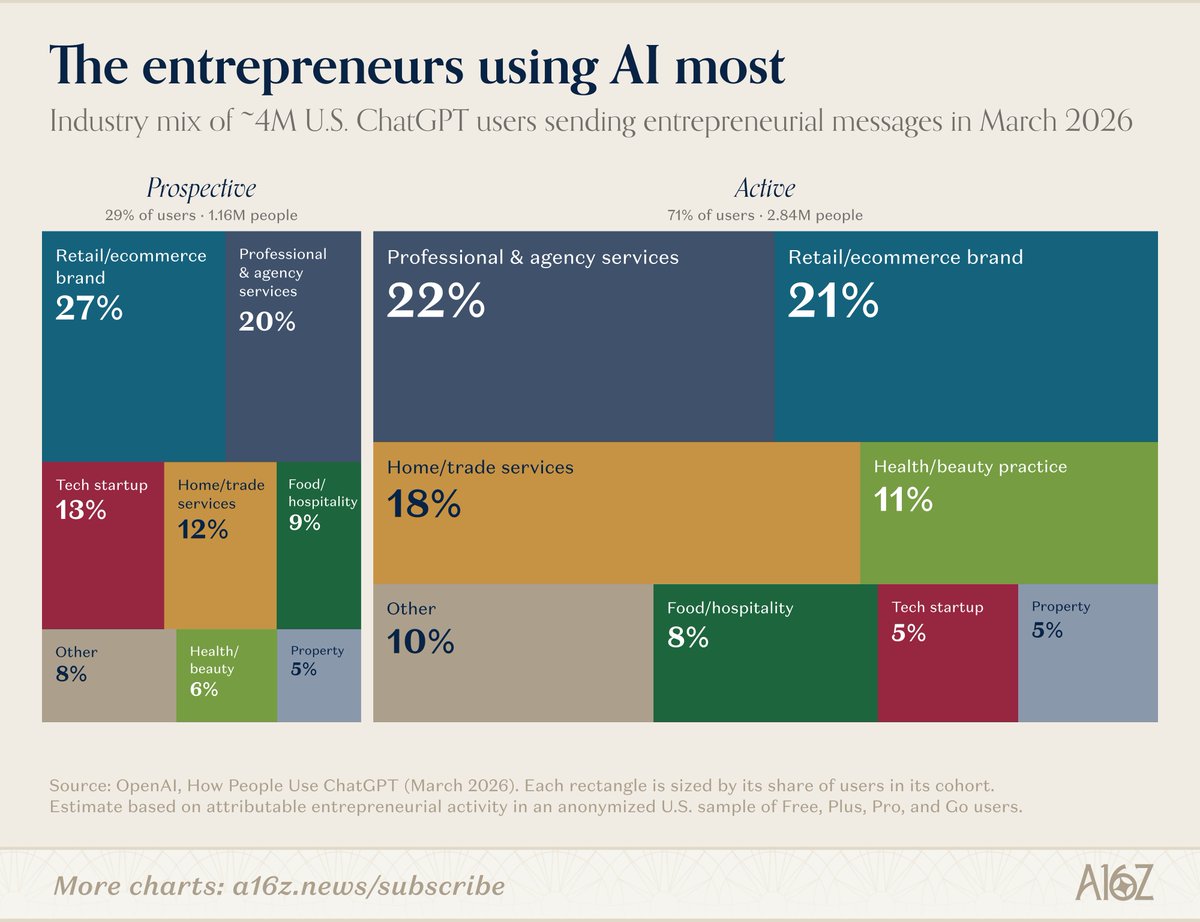
New data from @OpenAI (cc @RonnieChatterji) makes the pattern clear: tech startups account for about 5% of ~active~ U.S. users doing entrepreneurial work with ChatGPT.
The other 95% are spread across services, retail, healthcare, and trades.
AI adoption for entrepreneurship isn’t concentrated in tech. It’s happening inside everyday businesses, folding into routine work that used to be slower or outsourced or entirely overlooked.
I just built a Claude for RevOps playbook that tells you exactly what Claude can and cannot do for your GTM team, matches every task to the right model and mode, and gives you 8 copy-paste prompt templates you run today.
Feed it your pipeline data, your call transcripts, and your ICP criteria → it synthesises forecast risk, scores leads, drafts outreach, and builds QBR narratives → gives you structured outputs your CEO, VP, and reps can all act on immediately.
All inside Claude.
Perfect for RevOps and B2B sales teams who are still re-explaining their sales methodology every session, manually formatting the same pipeline report every week, and guessing whether to use Sonnet or Opus for the task in front of them.
If you are running RevOps in 2026, you already know the math - the teams getting the most out of Claude are not the ones prompting harder, they are the ones who know which model, which mode, and which context block to use so every output is accurate, formatted correctly, and ready to send.
This playbook solves it:
→ What Claude can actually do covers pipeline and forecasting, lead scoring, outreach drafting, deal health analysis, QBR narratives, and win/loss pattern analysis - plus the hard limits every RevOps leader needs to know before building on top of it
→ Model and mode matching gives you Sonnet for 80% of daily work, Opus plus ultrathink for complex pipeline analysis and high-value deal risk, Projects for persistent account context, Co-work for multi-step workflows, and API for CRM triggers
→ Six context categories tell Claude everything it needs about your sales org covering company and ICP, segments, methodology, fiscal calendar, tech stack, and output audience - packaged into a condensed block under 150 words you paste at the top of every prompt
→ Pipeline report summary produces a structured pipeline vs target analysis with risks, actions needed, and a one-paragraph executive summary from imported data and call notes
→ MEDDIC gap analysis shows what is known, what is missing, and exactly what the rep should do next for every component of every deal
→ Call transcript to CRM update converts any transcript into a structured note under 300 words covering pain points, stakeholders, next steps, risks, and updated MEDDIC fields
→ Pre-meeting brief outputs company background, contact priorities, three discovery questions, likely objections, and a suggested opening from a prospect name and company
→ QBR narrative builds what you set out to achieve, what happened, three learnings, what you are changing, and the ask from leadership in one prompt
→ Integrations guide covers CRM connection via Zapier and n8n, Gong transcript to CRM note trigger, Clay enrichment to Claude personalisation flow, and output format by audience
No re-explaining your ICP, methodology, and fiscal calendar every single session.
No manually formatting the same pipeline report for three different audiences every week.
No guessing whether the output is accurate enough to put in front of a board or investor.
What you get:
- The full capability and hard limits guide so you know exactly what to build on and what to keep human
- Model and mode matching for every RevOps task from daily email drafts to complex deal risk analysis
- Six context categories packaged into a 150-word block you paste once and reuse across every prompt
- 8 copy-paste prompt templates covering pipeline reporting, MEDDIC gaps, call transcripts, meeting prep, deal risk, QBR narratives, lead routing, and ICP scoring
- Integration patterns for CRM, Gong, Clay, Instantly, and HeyReach so Claude connects to your existing GTM stack without rebuilding anything
Built 100% inside Claude.
I put together the full playbook with every prompt template, the model matching guide, and the complete context block you paste at the top of every session.
Want it for free?
> Like this post
> Comment "REVOPS"
And I'll send it over (must be following so I can DM)
All companies have data. Some have knowledge bases. Few have real memory or a context graph. Almost none preserve the why behind important decisions.
That missing layer is what a true “Company Brain” needs. YC just put it on their 2026 RFS, but we’ve been building exactly this at @sentra_app for the last 6 months.
A few more thoughts on what will become a very busy space:
Across the entire available market there isn’t a single better trading experience for 1 minute markets than @linera_io
It’s so easy to trade, we’ve done 7 million predictions across 33 thousand unique wallets in just 4 weeks
We’ve built a dedicated cohort of Linera protocol believers that understand that owning the infrastructure and the killer app simultaneously is the golden goose other aspirational PMs will have to fight for.
We already have both. We’re building a USDC bridge to Linera L1 right now. We’ll have pay to enter trading competitions soon with roughly 10k traders already predicting 50+ times each per day on average.
Like I said, those dedicated users? Theyre showing our infra can handle running 600k+ predictions a day and we haven’t even expanded past 9 markets.
Gmarkets
The GTM Engineer role is replacing entire ops teams in 2026.
What a GTM Engineer does:
> Builds lead enrichment pipelines (not clicks through Clay manually)
> Writes ICP scoring algorithms (not guesses at targeting)
> Automates reply routing and classification (not checks inboxes on a schedule)
> Monitors campaign performance programmatically (not reads dashboards weekly)
> Integrates every tool via API (not exports CSVs between platforms)
What they DON'T do:
> Write cold email copy (that's the strategist)
> Handle sales calls (that's the closer)
> Manage client relationships (that's the AM)
One GTM Engineer with Claude Code replaces 3-4 ops people doing manual enrichment, list building, and campaign monitoring.
The role didn't exist 2 years ago. By 2027, every outbound team over $3M ARR will have one. The companies that hire early will have 6-12 months of infrastructure advantage.
🚨 Holy shit...A developer on GitHub just built a full development methodology for AI coding agents and it has 40.9K stars on GitHub.
It's called Superpowers, and it completely changes how your AI agent writes code.
Right now, most people fire up Claude Code or Codex and just… let it go. The agent guesses what you want, writes code before understanding the problem, skips tests, and produces spaghetti you have to babysit.
Superpowers fixes all of that.
Here's what happens when you install it:
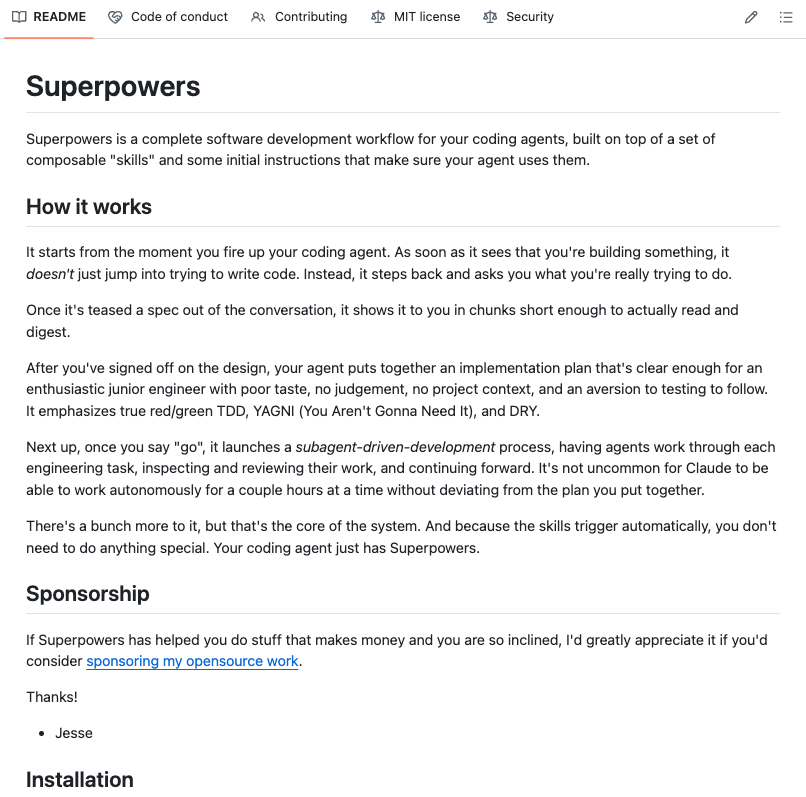
→ Before writing a single line, the agent stops and brainstorms with you. It asks what you're actually trying to build, refines the spec through questions, and shows it to you in chunks short enough to read.
→ Once you approve the design, it creates an implementation plan so detailed that "an enthusiastic junior engineer with poor taste and no judgement" could follow it.
→ Then it launches subagent-driven development. Fresh subagents per task. Two-stage code review after each one (spec compliance, then code quality). The agent can run autonomously for hours without deviating from your plan.
→ It enforces true test-driven development. Write failing test → watch it fail → write minimal code → watch it pass → commit. It literally deletes code written before tests.
→ When tasks are done, it verifies everything, presents options (merge, PR, keep, discard), and cleans up.
The philosophy is brutal: systematic over ad-hoc. Evidence over claims. Complexity reduction. Verify before declaring success.
Works with Claude Code (plugin install), Codex, and OpenCode.
This isn't a prompt template. It's an entire operating system for how AI agents should build software.
100% Opensource. MIT License.