🚀 Stop using Transformers for weight-space programming
If you are not training with gradients on a GPU, why default to a Transformer?
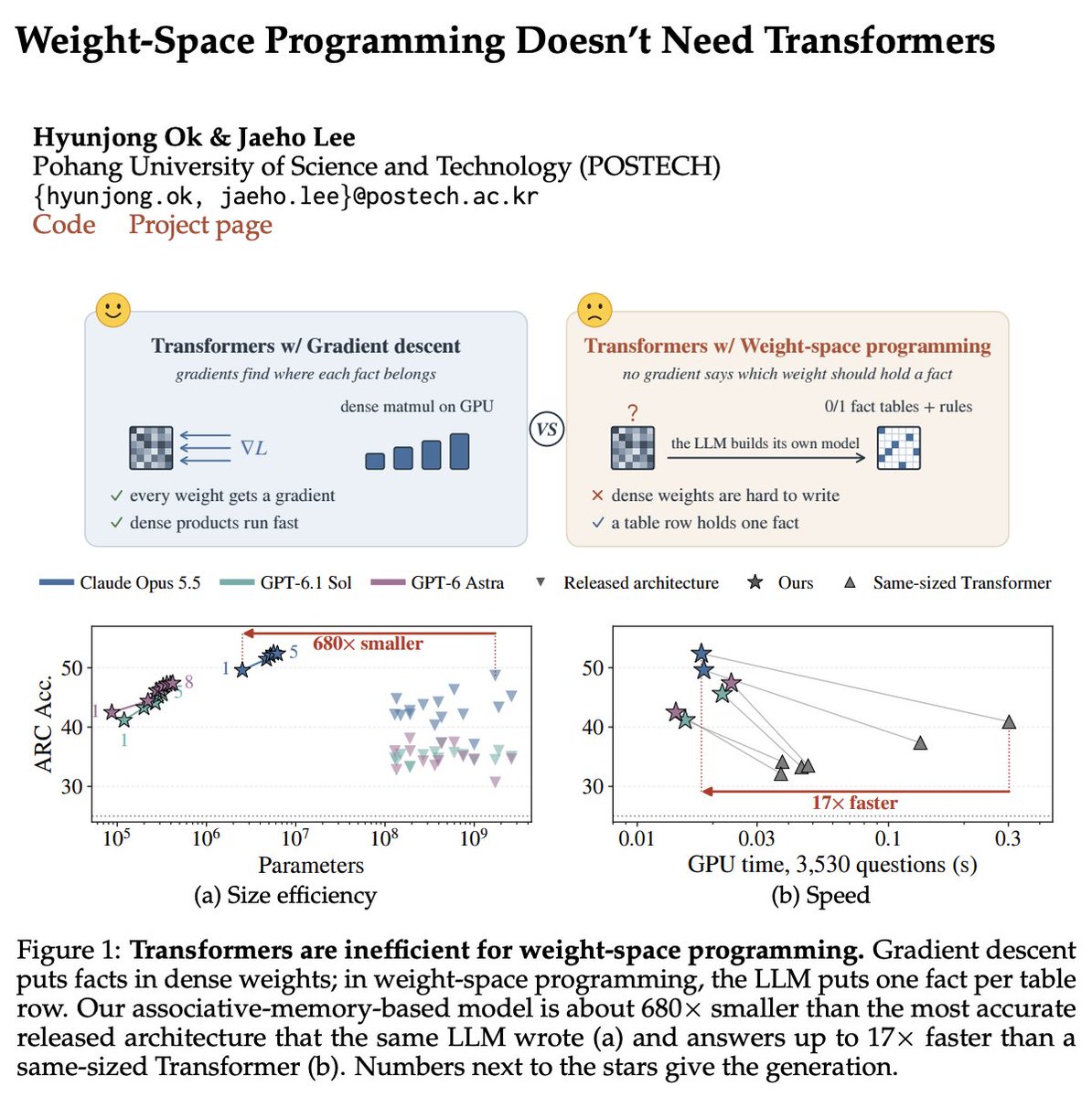
When an LLM writes network weights directly, letting it also design the architecture achieves:
📉 ~1,800× fewer parameters at matched accuracy on ARC (AI2 Reasoning Challenge), compared to the best Transformer the same LLM wrote.
⚡ Up to 17× faster GPU inference with a memory architecture built for these tables, compared to a Transformer of the same size.
🧵 Paper & code at the end 👇
We're also on Hugging Face Daily Papers & arXiv today! Check out the paper here:
🤗 Daily Papers: https://t.co/zS7fHbNXPY
📄 arXiv: https://t.co/d5OKZNiuKu
We're also on Hugging Face Daily Papers & arXiv today! Check out the paper here:
🤗 Daily Papers: https://t.co/zS7fHbNXPY
📄 arXiv: https://t.co/d5OKZNiuKu
🚀 Stop using Transformers for weight-space programming
If you are not training with gradients on a GPU, why default to a Transformer?
When an LLM writes network weights directly, letting it also design the architecture achieves:
📉 ~1,800× fewer parameters at matched accuracy on ARC (AI2 Reasoning Challenge), compared to the best Transformer the same LLM wrote.
⚡ Up to 17× faster GPU inference with a memory architecture built for these tables, compared to a Transformer of the same size.
🧵 Paper & code at the end 👇
🔗 8/8 Read the paper & explore the code!
📄 Paper: https://t.co/OiSMvTP7md
💻 Code & Models: https://t.co/Wmc6Lgrufz
🌐 Project Page: https://t.co/lmqldHgrNn
This is ongoing work—we're actively pushing this direction further, so stay tuned for what's next! Feedback and thoughts are very welcome.
(P.S. I'm also open to research internships and collaborations—feel free to reach out via DM or email! #MachineLearning #AI)
@kforris_w Try the demo: https://t.co/lP34VTuvw5
Delete it and the answer stays "hollow bones" — the next row still supports it. Delete that one too and it flips.
🎉 I’ve been selected as a 2026 Google PhD Fellow in Natural Language Processing!
My research focuses on understanding and evaluating language and multimodal models through diagnostic benchmarks and efficient evaluation methods.
I’m grateful to my advisor, @jaeho_lee_, for his guidance and support, and to my collaborators for the discussions and ideas that have shaped my research.
https://t.co/icWYrSRjFX
Every leap in technology starts with a researcher asking a bold question.
Meet the 2026 Google PhD fellows: 148 new fellows from 38 countries, advancing breakthrough research for the public good, supported by $13 million from @Googleorg: https://t.co/jmGCMQg5b8
@burkov We observed the same phenomenon and looked into the mechanism — it seems largely driven by a limitation of causal attention in decoder-only LMs. Details & analysis here: https://t.co/KpW7dBnq1a
``Imagine to Hear: Auditory Knowledge Generation can be an Effective Assistant for Language Models,'' Suho Yoo, Hyunjong Ok, Jaeho Lee, https://t.co/HUY4dc3DMD
``YuE: Scaling Open Foundation Models for Long-Form Music Generation,'' Ruibin Yuan, Hanfeng Lin, Shuyue Guo, Ge Zhang, Jiahao Pan, Yongyi Zang, Haohe Liu, Yiming Liang, Wenye Ma, Xingjian Du, Xinrun Du, Zhen Ye, Tianyu Zheng, Yinghao Ma, Minghao Liu, Ze… https://t.co/AT6fLqBclg
Are you curious about the details of AudioBERT and how we built AuditoryBench? Dive into our paper and code repository!
📄 Paper: https://t.co/WT5QamXPYf
💾 Code: https://t.co/WMXmxhgtDu (more updates coming soon!)
(4/4)
🚨 New ICASSP 2025🇮🇳 Paper Accepted! 🚨
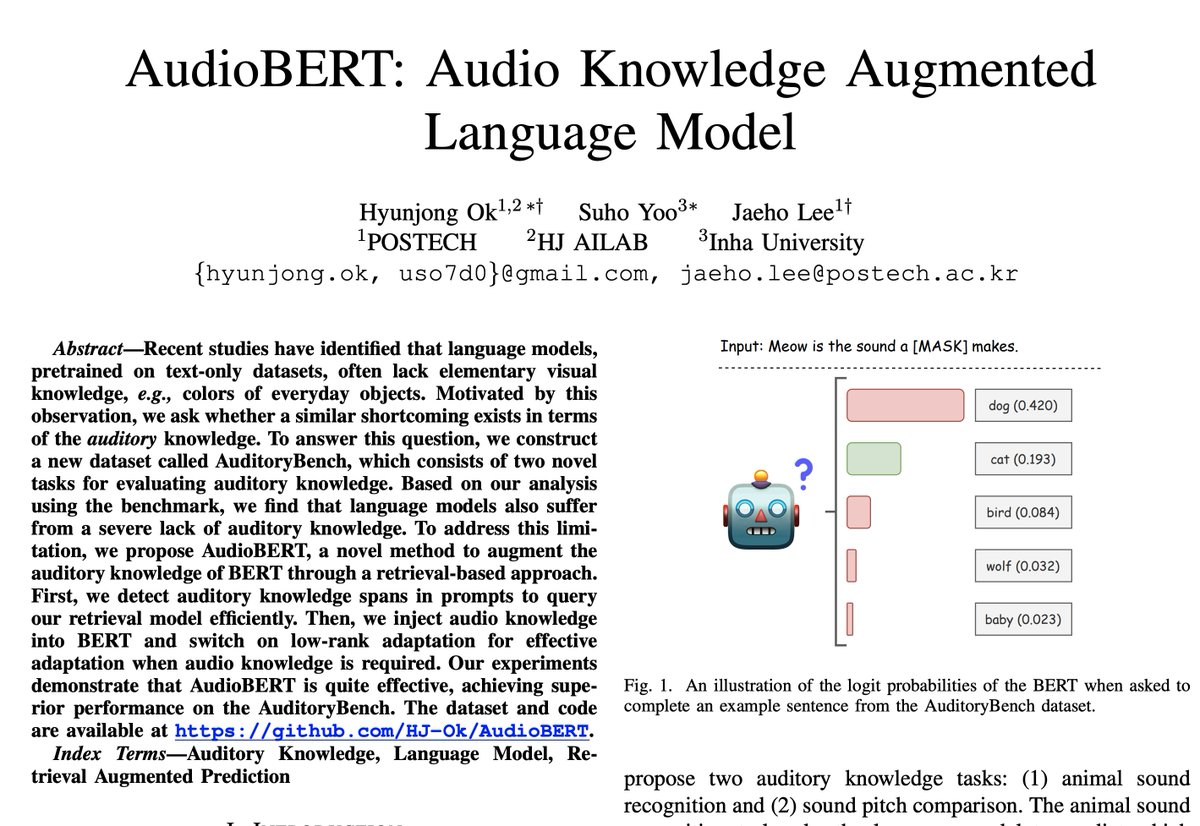
Do language models include auditory knowledge? 🤔
Our research says no! Language models struggle to identify animals' sounds
—like "meow" with cats. 🐱❌
Check out our paper here: https://t.co/WT5QamXPYf (1/4)
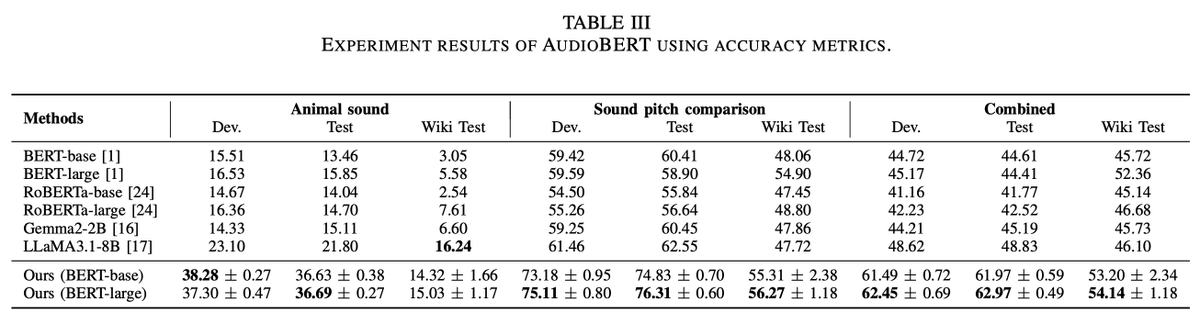
How do language models perform? Not great.
As shown in Table 3, their performance falls short.
To address this, we propose AudioBERT, an audio retrieval-based method that improves auditory understanding.
(3/4)