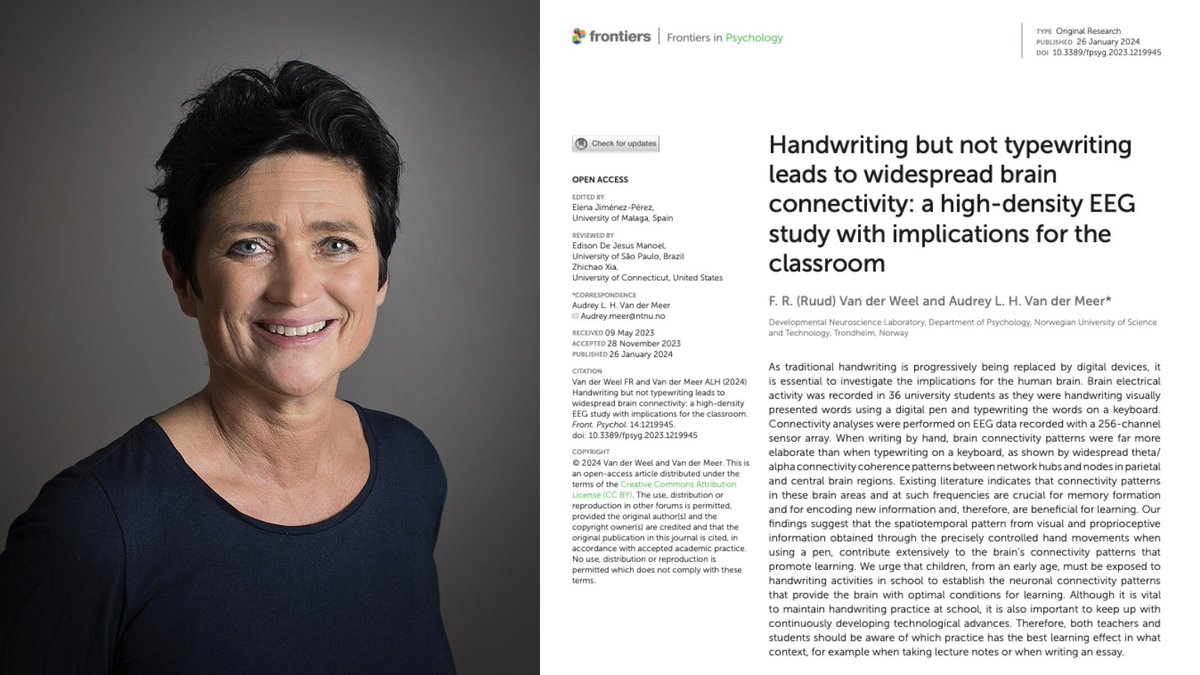
A Norwegian neuroscientist spent 20 years proving that the act of writing by hand changes the human brain in ways typing physically cannot, and almost nobody outside her field has read the paper.
Her name is Audrey van der Meer.
She runs a brain research lab in Trondheim, and the paper that closed the argument was published in 2024 in a journal called Frontiers in Psychology. The finding is brutal enough that it should have changed every classroom on Earth.
The experiment was simple. She recruited 36 university students and put each one in a cap with 256 sensors pressed against their scalp to record brain activity. Words flashed on a screen one at a time.
Sometimes the students wrote the word by hand on a touchscreen using a digital pen, and sometimes they typed the same word on a keyboard. Every neural response was recorded for the full five seconds the word stayed on screen.
Then her team looked at the part of the data most researchers had ignored for years, which is how different parts of the brain were communicating with each other during the task.
When the students wrote by hand, the brain lit up everywhere at once.
The regions responsible for memory, sensory integration, and the encoding of new information were all firing together in a coordinated pattern that spread across the entire cortex. The whole network was awake and connected.
When the same students typed the same word, that pattern collapsed almost completely.
Most of the brain went quiet, and the connections between regions that had been alive seconds earlier were nowhere to be found on the EEG.
Same word, same brain, same person, and two completely different neurological events.
The reason turned out to be something nobody had really paid attention to before her work. Writing by hand is not one motion but a sequence of thousands of tiny micro-movements coordinated with your eyes in real time, where each letter is a different shape that requires the brain to solve a slightly different spatial problem.
Your fingers, wrist, vision, and the parts of your brain that track position in space are all working together to produce one letter, then the next, then the next.
Typing throws all of that away. Every key on a keyboard requires the exact same finger motion regardless of which letter you are pressing, which means the brain has almost nothing to integrate and almost no problem to solve.
Van der Meer said it plainly in her interviews.
Pressing the same key with the same finger over and over does not stimulate the brain in any meaningful way, and she pointed out something that should scare every parent who handed their kid an iPad.
Children who learn to read and write on tablets often cannot tell letters like b and d apart, because they have never physically felt with their bodies what it takes to actually produce those letters on a page.
A decade before her, two researchers at Princeton ran the same fight using a completely different method and ended up at the same answer. Pam Mueller and Daniel Oppenheimer tested 327 students across three experiments, where half took notes on laptops with the internet disabled and half took notes by hand, before testing everyone on what they actually understood from the lectures they had watched.
The handwriting group won by a wide margin on every question that required real understanding rather than surface recall.
The reason was hiding in the transcripts of what the two groups had actually written down.
The laptop students typed almost word for word, capturing more total content but processing almost none of it as they went, while the handwriting students physically could not write fast enough to transcribe a lecture in real time, which forced them to listen carefully, decide what actually mattered, and put it in their own words on the page.
That single act of choosing what to keep was the learning itself, and the keyboard had quietly skipped the choosing and skipped the learning along with it.
Two studies. Two countries. Same answer.
Handwriting makes the brain work. Typing lets it coast.
Every note you have ever typed instead of written went into your brain through a thinner pipe. Every meeting, every book highlight, every idea you captured on your phone instead of on paper was processed at half depth.
You did not forget those things because your memory is bad. You forgot them because typing never woke the part of the brain that would have made them stick.
The fix is the thing your grandmother already knew.
Pick up a pen. Write the thing down. The slower road is the faster one.
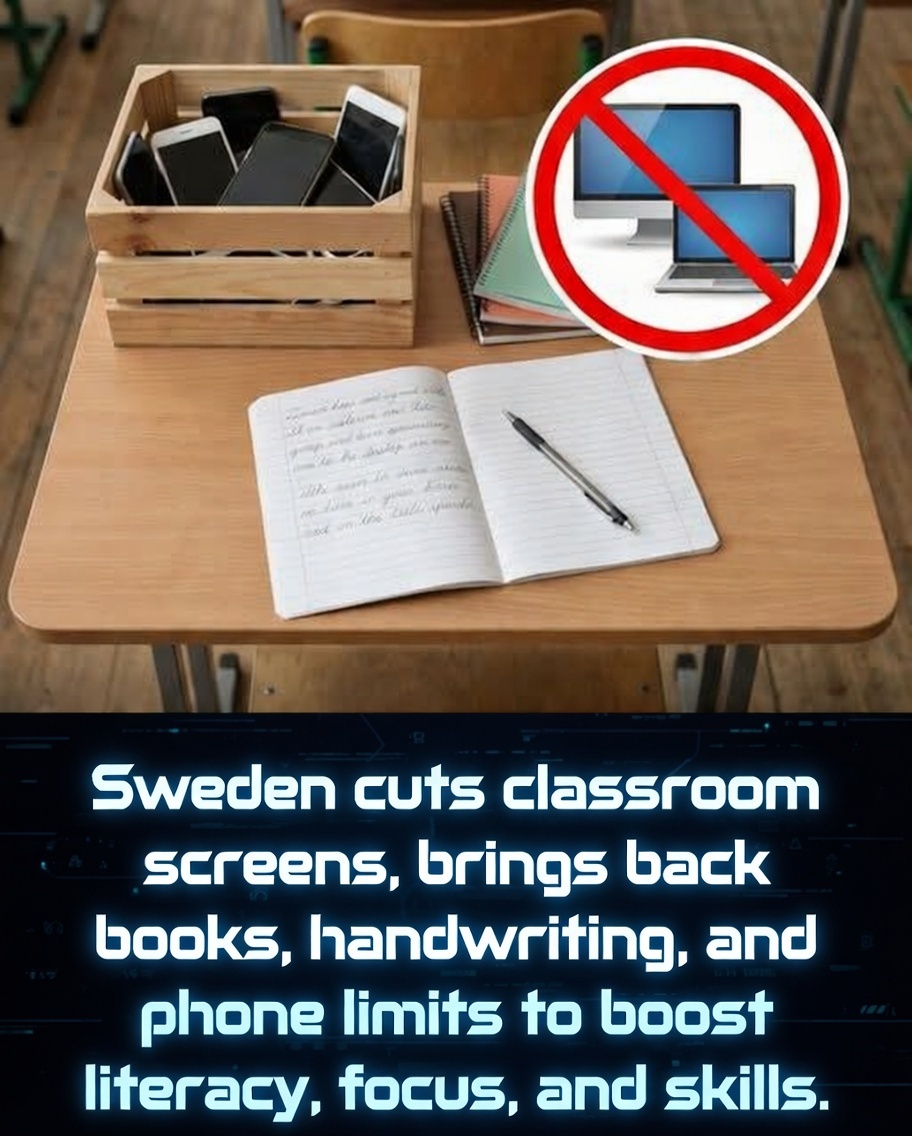
Sweden is committing more than €100 million to a sweeping classroom overhaul: replacing tablets and screens with traditional printed textbooks to help reverse falling student performance and sharpen focus.
After more than a decade of embracing digital-first education, Swedish authorities are now pivoting back to paper-based learning. Official data and recent studies cited by the Ministry of Education show that prolonged screen use in class has been linked to shorter attention spans, weaker reading comprehension, and reduced critical-thinking abilities.
Research consistently finds that reading on illuminated screens requires greater mental effort and invites more distractions compared to the calm, linear experience of physical books—factors believed to have contributed to declining academic outcomes in recent years.
Under the new plan, every student will receive printed textbooks for all core subjects, restoring books as the central learning tool. Digital devices and online resources will remain available as supportive tools, but they will no longer dominate daily instruction.
This bold €100+ million investment signals Sweden’s leadership in rethinking the role of technology in education. It underscores a broader, growing recognition worldwide: while screens provide speed and access, the hands-on, distraction-free engagement of physical books supports deeper concentration, stronger memory retention, and more effective long-term learning.
By choosing paper over pixels, Sweden is charting a path toward a more balanced, evidence-informed classroom future—one that puts proven pedagogical principles ahead of unchecked digital trends.
Welcome to the 2025 Readathon! Some of you are well into Midwinter's Eve depending on your time zone.
I hope everyone enjoys the decades-old tradition of reading The Dark Is Rising. Post your thoughts!
#ReadTDIR#TheDarkisRising#TheDarkisReading
"We are a politically diverse group.
Most of us are liberals and long-time Democratic Party supporters.
All of us share a commitment to evidence-based medicine and have been willing to stick our necks out, often at personal or professional cost, to speak the truth."
We welcome this coverage in @bmj_latest on the Pathways (to hell) trial of puberty blockers.
@AdeleWatersRx points out that some clinicians have serious concerns that this trial has been given the go-ahead, saying it is “unethical” to expose children to potentially damaging drugs without clear benefit.
We couldn’t agree more. Sound medicine is built on the principle of first do no harm — and the harms of PBs are well known
@wesstreeting@Keir_Starmer@10DowningStreet
CALLING ☎️ Simple question you still refuse to answer:
Why have you not issued an open, public call for former Tavistock GIDS patients, many now adults in their 20s and 30s, some 15–20 years post treatment to come forward and take part in a proper long-term health survey?
You do NOT need to recruit new children. The cohort already exists. Thousands of them are out there, living with the consequences.
All it would take is one tweet from the Department of Health or NHS England with a SurveyMonkey (or Typeform/Google Form) link asking six straightforward questions:
1. Are you a former Tavistock GIDS patient (any age)?
2. Year you were discharged?
3. Would you be willing to have a DEXA bone-density scan if offered free by the NHS?
4. Would you accept comprehensive bloodwork (hormones, lipids, liver, kidneys, prolactin, etc.)?
5. Would you consent to those results (anonymised) being used for research?
6. Any ongoing health issues you believe are linked to the treatment you received?
That’s it.
Within weeks you’d have the best long-term data in the world on puberty blockers and cross-sex hormones in adolescents data you claim “doesn’t exist”.
They haven’t vanished. They’re on Twitter, in detransitioner groups, in quiet despair, or still transitioned and happy living their best life. All of them have bodies that are walking evidence.
If the outcomes are as wonderful as you were told for years, this survey will prove it.
If they’re not… well, that’s obviously why you’re terrified to ask.
If the Government won’t do the bare minimum, will any proper journalist or media outlet step up and run the survey themselves? One viral tweet with a link is literally all it takes. These people are not hard to find. They are desperate to be heard.
Who’s willing to give them that voice?@GBNEWS@SkyNews@hannahsbee@nickwallis
#Tavistock #GIDS #CassReview #Detrans
“Gender Incongruence” (in reality gender stereotype incongruent) is a modern confected ailment based around old heterosexual norms.
If you visited a gay bar in the 1990s you’d see plenty of “gender incongruence” and would be thought a monster had you suggested curing it,
“When the delayed Pathways trial was announced last week, many were shocked. There had been an assumption that trialling drugs with known harms would not be approved by the designated ethics committee.” It must be stopped!
@suzanne_moore@bindelj Share token here...
This puberty blocker trial is a wicked betrayal of our children. Wes Streeting must stop it now
https://t.co/aA79MZ07cg
In the @thetimes, @eleanorhayward quotes Dr Alice Hodkinson of @biologyinmed:
“There is already clear evidence of harm, and there is no ethical justification for subjecting another 200 children to puberty blockers.”
We agree. Why isn’t more being done to follow up the hundreds of children who have already been given puberty blockers on earlier ‘clinical trials’ at the Tavistock?
https://t.co/zhSXBwOD2i
7/
@danielmgmoylan@wesstreeting Rather than exposing more children to risk, there ought instead to be thorough follow up on the patients who have already received puberty blockers.
This is the short film about puberty blockers made by @AllianceLGB at the height of the Tavistock scandal. If you watch this and still think troubled kids should be drugged to prevent them going through a normal puberty you've lost your moral compass.
https://t.co/uBdo2wo4pM
@SVPhillimore Exactly this. There is a large cohort who have already taken pbs - surely some follow up on them qould be the more ethical approach to gaining data?
@SonyaDouglas The majority of these children are likely to be same-sex attracted so conversion therapy lives on with Government support. No need now for that controversial Ban Conversion Therapy Bill where therapists might be free to explore a child’s trauma. All sorted, trans away the gay.
The failure of Cass and the shame of Kings College London: up to 250 children now stand to lose brain and body function bc medics feared telling activists the truth: that puberty is crucial and natural, but gender identity is self-constructed and illusory. https://t.co/UD8yVtl7JV