Congratulations to the poster prize winner, runner up and five honourable mentions at #48NPS: Forest interactions!
🏆Winner: Lena Sachsenmaier
@iDiv & Leipzig University, Germany
Stomatal behaviour across 38 tree species is not explained by commonly measured leaf traits
In the latest #InsideBiodiversity episode, host Volker Hahn speaks with Louise McRae (@OfficialZSL) about the Living Planet Index as a global biodiversity indicator. 💡
While no single metric can capture the full complexity of biodiversity, aggregated indicators can help policymakers and the public understand broad trends and serve as a starting point for deeper discussion and analysis. 📊🌍
🎧 Listen to the episode now and don't forget to subscribe: https://t.co/R1yK57jZJt
iDiv mourns the unexpected passing of Professor Dr Josef Settele, an internationally renowned biodiversity researcher, respected colleague, and cherished friend.
We have lost an exceptional scientist and a wonderful human being. His contributions have left a lasting mark on iDiv and on biodiversity research worldwide. We owe him a great deal, and his legacy will continue to inspire our work for many years to come.
@IPBES@UFZ_de
https://t.co/nezt6hzgYt
If you missed this week's episode of #InsideBiodiversity, now is a good time to catch up.
iDiv host Volker Hahn speaks with Louise McRae (@OfficialZSL) about the newly released Living Planet Index 2026 and what its latest findings mean for biodiversity research and conservation. 🌍🎧📈
🎧 Listen here: https://t.co/R1yK57jZJt
The new Living Planet Index reports an overall decline of 73.2% in monitored vertebrate wildlife populations since 1970.
But what exactly does that figure mean, and what are the strengths and limitations of this indicator? 📉🔍🌿
In the latest #InsideBiodiversity episode, host Volker Hahn discusses these questions with guest Louise McRae (@OfficialZSL), one of the scientists behind the index.
🎧 Listen now: https://t.co/R1yK57kxz1
How do we measure biodiversity change on a global scale?
In the latest #InsideBiodiversity episode, Volker Hahn speaks with Louise McRae (@OfficialZSL) about the Living Planet Index, the science behind it, and what decades of wildlife monitoring reveal about trends in vertebrate populations worldwide.
🔬🌍🎙️ The 2026 index draws on more data than ever before, expanding both its taxonomic and geographic coverage.
🎧 Listen here: https://t.co/R1yK57kxz1
A new episode of #InsideBiodiversity is out now.
Host Volker Hahn speaks with Louise McRae of the @OfficialZSL, one of the scientists behind the new Living Planet Index (LPI), featured in @WWF's Living Planet Report 2026.
Drawing on data from 35,803 monitored populations across 5,790 vertebrate species, the latest LPI provides one of the world's most comprehensive indicators of biodiversity trends.
🌍📊🎙️ What does the new index tell us about the state of nature, and how should we interpret its findings?
🎧 Listen now: https://t.co/R1yK57jZJt
🌱 iDiv's Dr Monica Farfan contributed to the @FAO's Status of the World's Soil Resources report. For iDiv, she reflects on science-based policy, soil biodiversity monitoring, and collaboration to protect soils.
#iDivImpact
🌍🔬 https://t.co/3fvk9xom9n
🎉 Herzlichen Glückwunsch an die @UniJena zur Auszeichnung als Exzellenzuniversität!
Als Gründungsmitglied und Trägerinstitution von iDiv ist die Universität ein starker Partner in der Biodiversitätsforschung.
Große Freude über diesen verdienten Erfolg. 🌿👏
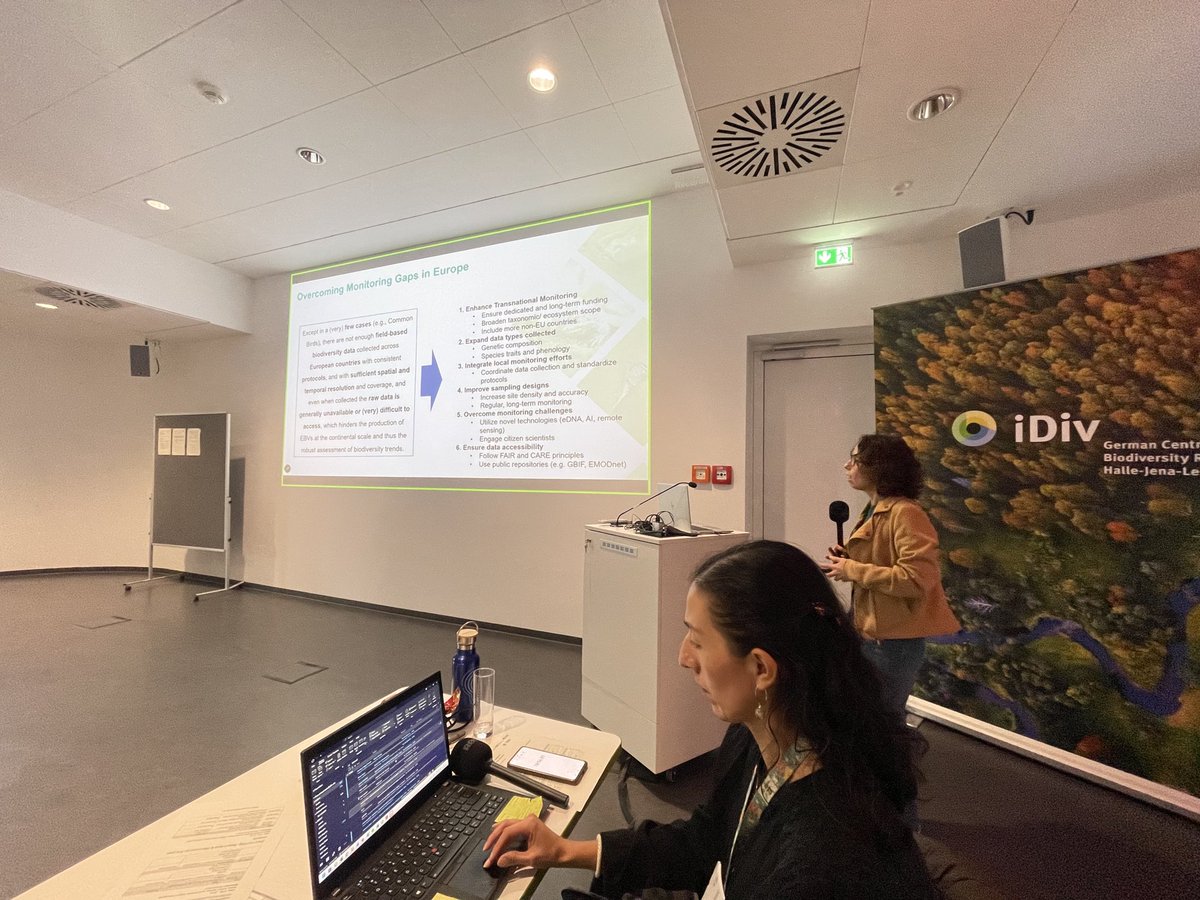
🌍 Today and tomorrow, experts from across Europe are gathering at iDiv for the European Biodiversity Observation Coordination Centre (#EBOCC) Workshop.
Building on @EuropaBon_H2020, participants will work to strengthen the connection between science and policy, refine monitoring approaches, and support the implementation of a coordinated European biodiversity observation framework. 🌱📊🇪🇺
This meeting was organised by Dr Lina Maria Estupinan Suarez and Prof @hmlfpereira from iDiv and @UniHalle.
https://t.co/2qsPYiYmD0
🌊 How can marine rewilding help ocean ecosystems recover?
In a recent paper, Dr Gavin Stark outlines eight principles for marine rewilding in a framework designed to support large-scale ecosystem restoration, reconnect habitats, reduce human pressures, and promote ecological recovery. 🦦 🪸
#iDivResearch @idiv@UniHalle
https://t.co/fSAOZ7pWVH
Why did one of northern Europe’s most important fisheries suddenly collapse?
For centuries, herring from the Sound between Denmark and Sweden was a major trade commodity. Then, around 1570, the Skanör-Falsterbo fishery collapsed. Comparable catch volumes were not reached again until the 1950s.
A new study by an international team led by Kiel University and iDiv shows that there was no single cause.
🌡️ Environmental change affected the ecosystem and herring populations.
🎣 Overfishing put additional pressure on the stock.
👥 Social and economic change altered how the fishery was used and managed.
In detail, overfishing had already weakened the herring stock and increased fishing costs. Cooling associated with the onset of the Little Ice Age then reduced the stock’s productivity further. At the same time, shifting dunes destroyed fishing infrastructure, newly imposed serfdom deprived the fishery of workers, and cheaper herring from the rising North Sea fishery made Baltic herring less competitive.
📖 Published in @naturesustainab
Read our press release: https://t.co/jsBEdyzyTH
#iDivResearch
@RudiVoss2
🌡️ ❄️ 🏜️ A new study in @Nature Communications shows warming, cooling and aridification shaped mammal communities in Central Asia during the Paleogene (66-23 million years ago).
Led by researchers from iDiv, @UniJena and @Senckenberg
https://t.co/MSKDRCi8rS
In the newest episode of #InsideBiodiversity, host Volker Hahn speaks with macroecologist Shai Meiri about how public perception shapes reptile research and conservation. 🐢 🦎
Meiri explains that many reptiles — especially snakes — are seen as dangerous or undesirable. 🐍 This perception has real consequences: fewer monitoring projects, less funding, and large gaps in global data.
🎧 🐊 Listen now: https://t.co/R1yK57jZJt
@uncshai@TelAvivUni
University of Melbourne