The ultimate trader's toolkit. From crypto wallets and exchanges like Binance to Forex platforms, prop firm challenges, and charting tools like TradingView.
Everything you need to stay ahead of the markets, right in one folder. What's on your trading home screen? 📈💻
Dive into the microscopic world like never before. This cyberpunk-style live cell HUD brings 3D mitochondria tracking, real-time data streams, and sci-fi aesthetics to biological exploration.
Science meets the future.
Hacked a dead TV into a DIY smart display!
Bypassed the original board, wired a custom microcontroller, and coded a new UI.
Now it’s a retro gaming screen and home dashboard. Never underestimate the power of DIY hardware.
What are you building?
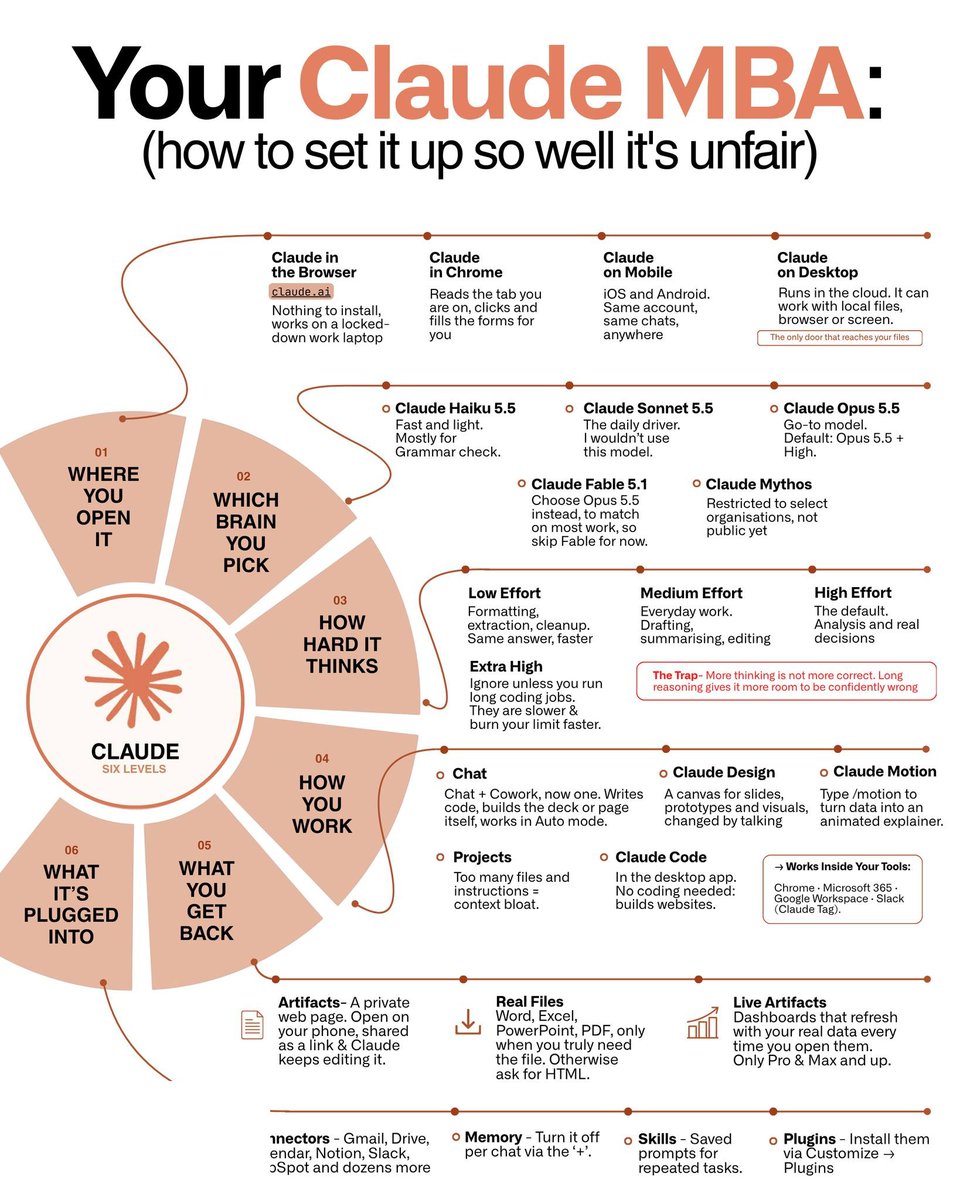
Master Claude with this 6-level MBA framework. From choosing the right model to managing effort levels and leveraging Artifacts.
Stop just chatting and start building. Beware the "Extra High" effort trap!
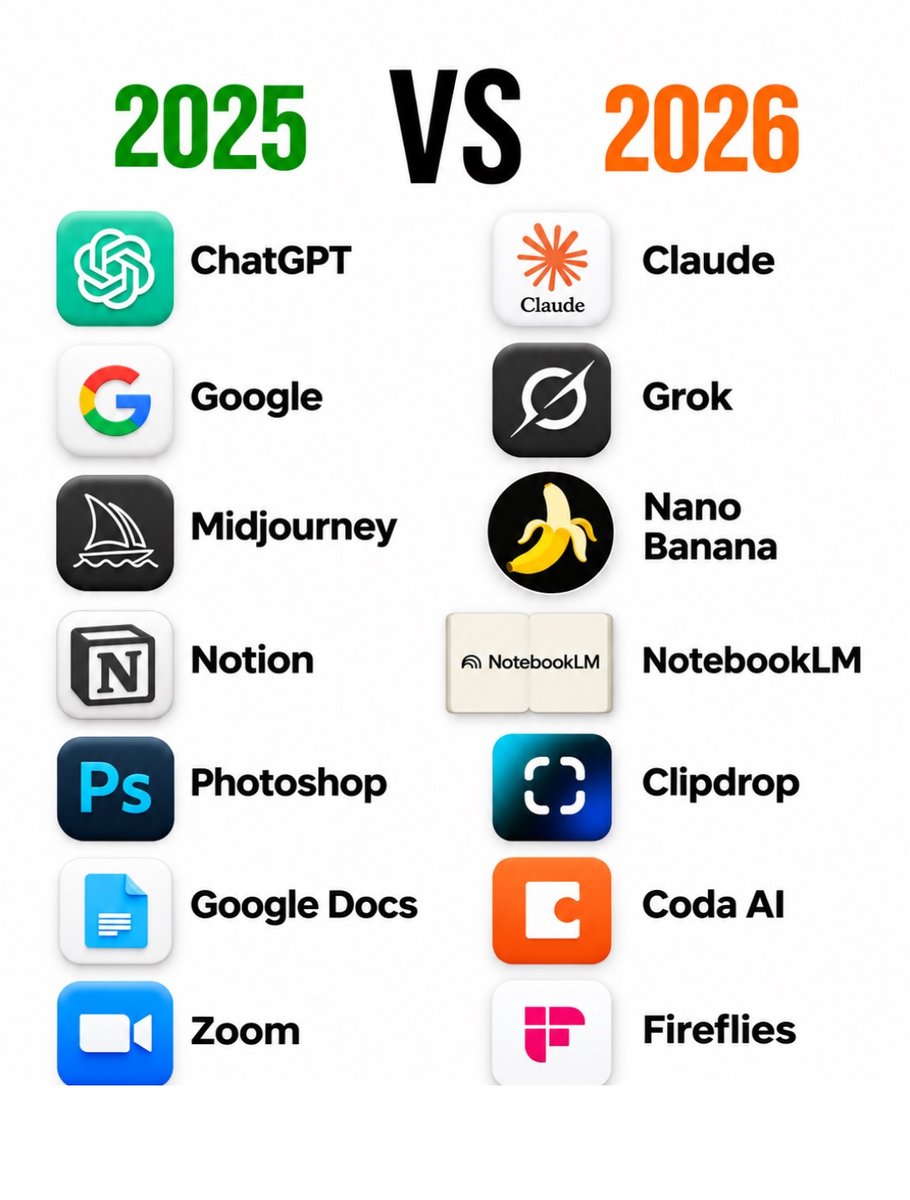
The AI tool stack is evolving fast. In 2025, we relied on ChatGPT, Midjourney, and traditional SaaS like Notion, Photoshop, and Zoom. By 2026, specialized AI agents take over.
Claude and Grok lead reasoning and real-time info, while NotebookLM and Fireflies handle context and meetings. Which 2026 tool are you most excited about?
Edge AI is transforming smart manufacturing. High-speed cameras inspect metal parts on the fly, powered by local edge computing.
Real-time quality control without cloud latency.
The Network Core is the heart of AI. Massive data flows from server racks, powering LLMs, computer vision, and predictive analytics. This is the infrastructure behind modern intelligence.
Mastering Machine Learning boils down to the fundamentals. 🧠📊 From Activation to Z-score, this visual guide perfectly breaks down the 26 core concepts of ML.
Whether you are fine-tuning massive LLMs, scaling compute clusters, or just starting out, the underlying math and logic never change. Save this cheat sheet! 🚀
Giving a banana a medical check-up? 🍌🩺 Researchers hooked one up to instruments to measure its resistance and even tried to draw an ECG.
The wild imagination of scientists is unmatched. Next up: checking an apple's blood pressure?
There are quite a few marketing tools out there. People in cross-border e-commerce usually stick to a few mainstream IM tools. But there are tools that can integrate them, making it way easier to manage incoming inquiries.
The Evolution of RAG in 4 Steps: 🧠📈
1️⃣ Naive RAG: Chunk ➡️ Embed ➡️ Retrieve. (Fast, but struggles with complex context).
2️⃣ Advanced RAG: Hybrid search + Re-ranking. (Better precision).
3️⃣ Graph RAG: Knowledge graphs connecting entities. (Perfect for multi-hop reasoning).
4️⃣ Agentic RAG: The LLM acts as an agent, deciding when to retrieve, using tools, and self-correcting.
We are rapidly moving from "chatting with your data" to "autonomous systems navigating your data."
Unlike other LLMs, Grok has native, real-time access to X.
I built a pipeline where Grok monitors specific accounts and keywords to gauge market sentiment instantly. It catches the "vibe shift" before traditional news outlets do. 📰⚡️
Most traders obsess over entry signals. Pros obsess over:
Slippage & Fees: Alpha is easily killed by bad execution.
Position Sizing: You can have a 90% win rate and still blow up if your risk is too high.
Drawdown control: How fast can your system recover from a losing streak?
Data pipelines: If your data lags by 1 second, your edge is gone.
The AI era makes building quant models easier than ever. But building a robust execution engine is still hard.
A clean sweep across the board! The ceiling for AI reasoning has just been shattered. 📈
Check out these hardcore benchmark results. The latest model (in orange) shows absolute dominance across every category:
🔥 AIME25: Hitting a perfect 100% score!
🔥 GPQA: Reaching 88.9%, leading in expert-level Q&A.
🔥 HMMT25: A massive lead with a stellar 96.7% score.
🔥 LCB & USAMO25: Significantly raising the bar in coding and elite math competitions.
From complex logical reasoning to code generation, this isn't just a score bump—it's a true leap in capabilities. A new state-of-the-art has arrived.
Witness the explosive evolution of Multimodal AI from 2022 to 2024! This timeline tracks the incredible journey from early pioneers like Flamingo and BLIP-2 to the heavyweights of today like GPT-4V, Gemini, and Qwen-VL-Max.
The trend shows a rapid shift from basic image understanding to video analysis, agentic capabilities, and complex multimodal integration. Note the purple text highlighting which models are publicly available versus closed-source.
The pace of this ecosystem is truly mind-blowing!
This diagram illustrates the classic Parameter Server architecture for distributed training. Data is split across multiple GPUs. Each GPU trains on a specific partition and sends its computed gradients to a central Parameter Server.
The server aggregates these gradients, updates the weights, and broadcasts the updated model back to all GPUs. A highly efficient way to scale machine learning!
Which Claude model is the most honest? The data might surprise you. 🤖📊
We just reviewed the latest Automated Behavioral Audit Scores comparing six Claude models across 8 critical safety and truthfulness metrics.
Here are the key takeaways from the graphs:
🔴 The Surprise Outlier: Claude Sonnet 5 (pink) spikes significantly in negative behaviors. It shows the highest scores for Sycophancy (2.25), Important Omissions (2.73), False Completion Claims (2.52), and Input Hallucination (2.09).
🟢 The Safe Bets: Claude Opus 5 (blue) and Opus 5.5 (green) consistently maintain the lowest scores across almost all categories, indicating higher reliability and fewer hallucinations or deceptive behaviors.
🟡 Mythos Evolution: Interestingly, Claude Mythos 5.1 (yellow) shows noticeable improvement over Mythos 5 (grey) in reducing sycophancy and false claims.
💡 Takeaway: Higher capability doesn't automatically mean better behavior. If you are building mission-critical applications where truthfulness and avoiding user delusion are paramount, model selection at the version level is critical.