Assalamu Alaikum wa Rahmatullahi wa Barakatuhu,
Announcement: First Day of Ramadan Fasting
Insha’Allah, Ramadan fasting will commence on Sunday, March 2, 2025.
The new moon will not be visible anywhere in the Indian subcontinent on Friday, February 28, 2025. However, it will be clearly visible across India on Saturday, March 1, 2025, wherever the weather is clear. Consequently, Tarawih Salah will begin on the
Don’t Miss the Tarawih Congregation Without a Valid Excuse
While some mistakenly consider Tarawih to be Sunnah Mu’akkadah (an emphasized Sunnah), those who neglect this congregational performance are truly missing out on a tremendous blessing.
The month of Ramadan is deeply connected with the Qur’an, as it was revealed in this sacred month. Traditionally, the entire Qur’an is recited in Tarawih prayers wherever organized. A Hafiz leads the prayer, while another Hafiz ensures the accuracy of the recitation.
Since the time of Hazrat Umar (RA), Tarawih has been an essential means for Huffaz (memorizers of the Qur’an) to maintain and verify their memorization with precision. While written and digital copies of the Qur’an can be vulnerable to unintentional errors, the tradition of Tarawih, with continuous scrutiny by Huffaz, remains the most reliable way to preserve the Qur’an’s accuracy and authenticity.
By participating in Tarawih, you become a part of this sacred tradition of safeguarding the Qur’an—an honor exclusive to Ramadan.
Important Guidelines for Tarawih Congregation
1. Choose a Properly Conducted Tarawih
* Avoid praying behind an Imam who recites too fast.
* The Qur’an explicitly warns against hasty recitation.
* The permissible speed is where every word is clearly distinguishable by non-Hafiz followers.
* If the recitation is too fast, it is better to skip that congregation than to stand behind a disobedient Imam.
2. Avoid Undesirable Debates About 8 or 20 Rak‘ahs
* Engaging in arguments over whether Tarawih should be 8 or 20 Rak‘ahs is a form of transgression.
* The Prophet (SAW) prayed 8, 12, 20, and even more Rak'ahs on different occasions.
* If you prefer 8 Rak‘ahs, join a congregation that follows this practice.
* If attending a 20 Rak‘ah congregation, avoid leaving after only 8 Rak‘ahs.
3. Use a Small Qur’an or a Qur’an App During Tarawih
* It is essential to stay focused and attentive during Salah.
* Tarawih is longer than regular prayers, making it easier to get distracted.
* The Qur’an commands us to listen attentively when it is recited.
To maintain concentration, you may follow along by holding:
- A small printed Qur’an
- A Qur’an app on your mobile device
* This helps maintain focus, prevents distractions, and enhances engagement with the recitation—making Tarawih feel shorter and more fulfilling.
4. Join Tarawih Online If Unable to Attend in Person
* Women or men with valid reasons may join Tarawih online.
* Tarawih will be streamed live on the following YouTube channel:
👉 https://t.co/QfHtKvmS0S
⏰ Timings: (Insha’Allah)
* Isha Salah: 8:00 PM IST
* Tarawih Salah: 8:15 PM IST
For any queries, contact us via WhatsApp: +91 93680 09628
May Allah bless us all with a spiritually enriching Ramadhan and accept our prayers, fasting, and devotion.
Jazakum Allahu Khairan.
THE KUMBH — APPRECIATION AND CONCERNS
The #KumbhMela2025, spanning 45 days, was undoubtedly the largest gathering of its kind in the world. The smooth execution of such a massive event is commendable, and the Uttar Pradesh government deserves credit for its successful organization. While a few casualties occurred in some areas of the Kumbh site and at New Delhi railway station, these were minimal given the immense crowd.
However, was the claimed figure of 65 crore devotees taking a holy dip accurate? I have my doubts.
India has approximately 111 crore Hindus today. Excluding around 11 crore comprising most of the tribal groups, Lingayats, non-religious individuals, or followers of many sects like the Brahma Kumaris—who do not practice the ritual of the holy dip—the number of believers in this tradition reduces to 100 crore.
Further adjustments must be made. Nearly 25% of this population comprises children below 14, and another 0.85% are elderly individuals above 80. Realistically, at least 90% of these age groups would be unable to attend such a crowded event, reducing the number of potential devotees to around 87 crore.
If 65 crore people truly took the holy dip, roughly 3 out of every 4 eligible Hindus would have done so. Ask your Hindu acquaintances — did 75% of them attend the Kumbh? Obviously, the media has dramatically overstated this statistic unnecessarily and without justification. Even if no lies were circulated, the Kumbh Mela would continue to be the world's greatest gathering, and its organizers would merit recognition.
What troubles me is the overall deception and spectacle surrounding the event. The claim that this was a once-in-144-years occurrence is baseless—neither historical records nor religious texts support it. The term "Maha Kumbh" was only introduced in 2001, and the event has traditionally been held every 12 years.
Furthermore, several high-ranking politicians and celebrities visited purely for PR purposes. According to YouTube videos, some people did not fully immerse themselves, while others did so only partially and some only stood in water without even taking a partial dip. According to Hindu tradition, a real holy dip necessitates complete immersion in the sacred river.
Finally, those sincere and learned Hindu reformists who emphasize the true spiritual importance of the symbolic plunge have been overlooked in favor of blind faith, which reduces it to a mere ritual.
As someone who envisions Bharat as the #VishwaGuru when #Satyuga rises from India, I'm disheartened to witness such pervasive fallacies on a national scale. How can we aspire to spiritual leadership when so much deceit pervades our collective consciousness? #manipulation
रमज़ान तुम में तक़वा जगाने में असफल है तो अल्लाह का यह नुस्ख़ा तुम्हारे लिये नहीं है। 'अल्-हकीम' को छोड़ कर किसी और को तलाशो। हाँ कहीं और भटकने से पहले एक बार यह try भी करलो! हर रोज़े के बीच स्वयं को कई बार याद दिलाओ कि तुम ने रोज़ा केवल अल्लाह की रज़ा के लिये रखा है। Good Luck!
Contacting you after three days. I was in Mumbai for two days with two engagements on Saturday, Oct. 22, and one on Sunday, Oct. 23.
Maharashtra head, Br. Awais Ansari, received me at the airport at 7:45 a.m. and we reached Heritage Hotel. His wife and little Kulsoom accompanied him. As we had to wait an hour for the room, Awais suggested I have the complimentary breakfast while they waited. I felt ashamed leaving baby Kulsoom as I ate.
At 3:00 p.m., we headed to Phoenix Paragon Plaza in Kurla for a podcast, delayed 15 minutes by Mumbai traffic. I had never met or spoken to the host, Zeeshan Sheikh, who has 4.3 million followers on his main channel. Like most Muslims, he had little knowledge of Islam, but his curiosity set him apart. Our brief pre-podcast chat revealed his rational, absorbing nature.
Initially, he intended to discuss Islam’s stance on the ‘Law of Attraction’ and ‘Manifestation.’ However, our earlier conversation shifted his focus to the true spirit behind Islamic practices, particularly Namaz (Salah), often reduced to rituals. His popularity is linked to the ‘Law of Attraction,’ and I am glad that it wasn’t brought up as addressing it honestly, might have cost him followers. While some of the Theory’s aspects like positivity are in common with Islam, its core philosophy is self-centered and focused on worldly success. In contrast, Islam prioritizes the life hereafter and encourages selflessness and charity.
The podcast went well—at one point, I saw tears in Zeeshan’s eyes, which moved me too. It was a first for me in an interview.
From there, we proceeded to Alma Latifi Hall, Sabu Siddique College, Byculla, for a talk on ‘The Role of Muslims in Promoting Peace and Understanding.’ Traffic delayed us an hour. The turnout was slightly below expectations, but the audience was deeply engaged. I poured my heart out and they seemed to absorb it all. The Pune team and some in Mumbai, including Br. Nadeem Quraishi, worked hard for this event. Thanks to Mr. Mushtaq Sb., a longtime supporter of WORK, we got the venue free of charge. Dr. Zaheer I. Kazi, secretary of the Anjuman, managing the college, presided, and other Anjuman office bearers attended.
On Nov. 23, we had a scheduled meeting with all the WORkers who had traveled to Mumbai. It was heartening to see participation not just from Mumbai and Pune but also from Nasik, Jalgaon, Latur, Sholapur, Ahmad Nagar, Gujarat, and even Karnataka and Dubai!
The three-and-a-half-hour meeting, including a quick lunch, flew by as if it were three-and-a-half minutes and then I had to depart.
One day, I will part from all the WORKers, and our time together will seem short. That is life, but the WORK will continue and proceed on and on, Insha’Allah.
NEWS AND VIEWS
The shrewd and sometimes misleading marketing techniques of international allopathic drug manufacturers have often been exposed.
News:
Baba Ramdev, in promoting Patanjali’s products, has come up with a unique stunt. In a viral video, he races against a horse, overtakes it, and declares:
"Ghode ki tarah tez daudne ki taakat, strong immunity, anti-aging aur power chahiye toh Swarna Shilajit avam Immunogrit Gold khaaiye."
(If you want the speed of a horse, strong immunity, anti-aging, and power, then consume Swarna Shilajit and Immunogrit Gold.)
https://t.co/yLPi0tjDwq
Views:
While video editing can enhance speed, a still frame reveals that the horse was trotting and the ‘Trot’ of a horse has a speed range of 10–19 km/h with an average speed of 15 km/h. Additionally, Ramdev ran for just 14 seconds before stopping. A healthy 59-year-old running at 20 km/h for such a short duration is not an extraordinary feat.
The benefits of the herbs he promotes are well known. However, instead of being swayed by marketing gimmicks, consumers should rely on genuine user reviews when deciding whether to purchase such products.
#falseadvertising #herbs
COMPASSIONATE GOD OR ANGRY GOD?
Mel (@Villgecrazylady) posted the following on X yesterday:
“This story is so disturbing. A Jewish man in Miami saw two other Jewish men driving and, assuming they were Palestinians, opened fire, unloading 17 rounds into their car. Then, while recovering in the hospital, the victims posted about the attack on social media—ending their post with ‘De*th to Arabs.’”
For more details, read thIs news story:
https://t.co/j60mb2d3YC
The Growing Hatred
Hatred continues to divide communities across the world:
* Many Hindus and Jews harbor resentment toward Muslims.
* Many Muslims and Christians hold animosity toward Jews.
* Yet, all believe in the same One God.
Some of the historical grievances fueling these divisions include:
* Hindus blaming Muslims for the partition of India.
* Jews resenting Muslims for occupying parts of their ancestral land.
* Muslims resenting Jews for displacing them and threatening their remaining presence in the "Promised Land."
* Christians blaming Jews for the crucifixion of Jesus.
Ironically, each religious community envisions God as compassionate toward themselves but wrathful toward others.
Can We Choose Peace Instead?
Isn’t it time to bury the past and abandon hatred? Revenge generates vengeance. An eye for an eye and the whole world would be blind.
The Earth is vast enough to accommodate all of humanity. Why not be content where we are instead of seeking to displace others?
God’s compassion extends to all His creation. Let us unite in His name, fostering peace through dialogue based on the original Words of God.
We (human being) have no right to say kafir to anyone, individual himself or herself can declare so.
Like only I can declare about my faith that what I believe in and what I believe not, no one else can declare it about what I believe in.
KAFIR (کافر)
Kafir—a word that sparks a sense of hatred among Hindus and, among Muslims, negligence. In recent years, it has gained much attention, with platforms like "WhatsApp University" perpetuating its use to promote hate and deepen the divide between the two communities. However, the reality of this word is different—surprising, even—for both sides.
The word Kafir literally has three meanings: Denier, Ungrateful, and Concealer. In the Qur'an, it is used in multiple contexts, generally referring to those who deny, be ungrateful, or conceal the truth after it has been clearly and convincingly proven to them. The key point here is that a person can only be labeled as a Kafir if the truth has been presented to them with utmost clarity and they still deny it. Until then, they are referred to as Ghafil, meaning someone who is unaware or unfamiliar with the truth—specifically, the oneness of God.
Those calling themselves Muslims may also be Kafir if they lie under the category of being ungrateful or concealers of Truth.
It is the duty of Muslims to convey the message of God's oneness to those who are unaware, with utmost compassion and kindness. It is worth noting that Prophet Muhammad (PBUH) never referred to anyone as a Kafir, even those who openly opposed him throughout his life.
Watch the video for better understanding in just 6 minutes: https://t.co/3sxNqkuMwx
(Script provided by A. Mannan)
THE FUTILE UNITY CALLS WITH INSINCERE MOTIVES
Although the Zaidiyyas and Ismailis had differed from other Shias of their time over religious leadership much earlier, the first major ideological split among Muslims, resulting in the formation of two distinct sects, occurred after 329 AH with the declaration that the 12th Shia Imam had gone into the state of being ‘Unseen’, only to appear in an unknown future. Since then, the divisions between Shias and Sunnis have never ceased, giving rise to numerous sects within Islam.
A striking aspect of these divisions is that no faction of a split group has ever reunited with its original counterpart. This pattern is not unique to Islam; throughout history, no major religious sect—whether Hindu, Christian, or from any other faith—has ever merged back into its parent tradition.
This underscores a fundamental reality:
The emergence of new sects is driven not by divine will, but by the ambitions of leadership. Calls for unity within religious communities often appear self-serving, as they rarely advocate for the unity of all humankind. True unity can only be achieved by returning to the original revelations of God, untainted by sectarian traditions.
Muslims too are unlikely to unite:
For Muslims, the Qur’an—preserved in its original form—offers the potential for unity. However, this can only happen if every group abandons traditions that contradict its Muhkam (unambiguous) Ayahs. Yet, as long as religious leaders cling to their egos and insist, “We alone are on the true path,” any call for unity will remain futile. And, realistically, such a change is highly improbable.
सफलता का शिखर!
अपनी आंतरिक प्रकृति में बुराई के मुक़ाबले, भलाई चुनलो, तुम्हारा विकास होगा।
अपने बाहर इसी चयन यानि प्रकृति के नियमों के पालन से जीवन में सुकून आएगा।
अपने मालिक की तरफ़ से आने वाले signals से अपनी चयन-शक्ति को चार्ज होने देना। सदा की कामयाबी का शिखर तुम्हारा है।
Law of GOD is not changed and cannot be, it is declared itself in all the Devine Scriptures. Perticular in Quran,
Conditions of any individual or community cannot change until he change himself (reform himself first)
The Muslim community faces increasing marginalization worldwide, especially in India.
In the past, divine support often came from unexpected sources.
Has God changed, or have His principles and policies shifted?
I invite readers to reflect on this profound question.
Social media aware Muslim children, the world over, know more about the mostly imaginary life of #Ertugrul than of #Prophet#Muhammad (S.A.W.) I wonder if they practically adore him more than the beloved Prophet of #Islam!
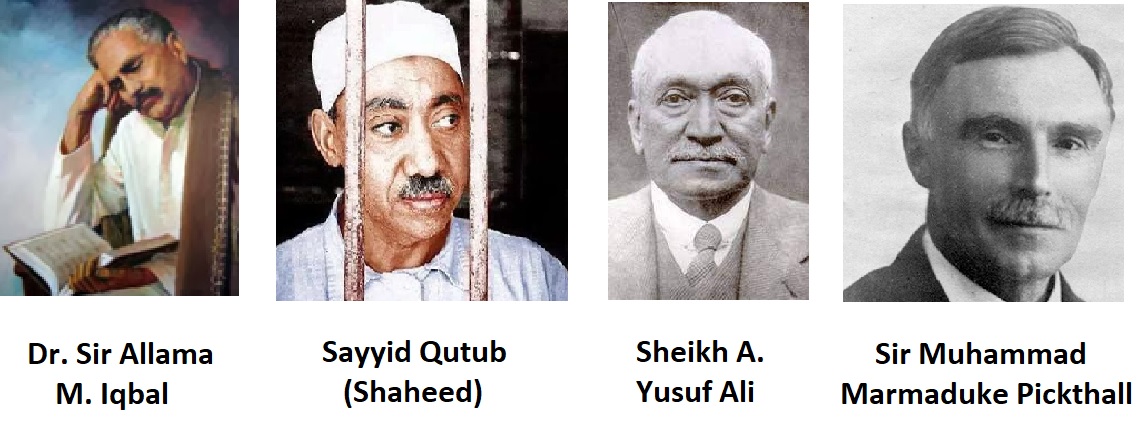
FOUR GREAT SERVANTS OF THE QUR’AN WHO KNEW THEIR PRIORITIES
Dr. Sir Allama Muhammad Iqbal (r.a.)
A man once dreamt that the Prophet (s.a.w.) was about to lead a prayer with the Sahaba standing in rows behind him. The Prophet glanced back and said, "Iqbal hasn’t turned up yet." Soon, a man with his beard shaved and sporting a mustache stepped forward, and the Prophet asked him to stand almost beside him.
Perplexed by the dream, the man later recognized the person in a newspaper photo—Dr. Iqbal. He travelled to Sialkot and upon his narrating the dream, Iqbal broke into sobs uncontrollably. No, doubt he was a Waliullah.
His father had taught him to read the Qur’an as if it were being revealed directly to him. This shaped his life and poetry, and in his last days, he spent most of his time with the Qur’an in hand and tears in his eyes. He was also well known for his unwavering love for Prophet Muhammad s.a.w.
Sayyid Ibrahim Husayn Shadhili Qutb Shaheed (r.a.)
In 1966, at age 13, I saw a rare photograph in the Urdu daily ‘Dawat’—a man with a shave beard and a thick mustache smiling from an army vehicle. My elders explained he was being taken to be hanged for his Islamic views. Sayyid Qutb’s Fi Dhilal-il-Qur’an remains a profound exegesis. A member of Islamic Brotherhood, Sayyid Qutb was one of the leading Islamist ideological thinkers and a liberal Islamic jurist of the 20th century.
He was accused of plotting against Egypt’s president, Nasser and was executed by a puppet judiciary, earning the honor of martyrdom (Shahadah).
Khan Bahadur Sheikh Abdullah Yusuf Ali (r.a.)
A scholar and barrister, Abdullah Yusuf Ali authored numerous works on Islam, but his most famous is his English Qur’an translation and commentary. Allah blessed his work with unparalleled popularity, making it the most widely used English version.
Though modern in appearance with no beard and prominent Mustache, he was deeply committed to the Qur’an and its teachings.
Sir Muhammad Marmaduke Pickthall (r.a.)
Born into a royal lineage, Pickthall was a celebrated writer whose work was admired by D. H. Lawrence and H. G. Wells. At 42, he dramatically declared his conversion to Islam in a 1917 lecture in London. His exegesis, The Meaning of the Glorious Qur'an became the second most widely used English Qur’an translation after A. Yusuf Ali’s commentary.
He was buried in the same Muslim cemetery in England in which A. Yusuf Ali was buried a few years later. He had a thick Mustache with no beard.
A Reminder on Priorities
The Islamic knowledge and love of the Qur’an should not be measured by the length of one’s beard. In the subcontinent, the beard has been made an essential identity marker for a Muslim, yet the Qur’an does not mandate it. Instead, it highlights Sajdah-marks on the forehead and the Ibrahimi spirit of sacrificing everything for Allah’s will as the hallmarks of Islamic culture.
This does not the least diminish the beard’s significance but places each Islamic order in its rightful status.
ENGAGING IN SPIRITUALITY AND CONNECTION WITH THE ALMIGHTY CREATOR
Question from Hana and Maheen (New Delhi):
How can people of different age groups engage in spirituality and connection with the Almighty Creator?
For instance, students under extreme academic pressure are barely involved in exploring the features & ultimate law of Allah (SWT).
MY RESPONSE:
The Importance of Connection with the Almighty
The key solution is to convince individuals—especially students struggling under academic pressure—that a connection with the Almighty Creator, Sustainer and Evolver is essential for easing their burdens.
People of all faiths instinctively turn to God for help in times of distress. Islam, in particular, emphasizes the Eternal life after this temporary existence and provides guidance for success in both worlds. Far from impeding progress in this life, the Qur’an lays down the principles of success in this world but emphasizes again and again not to be tempted by the lures in this world to the extent that the real future, the Eternal life is ruined.
Islamic Practices for Spiritual Connection
Islam prescribes various principles and , where one reaches a state of trance, detached from worldly distractions and fully absorbed in Allah’s presence.urpose. A person who neglects these practices lacks complete faith in the wisdom of the Almighty’s guidance.
The most significant among these practices is Salah (Namaz)—the five-times daily prayer—which establishes a direct connection with Allah.
The Role of Meditation in Salah for Relieving Pressure
The very beginning of Salah is a connection with Allah and as it proceeds, it involves:
* Suggestions from the Imam (in congregational prayers)
* Auto-suggestions in individual prayers, where one reaches a state of trance, detached from worldly distractions and fully absorbed in Allah’s presence.
To truly benefit from Salah, one must:
1. Understand the meaning of Takbeers and Zikr recited in the prayer.
2. Learn the meanings of all recitations included in Salah.
This may seem like a daunting task, but it is not. Investing time in understanding these elements will lead to both spiritual and worldly success, including stress relief and improved academic performance. Many organizations offer online classes to help with this learning process in a very short time. To join the next course organized by WORK, you may call +918533996247
The Correct Way to Offer Salah for Maximum Benefit
When preparing for Salah, do not proceed mechanically. Instead:
1. Prepare Mentally (The Niyat):
Before beginning, spend a couple of minutes cutting yourself off from distractions and focusing on Allah's divine presence. Say Allahu-Akbar only when you achieve a degree of mental readiness. Do not rush into prayer— Focus on ‘Allahu-Akbar'.
2. Maintain Focus Throughout Salah:
This is the most challenging part, as the mind often drifts. The repeated phrase Allahu-Akbar at the beginning of each posture serves as an alert, a reminder to bring your focus back to Allah’s presence.
3. Learn the Meanings of Recitations:
Once you understand the words recited during Salah, a deeper connection will naturally develop."This"This technique is meant to release your pressures. Consider it as a compulsory part of your syllabus."
Performing such a mindful Salah five times a day will release stress and tension, benefiting not only studies but all aspects of life.
Addressing the ‘Lack of Time’ Argument
If someone claims they do not have time for Salah due to academic or personal pressures, remind them:
"This technique is meant to release your pressures. Consider it as a compulsory part of your syllabus."
The Universality of Meditation for Stress Relief
Since the question came from Muslim students, the response has been given from an Islamic perspective. However, meditation itself is universally acknowledged as an effective tool for stress relief.
Even Buddha, who some claim did not believe in a divine being, made compulsory meditation an essential part of his Eightfold Path—the foundation of Buddhism.
While general meditation provides relief, the benefits of Salah go far beyond simple meditation, offering a structured, spiritual, and deeply fulfilling connection with the Almighty.
#meditation #spirituality #salah
FALSEHOOD CAN NOT STAY IN THE PRESENCE OF TRUTH
When you switch on a torch, darkness instantly has to give way to light wherever the beam is directed. There is no device emitting darkness to overpower light, for darkness has no real existence—it is merely the absence of light.
Similarly, falsehood has no existence of its own; it endures only because it has not yet been confronted with Truth. Stand firm as a fearless bearer of Truth, and falsehood, no matter how imposing it seems, will inevitably vanish.
Noor (Light) is One, (Zulumat) Darknesses many, says Qur’an. Under which of these do we classify mutually hostile numerous Maslaks (Creeds)?
क़ुरआन ने प्रकाश (नूर) को एक कहा है, अंधेरे (ज़ुलुमात) बहुत। मसलकों (पंथों) को प्रकाश कहें या अंधेरे? ये अनेक हैं और परस्पर संघर्षमय भी।
قرآن میں نور کی جمع اور ظلمات کا واحد استعمال نہیں ہوئے۔ یعنی نور ایک اندھیرے بہت۔ مسالک نور ہیں یا ظلمات جو بہت ہیں اور دست بہ گریباں بھی؟
THE ARROGANCE AND IDEOLOGY
#Arrogance without an ideology to support it is short-lived. Kejriwal in Delhi found to his dismay that he was an isolated arrogant. Disappointment can also serve as a catalyst for growth, learning, and self-reflection. Can @ArvindKejriwal patch up with the breakaway founding members who included at least two ideologues? Most probably not.
So, it's goodbye to him for good.
Bigger Arrogant:
There are even greater examples of arrogance in the country, but they persist because they are backed by strong ideologues. While ideologies may be defeated, they seldom fade away. Recent history shows that whenever and wherever ideologues withdrew their support, the arrogant were forced to bow down.
However, ideologies themselves sometimes evolve. Looking ahead, we face three possible scenarios:
1. If the ideology is defeated, arrogance will be wiped out.
2. If the ideology remains stagnant, arrogance will persist, and India will continue as a land of contradictions, unable to become a Vishwa Guru.
3. If the ideology is modified in a healthy and creative way, arrogance will dissolve, paving the way for India to truly become a Vishwa Guru.
Let us convince and help the ideologues to move toward the path of constructive evolution.
#DelhiElections2025
@YogendraYadav@pbhushan1@DrKumarVishwas