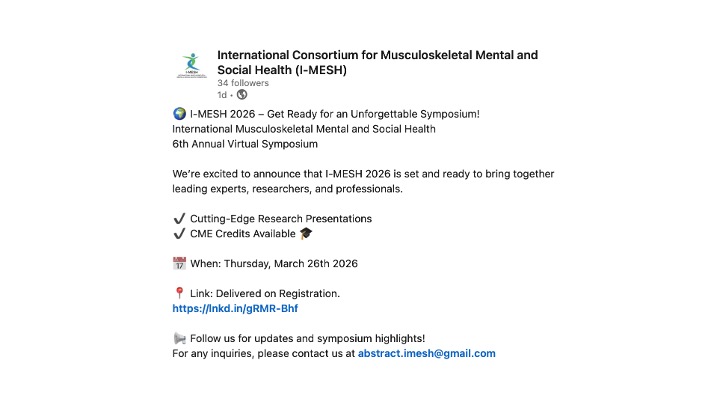
Call for Papers: #CORR is accepting papers from the 6th annual I-MESH meeting for our next proceedings. Submit your paper by June 30, 2026 to be considered for inclusion.
Get started now ➡️ https://t.co/e0n1qCSBDK
#orthoTwitter#medTwitter#callforpapers#iMESH#mentalhealth
📣 Call for Papers: #CORR is now accepting papers from the 6th annual I-MESH meeting for our next proceedings. Submit your paper by June 30, 2026 to be considered for inclusion!
Get started now ➡️ https://t.co/e0n1qCSBDK
#orthoTwitter#medTwitter#callforpapers#iMESH
At four months, higher BMI, manual labour occupation, and greater kinesiophobia were associated with poorer OMAS and EQ-5D outcomes, whereas male sex and higher pain self-efficacy predicted better outcomes.
#Trauma#BMI#Pain#AnkleFracture
https://t.co/weoqakvFfp
💊 THE IMPACT OF UNHELPFUL PAIN BELIEFS ON PATIENT OUTCOMES AFTER SURGICALLY MANAGED ANKLE FRACTURES 🦶🏽
Read the full paper here!
#Pain#AnkleFracture#Trauma#Surgery@BrethertonC
https://t.co/G2P5ycof6o
🚩 Free to read through March 30: In a survey-based experiment in #CORR, Drost et al. found that surgeons are more likely to order a low-yield, low-value test when a patient's symptoms last longer, are more intense, or are very limiting due to pain; not due to a surgeon's intolerance for uncertainty.
"Overdiagnosis and overtreatment are much easier to recognize when performed by someone else," writes Alicia R. Jacobson MD in a #CORRInsights commentary. "It would be interesting if future studies could quantify the impact of low-yield testing in time spent, dollars lost, and/or physical harm... (so) we could use (those) data to support decision-making."
Read the article here: https://t.co/6ipPJZWkZL
Read the commentary here: https://t.co/nBNm3JDTrM
#orthoTwitter #medTwitter #iMESH
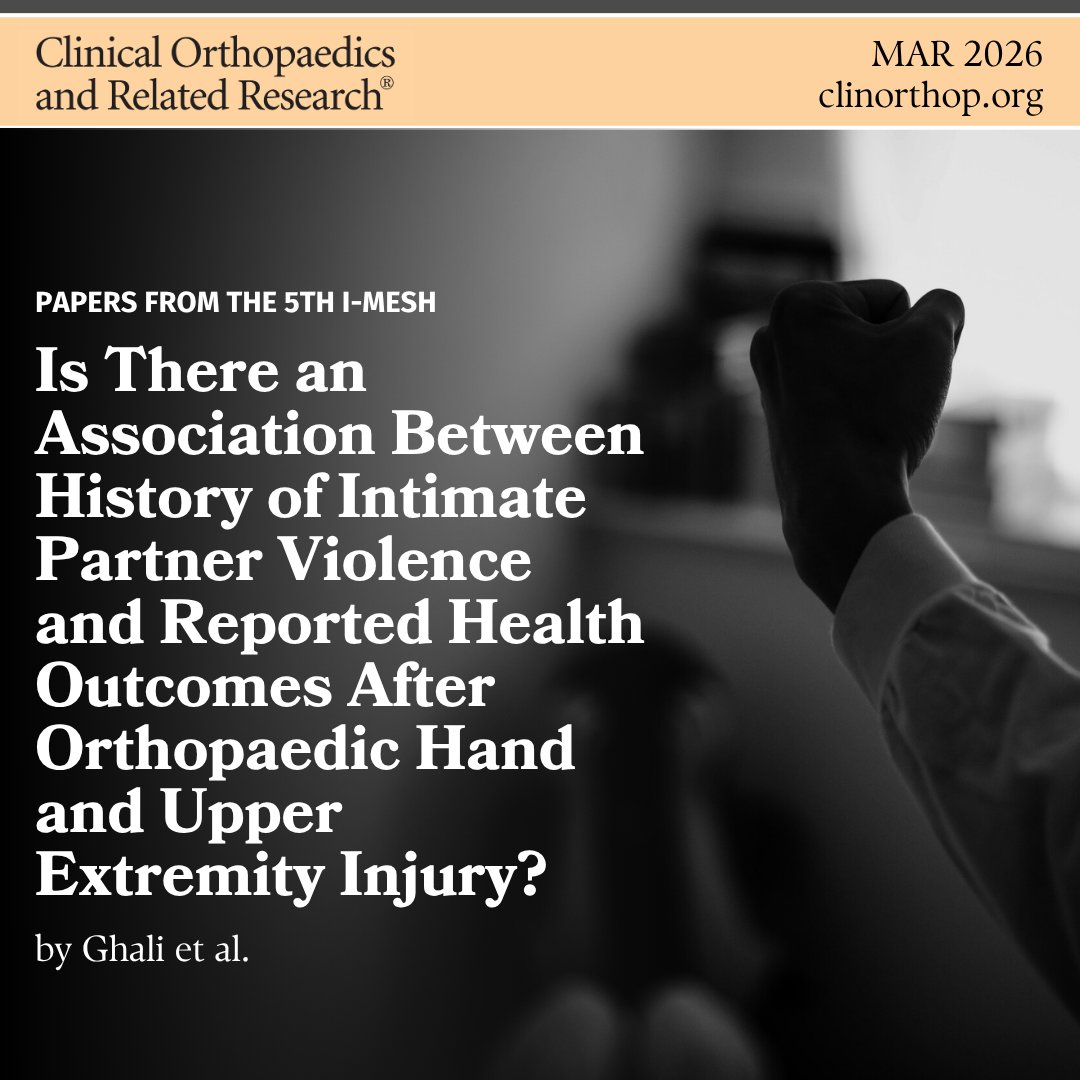
In a diverse population of patients with orthopaedic hand & upper extremity trauma, Ghali et al. found that those who disclosed a history of IPV (24% of patients) also reported greater disability and poorer health outcomes.
"Our study lends further support (to) screen for IPV in orthopaedic clinics, as surgeons who fail to screen for IPV may miss a root cause of prolonged disability or delayed recovery," the authors write.
"The direction forward involves widespread adoption of universal screening in acute musculoskeletal injury settings," writes Gregory J. Kirchner MD, MPH in a #CORRInsights commentary.
Read the article here: https://t.co/w7LX2f8y6K
Read the CORR Insights commentary here: https://t.co/xZ81khcTKy
#orthoTwitter #medTwitter #iMESH #CORR
In a systematic review in #CORR, Samson et al. found that multiple aspects of social health—such as limited health insurance, unstable employment, and housing insecurity—are associated with greater levels of musculoskeletal discomfort and incapability.
"'The patient’s social history was noncontributory' (is a) statement uttered by nearly every medical student and trainee alike, including me," writes Alicia R. Jacobson MD in a #CORRInsights commentary. "(But) based on these data, surgeon visits can and should provide patients the opportunity to learn about and enroll in community resources for modifiable factors like health insurance."
Read the article here: https://t.co/wNXKZpy5wC
Read the CORR Insights commentary here: https://t.co/95416vcbLv
#orthoTwitter #iMESH #medTwitter
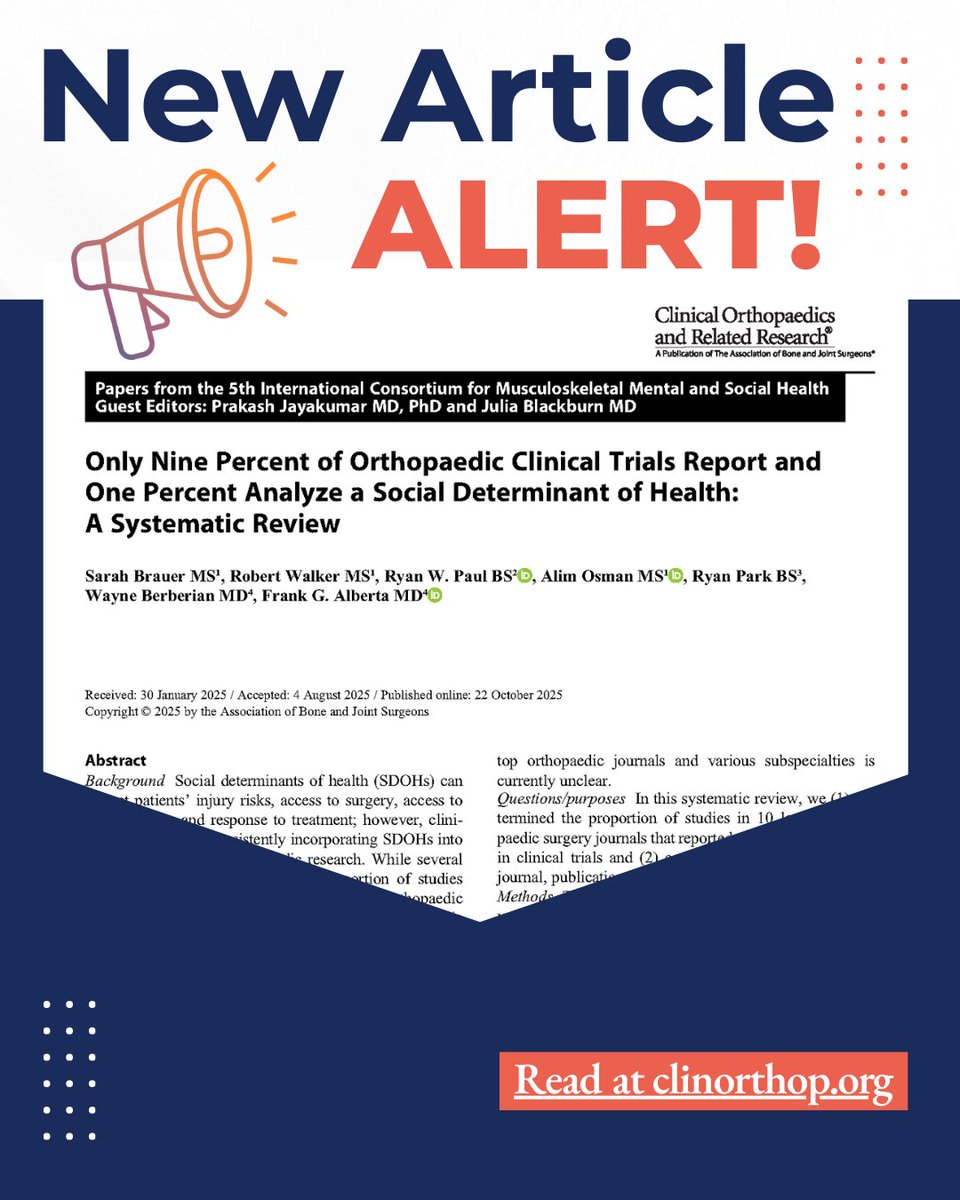
Despite the strong clinical relevance of social determinants of health to patient care, Brauer et al. found that only 9% of trials in leading orthopaedic surgery journals reported at least one SDOH, and only 1% of trials analyzed one.
"While SDOHs may not have an important clinical impact on all orthopaedic surgeries or interventions... the collection of these data can (provide) better control for potential confounders (and) potentially identify inequalities in patient care and access," the authors write.
"Luckily, after the almost universal adoption and standardization of EMR systems, we have the tools for this (collection)," writes Kacy Peek MD, MS in a #CORRInsights commentary. "Living circumstances, support systems, health, and health literacy all inform treatment strategies, postoperative recovery, and follow-up for fracture care and elective procedures."
Read the article in #CORR here: https://t.co/kIzMA0gGqD
Read the commentary here: https://t.co/AmswYcLF0M
#orthoTwitter #medTwitter #iMESH
When tingling feels like intense pain, look at the mindset—not just the nerves. Distress and unhelpful thoughts—not nerve severity—often drive pain intensity in intermittent paresthesia.
https://t.co/EZn65m0GUI
#JHS#HandSurgery#Painintensity
🚩Free to read for a limited time: In this month's spotlight article, Azib et al. found that surgeons are relatively unlikely to acquiesce to potentially unhealthy patient requests, unless the patient persists with multiple return visits.
"Although surgeons seem able to navigate around direct manifestations of patient distress, they could increase their awareness of indirect manifestations of patient distress (such as a greater number of return visits) to further mitigate the risk of overdiagnosis and overtreatment," the authors write.
"Making the right choice of protecting patients from unnecessary harm may seem easy when we consider these dilemmas from the comfort of our office chairs, but it’s all too easy to lose track of benefit-harm boundaries during a busy clinic, with the cloud of patient satisfaction surveys constantly hanging over us," writes M. Daniel Wongworawat MD.
The article is free to read until March 18: https://t.co/t6flYSShsn
The Editor's Spotlight/Take 5 interview is free to read all month: https://t.co/Bz1X4IN8C1
#orthoTwitter #medTwitter #iMESH #CORR
"While previous I-MESH meetings focused on establishing the importance of identifying and associating psychosocial factors with outcomes in musculoskeletal care, the 2025 symposium marked a growing emphasis and commitment toward translating these research findings into strategies for everyday clinical practice," write Prakash Jayakumar MD, PhD & Julia Blackburn MD in #CORR.
Read their Editorial Comment introducing this month's selected proceedings from the 5th Annual Meeting of the International Musculoskeletal Mental and Social Health Consortium (I-MESH) here: https://t.co/OJb796Eeea
#orthoTwitter #iMESH #medTwitter
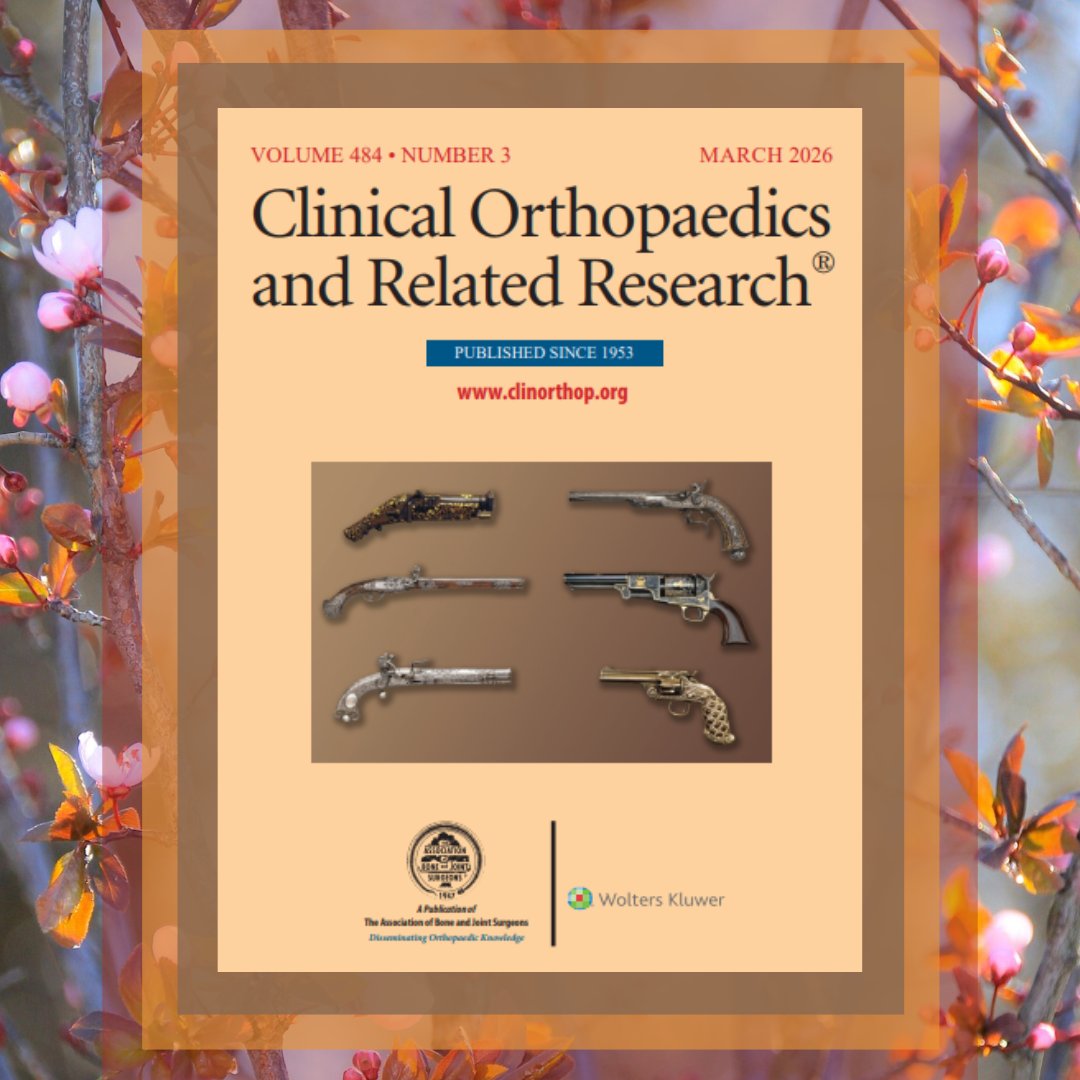
The March 2026 issue of #CORR is now available! This issue contains papers from the 5th Annual I-MESH Symposium, a guest editorial on recalling a recall, and plenty of columns, letters, and clinical research articles to keep you busy on the plane ride to #AAOS2026.
Start reading now: https://t.co/6dNdp86leX
#orthoTwitter #medTwitter #iMESH
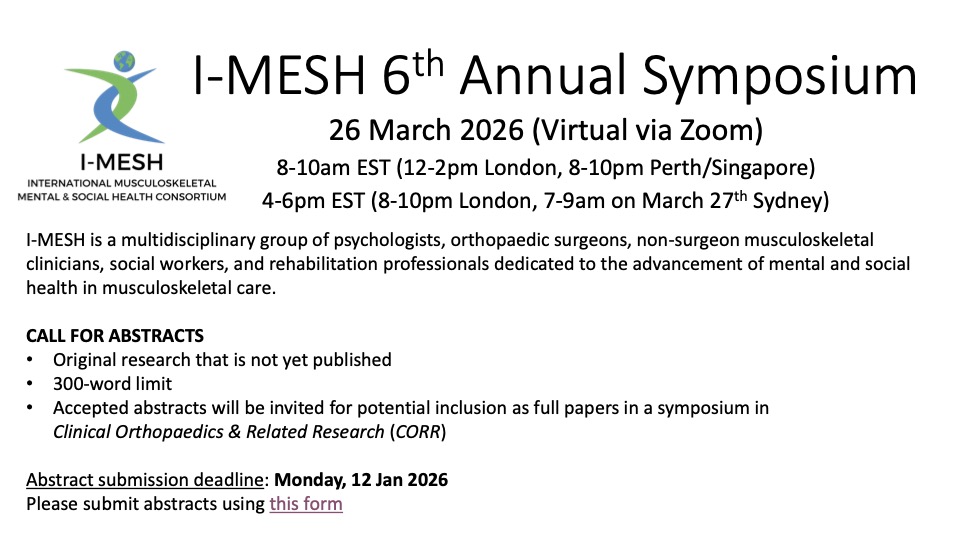
Call for abstracts for our 6th Annual Symposium
A little job that you can tick off your list before the holidays - submit your abstracts now! https://t.co/oKtHIyKByL
📣 #NewinCORR: "Only Nine Percent of Orthopaedic Clinical Trials Report and One Percent Analyze a Social Determinant of Health: A Systematic Review" by Brauer et al.
Read it here: https://t.co/PVdMZVOVFG
#orthoTwitter#medTwitter#meded
I’m honored and excited to give this year’s Denise Fandel Distinguished Lecture at UNO. Looking forward to connecting on whole-person healthcare and the mind-body connection in rehabilitation 🌟 See below for registration details - in-person & Zoom options - registration is free.
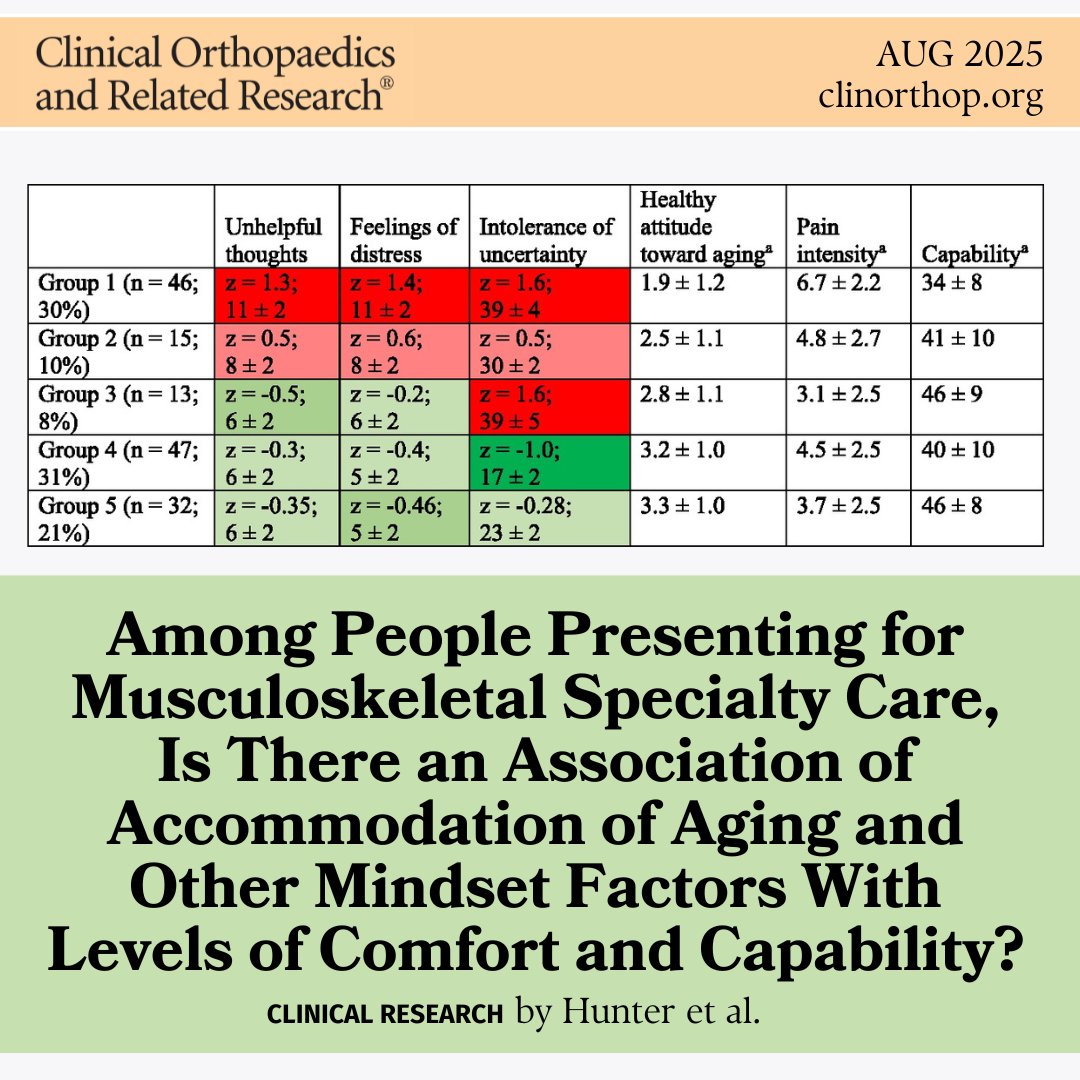
Using a cluster analysis technique, Hunter et al. found that a healthy attitude toward aging is associated with greater levels of comfort and capability along with lower levels of distress, unhelpful thoughts, and intolerance to uncertainty.
"What makes this study important is its focus on a specific potential determinant of one’s mindset: The patient’s attitudes toward aging," writes Trevor A. Lentz PT, PhD, MPH in a #CORRInsights commentary. "This work suggests changing patients’ mindsets and expectations about the normal aging process could be a helpful firstline intervention to improve capability among people with age-related musculoskeletal conditions."
Read the study here: https://t.co/nDtrp4hcKU
Read the #CORR Insights commentary here: https://t.co/Gw3KWdhvEq
#orthoTwitter @DrDavidRing
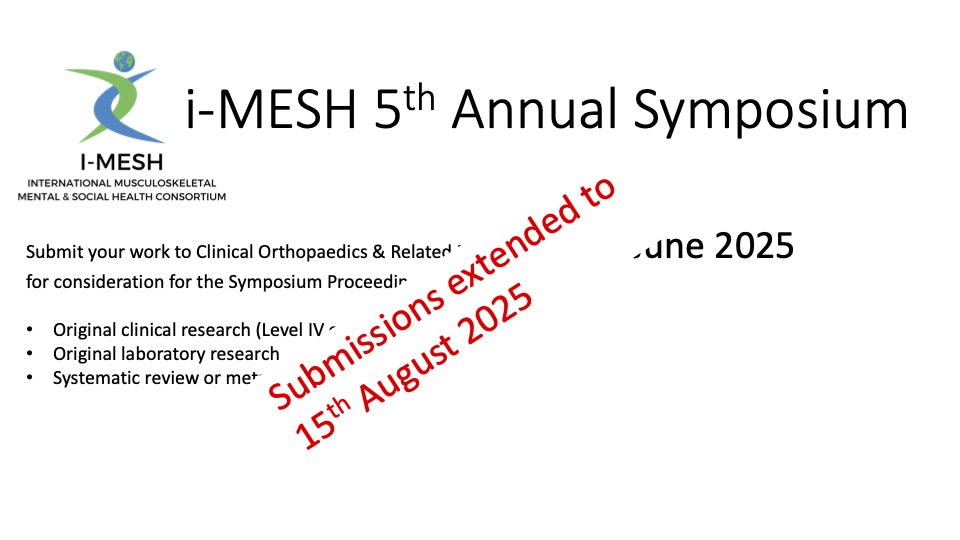
Last chance to submit your paper from the 5th annual I-MESH meeting! The deadline is Friday, August 15, 2025. Don't miss the opportunity to be included in our next proceedings.
Get started now ➡️ https://t.co/e0n1qCSBDK
#orthoTwitter#CORR#callforpapers#iMESH@DrDavidRing
The deadline for submission of papers to @Clinorthop has been extended to 15th August. Please submit your work, so everyone can be inspired by @iMESHorg