🚨HUGE: China pushes to establish a "National Blockchain Network".
According to Xinhua, China introduced a 19-measure policy to build nationwide blockchain and computing infrastructure.
The plan aims to integrate blockchain into manufacturing, banking and data sharing, while improving data ownership rules and cross-border data flows.
China is laying the digital infrastructure to bring blockchain into the REAL ECONOMY, far beyond cryptocurrencies.
🔥 TRUMP JUST REPOSTED JFK’S MOST TERRIFYING SPEECH — AND THE DEEP STATE IS PANICKING
JFK saw it coming. In 1961. And now, Trump has just made sure 300 million Americans see it, too.
The speech everyone’s talking about: Kennedy’s address to the American Newspaper Publishers Association, April 27, 1961. The CIA had just botched the Bay of Pigs. Kennedy was livid. He’d been lied to by his own intelligence apparatus. And he walked onto that stage and said something no president has dared say since.
“We are opposed around the world by a monolithic and ruthless conspiracy that relies primarily on covert means for expanding its sphere of influence — on infiltration instead of invasion, on subversion instead of elections, on intimidation instead of free choice.”
Read that again. Monolithic. Ruthless. Conspiracy.
This wasn’t some fringe radio host. This was the sitting President of the United States, on live television, telling the American people that a shadow network of power — operating through intelligence agencies, media complicity, and institutional capture — was working against the republic itself.
And then he said the quiet part out loud:
“Its preparations are concealed, not published. Its mistakes are buried, not headlined. Its dissenters are silenced, not praised. No expenditure is questioned, no rumor is printed, no secret is revealed.”
Sound familiar?
Sixty-five years later, Trump drops this video on Truth Social. No commentary needed. The speech does all the work. And within hours, the same media outlets that spent four years calling Trump a conspiracy theorist are suddenly very quiet.
Here’s what they don’t want you to connect:
- Kennedy was assassinated 2.5 years after this speech
- The Warren Commission was a joke — even the House Select Committee on Assassinations in 1979 concluded Kennedy was “probably assassinated as a result of a conspiracy”
- The files are STILL classified
- Trump has been pushing to release them, but the permanent national security state refuses, instead slow-walking the order
The timing isn’t random. This isn’t just history. JFK described a permanent national security state that has only grown more entrenched — one that operates beyond elections, beyond accountability, beyond the reach of voters.
Kennedy called it “a system which has conscripted vast human and material resources into the building of a tightly knit, highly efficient machine that combines military, diplomatic, intelligence, economic, scientific, and political operations.”
That machine didn’t disappear when he died. It got even stronger.
Trump reposting this isn’t nostalgia. It’s a signal. The same forces JFK warned about are the same forces that tried to destroy Trump — Russiagate, two impeachments, lawfare, media blackout, assassination attempts. The playbook hasn’t changed. Only the names.
And now the sitting president just reminded the country who the real enemy has always been.
The speech that scared them then is the speech they’re terrified you’ll watch now.
Sharing this because they’re counting on you not to watch it. Don’t let them win. 🎯
“And the kings of the earth, the great men, the rich men, the commanders, the mighty men, every slave and every free man, hid themselves in the caves and in the rocks of the mountains, and said to the mountains and rocks, “Fall on us and hide us from the face of Him who sits on the throne and from the wrath of the Lamb!” - Revelation 6:15-16
Here's how to turn an iPhone into the most secure crypto wallet. 10 steps:
1. Buy the cheapest new iPhone (17e, $699 in the US). Never used.
2. New Apple ID, fresh email, unique password
3. Face ID off. Custom alphanumeric passcode, 12+ characters
4. Lockdown Mode on
5. Erase data after 10 failed passcode attempts: on
6. iCloud backup off, before you install anything
7. Install the wallet from its official site and check the publisher
8. Generate a new address. Write the seed phrase on paper or steel. Never photograph it
9. Send a small test amount first, then move everything
10. Airplane mode, no SIM, no Wi-Fi ever again. Phone in a safe, seed in a different place
Skip step 6 or step 8 and the whole setup falls apart.
Bitcoin's proof of work has done around 2^96 hashes over all time. Breaking the ZKP's in Zcash requires a minimum of 2^120 elliptic curve operations assuming ECDLP. If you had a dedicated ASIC, an elliptic curve addition would cost around 10-100x more than SHA2.
So today breaking an Elliptic curve would cost around 1 billion Bitcoin-hashrate equivalents. AKA a billion times the hardware buildout of all Bitcoin mining ASICs, dedicated to break this.
If a hypothetical billion X improvement came in, you'd need a chip buildout on the level of bitcoin mining before you can break anything. While competing against all the hyperscalars for fab-space.
AKA plenty of warning time, for a recovery process that takes a couple day response time max.
Football history was never written by the fans. It was written by FIFA, and FIFA has always needed a clean, marketable god.
That is why they chose Pelé over Maradona.
Pelé was perfect for FIFA's business plan. He was the smiling, non-political, sponsor-friendly ambassador. He never challenged power. He retired early to be an ambassador for Coca-Cola, for the American project, for FIFA itself. He was the safe black icon they could sell to the world without risk.
Maradona was the opposite. He was poor, angry, anti-establishment. He called out FIFA's corruption, he defended the workers, he talked about the Falklands, he exposed how FIFA treated players. He was too real, too dangerous, too loved by the actual people and not by the boardrooms. So FIFA had to erase him.
Look at the timeline. Maradona wins the 1986 World Cup almost alone — the greatest individual World Cup ever. What does FIFA do? They immediately start drug testing him obsessively. In 1990 they let brutal fouling on him go unpunished in the final. In 1994 they kicked him out of the World Cup in the middle of the tournament on live TV to humiliate him. Then they gave Pelé the title "Footballer of the Century" and later forced a shared award when the public voted overwhelmingly for Maradona, because even they couldn't hide the people's vote. They needed Pelé as the official history, even if the streets knew Diego was greater.
Now watch what is happening today with Messi and Ronaldo. It is the exact same script.
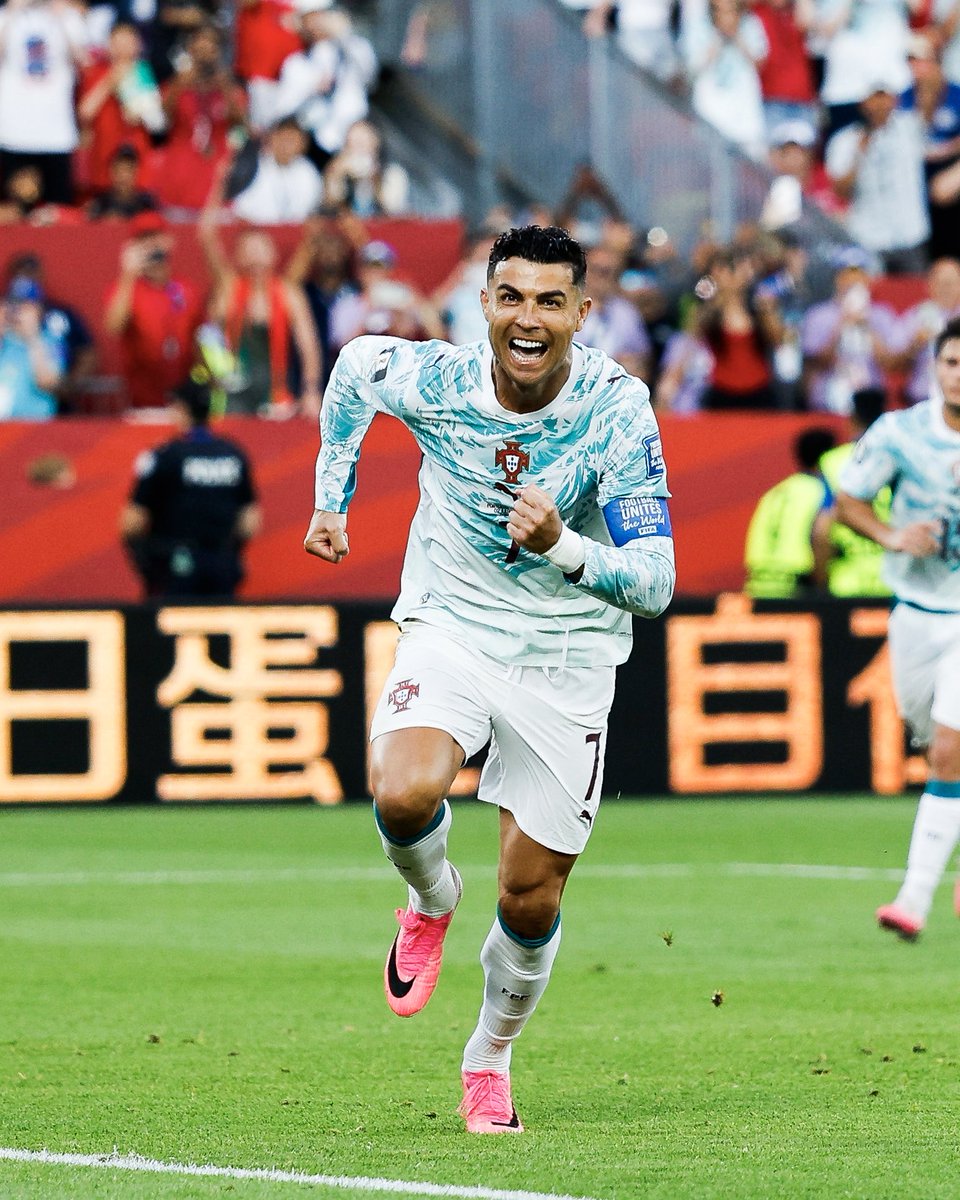
Ronaldo is Maradona in this era. He is self-made, outspoken, not owned by the system. He left Europe, he challenged FIFA's new money projects, he speaks openly. Messi is the new Pelé — quiet, sponsor-safe, Adidas, well-managed, never attacks the institutions. He is perfect to be the face FIFA can control after Infantino needed a new legacy.
That is why Ronaldo can score 50 goals a year, carry his country, reach 900 goals, and still be pushed out of the Ballon d'Or conversation. That is why Messi wins a Ballon d'Or for winning Ligue 1 and a World Cup where he got a penalty in every knockout game. That is why every FIFA The Best campaign, every Club World Cup promo, every Inter Miami push is centered on Messi while Ronaldo, who still has the biggest audience in football history, is treated like he doesn't exist.
FIFA did it before. They turned Pelé into a museum statue and tried to make us forget that Maradona was the people's god. Today they are trying to turn Messi into that untouchable statue and make the next generation forget that Ronaldo was the one who defied them and still conquered everything.
History repeats itself because the same organization is writing it.
I wasn’t going to comment since this is a really bad take IMO, but since it’s taken off I feel the need to. To my understanding, there is no evidence whatsoever pointing to a break of decades old hardness assumptions like elliptic curve cryptography. 1/n
People read one emotional Matt Green tweet about public key encryption, spent 0 seconds thinking about it, and decide to panic.
Sure ECDLP will be broken with QC's one day. But there's so many levels to this being wrong to panic over.
- 0 actual progress on attacking anything
- We have tons of alternate plans available.
- Quadratic advantage hash-based PKE
- Lattices
- Multivariate polynomials
- A whole field of KEM's from fine grained cryptanalysis. (Fun fact, works even if P=NP)
Sure you can wake-up and choose doomer and be wrong.
We have decades of cryptography to draw from on for all the above options, AND how to build a lot of what we want from UX tweaks without PKE. PKE just made a lot much easier, and less web of trust routing like.
I don't recommend anyone scramble to move their funds to new wallets today. But we should take the risks to cryptography from AI-accelerated math seriously, and minimize our exposure to not just quantum-vulnerable cryptography, but also potentially AI-vulnerable cryptography.
The core new area of risk from this viewpoint is, unfortunately, ML-DSA / FHE / lattices.
(and it's also another reason, along with quantum, why ECDSA might fall even faster than expected, hence the "fresh address" recommendation)
So far most people have been in the mode of thinking "elliptic curves broken, hashes safe, lattices safe". But there is a good chance that the concrete security of lattices will take serious hits from the next two years of AI math.
The basic threat model is: factoring is something that naively takes 2^(n/2) time, but over decades smart people have found and optimized number field sieves, and degraded that to 2^O(n^(1/3)), which is why RSA keys and signatures need to be ~400 bytes (and not 64 bytes). What if there are skeletons in the closet like that, both for elliptic curves and lattices, that we are simply not smart enough to discover - but bots soon will be?
This is a major part of the reason why for the past year ethereum's lean roadmap has been going in the "hash-only" direction: no lattices, no ML-DSA, no Falcon, no lattice-based commitments inside ZK proofs, etc. Signatures in lean ethereum are all hash-based, either WOTS or SPHINCS-.
For signatures and proofs, we already know how to go hash-only. The bigger challenge is for *public-key encryption* - and this goes far beyond blockchains. Secure communication, anonymizing protocols, lots of things need public-key encryption.
And unfortunately there are long-standing mathematical theorems showing why public-key encryption cannot be done with hashes alone. You have to have some kind of trapdoor object that has at least one form of usable "structure" - either group theory (incl. isogenies) or lattices or code-based or potentially in the future even more newfangled and spooky things (local mixing?). But for anything that has structure, you should assume that AI will make at least some progress in breaking that structure. Here, one reasonable inference is that if you want to make something plausibly long-term secure, multiply the key sizes by 10.
To me that's a very plausible world and something not at all extreme to predict. If AI will bring us 50 years of math in 2 years, then that 50 years of math may very plausibly include a "naive factoring -> GNFS" level of improvement to our ability to break lattices. In that world, lattices will still exist, but they will have to be significantly bigger to guarantee the same level of safety.
And at those new larger sizes, hash-based constructions will beat lattice-based constructions on concrete efficiency in every use case where hash-based constructions are possible at all.
Theoretically, of course it's possible that hashes are broken too (eg. P = NP would imply that). But I think P = NP is very unlikely. And intuitively, it's much more likely that a mathematical object has exactly no exploitable structure (like hashes are intended to), than that a mathematical object has exactly ~3 forms of exploitable structure (for elliptic curves: associativity, Schoof, pairings) and not some secret fourth form of structure we have not yet discovered that greatly degrades its security (for elliptic curves, ECDLP and pairing security). Similar for LWE, SVP, RLWE and the zoo of lattice problems.
For this reason, we do not yet see any reason to worry and start padding the byte size of hashes (if we start to worry more, we would pad the round count first before doing anything to the byte size).
Concrete TLDR, my own personal views:
* Hash-based > lattice-based, in those situations where hash-based is possible at all
* For anything lattice-based, be much more paranoid on param sizes. Remember that blockchains are only a small portion of the cryptography story; this point goes far beyond blockchains and applies to eg. access to websites, secure messaging, Tor / VPNs ...
* For privacy protocols, strongly favor NOT putting encrypted notes onchain. Instead, send them offchain through some third-party mechanism.
* If it's not difficult for you, keeping your funds in addresses which have not yet been used to make a transaction is a good idea. If it's easy for you, do it. **But be careful about migrations; I personally have lost more money in botched migrations than I have lost in all hacks combined**.
* For multisig wallets, doing confirmations offchain is better than onchain, because this way the signatures of signer wallets do not get exposed to the public, so if ECDSA falls to AI much faster than expected, at least the multisig "gracefully degrades" to a 1-of-1 where the 1 is whoever was gathering the signatures - a much better place to be than "anyone can take the money"
https://t.co/oVjwZog2lL
So many people have DM’d me about this trailer and I’ll be honest, watching it made me physically throw up.
I was COO from before FTX even had a name, it was my baby, and I was the last one out of the Bahamas after Sam got extradited. I lost everything I had on it and it took me a long time to get over, so I have zero interest in defending the people who caused this.
The media loves the story that FTX blew up because we were all partying in the Bahamas, but the place I worked looked nothing like that.
We had under 200 people in the core company at its peak, not counting subsidiaries, when other exchanges our size had thousands, so a lot of us were doing 16 to 18 hour days for over three years and barely had time to sleep, and whenever we walked in, day or night, Sam was at his desk.
I worked with Caroline and never once saw her get aggressive like she does in this trailer. She’s quiet and mild, and often lost in her own thoughts.
Most of us didn’t even know she and Sam were dating until we read about it after the bankruptcy, and I never saw him so much as put an arm around anyone.
FTX’s collapse ruined so many people’s lives, including ours, and Netflix decided to make it a love story.
Shame on you @netflix.