After months of dissecting AMM, CLMM, PropAMM, and Lending/Borrowing protocols + with notes(libraries t00) down to the bone and optimizing them, I’m fully equipped to pivot into Web3 security. Time to dig deep.
#web3security#SmartContractAudit#VulnerabilityResearch#Whitehat
I just got my @EFDevcon ticket!
Next stop: Mumbai 🇮🇳 Join me at Devcon 8 from November 3–6, 2026 for four days of big ideas, technical depth, community, and the people building the future of open source technology. https://t.co/mLw5dpOrW9
Sharing the first prototype of Solizone.
An EVM-compatible Sovereign Zone designed to make Logos more accessible to Solidity developers.
The idea is simple: developers keep the tools and execution model they already know, while Solizone handles the EVM layer and publishes canonical blocks to Logos for ordering and finality.
This first prototype already proves the core flow:
Solidity → REVM execution → Solizone block → Logos → finality
The goal is to make building on Logos feel familiar to the Ethereum ecosystem, and in turn make it easier for more developers and applications to enter the Logos network.
Early prototype, but a meaningful first step.
@Logos_network@Logos_devs@LogosRnD
Demo Video - https://t.co/n2qtCHU35U
Github - https://t.co/t5JH38hcrJ
Please do share your feedback.
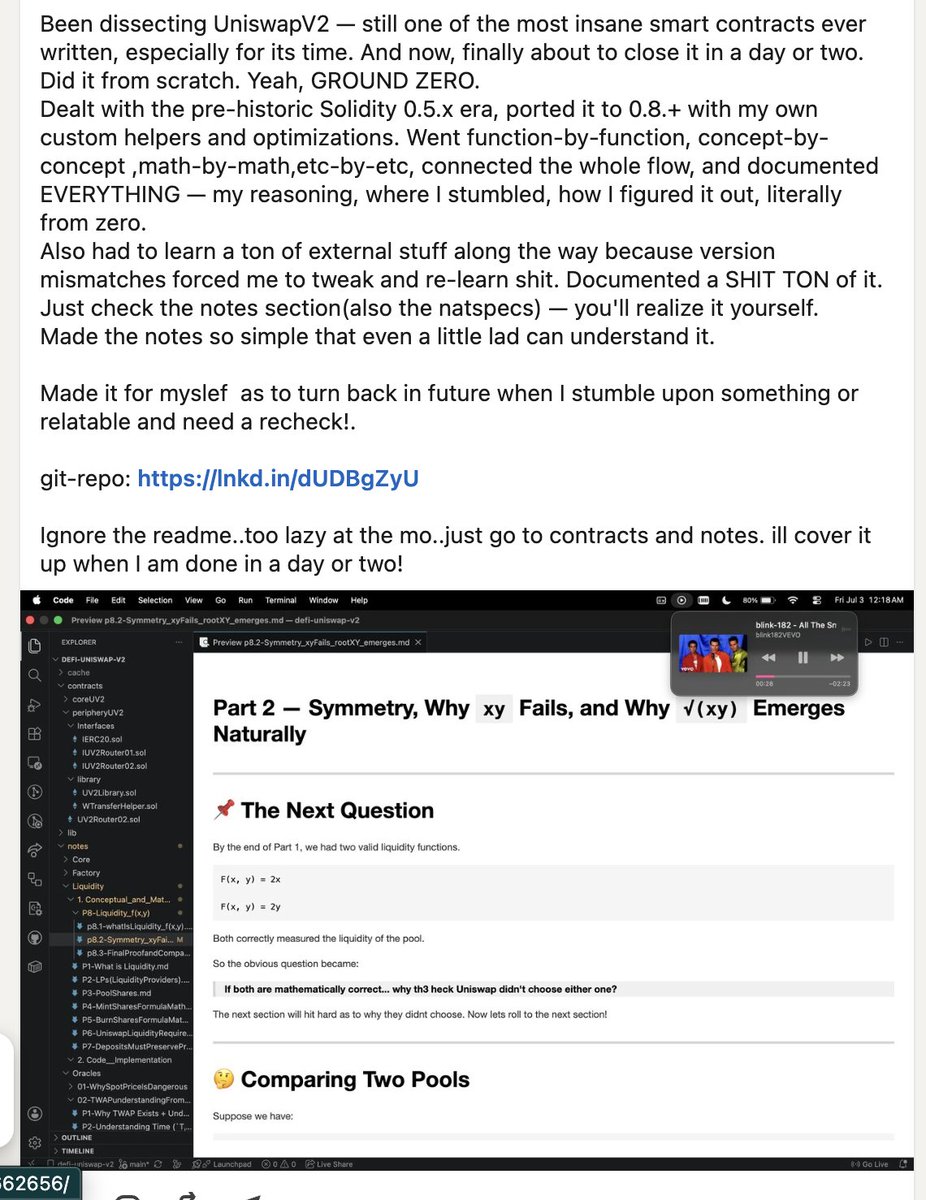
UniswapV2 Succesfully reverse Engineered and Dissected and Made it better with my custom optimazations and also with sol 0.8.20 inbuilt optimizations with all documented in natspecs and notes section of my repo, GGs
git: https://t.co/zAoUXTaeLA
The cohort has come to a close.
From understanding how protocols are structured to seeing how everything connects, it’s been a solid journey.
More ahead. We’re still building. Everyone deserves a garden.☘️
gBlok builders ☘️
Missed the live cohort session this week?
No worries, the full class recording from our Google Meet is now on our YouTube channel
If you want to see what our builders are learning about real protocol architecture and smart contract systems, this is a good place to start.
Catch up here 👇and stay in the loop.
https://t.co/iz179Su8XX
Don’t forget, game night is tomorrow and it’s going to be a fun one. Make sure you’re around.
Everyone deserves a garden.
Your swap price changed at the last second?
It was not the market. It was a bot.
In DeFi, your trade does not happen instantly.
It sits in a public waiting room.
Bots pay to jump in front of you.
> They shift the pool ratio.
> They extract a profit from your slippage.
> This is an invisible tax.
I recorded a breakdown of exactly how this works. And how our wallet infrastructure at @blok_cap can stop it.
If you don't know who is profiting from your trade, it is probably not you.
Will be dissecting the the Core UniswapV2 combo next, so give youself the edge and be prepared before jumping to the next Section which I will dissect and push soon!
@VitalikButerin Now finally we will get the tast of AA and ho0w it should have been in Ethereum from the early days! ERC4337 certainly had it's drawback but EIP-8141 patches those up for better! Lets see where it heads, looking bright at the moment!
Now, account abstraction.
We have been talking about account abstraction ever since early 2016, see the original EIP-86: https://t.co/E4xJymAxiH
Now, we finally have EIP-8141 ( https://t.co/YD9nIpsxcC ), an omnibus that wraps up and solves every remaining problem that AA was intended to address (plus more). Let's talk again about what it does.
The concept, "Frame Transactions", is about as simple as you can get while still being highly general purpose. A transaction is N calls, which can read each other's calldata, and which have the ability to authorize a sender and authorize a gas payer. At the protocol layer, *that's it*.
Now, let's see how to use it.
First, a "normal transaction from a normal account" (eg. a multisig, or an account with changeable keys, or with a quantum-resistant signature scheme). This would have two frames:
* Validation (check the signature, and return using the ACCEPT opcode with flags set to signal approval of sender and of gas payment)
* Execution
You could have multiple execution frames, atomic operations (eg. approve then spend) become trivial now.
If the account does not exist yet, then you prepend another frame, "Deployment", which calls a proxy to create the contract (EIP-7997 https://t.co/sIQrtJDXLt is good for this, as it would also let the contract address reliably be consistent across chains).
Now, suppose you want to pay gas in RAI. You use a paymaster contract, which is a special-purpose onchain DEX that provides the ETH in real time. The tx frames are:
* Deployment [if needed]
* Validation (ACCEPT approves sender only, not gas payment)
* Paymaster validation (paymaster checks that the immediate next op sends enough RAI to the paymaster and that the final op exists)
* Send RAI to the paymaster
* Execution [can be multiple]
* Paymaster refunds unused RAI, and converts to ETH
Basically the same thing that is done in existing sponsored transactions mechanisms, but with no intermediaries required (!!!!). Intermediary minimization is a core principle of non-ugly cypherpunk ethereum: maximize what you can do even if all the world's infrastructure except the ethereum chain itself goes down.
Now, privacy protocols. Two strategies here. First, we can have a paymaster contract, which checks for a valid ZK-SNARK and pays for gas if it sees one. Second, we could add 2D nonces (see https://t.co/1cRegaXpHM ), which allow an individual account to function as a privacy protocol, and receive txs in parallel from many users.
Basically, the mechanism is extremely flexible, and solves for all the use cases. But is it safe? At the onchain level, yes, obviously so: a tx is only valid to include if it contains a validation frame that returns ACCEPT with the flag to pay gas. The more challenging question is at the mempool level.
If a tx contains a first frame which calls into 10000 accounts and rejects if any of them have different values, this cannot be broadcasted safely. But all of the examples above can. There is a similar notion here to "standard transactions" in bitcoin, where the chain itself only enforces a very limited set of rules, but there are more rules at the mempool layer.
There are specific rulesets (eg. "validation frame must come before execution frames, and cannot call out to outside contracts") that are known to be safe, but are limited. For paymasters, there has been deep thought about a staking mechanism to limit DoS attacks in a very general-purpose way. Realistically, when 8141 is rolled out, the mempool rules will be very conservative, and there will be a second optional more aggressive mempool. The former will expand over time.
For privacy protocol users, this means that we can completely remove "public broadcasters" that are the source of massive UX pain in railgun/PP/TC, and replace them with a general-purpose public mempool.
For quantum-resistant signatures, we also have to solve one more problem: efficiency. Here's are posts about the ideas we have for that: https://t.co/xzG3Jp7Yky https://t.co/WikL7gJ5qg
AA is also highly complementary with FOCIL: FOCIL ensures rapid inclusion guarantees for transactions, and AA ensures that all of the more complex operations people want to make actually can be made directly as first-class transactions.
Another interesting topic is EOA compatibility in 8141. This is being discussed, in principle it is possible, so all accounts incl existing ones can be put into the same framework and gain the ability to do batch operations, transaction sponsorship, etc, all as first-class transactions that fully benefit from FOCIL.
Finally, after over a decade of research and refinement of these techniques, this all looks possible to make happen within a year (Hegota fork).
https://t.co/p7XOgId5NN
We shouldn’t lose context every time we switch AI tools.
Introducing SharedContext ✨
- End-to-end encrypted
- Portable across devices
- Persistent across Claude, Cursor, Codex
- Shareable by link - same exact context
- Synced on the Blockchain
Only you can decrypt it. Fully Open Source and free.
"npm i -g ai-singlecontext"
Give it a try.
zkSync Native AA Dissection - https://t.co/erd3vV1T1o
ERC-4337 enabling AA for Ethereum Dissection -
https://t.co/BB9Bp1J0jE
Lemme save it for my future self!
Just finished dissecting zkSync Native Account Abstraction after breaking down ERC-4337.
Deep technical walkthrough, step-by-step flow, rapidFire Q&A (who calls,what, why,if it fails,), with child level logs so the core mechanics click clearly.
Repo:
https://t.co/UiKL13sjxj
Just finished dissecting zkSync Native Account Abstraction after breaking down ERC-4337.
Deep technical walkthrough, step-by-step flow, rapidFire Q&A (who calls,what, why,if it fails,), with child level logs so the core mechanics click clearly.
Repo:
https://t.co/UiKL13sjxj
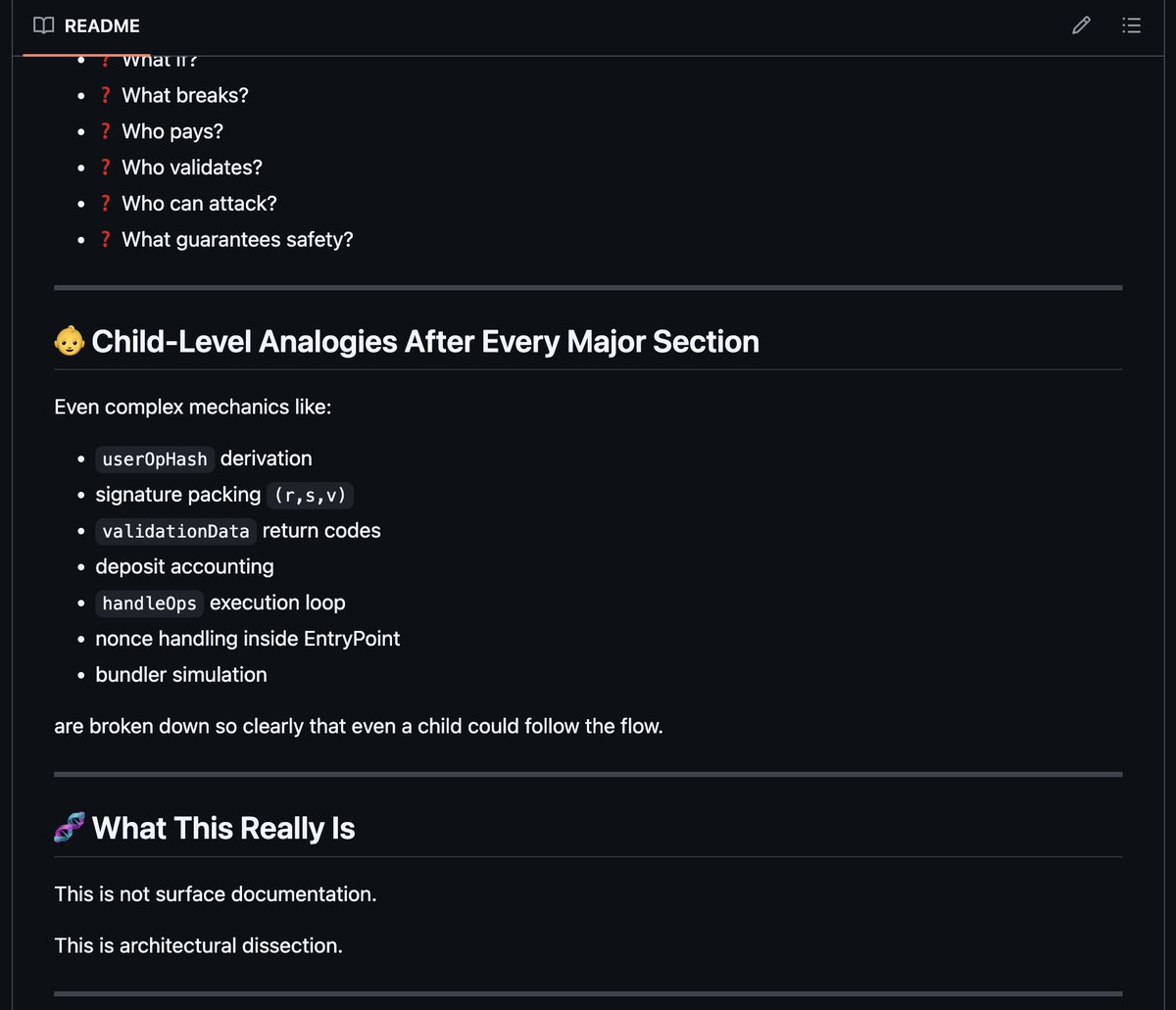
Just Created a Education Doucmention for ERC4337 enabling AA for Ethereum, and No worries Native Zksync AA soon!
Every Topic presents with deep explanation and Q/A and with Child Analogy storytelling!
Enough Talk, just go and see for yourself! 🙆♂️
Repo : https://t.co/GXxWE7xFvk