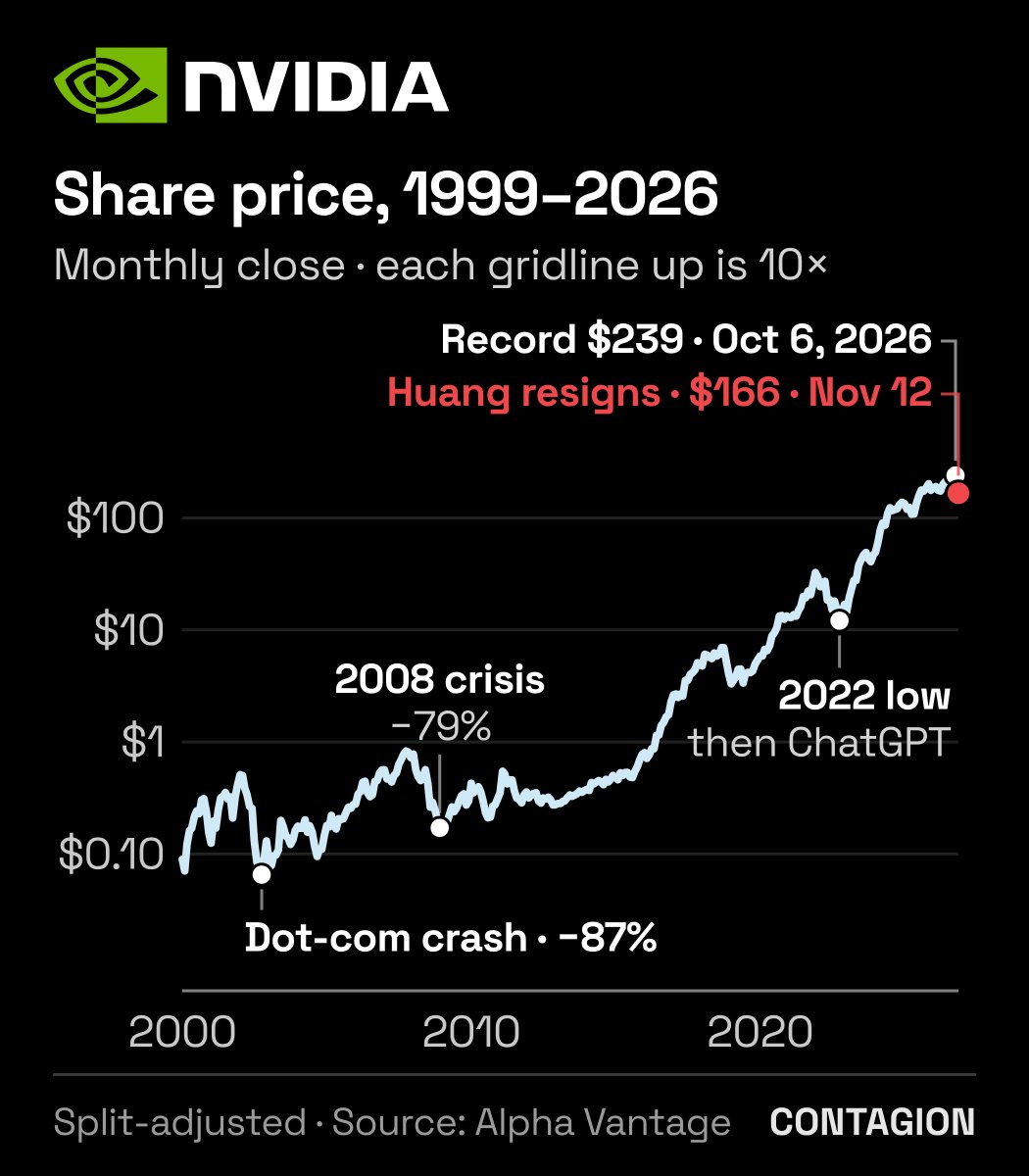
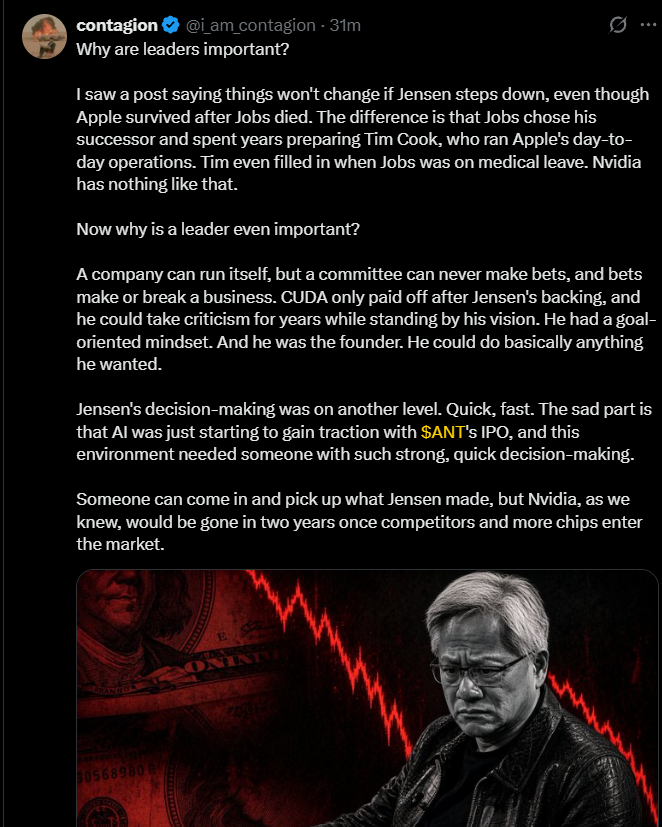
Nvidia lost 11% in four trading days, from $186.64 on November 6 to $166.19 on November 12, 2026, as Jensen Huang went from admitting an affair to resigning. The company climbed back from the dot-com crash, 2008, and 2022 with him in charge, and this is the first fall it has to climb out of without him.
In October 2026, the U.S. spent $128.9 billion on defense, more than any month since at least 2002, while running a $404 billion monthly deficit ($773 billion spent vs. $369 billion in taxes). Yet when asked how much of the past year’s defense surge came from the Iran war, they couldn't put a number on it.
TSMC confirmed on November 12, 2026, that personal data belonging to some of its current and former employees has surfaced for sale online. Sellers on two underground forums say they hold 46,000 records totaling 6.9GB and are asking 3 Bitcoin, about $220,000.
They say they’ll release everything for free if nobody buys within a week. The sample they posted as proof shows names, national ID numbers, home addresses, bank details, and even the phone numbers of employees’ emergency contacts. TSMC says its own systems weren’t broken into and that the files match data held by an outside cloud provider it hasn’t named, with no chip production or customer data involved.
That still leaves a list of who works where inside the world’s most important chipmaker, which is exactly what someone needs to approach the right engineer under a fake name. It’s also not the first time attackers have come in through a partner: in June 2023, the LockBit ransomware gang demanded $70 million from TSMC after breaking into one of its hardware suppliers.
And it comes in a week when Taiwan’s Bank SinoPac lost NT$41.76 million to unauthorized transfers, and the travel site EzTravel exposed more than 690,000 customers.
Whoa, Burry's claims are worth talking about. First, he's saying the Department of Justice was already investigating Nvidia for monopolistic practices, such as forcing other companies to bundle GPUs with other products and restricting customer choice.
It was a protection racket. Basically, it means Nvidia penalized companies that bought from competitors by delaying shipments. That monopoly Nvidia created might not exist anymore, since Jensen is gone now.
This came directly from the top, and Jensen was basically acting as the don.
Nvidia also has a massive leadership bottleneck. Jensen had around 60 people reporting to him, and because of that, there was no operational leader.
The $NVDA Board would not have chosen Colette Kress during this crisis if it believed she were complicit. I imagine those that work with her know her to be beyond reproach. At the same time, the Board's inability to elevate, from inside, someone with sufficient operating experience is in itself concerning.
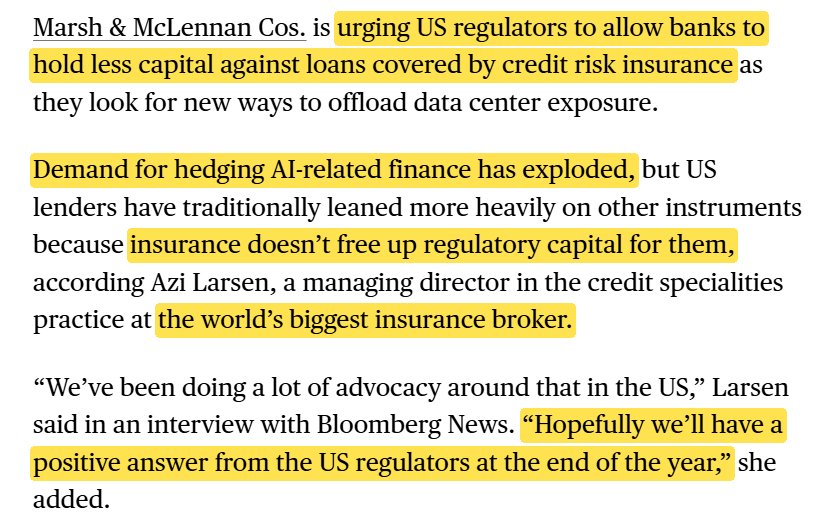
Marsh McLennan, the world’s largest insurance broker, is asking US regulators to let banks hold less capital against AI data center loans that are covered by credit risk insurance. Here's what I mean.
Banks have lent heavily to companies building data centers, and some now want insurers to share the losses if those loans aren’t repaid. Barclays has been looking to buy insurance on more than $10 billion of data center debt, and HSBC has explored a similar deal.
The rules are what make this matter.
Banks must keep a cushion of their own money, called regulatory capital, set aside against every loan in case it goes bad. In Europe, banks have long used this insurance to set aside less of their own money. The rules work like this: for every loan a bank makes, it must lock away some of its own money as a safety cushion in case the loan goes bad. If an insurer agrees to cover part of the loss, regulators see the loan as less risky and let the bank lock away less. The money that’s no longer locked away can then go out as new loans.
Azi Larsen, a managing director at Marsh, said the firm has been lobbying US regulators to change that and hopes for an answer by the end of 2026. Separately, Federal Reserve Vice Chair for Supervision Michelle Bowman said on November 10, 2026, that the Fed will finish its new bank capital rules in the coming weeks.
The insurers being asked to take on this risk are already stretched. A Willis Towers Watson survey published in May 2026 found that several were close to, or already at, their data center exposure limit. So the banks aren’t stepping back from the boom. They are paying someone else to carry part of the risk so they can lend even more, and the ones being asked to carry it are already running out of room.
A Dutch bank, ING, is trying to sell $500 million in loans it made to US data centers all at once.
One of those loans is a $25 million stake in the financing behind OpenAI’s Stargate data center in New Mexico. Buyers have until November 19, 2026, to bid, and it is reportedly the first sale this big made up only of data center loans.
ING is not alone. Reuters reported on November 9, 2026, that some banks no longer want to lend more money for AI projects after the stock market drop following the US midterm elections wiped $2.5 trillion off the Nasdaq 100.
That is bad timing for the companies building data centers. They have $13.4 billion in loans due in 2027, and most will need new loans to repay them. Interest rates have risen since they first borrowed, so those new loans could cost them about $380 million more in interest each year.
Banks are also trying to protect themselves. Barclays has bought insurance that pays the bank if a data center can’t repay its loan.
US sales of previously owned homes fell to their lowest level in more than 16 years in October 2026, even as the median price set a monthly record.
The National Association of Realtors reported on November 12, 2026, that sales fell 5.5% from September 2026. At October’s speed, about 3.75 million homes would sell over a full year. Home sales usually rise in spring and summer and dip in autumn and winter, and NAR evens out that pattern before publishing the number, so this drop reflects a real slowdown, not just the normal autumn dip.
That pace is the slowest since August 2010, when sales slumped after a federal homebuyer tax credit ended. It is also 8.8% below October 2025 and well short of the 3.85 million economists had expected.
Yet even with so few buyers, prices did not fall.
The median price, the price in the middle of all homes sold, rose 0.4% from October 2025 to $416,700. That was the 40th straight month of yearly gains, although it was also the smallest rise since February 2026.
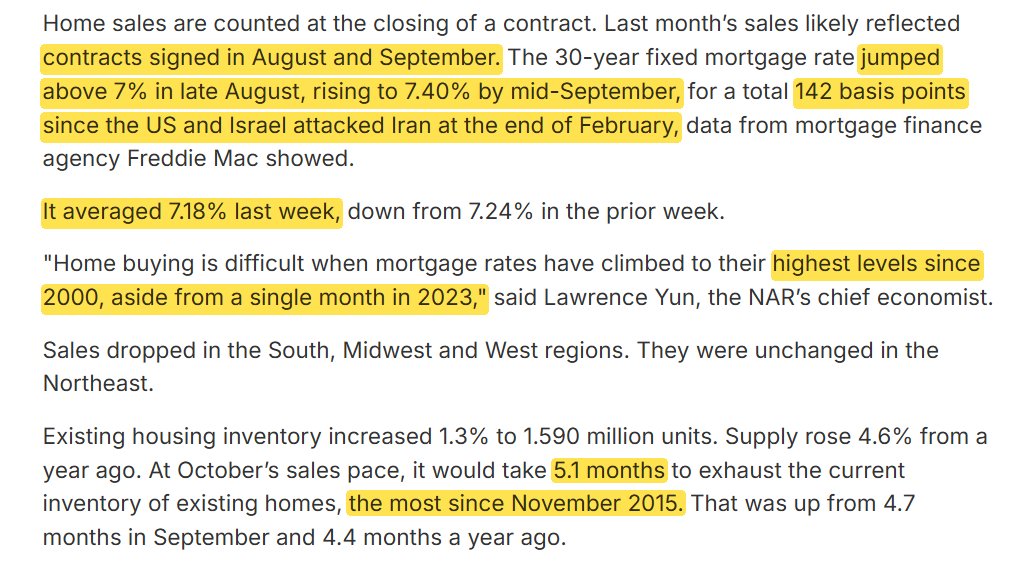
NAR chief economist Lawrence Yun said borrowing costs are keeping buyers away because mortgage rates have climbed to their highest levels since 2000, except for a single month in 2023. Last week, the 30-year mortgage rate averaged 7.18%. Since fewer people can afford loans like that, homes are sitting longer.
The median home took 35 days to sell, and at this pace the homes now listed would take 5.1 months to sell, the longest since November 2015. The same squeeze is changing who buys.
First-time buyers made up 29% of sales, down from 32% in October 2025, while investors and second-home buyers rose to 20% from 16%, and 29% of all deals were paid in cash. More houses are on the market, but fewer people can afford them, and those still buying are increasingly people who already own a home.
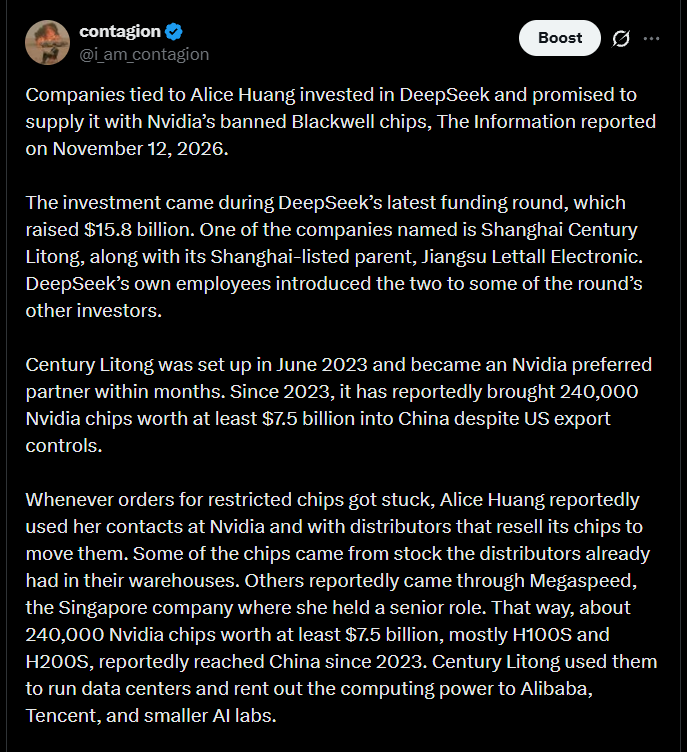
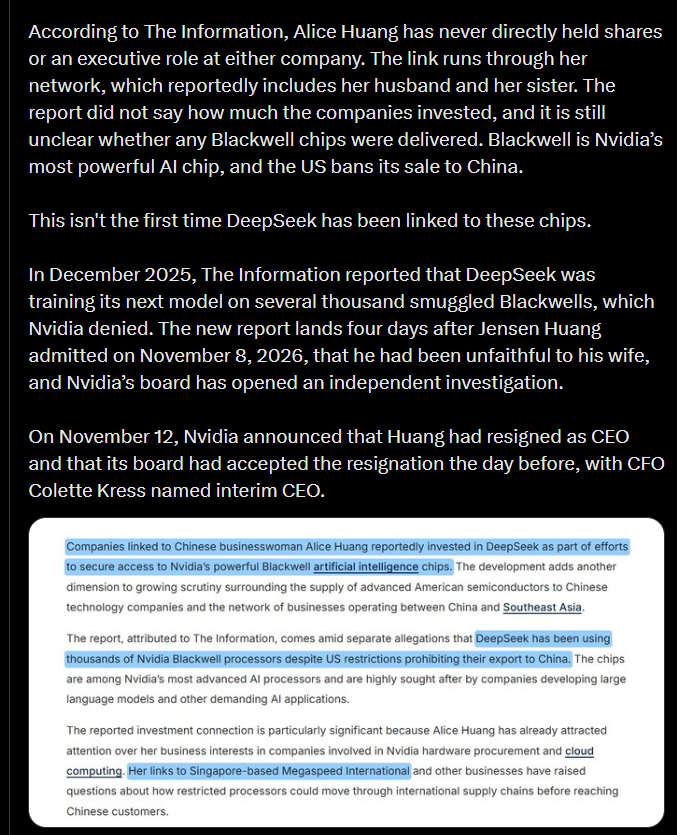
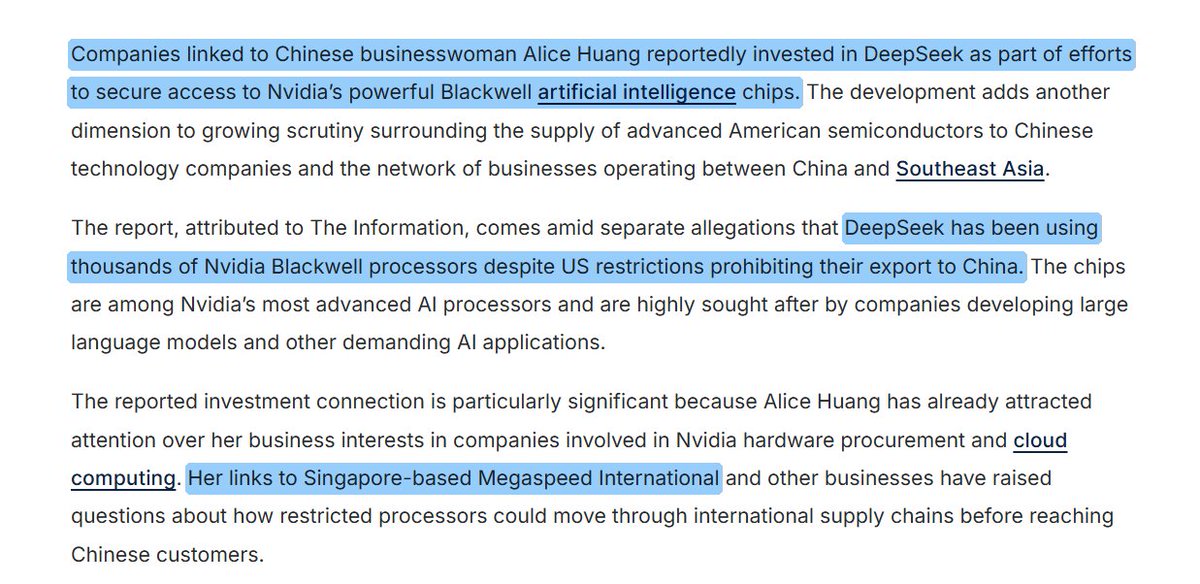
Companies tied to Alice Huang invested in DeepSeek and promised to supply it with Nvidia’s banned Blackwell chips, The Information reported on November 12, 2026.
The investment came during DeepSeek’s latest funding round, which raised $15.8 billion. One of the companies named is Shanghai Century Litong, along with its Shanghai-listed parent, Jiangsu Lettall Electronic. DeepSeek’s own employees introduced the two to some of the round’s other investors.
Century Litong was set up in June 2023 and became an Nvidia preferred partner within months. Since 2023, it has reportedly brought 240,000 Nvidia chips worth at least $7.5 billion into China despite US export controls.
Whenever orders for restricted chips got stuck, Alice Huang reportedly used her contacts at Nvidia and with distributors that resell its chips to move them. Some of the chips came from stock the distributors already had in their warehouses. Others reportedly came through Megaspeed, the Singapore company where she held a senior role. That way, about 240,000 Nvidia chips worth at least $7.5 billion, mostly H100S and H200S, reportedly reached China since 2023. Century Litong used them to run data centers and rent out the computing power to Alibaba, Tencent, and smaller AI labs.
According to The Information, Alice Huang has never directly held shares or an executive role at either company. The link runs through her network, which reportedly includes her husband and her sister. The report did not say how much the companies invested, and it is still unclear whether any Blackwell chips were delivered. Blackwell is Nvidia’s most powerful AI chip, and the US bans its sale to China.
This isn't the first time DeepSeek has been linked to these chips.
In December 2025, The Information reported that DeepSeek was training its next model on several thousand smuggled Blackwells, which Nvidia denied. The new report lands four days after Jensen Huang admitted on November 8, 2026, that he had been unfaithful to his wife, and Nvidia’s board has opened an independent investigation.
On November 12, Nvidia announced that Huang had resigned as CEO and that its board had accepted the resignation the day before, with CFO Colette Kress named interim CEO.
Our direct experience with Nvidia, never shared before:
22 months ago, we published the below analysis raising concerns that Nvidia's AI chips were potentially being routed to China through Singapore.
Less than 24 hours later, Nvidia's Head of PR contacted us, directly addressing our analysis. Their message to us is included below.
At the time, in the previous 3 quarters, $17.4 billion of Nvidia's revenue came from Singapore versus $11.6 billion from China.
Furthermore, at the time, the US had ~5,375 data centers, China had 448, and Singapore had just 99. The numbers just did not add up. You can read our full analysis below.
Nvidia's PR team sent us the following message:
"The revenue associated with Singapore does not indicate diversion to China. Our public filings report 'bill to' not 'ship to' locations of our customers. Many of our customers have business entities in Singapore and use those entities for products destined for the US and the West. We insist that our partners comply with all applicable laws, and if we receive any information to the contrary, act accordingly. Our last 10-Q noted: 'most shipments associated with Singapore revenue were to locations other than Singapore and shipments to Singapore were insignificant.'"
Fast forward to today.
According to new reports, Nvidia, $NVDA, CEO Jensen Huang's relationship with a suspected Chinese spy helped facilitate at least $7.5 billion in Nvidia chip shipments to Chinese companies through a network spanning China and Singapore.
The reported shipments date back to 2023 and involved ~240,000 advanced Nvidia AI chips.
These allegations remain under investigation, and it is not yet established whether the shipments were connected to the revenue discrepancies we highlighted 22 months ago.
Nvidia maintains that it has no reason to believe US national security or company secrets were compromised.
But the overlap between these new allegations and the questions we raised in January 2025, along with Nvidia's response to us at the time, is noteworthy.
We stand by our view that Jensen Huang is likely to remain CEO of Nvidia and will continue to be an integral figure in the AI Revolution.
We expect more on this soon.
CoreWeave just showed it can raise prices on the most wanted product in tech and still watch demand grow. What it hasn't shown yet is that it can outrun its own interest bill. That interest already eats four times what the business earns, and it is forecast to pass $1 billion a quarter from October–December 2026. So the next year is one race: cash that customers pay upfront replacing borrowed money before the debt catches up. The hunger for AI is clearly real, and what's being tested now is how long it can be fed on borrowed money. Below is the full picture.