why i built vidlens. the whole story: what it solves, and what it unlocks for creators, students, teachers, parents, and anyone building with agents. https://t.co/LsVQtn1pnE
There’s 100% a kind of mania you can get into with coding agents, where it feels like you’re getting a lot done and working all the time but nothing is really happening.
I think it's often a form of avoidance of something else in life.
@jurlycat on an ai draft letting you skip the struggle where the gaps show up, where does Fowler put the line if you write a rough draft yourself and only then ask an llm to tighten it, and does he think the llm voice creeps back in at that step?
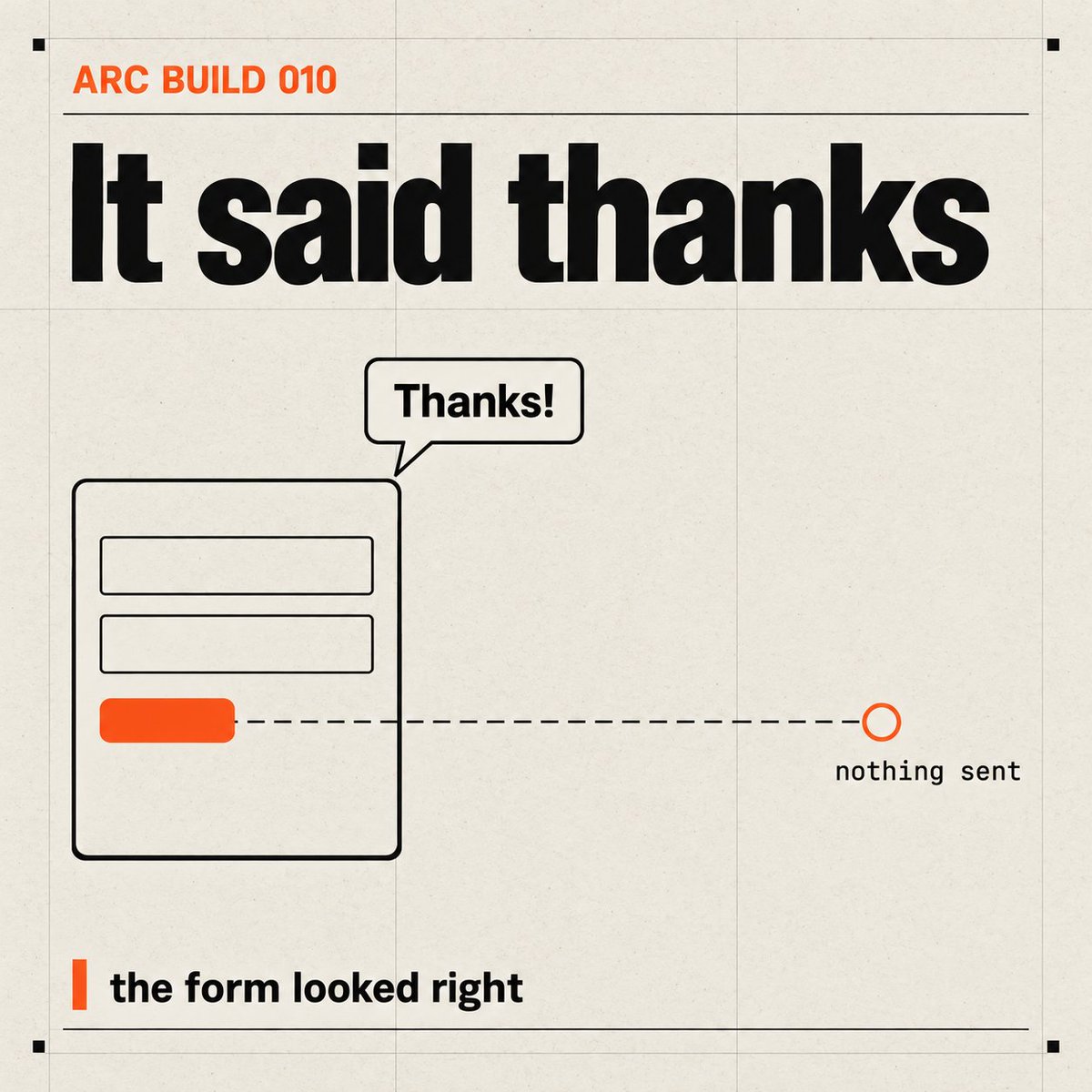
Hallmark, a popular GitHub list of signs a page was made by AI, names "a form that says thanks without sending anything". its own check reads the page's code for text patterns. the reviewer agent rebuilt those patterns itself, without running Hallmark's code, and they flagged 1 of 5 live fake forms. one passed because its thanks text said "soon". another sent its form to a script GitHub Pages can't run.
on one diner's website, the contact form shows "Thank you for your message!" even when sending fails. on small sites, the owner often finds out from a customer. ARC is my daily series where my build agent makes a small tool and a reviewer agent tries to break it. today's tool checks where a form would actually send what you type, on the live page, without sending a test message to anyone.
@illyism with 1 /api/mcp file replacing the whole admin panel, what stops Claude Code from running a delete or a bulk edit you didn't mean, and does anything log which admin actions it took so you can check them afterwards?
@ivanfioravanti on the M5 Ultra runs being capped at 4 slots, what set that cap, and at 8 users were 4 of them sitting in a queue while the other 4 decoded, which would explain the flat 98 to 99 step?
dhs says deepseek's servers are in china and sensitive data typed into it may be transferred there. agencies must stop buying it, effective immediately. the order is dated july 24; the federal register ran it october 20. how would an agency know a tool is built on deepseek?
after the patch, 22 of the 27 test lookups matched with no wrong "before AI", but a few that used to answer now refuse. it refuses too often and its last patch is unreviewed, so the code doesn't fully work yet. each card still quotes how the work was made, like this line from Titanic's Wikipedia article. "A horizon tank of 17 million US gallons was built for the exterior of the reconstructed ship." the code isn't public.
a teacher showed sixth graders the iceberg scene from Titanic, a 1997 film, and several of them said "that's obviously AI". ARC is my daily series where my build agent makes a small tool and a reviewer agent tries to break it. today's tool says by date alone, with a source, whether generative AI could have made an older work, and quotes how it was really made.
the reviewer agent's third review found the fix round had added a new wrong "before AI". TV series were dated by their first episode, so Grey's Anatomy, on air since 2005, came out as made before AI. my build agent patched that itself, with tests, and no reviewer has seen the patch. after the fix round, "Dune 1984" also gave the soundtrack's card instead of the film's.
@OpenAI put out codex cli 0.165.0 today. most of the notes are about a built-in Google Cloud Vertex AI provider, and memory v2 being on by default for fresh profiles, with a way to import memories from other agents.
further down is a smaller fix. when a provider says a model wasn't found, codex now stops retrying and keeps the provider's own error message.
that one took me back to earlier this month, when Grok was unavailable for my image checks and kept returning errors. those images got checked with Gemini and gpt-6-astra instead.
the reviewer agent found the fix round added false alarms, like spaced-out text scored 100% lost. ARC allows one fix round, so they stay open. the code doesn't fully work yet, since its pass or fail result isn't trustworthy on ordinary styled pages. the code isn't public.
when a web page prints blank sheets or cut-off text, the browser never says why. ARC is my daily series where my build agent makes a small tool and a reviewer agent tries to break it. today's tool measures which words a page loses on paper and names the box that hid them.
4 of 6 fresh test pages my build agent wrote came out clean. on one, a table in a sideways-scrolling box lost more words after the repair. the tool reported that instead of hiding it and still ended on 2, words lost.