BODYSCAPES
Venue: @LoadGallery , Miami
Dates: December 2, 2025 – January 31, 2026
Work on View:
Aesthetic Intelligence
Exhibition details:
https://t.co/RP7AwRU329
Honored to be part of BODYSCAPES, a group exhibition with other incredible women artists. The exhibition unfolds within an immersive field of LED walls, where each work appears in quiet rotation… almost like a slow, luminous pulse.
Featuring an extraordinary constellation of artists:
@dancevatar @maryafynsknorup @serifastudio@ChristyLeeRoger@x_new_worlds@ivonatau@farrahxyz@emikusano
Michelle van Dijk · Alba Duque · Adaeze Okaro · Zhuk
TULPA: Neural Presence
I’m developing TULPA, a BCI-driven artwork exploring how brain activity, light, AI, and generative systems can become an immersive visual experience.
The science of consciousness needs advanced meditation.
Despite decades of research and incredible advances in neuroscience and AI, we are still no closer to explaining how or why consciousness arises in the brain. The hard problem remains as hard as ever.
At the Meditation Research Program at @harvardmed & Mass General (MGH), we argue that a key reason for this impasse is the field’s near-exclusive focus on ordinary states of waking consciousness. These states may actually obscure the mechanisms we seek to understand.
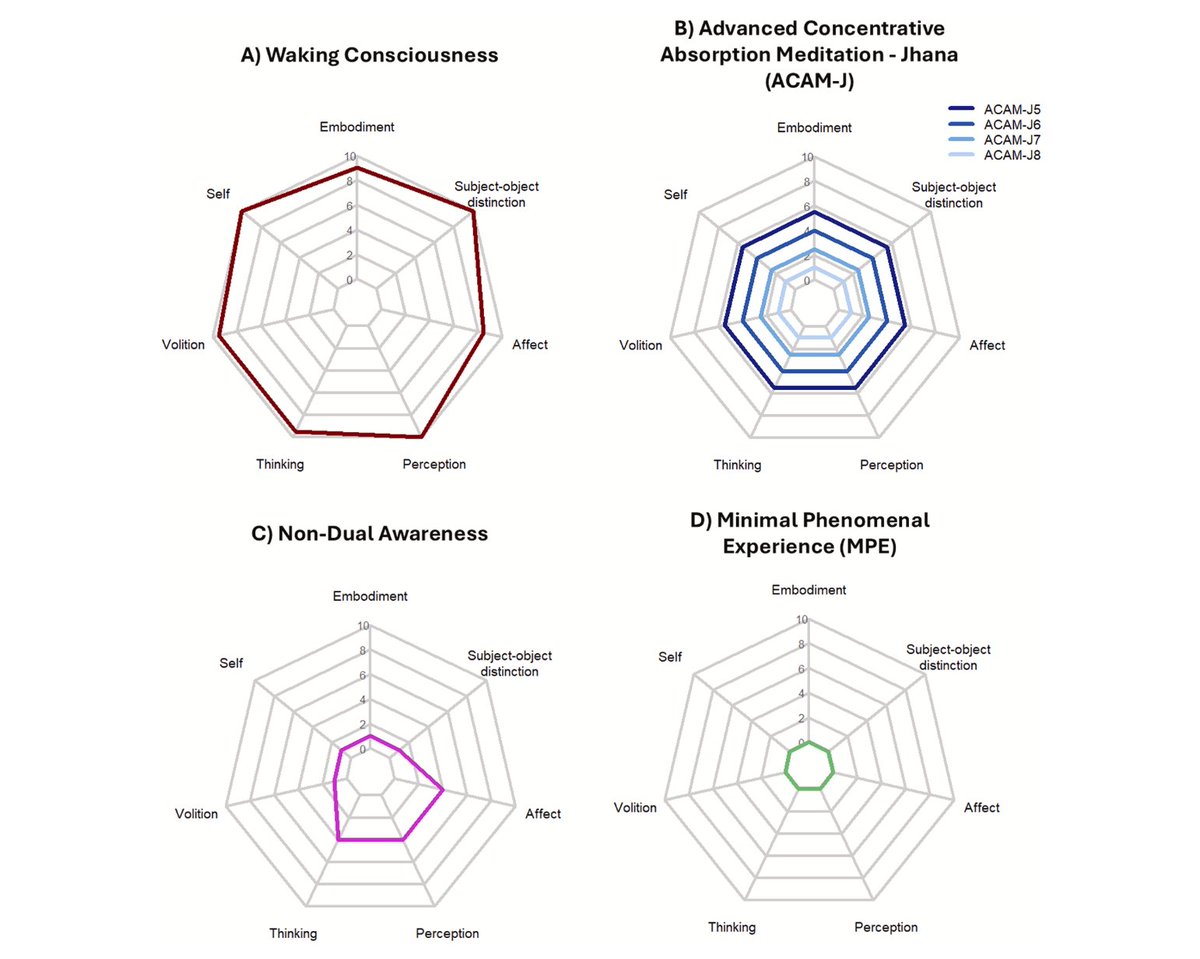
In our new paper, Toward a Neuroscience of Consciousness Using Advanced Meditation, just out in Neuroscience & Biobehavioral Reviews, Jonathan M. Lieberman and I take this argument one step further. We propose that advanced meditation—states and stages of practice that unfold with increasing expertise—offers a powerful and largely unexplored opportunity for a rigorously theory-driven neuroscience of consciousness.
Notably, over the past several years, our team has combined cutting-edge neuroimaging with sophisticated analytic tools to study two highly advanced yet replicable meditative phenomena: advanced concentrative absorption (sometimes called jhāna) and meditative endpoints such as cessation events (related to what is known as nirodha).
These are phenomenologically stripped-down states in which consciousness is either radically altered or temporarily suspended altogether. Precisely for this reason, we argue they are exceptionally well suited for what is often called a minimal model approach to consciousness research.
If these states approximate the simplest forms of conscious experience that a human being can have, then studying them neuroscientifically may allow us to identify candidate necessary and sufficient neural conditions for consciousness at all.
This approach will not solve the hard problem overnight. But it may help resolve many of the “easier” problems (which remain profoundly difficult!) and provide a powerful test case for evaluating competing theories of consciousness based on their ability to explain minimal states.
Compared to other non-ordinary states now receiving scientific attention, such as psychedelic states, advanced meditation offers several unique methodological advantages. More than that, we argue it offers a uniquely powerful and underutilized tool for answering one of science’s most fundamental questions: what does it take for us to be conscious at all?
If you agree or disagree that consciousness research should look beyond ordinary states, we welcome discussion, critique, and sharing of this work among researchers and others interested in advancing a more explanatory science of consciousness🙏