Telegram’s Shadow Economy
Our recent research with @theTelescopeio and @Sycek_osint proves that a huge underground economy is still running on Telegram.
Telegram isn’t just a chat app — it’s an underground economy.
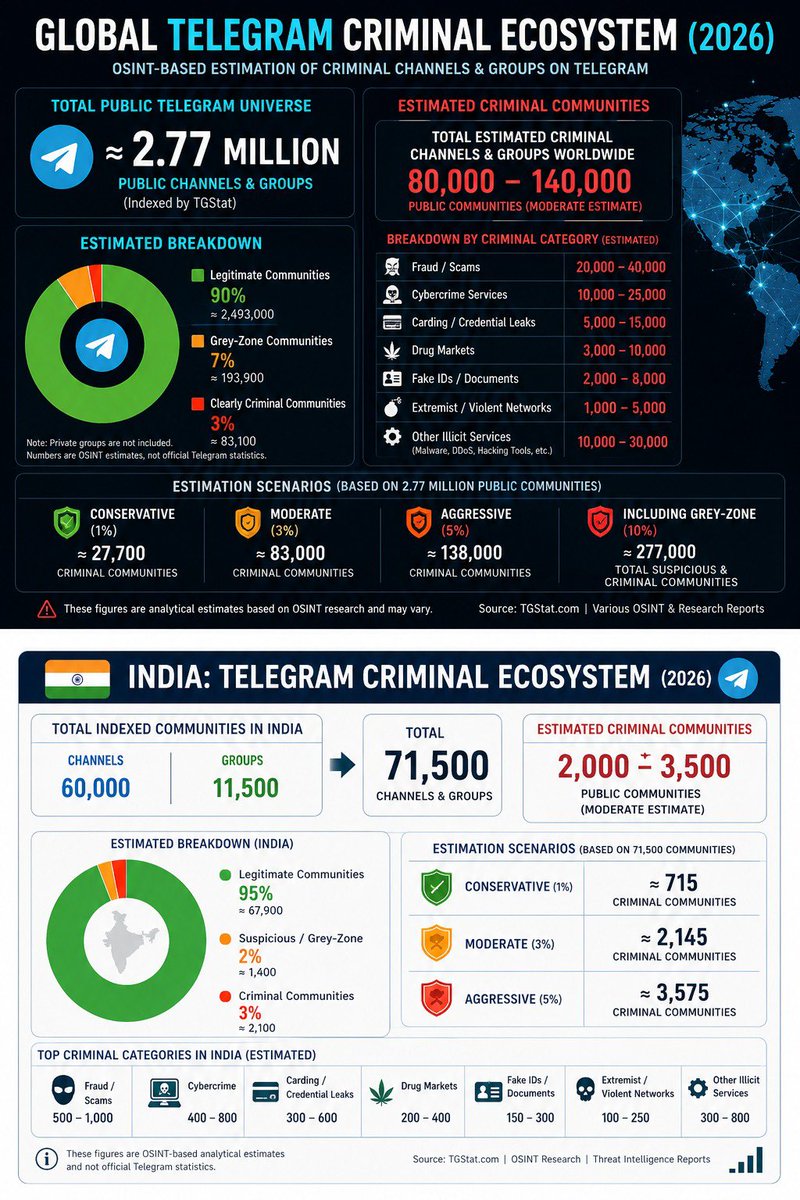
Of 2.77M (TG Stats) public communities, a 2026 report estimates:
• ~83,100 (3%) clearly criminal
• ~193,900 (7%) grey-zone
Fraud, stolen cards, malware-as-a-service, drug markets, forged IDs, extremist networks.
~1 in 10 leans illicit.
Source: Multiple researches.
Meta hiring spree highlights that the scarcest resource in AI is not technical talent, but leadership with taste, just as models themselves are more taste-oriented
The core algorithms of sota models are pretty much the same, the data & how it is used differs
Really rare talent
“Deepseek makes it cheaper to train on India context”
Man stfu!
What’s up with taking new innovations and “making it for India”?
Does that even mean anything? Is that the extent our ambition goes to?
Why don’t we focus on what works in Deepseek or Llama or every frontier model out there and what doesn’t?
Why is it that these models perform amazingly well on benchmarks but they can’t solve simple problems any human can solve?
Let’s talk about research driven fundamental innovation? Online learning? Queuing systems? High frequency action reaction cycles? Long term thinking?
Let’s invest in companies that truly are trying to achieve AGI/ASI than “building for Indian context”?
Who’s up for thinking from first principles?
If we’re being honest:
Aside from Nvidia, the people who have benefitted the most financially from AI is spammers.
We’re not far from most of the content we see on social networks, on search engines, and on phone calls being AI-generated.
While passing the Turing Test has been a miraculous technical achievement, it’s a very miserable experience for the end user.
If Facebook beat MySpace with real names and privacy, then there might be an analogous opportunity emerging.
How a Secret BJP War Room Mobilized Female Voters to Win the Indian Elections
In April, we got access to a BJP war room & documented the efforts to use technology to identify women who could bring other women out to vote, offering a glimpse of the future of campaigning in India
https://t.co/SGXV2ExAMb
Will training on AI-generated synthetic data lead to the next frontier of vision models?🤔
Our new paper suggests NO—for now. Synthetic data doesn't magically enable generalization beyond the generator's original training set.
📜: https://t.co/K8PCArnFLD
Details below🧵(1/n)
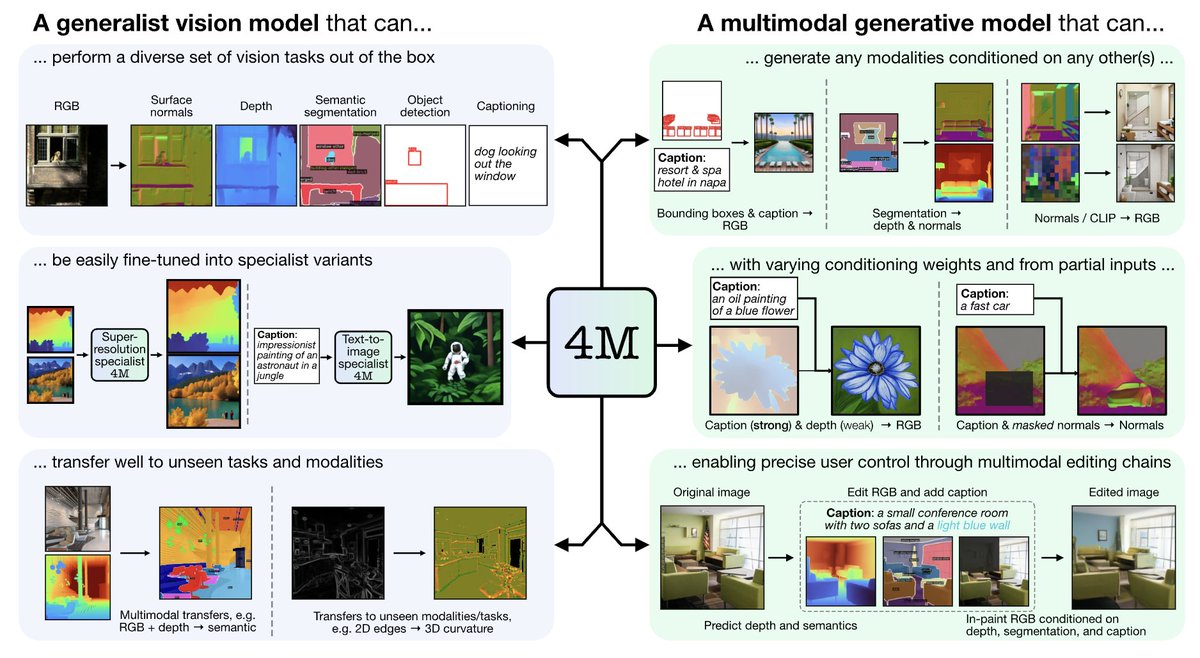
EPFL and Apple just released 4M-21: single any-to-any model that can do anything from text-to-image generation to generating depth masks! 🙀
Let's unpack 🧶
Intelligence is spreading. And it looks like it's actually starting to make a difference, delivering concrete value - literally so, making our cities better places to live and work... https://t.co/duxOMMmtLB
.@i_cepice co-founder of https://t.co/hZCnv5DWC7, a deepfake-detection firm in India, told @NilChristopher that he helped fact-checkers investigate and debunk a little over 30 pieces of AI-generated media in April and May. https://t.co/dkcKKma98W @Karen_Rebelo@TheAtlantic
Naval Ravikant explains the importance of hiring high-agency people
“[Hire] people who just solve problems without even being asked to solve the problem—they identify the problem, they go solve it, they don’t even necessarily have to update you every step of the way, they’re not asking silly questions, and they’re just coming up with solutions. Because building a startup is an infinite set of problems that are being thrown at you.”
Video Source: @AngelList
In today’s @WIRED magazine, @VarshaaBansal and I delve into the world of India’s election
Our investigation uncovered a slew of AI-driven tactics reshaping political outreach. Here are 8 audio/video AI campaign artifacts used in the 2024 Indian elections ⬇️
https://t.co/h0KIRdl2AC
Excited to share Penzai, a JAX research toolkit from @GoogleDeepMind for building, editing, and visualizing neural networks! Penzai makes it easy to see model internals and lets you inject custom logic anywhere.
Check it out on GitHub: https://t.co/mas2uiMqj9
if youre in college right now, you have a golden opportunity:
a chance to get ahead of the curve and set yourself up for godhood
dont just sit on your ass between classes, between meals
create value, build shit you need shit people use
the job market out there is a fucking warzone, if you want to come out on top, you cant just be average you cant just coast by with a generic portfolio and some todo list bs
become a god
go forth and build
and let the universe tremble at your brilliance.
@abhilashi high friction onboarding !
to a recluse like me (i go out but i still stay inside iykwim) they are asking too much for it to be a "good enough" profile
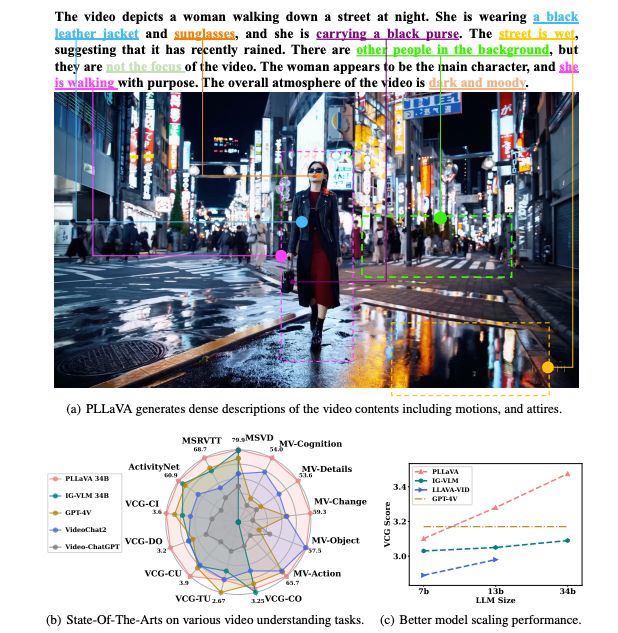
PLLaVA
Parameter-free LLaVA Extension from Images to Videos for Video Dense Captioning
Vision-language pre-training has significantly elevated performance across a wide range of image-language applications. Yet, the pre-training process for video-related tasks demands
The audio embedded with the following tweet is #not a #deepfake : https://t.co/nBgqMdoroQ
We escalated this audio to two of our expert partners for analysis. Dr. Hany Farid's #forensic lab confirmed that the audio was not produced using #GenAI. They used automated and manual techniques to analyse the audio. @FactlyIndia @LogicallyFacts
I think AI agentic workflows will drive massive AI progress this year — perhaps even more than the next generation of foundation models. This is an important trend, and I urge everyone who works in AI to pay attention to it.
Today, we mostly use LLMs in zero-shot mode, prompting a model to generate final output token by token without revising its work. This is akin to asking someone to compose an essay from start to finish, typing straight through with no backspacing allowed, and expecting a high-quality result. Despite the difficulty, LLMs do amazingly well at this task!
With an agentic workflow, however, we can ask the LLM to iterate over a document many times. For example, it might take a sequence of steps such as:
- Plan an outline.
- Decide what, if any, web searches are needed to gather more information.
- Write a first draft.
- Read over the first draft to spot unjustified arguments or extraneous information.
- Revise the draft taking into account any weaknesses spotted.
- And so on.
This iterative process is critical for most human writers to write good text. With AI, such an iterative workflow yields much better results than writing in a single pass.
Devin’s splashy demo recently received a lot of social media buzz. My team has been closely following the evolution of AI that writes code. We analyzed results from a number of research teams, focusing on an algorithm’s ability to do well on the widely used HumanEval coding benchmark. You can see our findings in the diagram below.
GPT-3.5 (zero shot) was 48.1% correct. GPT-4 (zero shot) does better at 67.0%. However, the improvement from GPT-3.5 to GPT-4 is dwarfed by incorporating an iterative agent workflow. Indeed, wrapped in an agent loop, GPT-3.5 achieves up to 95.1%.
Open source agent tools and the academic literature on agents are proliferating, making this an exciting time but also a confusing one. To help put this work into perspective, I’d like to share a framework for categorizing design patterns for building agents. My team AI Fund is successfully using these patterns in many applications, and I hope you find them useful.
- Reflection: The LLM examines its own work to come up with ways to improve it.
- Tool use: The LLM is given tools such as web search, code execution, or any other function to help it gather information, take action, or process data.
- Planning: The LLM comes up with, and executes, a multistep plan to achieve a goal (for example, writing an outline for an essay, then doing online research, then writing a draft, and so on).
- Multi-agent collaboration: More than one AI agent work together, splitting up tasks and discussing and debating ideas, to come up with better solutions than a single agent would.
I’ll elaborate on these design patterns and offer suggested readings for each next week.
[Original text: https://t.co/y4McIAjD2m]
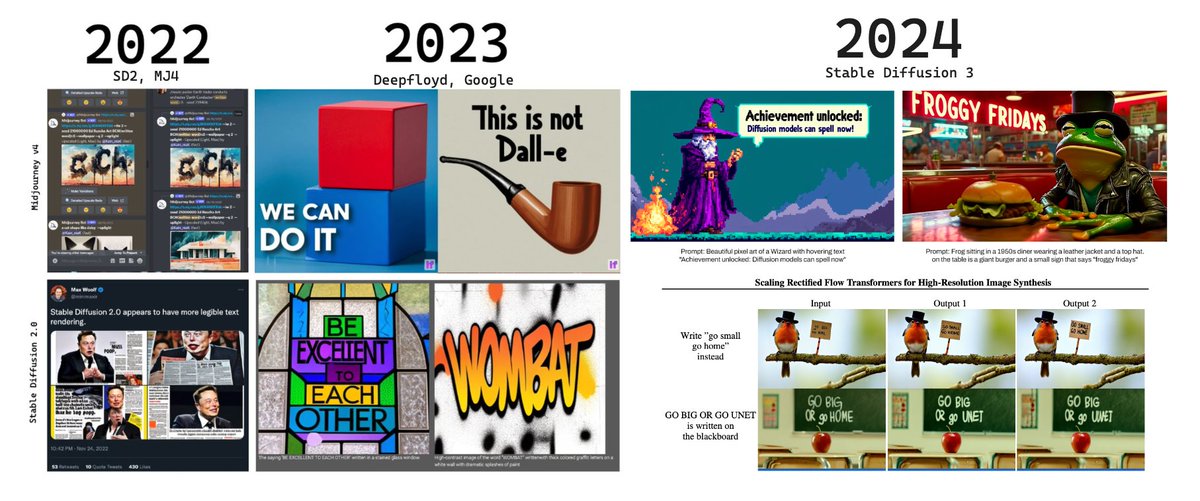
updated my text-in-image chart for 2024. Looks like adding @colinraffel's T5 is key for long text-in-image!
congrats to @pess_r et al for pushing the Diffusion Transformer yet another step ahead into multimodality!
(the architecture is a beast, wtf. basically cotrain two transformers per block for image and text "so that both representations can work in their own space yet take the other one into account")
this chart is a lil hard to read but on Partiprompts (aesthetics/prompt following/typography) human ratings, Stable Diffusion 3 is now the SOTA imagegen model, beating Midjourney and Dalle3 (and on par with Ideogram?)
numbers only say so much. look at the degree of control and creativity on this.










![AndrewYNg's tweet photo. I think AI agentic workflows will drive massive AI progress this year — perhaps even more than the next generation of foundation models. This is an important trend, and I urge everyone who works in AI to pay attention to it.
Today, we mostly use LLMs in zero-shot mode, prompting a model to generate final output token by token without revising its work. This is akin to asking someone to compose an essay from start to finish, typing straight through with no backspacing allowed, and expecting a high-quality result. Despite the difficulty, LLMs do amazingly well at this task!
With an agentic workflow, however, we can ask the LLM to iterate over a document many times. For example, it might take a sequence of steps such as:
- Plan an outline.
- Decide what, if any, web searches are needed to gather more information.
- Write a first draft.
- Read over the first draft to spot unjustified arguments or extraneous information.
- Revise the draft taking into account any weaknesses spotted.
- And so on.
This iterative process is critical for most human writers to write good text. With AI, such an iterative workflow yields much better results than writing in a single pass.
Devin’s splashy demo recently received a lot of social media buzz. My team has been closely following the evolution of AI that writes code. We analyzed results from a number of research teams, focusing on an algorithm’s ability to do well on the widely used HumanEval coding benchmark. You can see our findings in the diagram below.
GPT-3.5 (zero shot) was 48.1% correct. GPT-4 (zero shot) does better at 67.0%. However, the improvement from GPT-3.5 to GPT-4 is dwarfed by incorporating an iterative agent workflow. Indeed, wrapped in an agent loop, GPT-3.5 achieves up to 95.1%.
Open source agent tools and the academic literature on agents are proliferating, making this an exciting time but also a confusing one. To help put this work into perspective, I’d like to share a framework for categorizing design patterns for building agents. My team AI Fund is successfully using these patterns in many applications, and I hope you find them useful.
- Reflection: The LLM examines its own work to come up with ways to improve it.
- Tool use: The LLM is given tools such as web search, code execution, or any other function to help it gather information, take action, or process data.
- Planning: The LLM comes up with, and executes, a multistep plan to achieve a goal (for example, writing an outline for an essay, then doing online research, then writing a draft, and so on).
- Multi-agent collaboration: More than one AI agent work together, splitting up tasks and discussing and debating ideas, to come up with better solutions than a single agent would.
I’ll elaborate on these design patterns and offer suggested readings for each next week.
[Original text: https://t.co/y4McIAjD2m]](https://pbs.twimg.com/media/GJN6yJRaIAExh4D.jpg)


