Excellent, 👌 brilliantly executed piece by @PunYaab
I’d add @kishalay’s book “Blood on my Hands: Confessions of Staged Encounters” would be a great resource for filmmakers, with conscience, to produce films Jhelum & Brahmaputra, as suggested by Sandeep.
https://t.co/enmvCPInyj
Long post on Satluj and Khalra.
Hartosh Singh Bal keeps blabbering two things to call Satluj propaganda like a petulant child.
A 1992 magazine and a 1995 interview. Fine. Let's look at both honestly. And then let's look at what he conveniently forgets to mention.
First, the man's actual journey. Since Bal is so fond of biography.
Khalra came from a family of Ghadar revolutionaries. His grandfather Harnam Singh was tried in the 1915 Lahore Conspiracy Case.
As a young man in the early 70s, Khalra was a member of Naujawan Bharat Sabha. Yes, Bhagat Singh's organisation.
In 1992 he ran a magazine called Liberation Khalistan.
By 1993-94 his full-time work was human rights, in the Akali Dal's Human Rights Wing, going through municipal cremation records by hand. By 1995 his tools were writ petitions and press notes.
I am not going to claim I know what he believed in his heart. Nobody alive can tell you what happened inside that man between 1992 and 1994.
But look at what he did. A leftist youth. A questionable phase in the darkest years Punjab has ever seen. And then documents, courts and the Constitution.
That is not some detail you squeeze into one scene. That is a transformation. That is a whole chapter, honestly a film of its own.
Any filmmaker who invents that inner journey would be manufacturing the exact propaganda Bal claims to be fighting.
The movie starts in 1994 because that's where this story starts. A man walks into a cremation ground looking for a friend and walks out carrying six thousand names.
The CBI, restricting itself to just three municipal cremation grounds in one district, in a state where every town has one, still confirmed 2,097 of them.
And understand this clearly. Khalra was killed to stop the counting. After his murder, the counting was stopped anyway. Officially. At three grounds.
Second, the 1995 interview where Khalra calls Bhindranwale a Sant and a martyr.
This proves much less than Bal thinks. Sant was the man's standard honorific.
Even the mainstream Indian press used it in his lifetime. And after 1984, reverence for the dead is the Panth's mainstream grief, not a separatist programme.
Refusing to let your community's dead be branded criminals is not politics. It's mourning.
Millions of Sikhs who want nothing to do with Khalistan carry that exact sentiment. If it disqualifies Khalra, it disqualifies most of Punjab.
Third, the film itself. I watched it the way I read every screenplay. Because that is literally my job.
1. Not a single murder is shown on camera.
2. The CBI, an arm of the Indian government, cracks the case. It's practically one of the protagonists.
3. The police call the militants terrorists throughout. Even the worst cops see themselves as saviours. High moral ground in the mouth, unthinkable cruelty in the hands. That's not glorifying militancy. That's exactly how impunity talks.
4. The film doesn't even paint the whole department black. The new DGP is a good man. The honest cops are shown scared of the rotten ones.
Scene after scene, the makers keep balancing things that didn't even need balancing. That's not propaganda. That's restraint. I'd say too much restraint.
And now the part neither of Bal's exhibits can touch. The registers. The one thing Bal never brings up.
1. Khalra's politics did not write those cremation records. The police did.
2. His politics did not certify 2,097 illegal cremations. The CBI did.
3. His politics did not convict his killers. The courts did, right up to the Supreme Court in 2011.
4. A partisan with a photocopier still copied real documents. And every single institution of the Indian state that examined them said so.
5. And note this too. His killers were convicted. But for the mass cremations themselves, the case ended in compensation orders. Not one officer was ever tried for that policy. The man who counted the dead got justice. The dead he counted got a cheque.
CONT+
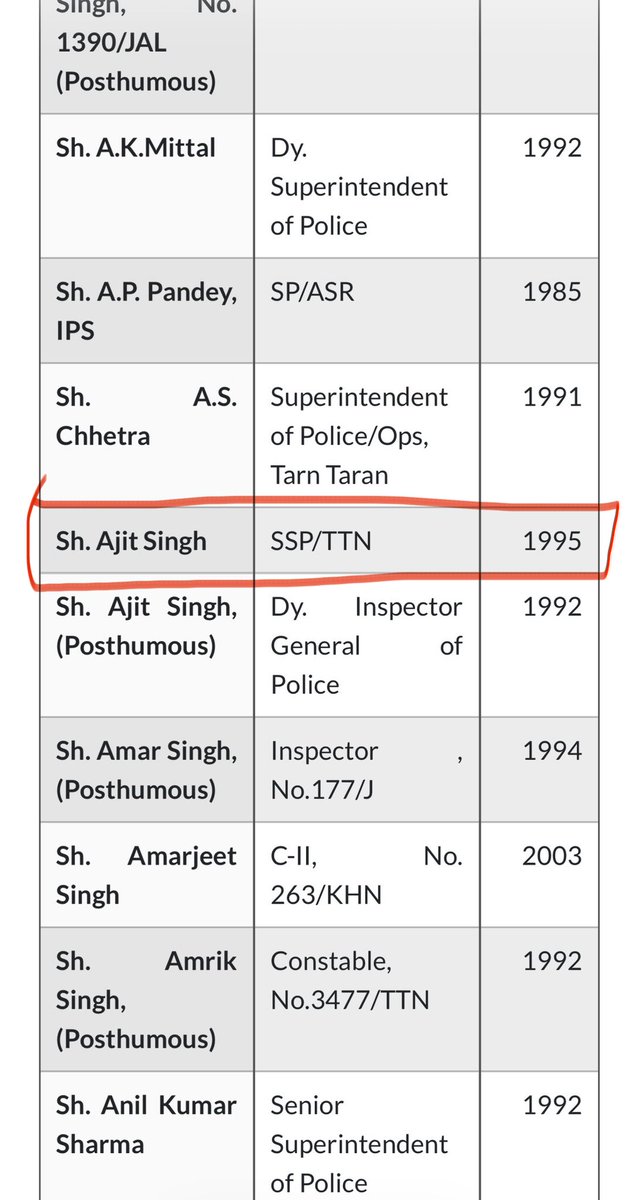
Punjab Police still commemorates the gallantry medals awarded to these convicted criminals in uniform who killed innocent youth in their quest for rewards and promotions.
-SSP Ajit Singh Sandhu (allegedly dead)
-DSP Jaspal Singh (jumped bail)
NL Hafta is here!
@MnshaP, @AbhinandanSekhr, @Shardool_, are joined by @HartoshSinghBal to debate whether filmmakers fail their “political homework” or if the state’s refusal to admit fault is the real barrier to reconciliation.
Tune in: https://t.co/ZR22ziXpQu
Inciting Hindus against Muslims through propaganda films is fine but Sikhs being shown truth about mass disappearances and encounters risks "rekindling anger". This is what I mean by Monopoly of Victimhood. Majority is free to consume hate but minorities don't even deserve truth
A film about slain Sikh activist Jaswant Singh Khalra is being screened across India after its removal from a streaming platform.
Khalra exposed killings and secret cremations by Indian security forces during the Punjab insurgency.
Satluj, based on the life of human rights activist Jaswant Singh Khalra, survived only two days on OTT in India - after the makers decided to release it online following nearly four years of censor board battles.
It was pulled after the government reportedly flagged security concerns.
Now it’s become a flashpoint in the larger debate: who decides what parts of India’s history get told, and what gets censored.
Read more here on what went down and the backlash it’s sparked:
Getty Images said on Tuesday it has called off its planned merger with Shutterstock due to the UK competition regulator's requirement to sell Shutterstock's editorial business as a condition for approval. https://t.co/QHpuairxB0
BREAKING: Microsoft is laying off 4,800 employees today. Most of the job losses are in Microsoft’s Xbox and commercial sales organizations. Details 👇https://t.co/niiZ56iAQN