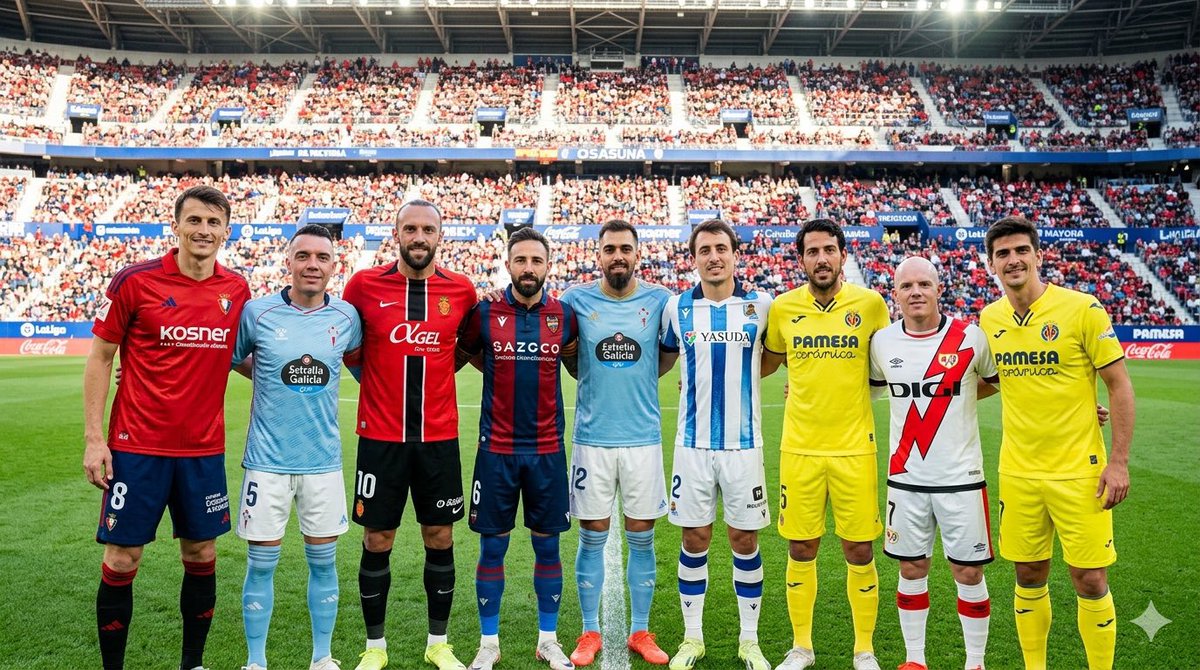
Midfield is always key for progression, especially when playing against a properly coached side.
If you don't have a metronome with rhythm, oxygen supply to your forwards is cut off. Even a decent passer will do.
See Pogba for France in 2018.
Diversity and inclusion in UK corporate environments is often a communication strategy rather than a structural commitment.
98% of the time, the diversity ends in the junior roles and the inclusion doesn’t reach the board level. Just optics with a budget lol
Once you figure out a manipulator and gaslighter, not only do you see through them, you can always predict their behaviour in every situation. Especially political manipulators. Demagogues.
Nigeria has been generating electricity since 1896. That’s 130 years.
Today, in March 2026, the national grid just dropped to 3,940 megawatts. For 220 million people.
South Africa generates over 48,000MW for 60 million people. Egypt has about 59,000MW installed for 110 million.
Nigeria? About 13,000MW installed. But we can only push around 4,000 to 5,000MW through the grid on a good day. The rest just sits there. Wasted.
The grid collapsed 12 times in 2024 alone. 128 transmission towers were destroyed by vandals in the same year. Government spent N8.8 billion just repairing them.
Between 2010 and 2022, NERC recorded at least 222 partial and total grid collapses. That’s roughly one every three weeks for 12 years straight.
Every time the grid collapses, restarting just three power plants (Azura, Delta, and Shiroro) costs Nigeria about $25 million. That’s N42.5 billion. Per collapse. For just three plants.
The power sector owes generation companies N6.8 trillion as of February 2026. Growing by N200 billion every single month. By end of March, it’ll hit N7 trillion.
Of that N6.8 trillion, about N3.3 trillion is owed to gas suppliers. So what did the gas suppliers do? They cut supply. Right now, thermal plants need about 1,630 million standard cubic feet of gas per day. They’re getting 692 million. Less than 43%.
That’s why your light is off right now.
The government approved N4 trillion in bonds to fix it. So far they’ve issued N590 billion. The rest? We’re waiting.
Meanwhile, Nigerians spend about $14 billion every year buying and fueling generators. 22 million generators across the country. Their combined capacity? About 42,000 megawatts. That’s 8 times what the national grid delivers.
We literally have more generator capacity than grid capacity. Think about that.
In 2023, 767 manufacturing companies shut down. 335 more became distressed. 18,000 jobs gone. In the first half of 2025 alone, manufacturers spent N676.6 billion on backup power and still couldn’t meet their needs. Another 18,935 jobs lost.
The World Bank estimates power outages cost Nigeria $29 billion annually. That’s about 10% of GDP. Every year.
This isn’t a power problem. It’s a governance problem.
Egypt added 14,000 megawatts of gas capacity in six years using the same Siemens equipment we’ve been talking about for decades. Ghana fixed its power crisis between 2012 and 2016 and now exports surplus electricity. South Africa just went 300 consecutive days without load shedding after committing to a real recovery plan.
We’ve been “fixing” power since 1999. Every president has had an emergency power plan. We’ve taken over $4 billion in World Bank loans for the power sector. The grid can barely hold 5,000MW. Any more and it literally collapses.
Nigeria cannot be a serious economy running on generators. No country industrialized on backup power.
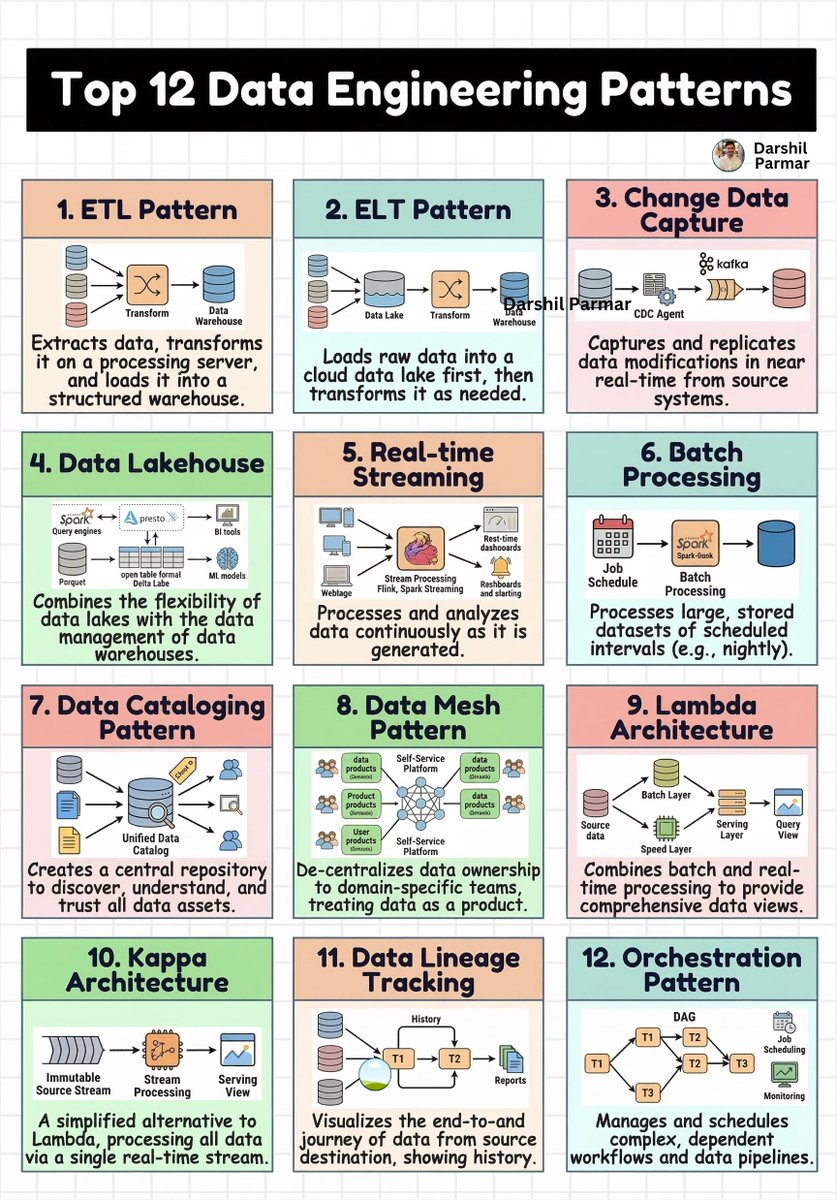
STOP overcomplicating Data Engineering!
You need to understand 12 patterns. That's it.
📦 1. ETL (Extract, Transform, Load)
→ Extract data, transform it on a processing server, load it into a structured warehouse.
→ Been around for decades. Still used everywhere.
📦 2. ELT (Extract, Load, Transform)
→ Load raw data into a cloud data lake first, transform it later.
→ Why? Because cloud storage is cheap. Compute is flexible. Transform when you need to, not upfront.
🔄 3. Change Data Capture (CDC)
→ Instead of reloading 10 million rows every hour, capture only what changed.
→ Uses tools like Kafka + Debezium to replicate changes in near real-time.
→ This is how Netflix, Uber, and Notion sync data without killing their source systems.
🏠 4. Data Lakehouse
→ Flexibility of a data lake + reliability of a data warehouse. One system.
→ Built on open table formats like Delta Lake, Apache Hudi, Apache Iceberg.
→ This is where the industry is heading.
⚡ 5. Real-time Streaming
→ Process data continuously as it arrives. No waiting for batch jobs.
→ Flink, Spark Streaming, Kafka Streams — pick your tool.
→ Powers real-time dashboards, fraud detection, live recommendations.
⏰ 6. Batch Processing
→ Process large stored datasets at scheduled intervals. Nightly, hourly, whatever.
→ Spark, Hive, dbt — the workhorses of most data teams.
→ Not as exciting as streaming. But 90% of pipelines are still batch.
📚 7. Data Cataloging
→ A central repository to discover, understand, and trust your data.
→ Without this, every analyst asks the same question: "which table do I use?"
🧩 8. Data Mesh
→ Stop centralizing everything. Give each domain ownership of their own data.
→ Treat data as a product. Each team builds, owns, and serves their data.
→ Sounds great in theory. Very hard in practice.
🔀 9. Lambda Architecture
→ Run batch AND real-time processing in parallel. Merge results at the serving layer.
→ Gives you comprehensive views but... you maintain two separate codebases.
→ That's why Kappa exists 👇
🔁 10. Kappa Architecture
→ Simplified Lambda. Process everything through a single real-time stream.
→ One codebase. One pipeline. Less maintenance.
→ Works great when your use case is truly streaming-first.
🔍 11. Data Lineage Tracking
→ Visualize the end-to-end journey of data. Source to destination.
→ When a dashboard breaks, lineage tells you WHERE it broke and WHY.
→ The pattern nobody cares about... until something goes wrong.
🎯 12. Orchestration
→ Managing complex, dependent workflows and pipelines.
→ Task A depends on Task B which depends on Task C. In the right order. With retries.
→ Airflow, Dagster, Prefect — all implementations of this pattern.
Gen Z : Am requesting for a salary increase.
Boss : What for?
Gen Z : Three different companies are after me.
Boss : Which ones?
Gen Z : Gas, Water, and Electricity.
A lot of young people in Lagos are obsessed over "packaging" than developing real value.
Na later we go know who dey pretend to work and who dey do the real work.
Don't believe the hype. Time always rewards value.
Be patient.