@RemitaNET Dear @RemitaNET I made a transaction this morning I was debited but it never replected on my portal I have sent you a Dm and here is the RRR: 3315-1451-2995
Please I’ll appreciate a prompt response as the matter is urgent thank you
If we want to make the Lean Ethereum consensus chain aggressively more "lean", and add strong validator privacy (ZK-unlink deposit from staking activity from withdrawal, and re-anonymize stakers every day), here is a path:
https://t.co/Gdee7tE53R
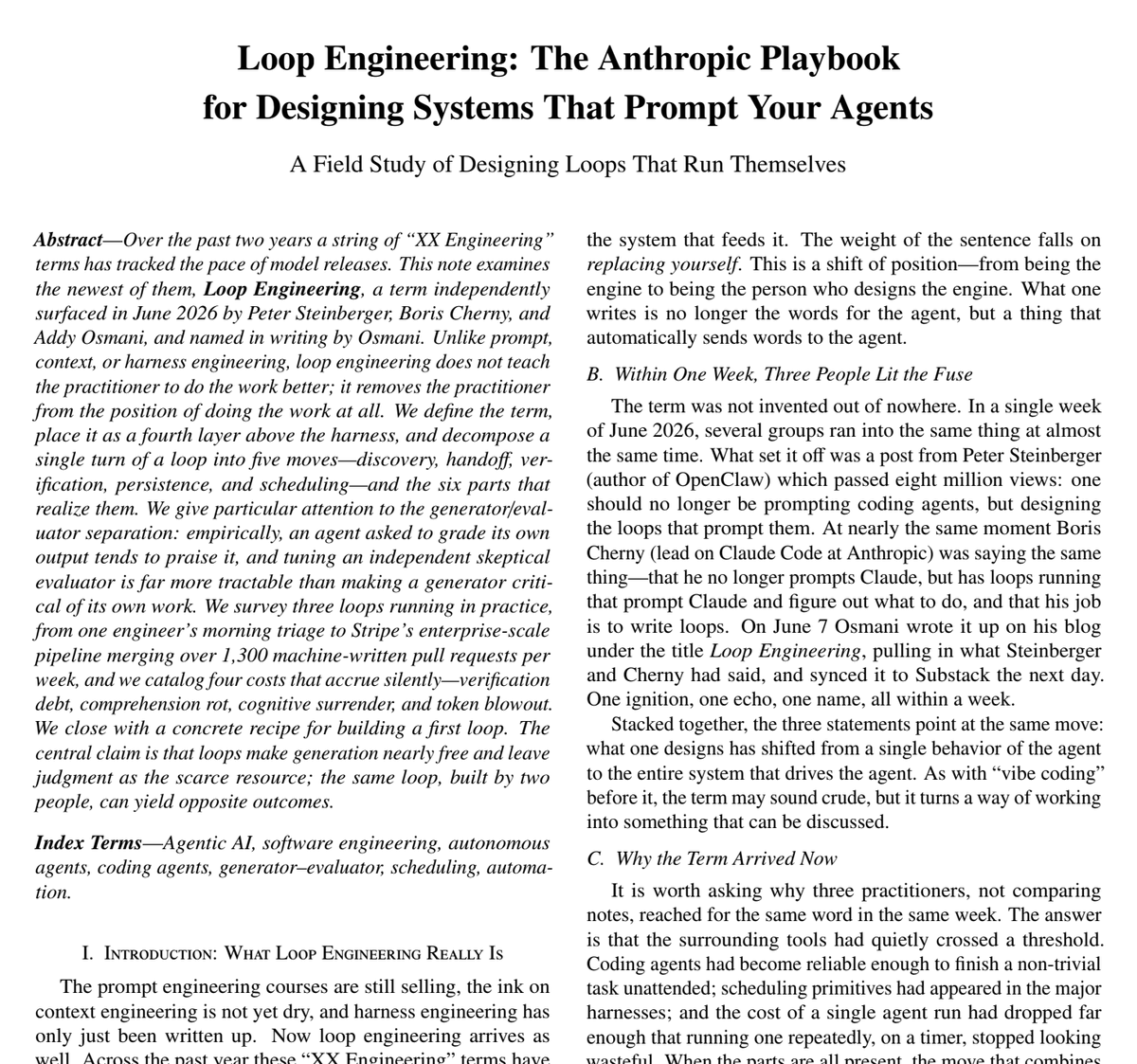
Anthropic's internal loop engineering playbook just got leaked.
And it's the most valuable AI guide I've read all year.
This guide is packed with info, and there are five things you need to know if you want to maximize your AI productivity with loops (save this):
1. You should structure every loop around these 5 principles:
• Discovery → Let the agent find its own work (CI fails, issues, commits)
• Handoff → Give every task its own isolated git worktree
• Verification → Never let the generator grade its own work
• Persistence → Always write state to disk (markdown or board)
• Scheduling → Run it on a timer so it works while you sleep
2. Separate Generator from Evaluator (most important rule)
Use two agents: one writes, the other is a skeptical judge who assumes the code is broken.
Make the evaluator act (run tests, click buttons, take screenshots) - this is what actually stops bad output.
3. Build with these 6 parts:
• Automations (the timer)
• Worktrees (safe parallelism)
• Skills (permanent project knowledge)
• Connectors (talk to GitHub, Linear, etc.)
• Sub-agents (generator + evaluator)
• Memory (state files that survive between runs)
4. Things you must watch out for with loop engineering:
• Verification debt (use verification agents)
• Losing understanding of your own codebase (start fresh if needed)
• Token costs exploding (solution below)
• Cognitive surrender (don't stop thinking because “the loop handles it”)
5. Solving token costs
Loop engineering can be crazy expensive.
I recommend you use an 80/20 "barbell" approach to loop engineering.
For your most complex tasks that require the best intelligence, use expensive models (Opus).
For the remaining 80% of your tasks (the gruntwork), use cheap, open-source models within the Claude Code harness (GLM-5.2 is great for code execution).
Save these 5 rules so you don't forget them.
This is a curated reading list that explains patterns for building scalable, reliable, and performant large-scale systems, with real case studies from companies serving millions to billions of users.
- Covers design principles, scalability, availability, stability, and performance
- Includes real-world architectures with completed diagrams for system design interviews
- Features talks and articles from engineers at tech giants like Google and AWS
- Contains sections on scaling teams, hiring, and organizational culture
Explore it here:
https://t.co/S4G8U4bATY
All you need to do is pick a category and filter through time period and you get all the job postings on that time no need for signups or logins
And this was powered by @desearch_ai , a fully decentralized search engine, a subnet (22) on @bittensor