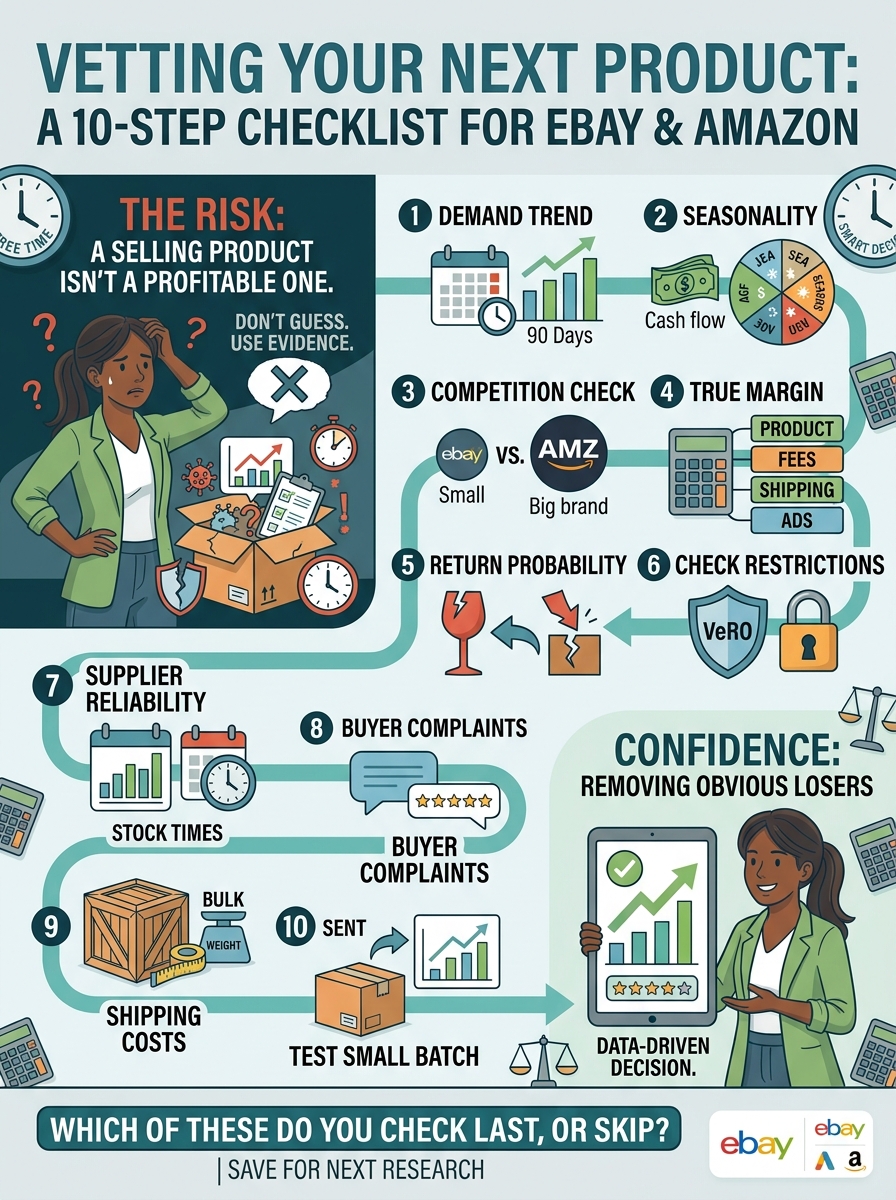
Most sellers pick research tools by popularity. I pick them by their answers.
Sold listings → is anyone buying?
Google Trends → spike or stable?
Keepa → Amazon price history?
Reviews (1-3★) → what’s broken?
Spreadsheet → do fees kill it?
Each tool removes a guess.
A “perfect” product can still be a bad bet.
Before I call anything good, I check:
Who makes the sales
Steady demand or a spike
Price trend
Margin after fees, returns & ads
1-3★ reviews
Competition trend
Ease of copying
Boring checks. Fewer dead stock piles.
A product that sells ≠ a product that makes money.
Before I list on eBay/Amazon:
Steady demand or spike?
Seasonal?
Who’s competing?
Margin after fees & returns?
Return risk?
Restrictions?
Supplier reliable?
Test small first
Save this 📌
Before you list 50 items, vet your supplier:
Order a sample
Test their replies
Verify the business is real
Get stock + lead times in writing
Read the 1-3 star reviews
Start with 3-5 listings
Predictable beats cheap.
Your account takes the hit.
By the time a seasonal product trends, the money’s gone.
Win it 2 months out:
Demand curve, not the peak
Who’s winning & why
Lead time vs calendar
Margin after fees, ads, returns
Early research = a few hours. Late = dead stock.
Low competition ≠ good niche.
Usually it means nobody wants the product. 📦
Before you list anything on eBay or Amazon:
✅ Sold items are moving
✅ Competitors have weak photos and titles
✅ 3-star reviews show gaps you can fill
An empty shelf is a warning.
A product can have real demand and still make you no money.
3 signs it’s oversaturated:
Prices bunched together, lowest one falling
New sellers only get seen via ads
Every listing looks identical
Demand = people want it. Saturation = can you profit.
Before you list anything on eBay, check this:
Filter to SOLD items
Find the price cluster, not one sale
Compare sold vs active count
Match condition and variation
Check the dates
Subtract fees, shipping, returns
Active = hope. Sold = proof.
#ProductResearch
Active listings show what sellers HOPE to get.
Sold listings show what buyers ACTUALLY paid.
Most new sellers pick products from active listings. Prices look high, margins look great, they buy stock.
Then it sits. 📦
A listing existing ≠ a product selling.
#eBaySellers