📚 Keep in mind the cool breeze, dear reader✨. I just published The many faces of beauty https://t.co/zv0eQISfNQ
I genuinely hope you'll enjoy reading it. 🤗
Please feel free to engage with me! I'm eager to know your thoughts on this. 🗣
Did he oppress you? You did not even attend the school to start with,but you want to help me feel my pain
Many of you are just loud and uncultured,what is your business if I choose to support the party?? Is it a crime if you mind your business and support your candidate in peace??
You all keep rinsing and repeating same statement,go back and tell them you all are not enough to silent me
When asked the question, “Can a Christian marry a non-Christian?” the verse most commonly cited is 2 Corinthians 6:14: “Do not be unequally yoked with unbelievers.”
But nowhere in the verses before or after does Paul say a single word about marriage. Should that not be a big red flag regarding using this verse to answer a question about marriage?
This is another reminder that we should never scissor a verse from its context and paste it as the answer to a question it was never written to address.
So what is Paul talking about? Think about and read about the context.
He is addressing the church in Corinth, a city overflowing with idols, temples, pagan rituals, and idolatrous assumptions about life. Remaining faithful to Christ in that environment was a daily challenge.
That is why, immediately after warning them not to be “unequally yoked,” Paul strings together Old Testament passages from Leviticus, Isaiah, Ezekiel, and 2 Samuel, all of which called Israel to be faithful and to shun idolatry (Lev. 26:11-12; Isa. 52:11; Ezek. 20:34; 37:27; 2 Sam. 7:14). These verses show that God dwells among his people; therefore, they must separate themselves from idolatry and uncleanness. Paul sees these promises fulfilled in the church, now the temple of the living God.
The unusual Greek verb “unequally yoked” (ἑτεροζυγέω) likely echoes Deuteronomy 22:10, where an ox and a donkey were not to be yoked together because they were unsuited for the same task.
Paul then explains exactly what he means. The unequal yoke is righteousness joined to lawlessness, light to darkness, Christ to Belial, and ultimately “the temple of God with idols” (2 Cor. 6:14-16). Notice where the argument ends: idols. That is the issue.
Elsewhere, Paul explicitly charges believers to remain married to unbelieving spouses, “To the rest I say (I, not the Lord) that if any brother has a wife who is an unbeliever, and she consents to live with him, he should not divorce her” (1 Cor. 7:12). Would that not be a strange command if 2 Cor. 6:14 did indeed prohibit such marriages? His concern in 2 Cor. 6, therefore, is not mixed marriages but spiritual compromise.
The church is God’s holy temple. Just as the Old Testament temple was not to be polluted by idols, so the church must remain wholly devoted to Christ.
Read in context, this passage is not about whom a Christian may marry. It is about guarding our exclusive allegiance to the living God in a world full of rival loyalties.
Elijah was a mighty prophet of God, but even he reached a place where the weight of everything became too much. In 1 Kings 19:4, he poured out his heart to the Lord and said, “I have had enough, Lord.” Exhausted, discouraged, and overwhelmed, he no longer wanted to keep going. God didn’t shame him for being tired or condemn him for a weak moment. He met him in his exhaustion, let him rest, provided what he needed, strengthened him, and reminded him that his story was not finished. Be real with God. You don’t have to pretend you’re strong when you’re hurting. Tell Him when you’re tired, disappointed, or when life feels too heavy to carry. God can handle the truth of your heart. Sometimes the most spiritual thing you can do is admit, “Lord, I’m tired. I need You.” Just as He met Elijah in his lowest moment, trust that God can meet you there, restore your strength, and help you keep going.
Let me brag about God with this story. 🙏🏿
Sometime in 2004, I was half-awake, meditating, when I heard a voice:
“Go and tell Cornelius Tay that the whole office must praise Me.”
Mr. Cornelius Tay was our MD/CEO.
Immediately, I said in my heart, “Never! Emi, ke? Me? 🤷🏿♂️”
At the time, the company was facing a serious financial crisis. There was little or no patronage for both the advertising agency and the water engineering company. As a result, salaries were not being paid.
When I got to the office, I shared the message with Foluso, who was close to the MD at the time.
“Hmmnn, Nduka, you want to lose your job.”
That one increased my fear. 😂
Then I told another colleague who was a pastor. He simply asked me:
“Who will you fear—God or man?”
With that, I summoned courage.
Mr. Tay and his wife came into the office around 9:00 a.m. I waited about five minutes for them to settle, then knocked on his door.
He ushered me in.
“Good morning, sir. God sent me to you.”
Immediately, his wife was startled. She held her husband and said, “Close the door.”
Then she told me something that shocked me.
They had been praying that morning, and God had told them that someone would come and tell them what they should do.
So they asked me, “What did God say we should do?”
I replied, “God said we should just praise Him. Raise our voices and praise Him.”
“So how do we do it?”
I said, “I will tell Pastor to handle it.”
We came out into the open office. Mr. Tay clapped his hands to get everyone’s attention. We prayed and praised God together.
Afterwards, everyone simply went back to their seats.
Around 2:00 p.m., we received a call from Ngozi at African Petroleum (AP):
Our cheque for ₦48 million was ready!The money they owed us for several months.
As we were still rejoicing, the water engineering company also received a contract from the Water Corporation at Ijora.
Two breakthroughs. Same day.
That was how God intervened in the financial crisis of the company.
And to think that when I first heard the instruction, I said:
“Emi, keh? Never!” 😂
So, yes, let me brag about my God:
He is good. He speaks. He provides. He makes a way where there seems to be no way.
PRAISE THE LORD! 🙏🏿❤️
Picture of my desk at the agency in between 2002 and 2006.
MY RESPONSE TO DATTI BABA-AHMED OVER MY COMMENTS ON EX-NIGERIAN MILITARY DICTATOR IBRAHIM BADAMOSI BABANGIDA AT 85: COMPASSION DOES NOT REQUIRE HISTORICAL AMNESIA
Dear Datti Baba-Ahmed,
Yesterday, at the National Peace Committee event, I met Dr. Hakeem Baba-Ahmed, Datti Baba-Ahmed’s elder brother and PRP chairman. I gently tapped him on the shoulder to say hello while he was standing with others. He immediately turned to me and, in the presence of his party’s presidential candidate, former Cross River State Governor Donald Duke, declared that he was my “number one fan.”
We laughed about it, but he reiterated that he wasn’t kidding. Donald Duke and I also exchanged a few words on the sidelines, including about something he has always enjoyed teasing me about. My advocacy for legalization of cannabis.
Later, when all the presidential candidates gathered to sign the “Peace Accord,” Dr. Hakeem Baba-Ahmed met me again. He handed me his business card and told me that no matter what I faced, I should never change my position on social justice. Earlier today, I messaged him to thank him for his kind words at yesterday’s meeting.
He replied, again reassuring me of his admiration, and then asked whether I had read what his younger brother, @dattibabaahmed, had written in @daily_trust, excoriating me over my comments regarding former military dictator Ibrahim Badamosi Babangida on his 85th birthday.
I hadn’t seen the piece. When I told Dr. Hakeem Baba-Ahmed that I couldn’t find it online, he explained that it appeared in the print edition of Daily Trust. I have now read Datti’s response, and I can only pity him.
Instead of confronting the historical record of Ibrahim Babangida’s dictatorship, Datti chose to deliver a sermon about “compassion,” while attacking me personally and attempting to whitewash a legacy that Nigerians have every right to interrogate. I have also been made to understand that Datti belongs to that class of Nigerians whose fortunes and opportunities were substantially shaped by the benevolence of the IBB-era establishment. I learned today he was an ex-military man and probably one of the military officers known as the “Babangida Boys.”
Perhaps that explains some of the reverence.
My own encounter with Datti was only once before now, ironically, also at a National Peace Committee event during the 2023 election cycle. I was seated in an area to deter the National Peace Committee’s attempt to separate those of us it did not consider “frontline candidates” from its preferred candidates. Datti confronted me, claiming I had no right to sit next to Peter Obi, his presidential candidate, because he was supposedly keeping the seat for him. I reminded Datti that he, as a vice-presidential candidate, had no superior claim to a seat designated for presidential candidates.
Then APC candidate Bola Tinubu arrived and sat next to me. What happened next was revealing. The same Datti Baba-Ahmed whose ticket was campaigning fiercely against Tinubu and the APC suddenly became extraordinarily deferential, “Uncle,” “Sir,” “Daddy,” all in practically the same breath; he practically knelt down for Tinubu in my presence. I was stunned. After all the ferocious rhetoric surrounding the election, particularly from the Obidient movement against Tinubu and the APC, here was one of its principal candidates displaying an astonishingly servile attitude toward the very political adversary his supporters were being mobilized to defeat.
When @PeterObi eventually arrived, Datti was moved to the back while I retained my seat, which was where I belonged under the alphabetical seating arrangement.
Interestingly, that same alphabetical principle I fought for was finally respected at yesterday’s event. But the spectacle did not end with Datti.
When the event concluded, I watched Peter Obi himself displaying similar deference toward Tinubu. I walked away, looked back at what was happening, and something became clearer to me, that is, beneath the public political warfare, Nigeria’s establishment politicians are often far more comfortable with one another than their followers are encouraged to believe.
Their supporters fight bitterly online and sometimes in the streets. They insult, threaten and destroy relationships, defending political figures who, behind the curtains, address one another as “Uncle,” “Daddy,” “Sir,” brother, and friend.
That experience stayed with me, and it provides useful context for Datti’s latest lecture about how Nigerians should treat members of the old political and military establishment. The records are there.
Now, let us deal with his arguments about General Ibrahim Babangida, history, compassion, and accountability.
I have read Datti’s lengthy response to my comments about former military ruler Ibrahim Babangida. Datti devoted considerable space to insulting me, suggesting drugs, alcohol, prison, and even an ICU, while simultaneously delivering a sermon about compassion, morality, and human decency. The contradiction is difficult to miss.
First, I did not attack Ibrahim Babangida because he is 85 years old. My criticism was about his record in power and what his decisions did to Nigeria. Age does not erase history; in fact, the world is replete with people facing punishment in old age for atrocities committed in their prime. Ill health does not confer political sainthood, and compassion for an elderly person does not require Nigerians to pretend that decisions made while that person wielded enormous power had no consequences.
I wish no illness upon Ibrahim Babangida, but I will not participate in rewriting his record simply because he has grown old.
Datti asks where Sowore will be at 85.
I do not even know if I will make it to 85; Nigerian wicked leaders, including Babangida, have dealt heavy blows on my body and soul; however, wherever I am at 85, Nigerians will have every right to examine what I did with whatever power or influence I possessed. If I betray the democratic will of Nigerians, they should say so.
If I impoverish people through disastrous policies, they should say so. If I violate their rights, they should say so. If I leave behind institutions weaker than I found them, history should record it. If I killed journalist Dele Giwa with a parcel bomb, I should be judged for it.
If I am credibly implicated in crashing a plane full of junior army officers because I feared they might become ambitious and overthrow me, the public should interrogate and judge that record. That is accountability.
Datti lectures me about compassion while speculating about alcohol, drugs, prison, and ICU. He wrote that perhaps alcohol or drugs would destroy me; politics might confine me to prison; or people might restrict me to an ICU.
Then, almost in the same breath, he preached about humanity. Apparently, his compassion extends to powerful former rulers but disappears when dealing with political opponents. I have already experienced prisons and detention because of my political beliefs and activism. Datti does not need to fantasize about them for me.
Then he describes Babangida as a “revered former Nigerian leader.” Revered by whom?
Datti is entitled to revere him. Millions of Nigerians are equally entitled to remember his disastrous rule differently. History is not determined by the affection of political elites.
Babangida himself has now acknowledged that MKO Abiola won the June 12, 1993 presidential election and has accepted responsibility for decisions taken under his watch. So what exactly is immoral about Nigerians remembering the consequences of that history?
Datti invokes Babangida’s supposed role in “managing” Nigeria’s political crises.
This is precisely the elite rewriting of history that I reject. A ruler cannot create or deepen political crises and then demand eternal gratitude for “managing” them. The June 12 election was not some minor administrative disagreement. Nigerians voted. MKO Abiola won. The democratic process was cruelly truncated for selfish reasons. Babangida himself now admits Abiola won. That is not my imagination. That is history.
Datti also speaks about Babangida’s “support for democracy.” Democracy means respecting citizens’ votes and their right to choose their leaders. You cannot annul Nigerians’ expressed democratic choice and then have your admirers demand that history remember you principally as a defender of democracy. The most elementary democratic principle is that when citizens vote freely, their votes must count.
Datti mentioned that I criticized him in 2023 for calling Tinubu “Uncle.” Yes, I did, and I stand by the principle behind that criticism.
The fact that today you no longer stand with the toxic and fraudulently packaged political expression and company you kept in 2023 only reinforces my view about the deceptive nature of establishment politics. Nigeria’s political establishment has spent decades turning public affairs into a family reunion.
“Uncle,” “Daddy,” “Leader,” “Baba,” “Your Excellency.” This culture of excessive deference to powerful people is one reason accountability remains so difficult. A President is a public servant, not my uncle.
A former military ruler is a historical figure whose record must be interrogated, not a family patriarch before whom citizens must kneel or genuflect.
You want me to worship before the altar of your fallen god. I will not.
Respect is earned; accountability is mandatory.
Datti says courtesy does not mean surrender. Fine. But neither does criticism mean cruelty. I wish I could separate respect for Babangida’s humanity from condemnation of his political record, but IBB’s record leaves me with little humanity to celebrate. A man whose regime executed his close friend, Mamman Vatsa, after a coup trial cannot simply have that history erased by the passage of time.
What I will not do is confuse respect for old age with surrendering historical truth.
Datti says political disagreement should not make us lose our humanity. I agree. So apply that principle universally. Apply it to the poor. Apply it to protesters. Apply it to political prisoners. Apply it to workers whose livelihoods have been destroyed by bad government.
Apply it to young Nigerians whose futures have been repeatedly squandered by leaders celebrated at elite birthday parties. Humanity cannot become a doctrine reserved for powerful men when they become old.
@dattibabaahmed says people like me seeking to rule Nigeria are “the real danger.”
No, Datti.
The danger to Nigeria is not citizens who refuse to worship former wicked rulers. The danger is a political culture nurtured by your types that repeatedly rehabilitates failure, protects privilege, and demands silence from anyone who refuses to participate.
The danger is historical amnesia. The danger is treating powerful people as untouchable while ordinary Nigerians bear the consequences of their decisions.
My politics has never been about hatred of individuals. It is about systems. It is about accountability. It is about institutions that work for all citizens regardless of class or social status. It is about refusing to accept that Nigeria must permanently rotate between the same political families, military-era power brokers, their protégés and their associates. I don’t care whether the person responsible is 35, 55 or 85. If you exercised public power, your record belongs to the public.
Finally, Datti, you are free to respect Ibrahim Babangida.
You are free to call @officialABAT “Uncle.”
You are free to admire whichever members of Nigeria’s ruling establishment you choose. But don’t demand that the rest of us surrender our memory in order to demonstrate compassion.
We remember.
We remember June 12. We remember Dele Giwa. We remember military officers executed over alleged coup plots.
We remember political detainees sent to rot in prison.
We remember the killings.
We remember the controversy surrounding the looting of $12 billion from the 1990 Gulf War oil windfall. We remember the Structural Adjustment Program and the economic devastation Nigerians associate with it.
We remember the corruption. We remember the deception.
We remember the self-styled “evil genius” and the political and economic legacy his years in power left behind.
We remember the endless transition program.
We remember what military dictatorship did to Nigeria.
And we will continue to interrogate the records of those who exercised enormous power over our country.
Growing old is a privilege. It is not immunity from history.
Nigeria must stop worshipping its rulers and start holding them accountable.
That is not hatred.
That is how a serious country learns from its past and builds a different future.
#RevolutionNOW
4× Dean’s Honour Awardee ✅
3 Undergrad Scholarships ✅
10+ Volunteer Experiences ✅
Diana Award Recipient ✅
Founder of a Business Serving 1,000+ People ✅
4 Fellowships ✅
Ayotomiwa Elesho
https://t.co/q1TCi1kLN7. Political Science (First Class Honours)
University of Ibadan
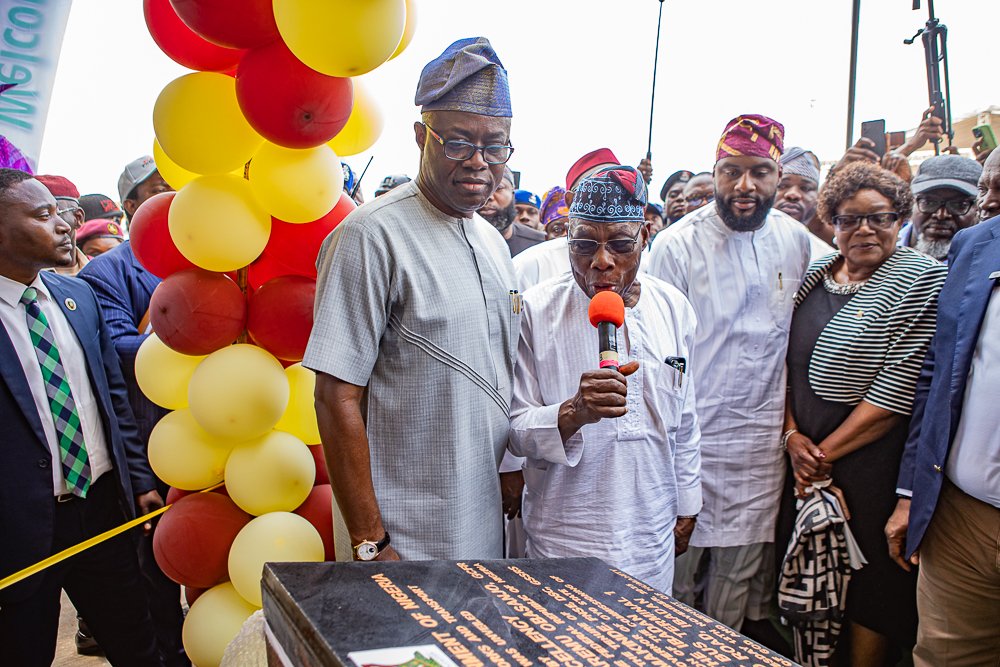
Grateful to His Excellency Chief Olusegun Obasanjo GCFR, who graciously commissioned the Ibadan Central Bus Terminals 1 & 2 today. Our administration is determined to complete projects which we have already commenced and ensure that we keep our pact with the good people of Oyo State.