Avalanche L1s give enterprises what blockchain often cannot, full control (validators, rules, compliance), real connectivity (shared liquidity via C-Chain), and high performance (fast finality, low, predictable costs). Built for business 🔺
@avax
Control. Connectivity. Performance.
These are the minimum requirements for any business considering blockchain.
For large institutions, integrating blockchain means operating within strict requirements: controlled environments, predictable performance, and access to real liquidity.
Avalanche L1s are built with that reality in mind.
You get infrastructure defined by your rules. Your validators. Built-in KYC and compliance aligned to your jurisdiction. Custom gas tokens. The ability to define how your chain operates, end to end.
At the same time, every L1 connects to the broader Avalanche ecosystem, with access to the C-Chain as a public liquidity hub. Stablecoins, DeFi rails, counterparties. Already live, already in use.
And it all runs with the performance businesses actually need. Fast finality. Predictable costs. High throughput without congestion from unrelated activity.
An enterprise-ready platform where control, connectivity, and performance are built in from day one.
That’s Avalanche. Built for business 🔺
Control. Connectivity. Performance.
These are the minimum requirements for any business considering blockchain.
For large institutions, integrating blockchain means operating within strict requirements: controlled environments, predictable performance, and access to real liquidity.
Avalanche L1s are built with that reality in mind.
You get infrastructure defined by your rules. Your validators. Built-in KYC and compliance aligned to your jurisdiction. Custom gas tokens. The ability to define how your chain operates, end to end.
At the same time, every L1 connects to the broader Avalanche ecosystem, with access to the C-Chain as a public liquidity hub. Stablecoins, DeFi rails, counterparties. Already live, already in use.
And it all runs with the performance businesses actually need. Fast finality. Predictable costs. High throughput without congestion from unrelated activity.
An enterprise-ready platform where control, connectivity, and performance are built in from day one.
That’s Avalanche. Built for business 🔺
@IrishSuela66483@TheDAOLabs@somi_thecat A little one shall become a thousand - One attribute of a long term lasting project is the ability to show a Progressive Growth overtime - @TheDAOLabs really doing some good work.
☆ Sui Integration Layer
Technically, I would say, @WalrusProtocol is not merely “built on” Sui, it treats @SuiNetwork as its native coordination and settlement layer. Every client and storage node runs a Sui client, which handles payments, resource allocation, shard assignment, and metadata management.
Walrus defines three core on-chain objects:
• A shared system object that manages the current committee of storage nodes.
• Storage resources representing available capacity (which can be split, merged, or transferred like Sui objects).
• Blob resources that register and certify each stored blob.
It is important to know that because blobs are first-class Sui objects, any Move smart contract can read a blob’s certificate, check its expiry epoch, verify ownership, or trigger actions such as auto-deletion. This deep integration turns storage into a composable primitive within the Sui ecosystem, allowing seamless mixing of on-chain logic and off-chain data.
☆ On-Chain vs. Off-Chain Separation
Did you know that @WalrusProtocol achieves massive scalability by cleanly separating control-plane logic from the data plane?
Observe below:
On-chain (Sui)
• Metadata, ownership, permissions, and cryptographic commitments
• Proof-of-Availability (PoA) certificates emitted as events
• Token economics, staking, payments, and committee formation
• Smart-contract-driven lifecycle management (extend lifetime, delete, transfer)
Off-chain (Walrus network)
• Actual blob data is erasure-coded into slivers and distributed across independent storage nodes
• Nodes store only the slivers belonging to their assigned shards during each two-week epoch
• Aggregators reconstruct full blobs on demand with high throughput
This hybrid model keeps the blockchain lean while still providing cryptographically verifiable availability. Applications on Ethereum, Solana, or any other chain can still consume Walrus storage because only the lightweight metadata lives on Sui.
☆The Role of Hashes and Smart Contract Interaction
Hashes serve as the immutable backbone of Walrus. Each blob receives a unique blob ID a cryptographic hash that acts as both identifier and integrity proof. When a blob is uploaded, its hash is registered on Sui as part of the Blob object.
Smart contracts can then:
• Query the Blob object directly to confirm certification and expiry
• Emit or consume custom Sui events for real-time node coordination
• Enforce access control or time-locked logic using the on-chain hash reference
This hash-object binding means developers can build sophisticated primitives tokenized storage capacity, auto-expiring AI datasets, or on-chain marketplaces without ever moving the heavy data onto the chain. Security is further strengthened by client-side encryption (via the Seal SDK) before blobs reach the network, ensuring that even publicly stored data remains private until decryption keys are shared.
Key Technical Insights
• Sui-native programmability: Blobs are Move objects, enabling smart contracts to treat storage exactly like any other resource composable, upgradable, and auditable.
• Erasure-coded efficiency: RedStuff reduces replication overhead while tolerating 1/3 faulty nodes, delivering Web2-like performance with blockchain guarantees.
• Verifiable off-chain storage: On-chain metadata & PoA events let any contract prove a blob exists and is recoverable without downloading it.
• Hash-driven integrity: The blob ID hash creates an unbreakable link between off-chain data and on-chain state, preventing tampering or forgery.
• Cross-chain extensibility: While control lives on Sui, any blockchain can reference Walrus blobs via the lightweight certificates, unlocking storage for the entire Web3 ecosystem.
In essence, @WalrusProtocol transforms decentralized storage from a passive bucket into an active, programmable layer of the Sui Stack. By binding massive off-chain blobs to on-chain objects through cryptographic hashes and smart contracts, it delivers the scalability, verifiability, and composability that next-generation AI, #DeFi, and media applications demand without forcing developers to reinvent storage primitives from scratch.
Kindly note
This post is for educational purposes only, and not a financial advice. Kindly make further research on Walrus Protocol before making any investment.
Research Sources:
• https://t.co/vdLngAcLkk
https://t.co/8tuGRl1FNA
• https://t.co/ma7dHnE2Jk
https://t.co/9ilFvbMvYe
• https://t.co/37EHmbheJr
• https://t.co/wRfaWRYz8J
An architectural deep dive into programmable Decentralized Storage
Case Study: Walrus Protocol
In this article, you will find these topics well analyzed through thorough research across several key works on @WalrusProtocol . Also, these topics reveal my focus to properly expatiate more on Walrus Protocol:
▪︎ Sui Integration Layer
▪︎ On-chain vs. off-chain separation.
▪︎ The role of hashes and smart contract interaction.
When it comes to Decentralized storage, it is needful to understand carefully strong networks, utilities and interesting integrations.
Walrus is a verifiable data platform purpose-built for high-stakes applications such as AI datasets, on-chain finance, NFT media, and full websites. Developed by Mysten Labs and now governed by the Walrus Foundation, it operates as a decentralized storage and data availability layer tightly integrated with the Sui blockchain. Unlike traditional blob stores, Walrus treats storage as a programmable, Move-native resource where every file (called a blob) is an immutable array of bytes that is cryptographically bound to a Sui object.
This design enables smart contracts to own, transfer, expire, or delete data using the same tools developers already use for tokens or #NFTs.
At its core, @WalrusProtocol employs an object storage architecture a flat namespace with no folders where each blob carries its raw data, metadata, and a unique identifier. Storage nodes hold erasure-coded shards of these blobs using the custom RedStuff 2D erasure-coding algorithm, ensuring resilience even if up to one-third of nodes fail.
The system runs on Testnet (ephemeral) and Mainnet (persistent), with all coordination handled through Sui.
☆ Use cases
Noticeably, @WalrusProtocol shines wherever large, rich media meets trust requirements. It could be #NFT imagery, game assets, and full websites load instantly yet remain provably immutable.
Also, AI agents store reproducible memory and datasets on Walrus, enabling verifiable training runs and cross-agent coordination.
In on-chain finance, institutions publish audited price feeds and reserve data as certified blobs, satisfying regulatory demands while keeping costs low.
Also, the recent Messaging SDK beta demonstrates hybrid power with end-to-end encrypted messages and attachments are stored on Walrus with on-chain membership controls, offering decentralized recovery without centralized backups.
• Even Ethereum or Solana apps can plug in via Walrus’s chain-agnostic storage layer.
☆ The vision
I discovered that Walrus envisions storage as a programmable primitive, and not a commodity. A place where data becomes a first-class citizen in the Sui ecosystem composable, upgradable, and economically incentivized. Also ensuring that anyone can run a node, any developer can build storage marketplaces or auto-expiring policies using familiar blockchain tools.
The Possibility:
This happens by making every byte provable, programmable, and always available, Walrus then bridges the gap between high-performance off-chain storage and on-chain trust, powering the next wave of AI-native and tokenized applications.
Some Key technical insights
In just one year on Mainnet, Walrus has gone from launch to becoming the second-largest decentralized storage protocol by total data stored.
Key Technical Insights
• Programmability: Blobs as Sui objects let smart contracts control lifecycle (extend/delete/route) natively.
• Resilience: RedStuff 2D erasure coding and 1/3 fault tolerance delivers fast reconstruction, & minimal replication.
• Hybrid design: On-chain metadata and off-chain slivers deliver Web2 speed with cryptographic verifiability.
• Permissionless & chain-agnostic: Stake-based nodes; any chain can use it via Sui.
• Real-world proof: 467 TB live (NFTs, AI datasets, 250 TB Team Liquid esports).
Major Milestones
• Three releases (Seal encryption, #Quilt, Upload Relay) now fully programmable platform.
• $140 M raise (a16z, Standard Crypto, Franklin Templeton); $WAL token strong & #Coinbase roadmap (Feb 2026).
• Explosive growth: +40% storage in 30 days; now powers AI, DeFi, gaming, encrypted messaging.
• 200+ partners, 120+ projects, 11 full decentralized websites, ~800ms small-file downloads.
@WalrusProtocol has turned verifiable data from a buzzword into infrastructure. Its first year proves the model works; the next will show how deeply it reshapes AI and finance.
I am wishing Walrus Protocol, the team, devs and it's amazing community a wonderful first year of mainnet, and more years of opportunities and growth.
Useful links:
https://t.co/zcoXGpISms
https://t.co/ma7dHnE2Jk
How it Works
• This happens by binding every blob to a @SuiNetwork object, it provides on-chain receipts of availability, ownership, and expiry.
• Verifiable data turns off-chain storage from a black box into a trust layer.
• Auditors no longer need to ask, “how do you know this is correct?” they receive mathematical proof.
This is essential as regulations like the GENIUS Act demand audited reserves and AML compliance for stablecoins.
☆ Walrus technology
I have observed that @WalrusProtocol employs a hybrid object-storage architecture.
• Blobs (arbitrary files images, videos, AI datasets, full websites) live in a flat namespace with no folders.
• Each contains raw data, metadata, and a unique ID.
• Data is never stored on-chain; instead, it is erasure-coded with the custom RedStuff 2D algorithm into “slivers” distributed across independent storage nodes.
• Only metadata, ownership, certificates, and payment logic reside on #Sui as native Move objects.
Comprehensible breakdown
Storage nodes stake $WAL, form committees via #Sui, and operate in two-week epochs.
It goes thus in the following steps:
• The system tolerates up to one-third faulty nodes while guaranteeing reconstruction.
• Users publish blobs via clients; Sui smart contracts handle certification, expiry, and deletion.
• This on-chain/off-chain separation delivers Web2-scale performance with #Web3 guarantees programmable storage capacity can be tokenized, split, merged, or traded exactly like any other Sui resource.
• Composability is native Move contracts that can read blob status, enforce access rules, or auto-expire files without off-chain oracles.
Walrus Protocol at One
An architectural dive into Verifiable Data and its concept set to revolutionize the crypto space.
As @WalrusProtocol turns one and the celebration kicks off, it becomes important I give a comprehensible technical analysis on the decentralized storage protocol built by Mysten Labs and governed by the Walrus Foundation.
Case Study: Walrus Protocol
Verifiable Data
☆ Verifiable Data in the decentralized space
In traditional finance, every transaction, price feed, and balance carries built-in integrity checks. Of which blockchain pipelines often lack. Resulting errors from RPC providers, chain reorganizations, or corrupted logs create invisible risks misattributed funds, failed reconciliations, regulatory exposure.
Whereas Verifiable data extraction preserves cryptographic proofs: blocks are signed, transactions linked, and alterations traceable. And through a careful study, I discovered that Walrus Protocol delivers exactly that.
☆ Understanding why Verifiable Data Matters
In high-stakes systems like AI and on-chain finance, verifiable data is essential because trust depends on proof, not promises. Bad data leads to wrong decisions, regulatory failures, and lost billions.
▪︎ The Problem:
Most blockchain data pipelines are black boxes. RPCs, indexers, and databases can silently drop, corrupt, or reorder transactions. Traditional institutions expect audit-proof integrity, but current off-chain storage offers no cryptographic guarantees.
▪︎ Walrus solution:
In order to proffer the right solution, Walrus stores large blobs off-chain using efficient RedStuff erasure coding across decentralized nodes, while binding every blob to a programmable Sui object on-chain. This delivers cryptographic Proof of Availability smart contracts and auditors can instantly verify a blob exists, is untampered, and is available before its expiry without downloading the full file. Storage becomes fully programmable, composable, and trustworthy.
Verifiable data turns “off-chain” from a risk into a reliable foundation.
🌌 Workdrop #61 highlights!
@TheDAOLabs
🔥 @everyoung1991 earned $111.09, crossed 40,160 $LABOR points, & hit 1.291 REP on the #DAOVERSE board.
👷♂️ Grinding from dawn to night, he proves consistency leaves a mark in Galaxy.
💪 That’s what relentless #SocialMining looks like! 🚀
Kudos to these set of amazing researchers on @TheDAOLabs exposing bad players in the crypto space.
Many have fallen due to poor knowledge or ignorance about new startups. But through #SocialMining the right metrics is employed to easily spot fake projects.
https://t.co/MWA5JQI0Jb
The Dawn of Retro9000 on Avalanche
(Discover the Retroactive way to reward real builders based on measurable impact and on-chain usage)
I just spent some time digging deeper into #Retro9000, and I have to say this might be one of the smartest funding mechanisms I’ve seen in the crypto space. What's more fascinating is that there is zero room for hype, zero upfront promises, the focus remains just real results getting rewarded.
Let's walk through this comprehensible breakdown on Retro9000.
☆ What Is Retro9000?
In looking at the core mechanism, it interesting to know that Retro9000 doesn’t give money for ideas or pitch decks, it’s pure retroactive funding. You have to ship, go live on mainnet, and prove traction first. Once you’re running, the program rewards projects based on actual on-chain activity.
The single most important signal?
☆ $AVAX burned through transaction fees on the C-Chain.
Understand this:
Every time someone uses your #dApp or contract, gas is paid and permanently burned. That burn number isn’t theoretical it’s the transparent, on-chain proof of how much real people are actually using what you built.
It is important to know that:
• Community usage directly decides the outcome.
• Effective usage is the vote.
• The more value you deliver, the more $AVAX gets burned, the higher you rank.
It is simple, verifiable, and almost impossible to fake.
☆ Two Tracks, Two Logics
The program actually runs two completely different tracks side by side:
▪︎ On Avalanche L1s & Infrastructure Tooling
This track is for teams building new @avax Layer 1s or the core tools that help others build them (deployment frameworks, explorers, validator dashboards, testing suites, etc.).
Things to know:
• It is evaluated quarterly, not monthly.
• The focus is long-term ecosystem relevance, deep technical quality, and sustained adoption.
• They look at real metrics like transaction count, number of validators, TVL, monthly active users, ICM/ICTT integrations, and overall technical contribution.
This is the “build the foundation” track.
▪︎ Whereas on Avalanche C-Chain Rounds
These are the new monthly rounds that kicked off in March 2026.
Things to know:
• Rankings are driven almost entirely by how much $AVAX your contracts burn that month.
• There’s a public leaderboard anyone can watch in real time.
• New projects can get multipliers (for example 1.5× in the first round), and the entire reward pool is distributed strictly based on usage.
• Top 40 projects share the monthly AVAX pool, with clear rules: max 25% of the pool per project, max 90% of what you actually burned, $200K lifetime cap per project, and a $500 minimum payout.
One track rewards vision and technical depth. The other rewards proven product-market fit every single month. Builders can (and are encouraged to) participate in both.
☆ Understanding the importance of this Model
1. Implementing usage-based funding is genuinely hard to game, where you can’t fake thousands of real users willingly paying gas.
2. It perfectly aligns three groups:
• Builders are forced to ship products people actually use,
• Users become the ones who decide winners with their wallets, and
• The Avalanche network gets stronger every time more $AVAX is burned (real utility plus supply reduction).
This setup is a breath of fresh air for serious builders. Projects that focus on retention, real adoption, and long-term value keep climbing the leaderboard month after month. Pure hype projects without actual usage disappear fast.
What's in it for early birds?
Like the saying, the early bird gets the worm, so is applying early on #Retro9000.
• New projects can catch multipliers,
• You can compound across every monthly C-Chain round, and
• The $200K lifetime cap means getting consistent traction early maximizes what you can ultimately receive.
If you’re building an L1 or any serious tooling that supports the #Avalanche ecosystem, this program is worth paying attention to right now. The first monthly C-Chain round is already live.
Have you checked out Retro9000 yet?
Drop a comment if you’re building happy to share the link or answer questions.
Apply here:
https://t.co/hTMOGXWbP3
Research materials:
https://t.co/GAJf5B7UYs
https://t.co/81VWpr6SaL
🧵/ 1
Been watching this #SocialMining narrative closely tbh. real talk: projects don't just need hype, they need loyal & educated communities.
Tourists are fun to hang out with during the sunny days, but you definitely can't escape the crypto winter with them. 🥶
Momentum isn’t noise.
Momentum is coordination.
The @TheDAOLabs X Community isn’t just growing — it’s organizing builders, creators & Social Mining Ninjas under one banner.
DAOLabs isn’t about hype.
It’s about presence.
And we’re just getting started. 👀
#DAOVERSE $LABOR
An outstanding run in the Daoversian Galaxy by @prof_michaelt 🧵
From #SocMin Ninja to Meme Miner, he’s been leveling up both writing and visuals, earning $117.06 in Workdrop #62 and cementing his footprint across Avalanche Hub and DAOVERSE.
Proof that consistent #SocialMining really pays off.
In DAOVERSE, your effort builds more than just digital reputation—it builds real life. ⚒️
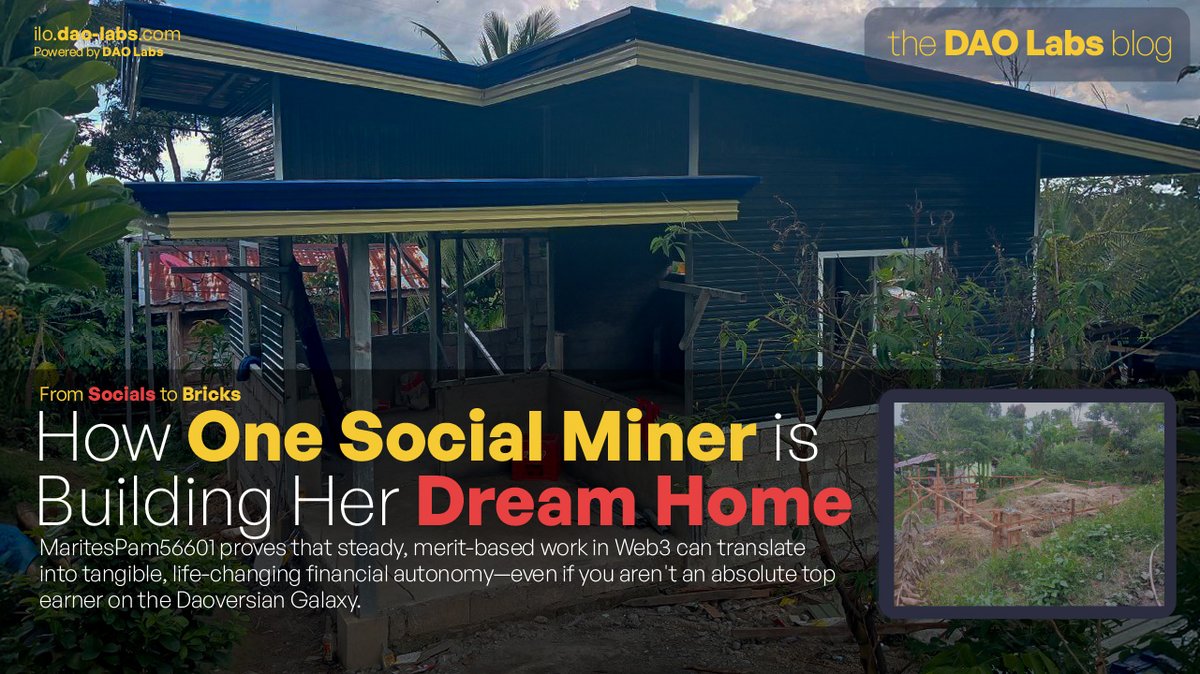
Check out our latest blog post on how @Marites1092 funded her family's new house entirely through #SocialMining.
She proved that you don't need to be the #1 top earner to fundamentally change your life; you just need consistency and hard work. 💪
Read the full story on our website's blog section
Avalanche powers next-generation fan experiences.
Be part of football history. Access the FIFA World Cup 2026™ with a Right-to-Ticket available now on @FIFACollect.