We trust banks with our money but not decentralized networks with our data? @Filecoin flipped that script years ago. Actual cryptographic guarantees, retrievals that work, and a token that rewards honest storage. This is why I’m still all-in on $FIL even when it’s quiet.
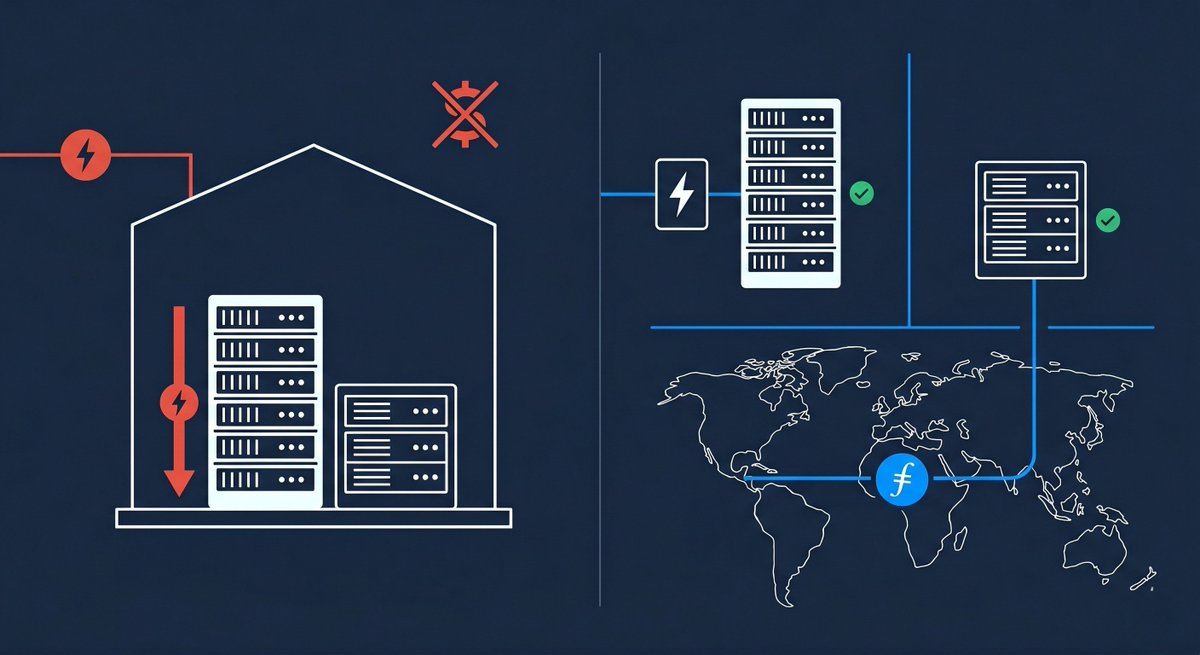
GPU clusters draw 160kW per rack at near-100% utilization. Storage draws under 10kW and tolerates latency in a way compute cannot.
Bundling both in the same premium facility wastes finite grid capacity on static files.
Filecoin is built for that separation.
€7.1 billion in cumulative GDPR fines. 443 breach notifications are filed daily.
Regulators issued €1.2 billion in fines in 2025 alone.
Filecoin is built for storage where jurisdiction, performance, and integrity are independently verifiable.
Happy Sunday to the amazing @filecoin community ☀️💙
Another day to believe, build, store, and accumulate. 👀
While others focus on short-term noise, we remain focused on the bigger vision.
Here’s to stronger conviction, stronger growth, and a stronger $FIL. 🚀
Over $2 billion in SEC fines for recordkeeping failures since 2021. Rule 17a-4 mandates immutable retention for six years.
Filecoin is built for exactly that: tamper-evident audit trails across independent providers.
The network is already live.
Weekend thought.
Every time a major centralized platform has an outage, a data loss incident, or some unexpected failure during peak demand, it reminds me why decentralized infrastructure matters.
We spend a lot of time talking about AI, cloud computing, and the future of the internet, but all of those things depend on one simple requirement: data has to be available, verifiable, and resilient.
That's what first drew me to @Filecoin.
While most people focus on price action, the network has been quietly doing something much harder: building a marketplace where storage providers are rewarded for proving they actually store data. Real cryptographic verification. Real economic incentives. Real infrastructure.
The amount of data being created globally isn't slowing down. AI models, research datasets, public archives, media, enterprise backups, and machine-generated content are all pushing storage demand higher every year.
The question isn't whether we'll need more storage.
The question is what kind of storage network will be trusted to handle it.
Centralized systems will continue to play a role, but recent years have shown that putting too much trust in a handful of providers creates obvious points of failure.
That's why decentralized storage feels less like a crypto narrative and more like a long-term infrastructure story.
$FIL sits at the center of that conversation. Not because it's the loudest project, but because it's attached to a network already storing enormous amounts of data and aligning incentives between users and providers.
The market will do what the market does in the short term.
But on weekends I find myself thinking less about candles and more about where the internet is heading over the next decade.
Data is growing.
Demand is growing.
The need for verifiable, censorship-resistant, globally distributed storage is growing.
Who else is building for that future?
The future of AI shouldn't depend on concentrating everything in a handful of regions. As infrastructure demands keep climbing, distributed networks start making a lot more sense. That's one of the reasons I'm paying attention to @Filecoin, scaling storage without forcing every community to carry the same burden.
$FIL is sitting at the same zone where fear peaked and rallies were born.
Target 🎯 1 ➜ Sent it higher $3. 🚀
Target 🎯 2 ➜ Sent it higher $5. 🚀
Target 🎯 3 ➜ Loading... ⏳
Most traders see weakness. Smart money sees an opportunity.
If this structure holds, the move that follows could catch a lot of people offside.
The crowd is distracted. The chart is speaking.
@Filecoin $FILECOIN 👀
The Impact of Deep Integration Between ADA and $FIL on the Industry's Future🤔
1. Collaboration Timeline
December 2024: The Filecoin Foundation and Blockfrost announce a partnership, integrating Filecoin as a decentralized storage backup layer for building Cardano applications using Blockfrost.
April 2026: The partnership is upgraded to a specific "Advanced Storage Tier" product, allowing Cardano developers to access Filecoin-supported distributed storage services through Blockfrost.
2. Core Collaboration Content
Blockfrost integrates with Filecoin via the Lighthouse platform, which is a Filecoin-based platform offering permanent storage, encryption, custom gateways, and multi-chain smart contracts.
3. The collaboration between ADA and $FIL marks a key turning point in the crypto industry from "ecosystem islands" to "interconnected infrastructure." Its impact is not limited to the two projects themselves but also
provides a standardized path for the industry to enable public chains and storage networks to develop collaboratively,
validates the feasibility of decentralized storage solutions entering the enterprise market, and promotes Web3 from technological experimentation to large-scale commercial application, solidifying the underlying infrastructure for data sovereignty and asset tokenization.
4. It is foreseeable that this "powerful alliance" cross-chain collaboration model will become the norm for future infrastructure development in the crypto industry, and the partnership between Cardano and Filecoin will be seen as the beginning of this trend.
#FIL🔥🔥 🔥🔥 @Filecoin@FILBuilders@FilFoundation
$FIL hitting $10 in Q3-Q4? That’s the kind of bullish
energy we love for Filecoin! As the backbone of a
decentralized storage marketplace,
@Filecoin
permissionless, provable, and rewarding system is
disrupting traditional cloud providers.
AMERICANS ARE KEEPING THEIR CARS LONGER, RESHAPING THE AUTO INDUSTRY
U.S. consumers are holding onto vehicles for longer periods due to high new-car prices, elevated interest rates, affordability concern: WSJ
AI racks pushing 160kW are turning hyperscale facilities into localized hurdles on water, power, and land.
Northern Virginia data centers consumed nearly 2 billion gallons last year.
Filecoin is built so that no single location bears that weight.
While the UK chokes on a 50GW data center queue exceeding its entire peak winter demand and quoting 15-year waits @Filecoin's network already runs, distributed and queue-free, across independent providers worldwide.
The UK has 50 gigawatts of data centers in its utility queue, more than the country's entire peak winter demand.
Prime markets are quoting 15-year connection wait times.
Filecoin's network is already distributed across independent global providers. No queue required.