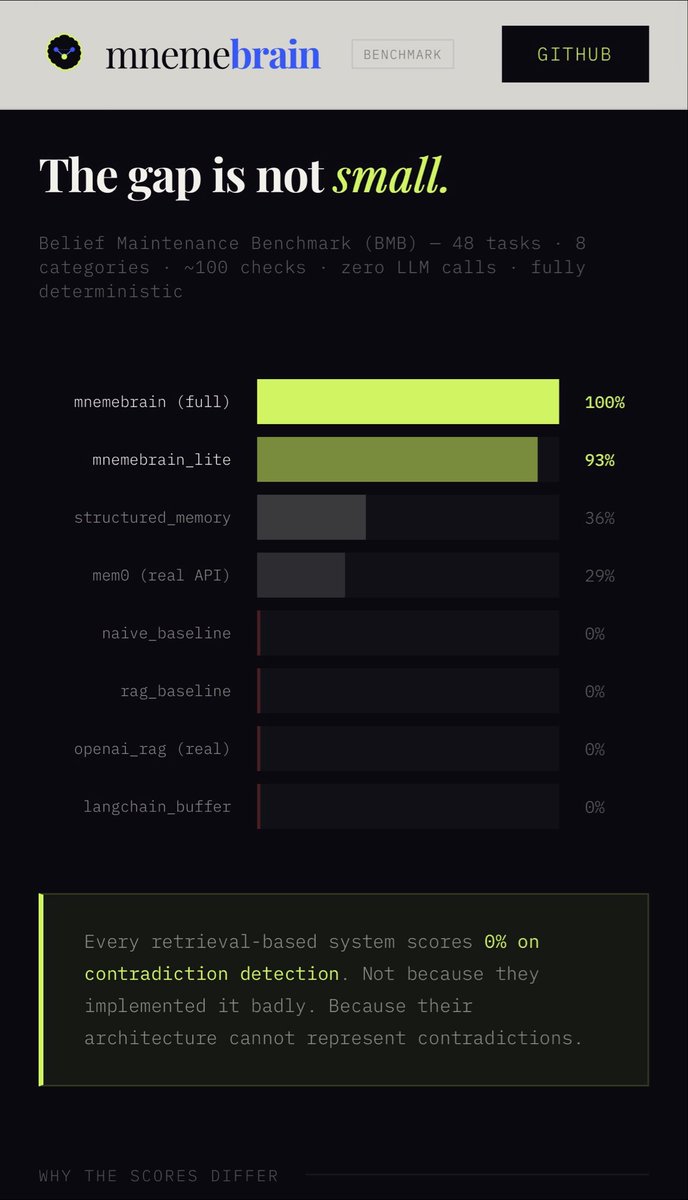
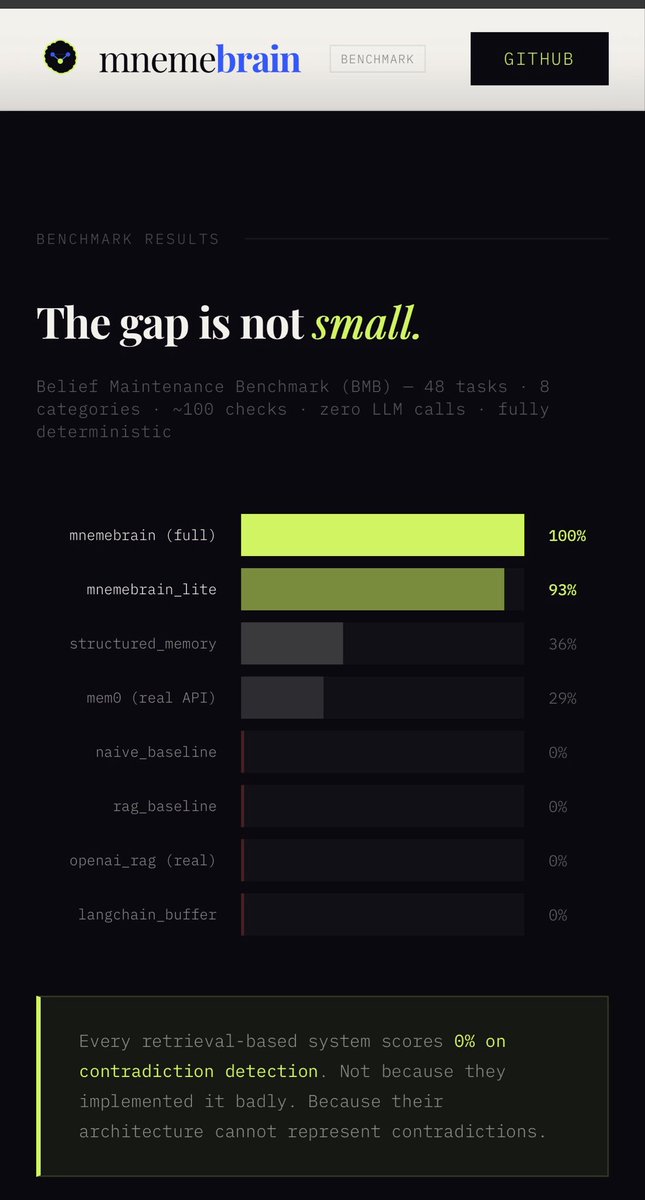
@boxmining Building MnemeBrain — a belief memory layer for AI agents.
Instead of storing text like RAG systems, agents store beliefs with evidence, contradictions, and revision over time.
Think TCP/IP for agent memory.
https://t.co/IQ7ZzNvdnA
@X4AES@BLUECOW009 Exactly. The hard part isn’t storing memories — it’s how new evidence reshapes old beliefs.
Once agents run for weeks/months, memory becomes a dynamic system:
new evidence → belief update → confidence shift → possible contradiction
That update rule is still an open problem
@navtechai@BLUECOW009 You need a way to track:
• evidence sources
• timestamps
• confidence
• conflicting states
Otherwise the system either overwrites or averages the truth.
@navtechai@BLUECOW009 The hard part isn’t compression, it’s belief consistency.
If two memories contradict:
“user is vegetarian”
“user ate steak”
Compression alone can’t represent that conflict.
@karpathy Most agent memory today looks like this:
logs → embeddings → similarity search → context
But that pipeline can’t represent things like:
• contradictions
• confidence
• evidence over time
So instead of storing text…
MnemeBrain stores beliefs with evidence.
@Starwatcher_vc Better retrieval helps.
But even perfect retrieval doesn’t solve contradictions.
Agents eventually store:
“user is vegetarian”
“user ate steak”
Vector systems retrieve both.
They still can’t represent truth state.
That’s a different layer: belief maintenance.
@sukh_saroy Persistent memory is the easy part.
The real problem is contradictions.
If an agent stores:
“user is vegetarian”
“user ate steak”
Vector memory retrieves both.
Which one is true?
Most systems push the problem back to the LLM.
Agents need belief revision, not just storage.
@nextxAG@intheworldofai So instead of:
old → deleted
new → stored
we get:
supporting evidence ↑
conflicting evidence ↑
truth state recomputed (TRUE / FALSE / BOTH / NEITHER)
This lets agents track evolving beliefs instead of flipping state.
@nextxAG@intheworldofai Good question.
We avoid hard overrides.
Each belief keeps:
• evidence graph
• confidence score
• timestamps
New evidence triggers belief revision, not replacement.