@LayerZero@PythNetwork What's interesting is that every platform on ATLAS gets access to @PythNetwork market data from day one.
Pyth Pro feeds, Pyth Indices and datasets are already available through ATLAS, without each platform needing to set up a separate integration.
@LayerZero is launching ATLAS on Zero on Nov 30.
Think of ATLAS as an exchange engine without its own app. It handles the trading behind the scenes, while other platforms build their own apps and trading experiences on top of it.
@LayerZero@PythNetwork ATLAS is built to handle trades extremely fast, with sub-millisecond median latency and an initial capacity of 250,000+ transactions per second.
Basically, it provides the infrastructure so platforms don't have to build an entire exchange system from scratch.
@PythNetwork This share keeps growing.
• September: 41.7%
• October: 49.8%
• November (1–13): 51.5%
More people are trading stock perps outside traditional market hours.
@PythNetwork tracks this shift as markets move beyond the usual opening and closing times.
US stock markets like the NYSE and Nasdaq have set opening and closing hours.
But stock perpetuals (perps) let people trade stock-linked markets even when those exchanges are closed.
So a lot of trading is now happening outside regular market hours.
@PythNetwork Between Nov 1–13, 51.5% of trading volume across the top 25 US stock perps happened while the NYSE and Nasdaq were closed.
That means more than half of the trading activity happened outside regular US stock market hours.
@PythNetwork Pyth has done this before with Circle, Figma, Cerebras, SpaceX and Shein.
It also runs an Anthropic index 24/7, even on weekends, unlike the stock feed.
Getting new market data live quickly is becoming a pattern for Pyth.
When a company goes public, its stock starts trading for the first time.
On Nov 19, @PythNetwork brought Anthropic’s (ANT) price feed live within minutes of its first trade.
That means the price data was available almost immediately.
@PythNetwork The feed covers trading from Monday to Friday, including pre-market, regular trading and after-hours.
So apps and platforms using Pyth don't have to wait long to access ANT's price data once trading begins.
@PythNetwork Why does this matter?
Every trade needs reliable prices to know what an asset is worth. When billions of dollars are moving, that data becomes even more important.
Pyth is supplying price data for a large share of these markets, including equity and RWA perps.
A lot of onchain trading happens through perps, where people trade an asset's price without owning the asset itself.
In October, @PythNetwork provided prices for 95.9% of the $384B equity perp volume tracked.
That's a huge share of the market.
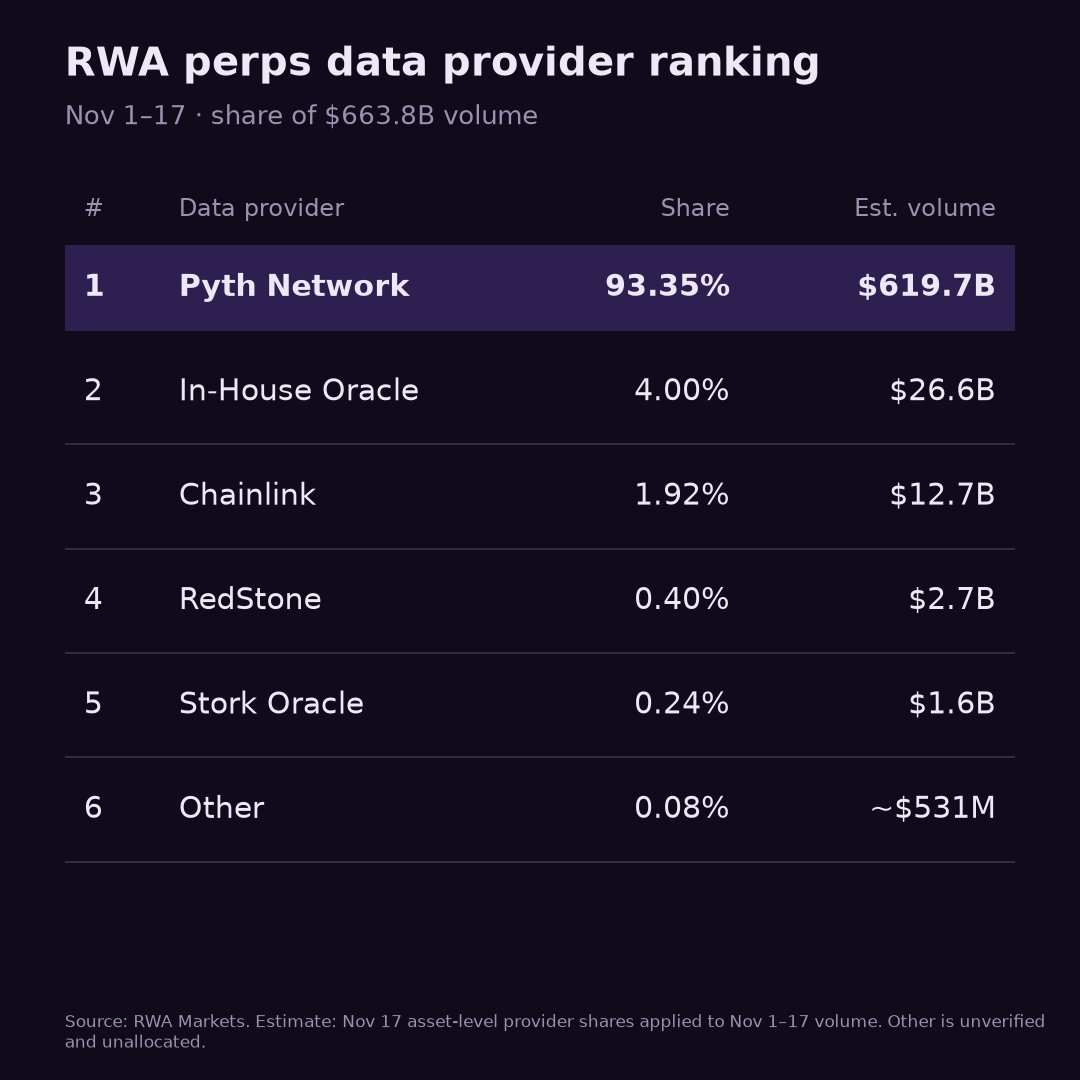
@PythNetwork Pyth also covered 92.15% of the $553.18B in RWA perp volume tracked between Nov 1–13.
Over the last 24 hours as of Nov 16, it covered 93.9%.
In simple terms, most of this trading relied on Pyth for price data.
Here's the interesting part:
76% of Apple's and 70% of AMD's trading volume over the next 24 hours happened while the NYSE and Nasdaq were closed.
This shows why 24/7 stock markets matter. Traders can react to company news without waiting for the next market opening.
Stock trading doesn't stop when the US market closes.
After Apple and AMD released their earnings reports in November, their stock perps saw massive trading activity outside regular market hours.
Here's what the numbers tell us.
In the first hour after Apple's report, its perps recorded $188.6M in volume, about 114x a typical hour.
AMD recorded $192.4M, about 132x its usual hourly volume.
Both saw huge activity after their earnings reports.
first 17 days of october: $418.4B in RWA perps.
first 17 days of november: $673.6B (+61%).
equities 48%, indices 33%, commodities 17%
26 venues, 93.5% priced by @PythNetwork
big month.
@PythNetwork This isn't limited to a few stocks.
All 25 stocks recorded at least 34% of their trading outside regular market hours.
SK hynix, Amazon and Microsoft were close to 60%.
Simply put, interest in trading US stocks doesn't end when the market closes.
More people are trading US stocks even when the traditional stock market is closed.
According to @PythNetwork, 41.7% of trading in the top 25 US stock perps happened outside regular market hours in September. That rose to 49.8% in October and 51.5% in November (first 13 days).
@PythNetwork Why does this matter?
The NYSE and Nasdaq have fixed opening and closing hours. But stock perpetual futures (perps) can be traded 24/7.
This allows people to trade and react to company news even when the traditional stock market is closed.