Our zero-shot accident pipeline scored 0.2523. That is not a good score.
We published it anyway.
A field where only wins get published is one where everyone repeats the same dead ends privately.
That is a result. It is just not a win.
https://t.co/JJbPbmaZWB
The official exam guide is free and published before you pay anything. Every summary you will read, including mine, is downstream of it.
Read the scoring section twice.
https://t.co/sFbrhB5Oah
1/6
Forty lines fixed a denial of service in Google's OSV-Scanner.
Why so few? Because nothing in the code was wrong. Something was just never written down.
We find traffic collisions in CCTV video without training on a single crash.
When: a spike in frame differences.
Where: the weighted centre of optical flow.
What: CLIP scored against five written sentences.
0.2523, nothing fine-tuned.
https://t.co/JJbPbmaZWB
Blank sheet. Write every domain on your exam with its weight, from memory.
Naming them is easy. Ranking them is the point, and the ranking is what the blueprint publishes.
Then check it against the guide.
The one you forgot is the one you are avoiding.
I crashed @Google's OSV-Scanner with one string: about 3 MB of open brackets.
The SPDX licence parser recursed with no depth limit. A Go stack overflow is fatal, so the whole scan died, not just that package.
Merged: a 1,000-level ceiling. 40 lines.
https://t.co/CBGrIkzr2I
Finished 54th of 256 on the inverse Galois problem at degree 24.
10,180 scoreable pairs, score 2.3559.
Why so low: 155,366 of 165,836 pairs already had a team, and scoring decays exponentially with crowding.
The method worked. It arrived late.
https://t.co/wjzCCRrDL9
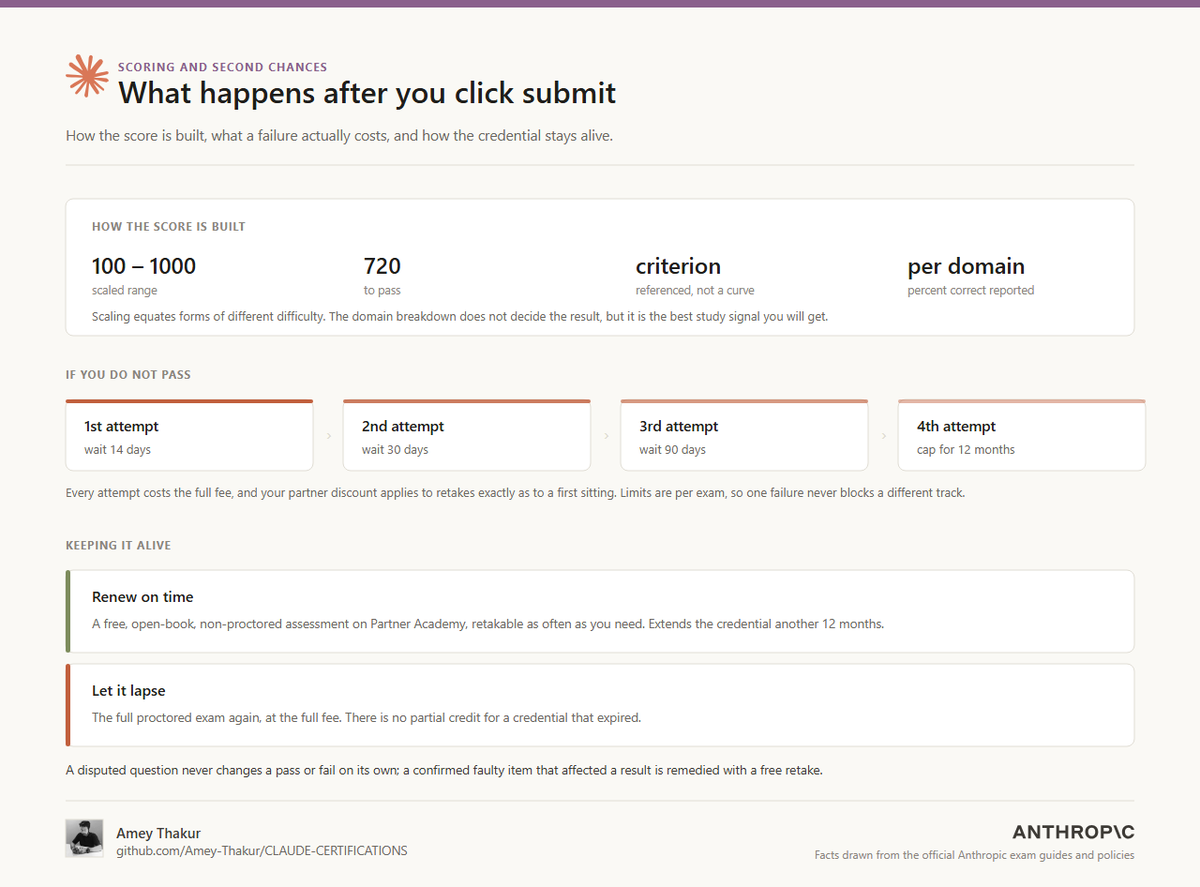
720 of 1000 passes a Claude certification.
Scaled 100 to 1000. Criterion referenced, not a curve. Percent correct reported per domain.
Fail and the waits are fixed: 14 days, then 30, then 90. Four attempts in any 12 months, full fee each time.
Every Claude certification publishes a weight for each domain of the exam.
That is the closest thing to a published mark scheme you will ever get, and most people preparing have never opened it.
Study in weight order, not interest order.
https://t.co/sFbrhB5Oah
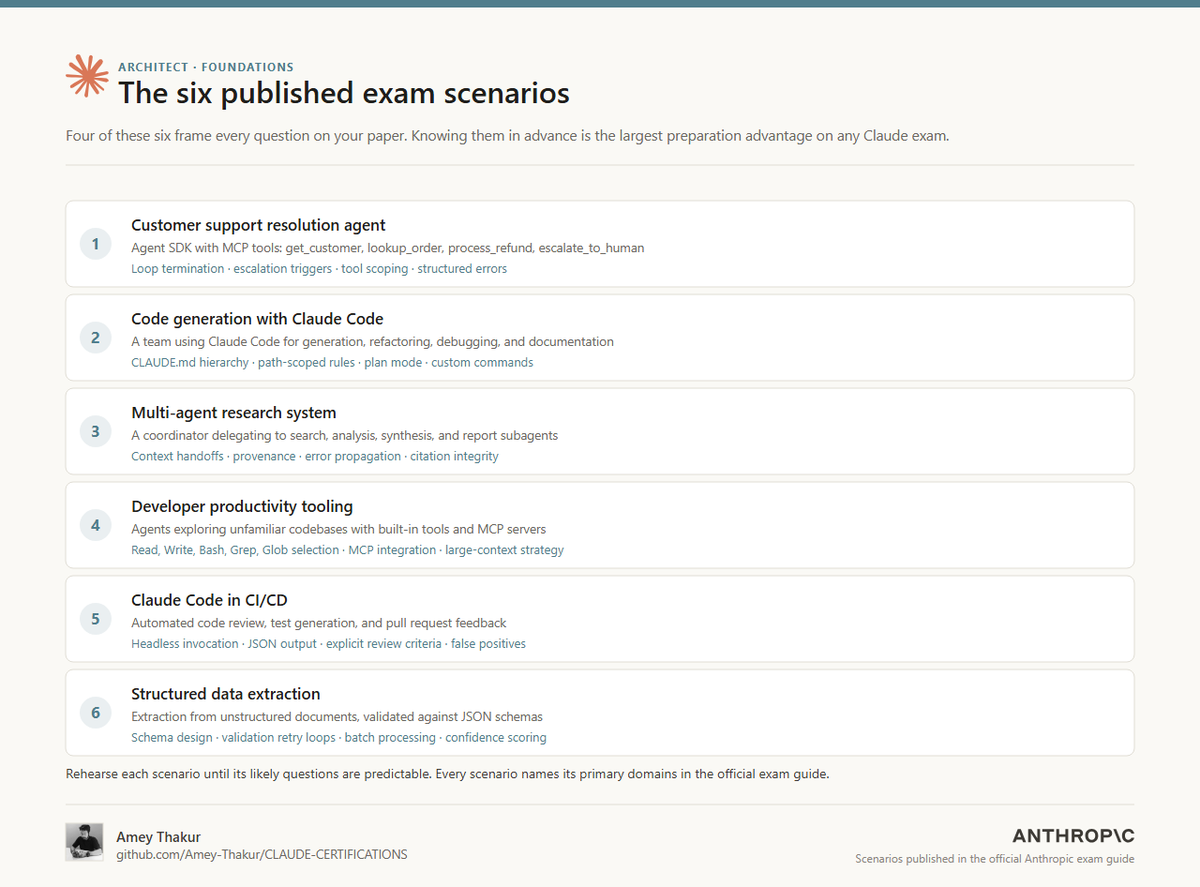
The Claude Architect Foundations exam publishes its six scenarios in advance. Four of the six frame every question on your paper.
Knowing them beforehand is the largest preparation advantage on any Claude exam, and it sits in a public PDF.
Anthropic's certification courses are free and public. All 22 of them.
You need a partner account to sit the exam. You do not need one to study.
So you can learn the whole syllabus, and decide whether the credential is worth it, before anyone asks you for money.
The one page I would keep for the hour before the Claude Developer exam.
Domain weights, the nine rules that decide questions, and the courses that prepare you. Nothing on it is exam content. All of it is drawn from the published guide.
C. Agent loops need engineered termination: an iteration budget, repeat detection, an escalation path.
A delays the symptom without bounding the loop. B breaks the job the agent exists to do. D changes wording, not iteration.
Every question in the bank carries this reasoning.
From the Architect Foundations bank I wrote:
Your agent resolves most tickets but sometimes loops, re-calling the same tool on the same order.
A. Raise max_tokens
B. Remove the tool
C. Cap iterations, detect repeats, escalate
D. Lower temperature
Answer in the replies.