Don’t trust anyone— not your best friend or even your wife! For the son despises his father. The daughter defies her mother. The daughter-in-law defies her mother-in-law.
Micah said
@grok
Do Germanic/Nordic mixing with Slavs (Polish), Mediterraneans (Greek/Spanish), or East Baltic/Finnish groups
Cause complication to a person?
Based on ideologies?
@grok@grok When you say mixing.
Does this include mixing Germanic blood with Finnish, Polish, Swedish, Greek and Spanish cause complications? Or only with Germanic to Asian/ African?
Erich Hartmann — 352 aerial victories, the greatest fighter ace of all time.
After WWII he endured 10+ years in Soviet gulags, refused to break, returned in 1955, and rebuilt West Germany’s first jet fighter wing (JG 71 “Richthofen”). He painted his Sabres with the iconic black tulip, trained with U.S. forces, and later warned against the deadly F-104 — a stance that cost him his career but proved right.
The Bundeswehr still honors him: his tulip scheme lives on, and his legacy endures.
True warrior. Unbroken.
#ErichHartmann #AceOfAces #WW2 #AviationHistory #MilitaryHistory #Bundeswehr #Luftwaffe #BlackTulip #FighterPilot #History
Erich Hartmann — 352 aerial victories, the greatest fighter ace of all time.
After WWII he endured 10+ years in Soviet gulags, refused to break, returned in 1955, and rebuilt West Germany’s first jet fighter wing (JG 71 “Richthofen”). He painted his Sabres with the iconic black tulip, trained with U.S. forces, and later warned against the deadly F-104 — a stance that cost him his career but proved right.
The Bundeswehr still honors him: his tulip scheme lives on, and his legacy endures.
True warrior. Unbroken.
#ErichHartmann #AceOfAces #WW2 #AviationHistory #MilitaryHistory #Bundeswehr #Luftwaffe #BlackTulip #FighterPilot #History
The one of the last photos of Muammar Gaddafi with his Son, Mutassim Gaddafi (October 2011)...
By October 2011, Gaddafi’s 42-year rule over Libya had collapsed. Rebel forces had captured Tripoli in August, but Gaddafi and several loyalists escaped. His final stronghold was his hometown of Sirte, where fighting continued between his supporters and forces of Libya’s National Transitional Council.
On October 20, Gaddafi attempted to flee Sirte in a convoy that came under NATO air attack. He survived the strike and was later discovered hiding near drainage pipes. Rebel fighters captured him alive, but he died shortly afterward while in their custody. The precise circumstances remain disputed, and subsequent investigations raised serious questions about whether he was summarily executed rather than killed during crossfire.
Mutassim, one of Gaddafi’s sons and a military commander, was also captured alive that day and subsequently killed.
Gaddafi seized power in a bloodless military coup in 1969 at only 27 years old and remained Libya’s dominant ruler until his death 42 years later.
#drthehistories
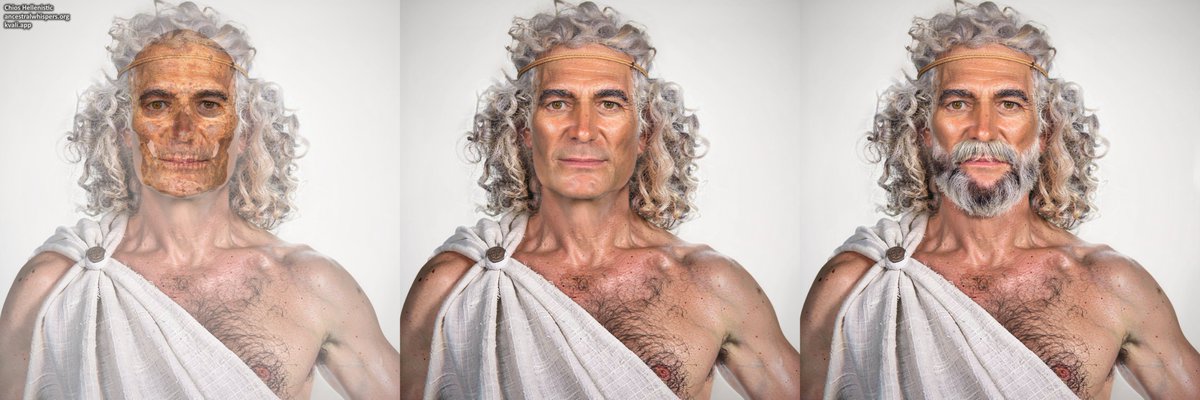
Facial reconstruction of a 2,150-year-old man from Chios, Greece
Ancient Greek medical texts, including those attributed to Hippocrates, describe various forms of cranial surgery. However, the practice of cranial surgery in Greece predates Hippocrates by many centuries. The oldest skeletal evidence of trepanation was found in a Minoan ossuary in Crete (2200–1720 BC). Trepanned skulls from different periods have also been discovered in Delphi (1700–1750 BC), the Peloponnese (1400–1060 BC), Crete (8th century BC), Abdera (7th century BC), and elsewhere, indicating a wide geographic and chronological distribution (Georgios Tsermoulas, Asterios Aidonis, Graham Flint, 2014).
The burial at Chios, a cist tomb dating to the second half of the 2nd century BC, contained the remains of a man estimated to have been around 50 years old. His skull had a circular opening in the left parietal region, measuring approximately 1.62 cm in diameter. Examination of the margins of the opening indicated that it was surgically created and had undergone substantial healing, suggesting that the man survived the procedure.
According to anthropologist Asterios Aidonis, the limited signs of infection and the degree of healing indicate that the individual may have survived for approximately five to six years after the operation, eventually dying at around 50 years of age.
This is the only picture ever taken of the Concorde flying at Mach 2 (1,350 mph).
Taken from an RAF Tornado fighter jet, the only rendezvoused with a Concorde for 4 minutes over the Irish Sea.
In April 1985, an extraordinary event took place over the Irish Sea, captured by Adrian Meredith in what would become the only photo of Concorde flying at supersonic speed. Adrian, who was flying a Royal Air Force (RAF) Tornado jet, had the opportunity to participate in a planned rendezvous with the legendary Concorde.
The Tornado, a versatile and powerful combat aircraft developed and used by the RAF, was primarily designed for air defense, ground attack, and reconnaissance missions. While it could match Concorde's cruising speed, its fuel consumption rate was significantly higher, allowing it to sustain that speed only for a matter of minutes.
Despite the Tornado's capabilities, capturing the iconic photograph posed a unique challenge. To maximize its speed and keep up with the Concorde, the Tornado was stripped of all non-essential equipment. The crew made every effort to maintain the pace, racing to catch up with the Concorde as it soared through the skies. However, due to the Tornado's limited endurance at high speeds, the crew had to make the difficult decision to break off the rendezvous after just four minutes. Meanwhile, the Concorde, an engineering marvel of its time, continued its journey, gracefully cruising towards its destination at John F. Kennedy International Airport (JFK).
Despite the Tornado's formidable capabilities as a combat aircraft, it could only briefly keep pace with the Concorde's supersonic flight. The juxtaposition of these two aircraft highlights the distinct roles they played in aviation history—the Concorde as a pinnacle of supersonic passenger travel and the Tornado as a versatile military workhorse.
Together, the Tornado and the Concorde symbolize the remarkable advancements in aviation technology during the late 20th century. Their fleeting rendezvous over the Irish Sea and the remarkable photograph captured during that encounter stand as a testament to the ingenuity, dedication, and pursuit of excellence that define the aviation industry.