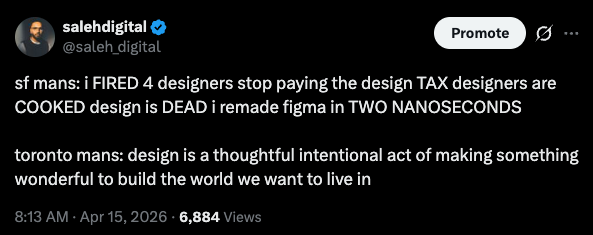
Jony Ive designing a car with Ferrari feels so old-school, in the sense that it represents a view of design as a specialty that can operate in all domains simultaneously. Like, cars are kind of the same shape as a magic mouse, I suppose.
PICARD: Data, shields up
DATA: Brilliant! Shields can reduce damage we sustain. Not immunity. Not hubris. Just prudence. It's not precaution—it's strategy.
[camera shakes]
WORF: HULL BREACHES ON NINE DECKS
DATA: Here's what happened: you told me to raise shields, and I didn't
Liam speaks with illustrator Libby VanderPloeg about how she relates to her work and what happens when the work takes on a life of its own.
📻 Tune in: https://t.co/MjH3rN16TN
#Illustration#ArtForChange#Humor#SocialGood#Podcast
In this episode, Liam speaks with Harvey Moon in his studio about how tools extend the human capacity for creation.
📻 Tune in: https://t.co/X3wJ8mIw91
#NewMediaArt#GenerativeArt#ArtAndTech#Podcast
The fact that no one on the left—and I mean *no one*—is even willing to *pretend* your stuffed animals’ feelings might be hurt when you don’t wish them goodnight, shows that we care far more about looking adult than confronting the issue
I mean the whole conversation right now is all over the place, because another key ingredient in the promotion of inevitability is "getting left behind," while forming a moat implies maintaining a static location and, presumably, your taste stays with you wherever you are.
the tasteslop post clarified a detail of the current discourse for me: "moat" is deployed with as much frequency as "taste" but functions as a rhetorical support for the inevitability of tech. A moat is only relevant in the context of imminent incursion (or paranoia)
i’ve made the surprising discovery in the last year that most of the tasks I thought could be automated are so entangled with my personality, context, and internal state in the moment that they simply are not worth automating
I think it's generally not a good sign of predictive power when someone says every new thing is the future. "Today but more" betrays a weak imagination.
Liam speaks with Bradley Munkowitz, unpacking GMUNK’s aesthetic, inspired by psychedelic experiences, and why it’s important as a designer to continually challenge and be challenged.
📻 Tune in: https://t.co/ILuDNxPnOP
#DigitalArt#Creativity