I gotta speak my truth.
Aventurine was never intended to be androgynous and its pretty clear to see that he's fairly masculine, even before the SP. A man being flashy ≠ androgyny or femininity. To me its pretty clear to see that he's always just been flamboyant 😭
Variations on a Cosmic Tour | Aventurine • Waveflair
"Friends, we meet again! I just wrapped up a sponsored shoot, and wow, keeping a smile plastered to my face for the camera is no easy feat. But now that I've been promoted to P46, I can finally go on vacation. Want to relax and enjoy your time with me? I guarantee you'll have an unforgettable getaway."
The grand festival illuminates the coast, while a storm brews amidst euphoria.
Secret orders in hand, he steps back into the eye of the storm to shake up this long holiday—
When treacherous waves subsume his figure, how will he emerge as the game changer?
@moniza_hossain i mean it's true though it's difficult to have sympathy for the landed gentry, whose worst fates of homelessness and shame were still miles better than the fate they condemned those they colonized
Just so everyone is clear, the gripe here is that China is destroying the profits of the western bourgeoisie, because they are forced to make their products cheaper to compete with Chinese competitors.
This is the central argument of 100% of all western economic analysis of China. The more affordable China's products, the more it destroys their monopolies and their profit margins.
As always, the purpose of such propagandists, as well as their "elected" governments, is to make the interests of the bourgeoisie appear like the national interests of their respective countries. It's the first rule of bourgeois economics: What's good for the bourgeoisie is good for the proletariat.
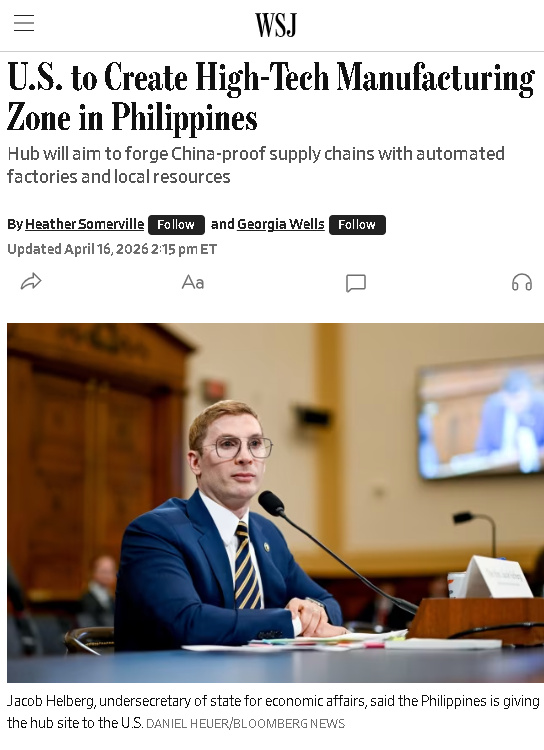
This is pretty insane: the U.S. just tried to literally re-colonize part of the Philippines.
They did so under the so-called "Pax Silica" initiative, the brainchild of - surprise, surprise - an ex-Palantir guy named Jacob Helberg who now runs U.S. economic "diplomacy" from the State Department.
It's causing a big outcry in the Philippines, which is quite a feat given this is by far the most US-friendly country in Southeast Asia.
If you're the US and you're getting the Marcos administration - of all governments - to push back on sovereignty, you've really overplayed your hand.
What is the "Pax Silica" initiative? In a nutshell it's about the US getting other countries to commit to restructuring their AI tech infrastructure around a US-led stack. It's basically vendor lock-in: you hand over your critical minerals, align your export controls with Washington's, regulate AI the way America wants, and in return you get to be a US "trusted partner," whatever that means these days.
In essence, let's not kid ourselves, it's all about China: this is the US's initiative to "win the AI race" by getting other countries to contractually commit to keeping China out of their tech supply chains. When you can't preserve your lead through innovation, you seek to lock countries in contractually.
For instance as a country, this would mean telling Huawei they can't sell you AI chips, and telling Chinese firms they can't invest in your data centers - even if they're better and cheaper. It's not about choosing the best technology, it's about choosing the right flag.
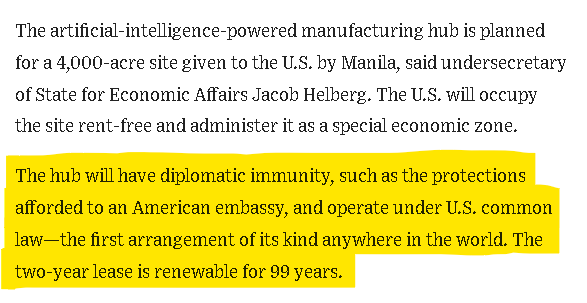
But in this instance, the US went much further still: they literally tried to carve out 4,000 acres of Philippine territory (in New Clark City, 60 miles north of Manila) to be governed under US common law with diplomatic immunity - the first arrangement of its kind anywhere in the modern world.
This is according to the WSJ who ran the story last month (https://t.co/kydhIQfo2A) as if it was a done deal (it wasn't).
Heard about the "French concession" or "British concession" in China during the century of humiliation? Same thing: the US basically asked for an "American concession" in the Philippines.
Unsurprisingly, there was quite a bit of backlash in the country with for instance the Peasant Movement of the Philippines (KMP) calling it a “massive sellout” of the country’s land, minerals, and sovereignty (https://t.co/nkXSajH2Q7).
So much so that the Philippines' government - namely Joshua Bingcang, president and chief executive of the Bases Conversion and Development Authority (BCDA) - issued a statement saying that the Philippines had rejected US proposals that would place the project beyond local jurisdiction (https://t.co/ZmNWJB03eH).
Note, by the way, this delicious irony: the BCDA is the government agency that was created in 1992 specifically to convert former US military bases at Clark and Subic Bay after the Philippines spent decades negotiating their closure. New Clark City - where the Pax Silica's hub would go - is built on the old Clark Air Base.
So the agency whose entire reason for existing is to turn former American colonial territory (i.e. US military bases) into sovereign Philippine land is the one now being asked to hand part of that very same land back under US jurisdiction (and, apparently, declined).
Of course though, blocking this specific jurisdiction grab doesn't change the bigger picture. The Philippines is still a Pax Silica signatory, and Pax Silica itself is structurally neocolonial: you supply the cheap labor and raw materials, align your export controls and regulations with Washington's, cut yourself off from the world's rising technological powerhouse - and in exchange you get assembly jobs and the privilege of getting a pat on the head and being called a "trusted partner."
They dropped the most cartoonishly colonial demand - governing Philippine soil under US law - but the underlying architecture is the same: you serve America's supply chain, on America's terms, and you relinquish your sovereign right to trade with whoever offers the best deal.