Vis dans ton époque
Aujourd'hui, nous vivons dans un monde où tout est instantané mais...
Le succès vient du travail acharné et du dévouement. Avoir envie de réussir ne suffira pas, être intelligent ne suffira pas non plus.
In 1948, a 32-year-old at Bell Labs published a paper nobody fully understood.
Engineers found it too mathematical. Mathematicians found it too engineering-focused. One prominent mathematician reviewed it negatively.
That paper - "A Mathematical Theory of Communication", became the founding document of the digital age.
The man was Claude Shannon. Father of Information Theory.
At 21, he wrote the most important master's thesis of the 20th century.
Working at MIT on an early mechanical computer, Shannon noticed its relay switches had exactly two states - open or closed. He had just taken a philosophy course introducing Boolean algebra, which also operated on two values: true and false.
Nobody had ever connected these two things.
His 1937 thesis proved that Boolean algebra and electrical circuits are mathematically identical, and that any logical operation could be built from simple switches.
Howard Gardner called it "possibly the most important, and also the most famous, master's thesis of the century."
Every digital computer ever built traces back to this insight.
At 29, he proved that perfect encryption exists.
During WWII, Shannon worked on classified cryptography at Bell Labs. His work contributed to SIGSALY, the secure voice system used for confidential communications between Roosevelt and Churchill.
In a classified 1945 memorandum, he mathematically proved the one-time pad provides perfect secrecy, unbreakable not just computationally, but provably, permanently, against an adversary with infinite power.
When declassified in 1949, it transformed cryptography from an art into a science. It laid the foundations for DES, AES, and every modern encryption standard.
At 32, he defined what information is.
His 1948 paper introduced one equation:
H = −Σ p(x) log p(x)
Shannon entropy. The average uncertainty in a probability distribution. The minimum bits required to encode a message.
Three things followed:
> He defined the bit - the fundamental unit of all information. His colleague John Tukey coined the name.
> He proved the channel capacity theorem, every communication channel has a maximum rate of reliable transmission. You can approach it. You can never exceed it.
> He unified telegraph, telephone, and radio into a single mathematical framework for the first time.
Robert Lucky of Bell Labs called it the greatest work "in the annals of technological thought."
Where his equation lives in AI today:
Cross-entropy loss - the function training every classifier and language model, is derived directly from H. Decision tree splits use information gain, which is H applied to data. Perplexity, the standard LLM evaluation metric, is an exponentiation of cross-entropy.
Every time a neural network trains, Shannon's formula runs inside it.
He also built the first AI learning device.
In 1950, Shannon built Theseus, a mechanical mouse that navigated a maze through trial and error, learned the correct path, and repeated it perfectly. Mazin Gilbert of Bell Labs said: "Theseus inspired the whole field of AI."
That same year he published the first paper on programming a computer to play chess. He co-organized the 1956 Dartmouth Workshop, the founding event of AI as a field.
The man:
He rode a unicycle through Bell Labs hallways while juggling. He built a flame-throwing trumpet, a rocket-powered Frisbee, and Styrofoam shoes to walk on the lake behind his house.
He called his home Entropy House.
When asked what motivated him: "I was motivated by curiosity. Never by the desire for financial gain. I just wondered how things were put together."
In 1985, he appeared unexpectedly at a conference in Brighton. The crowd mobbed him for autographs. Persuaded to speak at the banquet, he talked briefly, then pulled three balls from his pockets and juggled instead.
One engineer said: "It was as if Newton had showed up at a physics conference."
He died in 2001 after a decade with Alzheimer's, the cruel irony of information slowly leaving the mind of the man who defined what information was.
Claude, the AI model, is named after Claude Shannon, the mathematician who laid the foundation for the digital world we rely on today.
‼️ Hackers Let Microsoft 365 Users Complete MFA, Then Steal Logged-In Sessions
Source: https://t.co/oUtkj2xB0h
A sophisticated Phishing-as-a-Service (PhaaS) platform marketed as Mirage2FA is enabling threat actors to bypass multi-factor authentication (MFA) by allowing Microsoft 365 users to complete their regular login process before covertly stealing the authenticated session.
The Adversary-in-the-Middle (AiTM) framework generated thousands of potential compromise events from late 2024 through 2026, with the overwhelming majority resulting in hijacked session cookies rather than isolated password theft. Instead of attempting to break MFA algorithms directly, Mirage2FA positions itself between the user and legitimate authentication endpoints.
#cybersecuritynews
The so-called “calculator riots” of 1986 serve as a powerful reminder that today’s anxieties about artificial intelligence replacing human thinking are far from new.
In April 1986, a determined group of math educators staged a vocal protest outside the National Council of Teachers of Mathematics (NCTM) annual convention in Washington, D.C. Led by influential textbook author John Saxon, demonstrators carried signs declaring, “The Button’s Nothin’ ’Til the Brain’s Trained.”
They were opposing the NCTM’s new recommendation to incorporate electronic calculators into mathematics education at every grade level, including homework and exams.
The protesters worried that reliance on calculators would erode students’ mental arithmetic skills, numerical intuition, and deep conceptual understanding, potentially creating a generation of “calcuholics” overly dependent on machines.
The NCTM countered that calculators would free students from repetitive, low-level calculations, enabling them to tackle more complex problem-solving and higher-order thinking. Ultimately, the debate led to a pragmatic compromise: students would first master core mathematical concepts and mental strategies before using calculators as tools for more advanced work.
This balanced approach allowed technology to enhance, rather than replace, mathematical reasoning.
Today, as schools navigate the rapid rise of generative AI, the 1986 calculator compromise offers a valuable blueprint: prioritize genuine understanding first, then thoughtfully integrate powerful new tools.
🚀 1 Click for GitHub MCP in VS Code
You don't have to install an extension or mess with your mcp.json files to have GitHub Copilot in VS Code use the GitHub MCP server - learn that one weird trick on how to do it.
25 years ago, Microsoft’s CEO called Linux “a cancer.”
In 2026, Microsoft is shipping its own Linux distribution.
That’s not a joke. Azure Linux 4.0 is now public, free to download, open-source, and maintained by Microsoft.
But this is not Ubuntu, Mint, or Fedora for your laptop. Azure Linux is built for cloud workloads, Azure VMs, containers, Kubernetes, and enterprise infrastructure.
This means it does not have a desktop or a GUI. It is just a hardened, minimal Linux base tuned for Azure.
The technical stack is serious... Fedora 43 base, Linux 6.18 LTS, dnf5, glibc 2.42, systemd 258, Python 3.14 with JIT, OpenSSL 3.5 with post-quantum crypto support, and FIPS 140-3 certification in progress.
Microsoft already uses it internally across Azure services, and LinkedIn and Databricks have moved massive workloads to it.
It is an interesting move for Microsoft, as nobody really expected the company to build its own Linux distribution and ship it to the public.
10 System Design concepts every developer should master:
1. Scalability — design systems that handle increasing traffic and users
2. Load Balancing — distribute traffic across multiple servers efficiently
3. Caching — improve performance by storing frequently accessed data
4. Databases — understand SQL, NoSQL, replication, and sharding
5. Microservices — break applications into independent services
6. Message Queues — enable asynchronous communication between services
7. API Gateway — manage routing, authentication, and rate limiting
8. Fault Tolerance — build systems that continue working during failures
9. Distributed Systems — manage communication across multiple machines
10. Monitoring & Logging — track system health, errors, and performance
Grab the System Design Ebook: https://t.co/WIMretQFPE
geçen hafta claude ile 6 saat dijital ayak izimi sildim.
sonuç: 47 data broker listingi kaldırıldı. 12 ölü hesap silindi. 3 arama sonucu bastırıldı.
nasıl yaptım, adım adım. thread.
If you're just getting started with SYSTEM DESIGN, learn these 16 concepts (not joking):
1 The Computer Science Stack, Simply Explained
→ https://t.co/qfZnlyCSN5
2 Modular Monolith Architecture
→ https://t.co/VVV6v3KGHJ
3 How RPC Works
→ https://t.co/yeIgcmAxQx
4 How JWT Works
→ https://t.co/SZXXrlBsWH
5 Capacity Planning
→ https://t.co/umTNhM2dVY
6 How Bloom Filters Work
→ https://t.co/ntZXq7LxVn
7 How Consistent Hashing Works
→ https://t.co/7d6EipPcKF
8 How Service Discovery Works
→ https://t.co/BcL3tgxx1u
9 API Versioning - A Deep Dive
→ https://t.co/OHAtKSUgVN
10 Concurrency Is Not Parallelism
→ https://t.co/BwRHeuJ5AF
11 How Idempotent API Works
→ https://t.co/afe7ACuSYE
12 Saga Design Pattern
→ https://t.co/2CffTodOHL
13 How Databases Keep Passwords Securely
→ https://t.co/KSfIhpAT2j
14 API Design Best Practices
→ https://t.co/I2ejJ0kbYq
15 How Apache Kafka Works
→ https://t.co/8rOy9KgCMo
16 Distributed Systems 101
→ https://t.co/yi0K5K5RIE
What else should make this list?
===
👋 PS - Want my System Design Playbook (for free)?
Join my newsletter with 200K+ software engineers now:
→ https://t.co/ByOFTtOihX
===
💾 Save now & RT to help others start with system design.
👤 Follow @systemdesignone + turn on notifications.
Manage Your Cloud VPS Like a Pro Anywhere in the World with Full Server Management Included and a Free Migration of All Your Websites. Ideal for Developers & Hosting Companies.
Ultimate AI Engineer Roadmap 2026.
Built for real builders.
From multi-LLM orchestration → AI products that scale.
this is your blueprint.
Github: https://t.co/uDGWgvHvmw
BUILDING AN AGENT FROM SCRATCH ROADMAP
FOUNDATIONS OF PROGRAMMING AND AI
→ learn python programming and clean coding practices
→ understand data structures and algorithms basics
→ learn how APIs work and how to interact with them
→ understand core AI concepts and system design basics
UNDERSTANDING INTELLIGENT AGENTS
→ learn what an agent is (input → reasoning → action → output)
→ understand types of agents (rule-based, reactive, autonomous)
→ study agent architectures and decision-making flows
→ explore real-world agent use cases (chatbots, assistants, automation)
WORKING WITH LANGUAGE MODELS
→ understand how large language models (llms) work
→ learn tokens, embeddings, and context windows
→ explore prompt-response behavior and limitations
→ use APIs from providers like openai or open-source models
PROMPT ENGINEERING AND CONTROL
→ design clear and structured prompts
→ use system prompts to guide behavior
→ apply few-shot and zero-shot prompting techniques
→ control output format and consistency
MEMORY AND CONTEXT MANAGEMENT
→ implement short-term and long-term memory
→ store conversations and retrieve relevant context
→ use vector databases for semantic search
→ manage context windows efficiently
TOOL USAGE AND FUNCTION CALLING
→ connect agents to external tools and APIs
→ implement function calling and structured outputs
→ build tools for web search, calculations, and automation
→ enable agents to decide when and how to use tools
PLANNING AND REASONING SYSTEMS
→ implement step-by-step reasoning workflows
→ use chain-of-thought and reasoning strategies
→ build planners that break tasks into sub-tasks
→ create feedback loops for better decisions
AGENT FRAMEWORKS AND ORCHESTRATION
→ explore frameworks like langchain and llamaindex
→ manage workflows and multi-step pipelines
→ build modular and reusable agent components
→ orchestrate multiple tools and processes
MULTI-AGENT SYSTEMS
→ design systems with multiple collaborating agents
→ assign roles and responsibilities to agents
→ enable communication between agents
→ handle coordination and conflict resolution
EVALUATION AND IMPROVEMENT
→ test agent outputs for accuracy and reliability
→ implement evaluation metrics and benchmarks
→ reduce hallucinations and improve consistency
→ iterate and refine prompts and logic
DEPLOYMENT AND SCALING
→ deploy agents as APIs or web applications
→ integrate agents into real-world systems
→ monitor performance and usage
→ scale using cloud infrastructure and containers
SECURITY AND SAFETY
→ handle user data securely
→ implement guardrails and output filtering
→ prevent misuse and harmful outputs
→ ensure compliance and ethical usage
REAL-WORLD PROJECTS
→ build a chatbot agent with memory
→ create a research assistant agent
→ develop an automation agent for workflows
→ build a multi-tool AI assistant
KEEP LEARNING AND BUILD PROJECTS
→ explore new agent architectures and techniques
→ experiment with open-source models
→ follow latest trends in AI and LLMs
→ continuously improve and scale your systems
Grab the AGENT ENGINEERING EBOOK:
https://t.co/EF9vcd1Hze
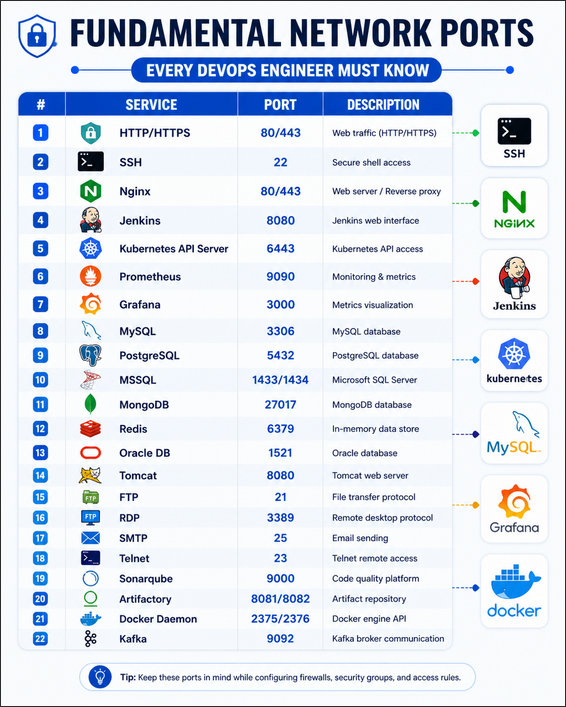
how to troubleshoot any network issue
your packet's journey from curl to some server in oregon goes through like 12 places it can die, and most ppl only check 2 of them.
the trick: walk the layers in order. each one you rule out narrows the blast radius. "ip route get 8.8.8.8" is the single most underrated command in linux - it tells you exactly which interface and gateway will be used. one line. done.
"getent hosts" over dig, btw - dig lies to you because it doesn't use NSS like your actual app does. wild how many DNS issues are just "/etc/nsswitch.conf" being weird.
mtr instead of traceroute, always. and if hops show as "* * *" past your ISP, run it with "-T -P 443" - turns out half the internet rate-limits ICMP but happily forwards TCP.
stuck in syn-sent? that's a firewall ghosting you.
"100.64.x.x" as your public IP? congrats, you're behind CGNAT and inbound is cooked.
works on small pings but breaks on big ones?
MTU. it's always MTU. (it's never DNS until it is)
cheat sheet:
https://t.co/voddV8PAlb
#linux #devops #sre #networking #sysadmin #homelab #tcpip