#MondayMotivation
Adewuyi Funke is missing.
She was last seen at oronna, Modakeke while on her way leaving the church premises on Wednesday, November 12, 2025 around 8 pm.
Confirmed by some of the church members that she exchanged pleasantries before leaving the church premises.
Wahala!! VDM create a scenario to us explain how important it is for zlatan to speak out for the mohabd case after a Lagosian tell him to please stop calling out Zlatan towards the Mohbad case 🕺🏃♂️🏃♂️🏃♂️🏃♂️
EFCC RECRUITMENT
Current Affairs, English, and Mathematics.
You should also visit the EFCC's official social media handle and study the monthly quizzes they post there.
Under the Child Right Act (Section 27) and Laws of different States passed to protect children, it is unlawful to take a child out of custody or protection of the parents or guardians without their knowledge or against their will. In fact, the Child Rights Act and Children protection laws prescribe upto 7-10years and 15-20years jail term for anyone found guilty of this.
Also, under the Nigerian Constitution, Section 39, which guarantees right to freedom of religion forbids the spread of religious instructions against the will of that person or religious practices that are not approved by the parents or guardians.
None of the above has any root in Shariah Law and No Shariah Court has jurisdiction over such offenses. Then I wonder where the people got the news from that the Borno woman was tried before a Shariah Court and under Shariah Law, to the extent that some of you here started attacking Islam/Shariah and by extension, the Muslims.
Again, no Shariah Court has power over non-Muslims. No non-Muslim can be arraigned or tried before a Shariah Court, except such non-Muslims submit to the jurisdiction of the Court in writing. No doubt, we have had instances and cases of extremists under the guise of enforcing shariah take laws into their hands. They are not different from those who carry out jungle justice in other parts of the country. No law in Nigeria empowers a private person or citizens to make laws or execute laws without following the laid down legal processes or allowing the lawful authorities to do so.
The closest we have under our laws is the power of private person to arrest upon reasonable suspicion of crime being committed or escape from lawful custody. In doing so, the private person is mandated to handover the arrested person to the lawful authorities and not take laws into their hands,
It is also important to note that the existence of shariah court and its jurisdiction is clearly provided for under the Supreme Law in Nigeria, the Constitution and laws made by different states. This does not by any extension suppress the existence and application of the Constitution and other laws in the States.
I have also said it repeatedly that any group of individual under the guise of any religion, including Islam, that wants to practice its religion and laws, must do so within the bounds of the existing legal system and the Constitution.
Enough of propaganda. Enough of anti-shariah narratives.
For those who cannot read it all or who read it but couldn't understand, this is the summary.
Aisha is a 16 year old girl staying with her mother in Borno. The first accused person who is the only person convicted by the court and sentenced to 14 years imprisonment is her neighbour in Borno named Lami, a Christian. Now the gist is that Aisha had earlier been convinced from her school at the age of 13 by a teacher to leave her house and travel to Jos where she was converted to Christianity and spent a year. She eventually returned home to her mother after feeling homesick. Her mother then handed her over to Lami to help get her back to school and enroll her in WAEC. The same Lami also convinced Aisha who is now 16 to return to Jos and continue her Christian training without the knowledge of her mother. Lami enabled and sponsored Aisha to return to Jos while pretending not to know of her whereabouts when her mother was desperately searching for her. As a matter of fact, Lami was purchasing the household properties of Aisha's mother which she sold to enable her raise money to search for her daughter. Once again, Aisha felt homesick and returned to Borno to meet her mother after a year. Aisha then opened up to her mother about everything including the things Lami has been buying for her to enable her stay in Jos. Aisha's mother confronted Lami about it and it caused an uproar. The court found only Lami guilty of abducting Aisha and forcing her to convert to Christianity. She was sentenced to 14 years imprisonment amongst others.
The Supreme Court has decided in Agbai v. Okogbue (1991) 7 NWLR (Pt. 204) 391 that “nobody can be compelled to associate with other persons against his will".
Any practice that forces membership or seizes property to enforce it is void as it violates the freedom of association.
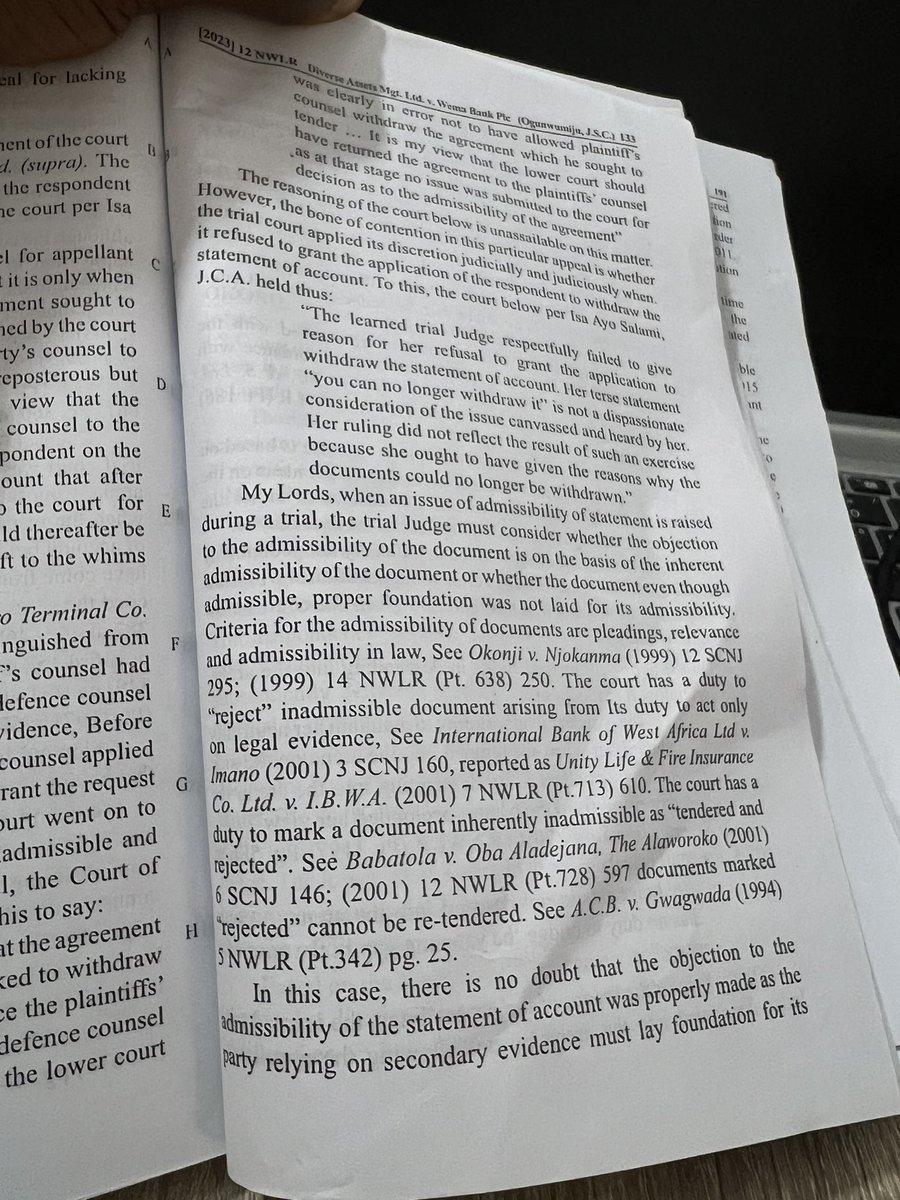
In Diverse Asset Mgt. Ltd. v. Wema Bank Plc (2023) NWLR. Pt. 1879, the Supreme Court held that where a document is rejected for lack of proper foundation and not for inherent inadmissibility, such documents can be re-tendered as exhibit after proper foundation has been laid.
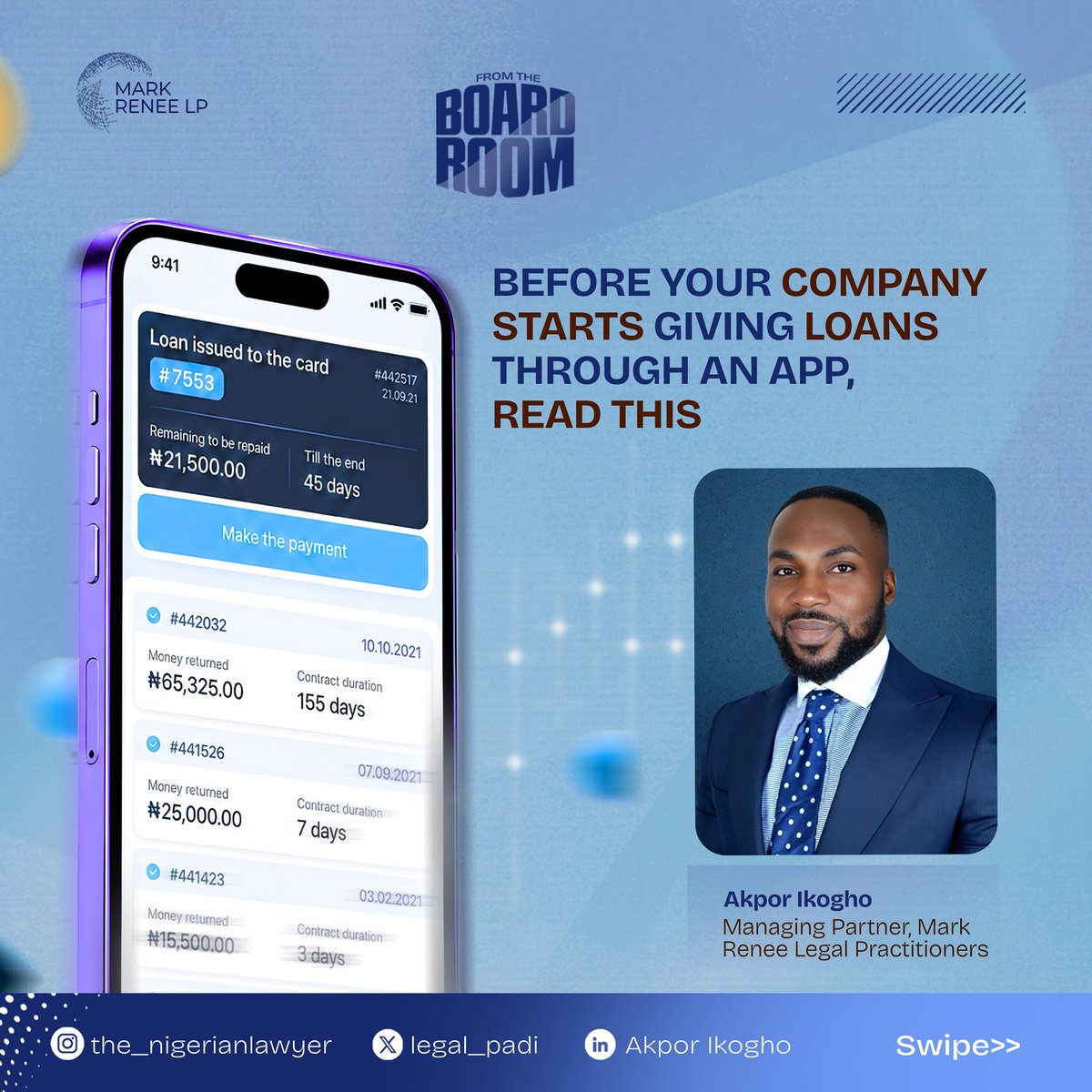
BEFORE YOUR COMPANY STARTS GIVING LOANS THROUGH AN APP, READ THIS
A founder wants to launch a loan app. The developers are almost done building it. There’s money available to lend, a system for checking borrowers, and a plan to recover loans when people default.
Everything looks ready.
Then someone asks, are we actually licensed to lend money?
And who is legally responsible if something goes wrong?
These are questions I would want answered long before the app goes live.
In Nigeria, building an app that gives loans is relatively straightforward. Setting up the business behind that app is where things can become complicated.
FIRST, WHO IS ACTUALLY GIVING THE LOAN?
This is one of the first things we need to establish.
Is your company lending its own money? Are you partnering with a bank or microfinance bank? Or are you simply providing the technology through which another company gives loans?
The distinction matters because the regulatory requirements may be different.
Depending on the structure, you may need a moneylender’s licence under the applicable state law, or a CBN licence where you’re operating as a regulated financial institution.
And then there’s the Federal Competition and Consumer Protection Commission (FCCPC).
Under the Digital, Electronic, Online or Non-Traditional Consumer Lending Regulations 2025, covered digital lending businesses must comply with the FCCPC’s registration and approval requirements.
But here’s what founders sometimes miss: FCCPC approval does not automatically replace whatever licence you need to carry on the underlying lending business.
Having your company registered with the CAC doesn’t settle that question either.
Before spending money building the app, establish the appropriate legal structure and the approvals it requires.
PARTNERING WITH A BANK DOESN’T SETTLE EVERYTHING
Suppose your startup doesn’t have a lending licence, so you decide to partner with a licensed microfinance bank.
The bank provides the money. Your company owns the app, brings in customers, assesses applications and earns a percentage of the revenue.
Fine. But who is the actual lender? Who decides whether a customer qualifies? Who bears the loss if the customer defaults? Who handles complaints and debt recovery?
These things should be clearly agreed.
The FCCPC’s 2025 Regulations also require approval for certain consumer lending partnerships. The agreement between the parties must address matters including their respective obligations, interest rates, allocation of risk, recovery methods and data protection.
So simply putting a licensed bank’s name somewhere in your app doesn’t automatically make the entire arrangement compliant.
And if the bank’s licence or approval becomes restricted or is withdrawn, that could affect your ability to continue offering the product.
This is why the partnership agreement deserves as much attention as the technology itself.
YOUR INTEREST RATE IS NOT THE ONLY THING THAT MATTERS
Imagine someone applies for a ₦100,000 loan.
Your app advertises 10% interest, but deducts ₦10,000 as a processing fee before disbursement. The customer receives ₦90,000 and must repay ₦110,000 after 30 days.
You’ve advertised 10%, but the customer is effectively paying ₦20,000 to use ₦90,000 for one month.
That’s about 22.2% of the money actually received.
Under Regulation 17 of the FCCPC’s 2025 Regulations, lenders must clearly disclose interest rates, repayment terms and associated fees before the customer completes the transaction.
You also need to be careful about default charges, automatic deductions and clauses allowing you to change the terms after disbursement.
The customer should understand how much they’re receiving, how much they’ll repay, when repayment is due and what happens if they default.
Hiding important charges inside lengthy terms and conditions is a very poor way to build a lending business.
“A document which bears no date of execution or date when it comes into effect or operation is uncertain, invalid and unenforceable.”
Anyaoha V. Obioha (2014) 6 NWLR Pt 1404
JAMB WARNS UNIVERSITIES AGAINST ISSUING ADMISSION LETTERS
The Joint Admissions and Matriculation Board, JAMB, has warned universities and other tertiary institutions against issuing admission letters to candidates, insisting that the responsibility rests solely with the board.
JAMB Registrar, Prof. Segun Aina, gave the warning when he received delegation from a private University in his office.
The registrar noted that the Board is the only body statutorily empowered to issue official admission letters to candidates seeking admission into universities, polytechnics and colleges of education.
While expressing concerns that candidates often assume admission letters issued by individual institutions are genuine, stressing that such practices could mislead applicants into believing they had secured valid admission.
The registrar however urged institutions involved in such practice to desist and ensure that candidates obtain the appropriate admission documents from JAMB as only admissions processed and recognised through CAPS would be accepted for purposes such as mobilisation for the National Youth Service Corps (NYSC).
Even as an experienced lawyer, if you have never done certain things before, you may not get them right on the first attempt and could find yourself fumbling embarrassingly.
One area where litigation lawyers often fumble is in arguing an appeal as an appellant before the Court of Appeal.
Recognising this challenge, I decided to share the procedure here in case it may help someone.
How to Argue an Appeal in the Court of Appeal:
1. My Lords, this is an appeal against the judgment (or ruling, as the case may be) of the High Court of Lagos State, Ikeja Judicial Division, coram Hon. Justice A. L. Yunusa, delivered on 25 May 2019. The judgment is contained on pages 119 to 129 of the Record of Appeal.
2. My Lords, the Notice of Appeal dated 26 May 2019 was filed on 26 May 2019. The Notice of Appeal is at pages 130 to 133 of the Record of Appeal.
3. The Record of Appeal in this matter was compiled and transmitted within time. It was transmitted to this Honourable Court on 14 April 2019.
4. The Appellant’s Brief of Argument was filed on 13 October 2021 but was deemed properly filed and served on 18 March 2022.
5. The Appellant filed a Reply to the Respondent’s Brief of Argument on 29 June 2022.
6. We adopt the Appellant’s Brief of Argument filed on 13 October 2021, deemed properly filed and served on 18 March 2022, as our argument in this appeal, and urge this Honourable Court to allow the appeal and set aside the decision of the lower Court.
Note: If you have a Reply Brief, also adopt it together with the Appellant’s Brief of Argument.
As Respondent’s Counsel, your role is easier: all you need to do is adopt the Respondent’s Brief of Argument and urge the Court to dismiss the appeal and affirm the judgment of the lower Court.
Michael Ugah, FCIArb, UK.
CAREER OPPORTUNITY: JOIN THE ENERGY SECTOR
A new recruitment opportunity is open to professionals across a wide range of disciplines, including:
We welcome applications from professionals across a wide range of disciplines, including but not limited to:
Corporate Communications, Branding, Advertising, Public Relations
Marketing, Business Development, Sales and Client Relations
Government Relations, Community Relations, Corporate Social Responsibility
Supply Chain, Purchasing, Procurement, Inventory Management and Demand Planning
Fleet Management, Transport and Logistics
Security and Health, Safety, Security and Environment
Facilities, Office Management, Real Estate, Construction
Strategy, Business Performance
Accounts, Finance, Risk, Audit, Internal Control
Human Resources, and General Administration
Legal, Corporate Governance and Company Secretariat
Drilling Operations, Well Services
Engineering, Oil and Gas Operations, Instrumentation
Geology, Geoscience, Sub Surface Engineering
Information Technology, Artificial Intelligence, Robotics, Software and Hardware
Sustainability (Environment, Social and Governance)
\Whether your expertise is technical, commercial or corporate, this could be an opportunity to contribute to the future of energy.
📌 Job Identification: 627
🔗 Apply here: https://t.co/l6YUAi0NfW