Cheers to 9 incredible years of @BinanceForIN
Grateful to celebrate this milestone with an amazing community. Here's to the builders, the believers, and the journey ahead.
Happy #BinanceTurns9
One thing I really like about the RISEx points system is that it feels community-first.
Excluding market makers from earning points means more rewards stay with actual traders instead of being concentrated at the top.
Still early to participate. If you're joining, feel free to use my referral code UFF6SIKK for a 15% points boost.
https://t.co/QpkINtMDXZ
Our Season 0 retro points dropped last night. A total of 1.6M points were allocated to the early users of the venue!
While some users are stoked with the outcome, others received below their expectations. I suspect our model differs from most venues, so a clarification is warranted.
As a product builder I like to ship incrementally, test features, iterate and adapt. You can't do that with a drop like this. A large chunk total allocation goes out in one shot, you get one chance to set the incentive structure for everything that follows.
So rather than looking at how others did it, we took a first-principles approach.
Retro allocation
Our goal was to ensure a smooth transition between the seasons while giving an increased boost to early users given they participated on the venue when it was less mature.
We landed on 1.6M points directed to the retro drop followed by a 200k weekly emission for season 1. Given S0 had a $47M daily average, and we’re now tracking for a ~$98M daily average during the first week of S1, meaning S0 traders received a 40% bonus on pts-per-volume relative to S1 so far.
Depending on the length of the program, we expect this will be 15-20% of the total points allocation. We checked this number against other programs. Our pre-season was 12 weeks, relative to competitors this was generous. We felt this was a good way to reward the early users.
Retro points model
So what are the goals of the retro drop? Here’s what we prioritised:
- Genuine traders, the kind we want on the venue regardless of points
- Reward genuine economic spend
- Reward earlier users for trading on a less mature venue
- Reward retention and encourage more of it
Now I can’t share too many specifics because we intend to continue using a similar model, albeit with tweaks and different weights and boosts, but I’ll share enough to add clarity to our approach.
The primary contributors to the model are:
- Trading & Liquidation Fees: What the users spent on the venue
- Slippage: Rewards high value whale takers who provide good flow to the exchange.
- Maker Adverse Selection: Makers who were adversely selected actually got paid back on it
- OI Carry: Cost-of-capital to hold market exposure on the venue
Additional contributors include a retention boost and user segmentation. Referrals follow the same logic. If you refer someone, you earn 10% of the points they generate, not their raw volume. They keep every point they earn, and you earn an additional 10% alongside them.
Retention
The retention boost is simple. The more you use the product, and the longer you have used it, the more boost you receive, and the more you will continue to receive as season 1 continues.
Slippage
Traders who are willing to put large orders directly into the book create opportunity for market makers, but also lead to skew in the book, which in turn attracts more sophisticated traders, like systematic traders and funding-rate arbitragers. This diverse user base is what creates a really healthy venue.
Additionally, we found this rewarded the most active click traders, in particular scalpers, swing traders, momentum traders and traders who put large orders directly into the book. This cohort is a priority.
Note: Slippage is potentially gameable so we’re quite cautious about it.
Per-week distribution
We decided against a fixed-weekly allocation. Why?
During Season 0 the daily volume ranged from $10M per day to . Given the variance in activity week-to-week, a fixed-weekly distribution would lead to very large outliers, leading to grossly underpaying and overpaying for the same activity. Rather, we boosted the early traders relative to their baseline. Week 1 starting with the largest multiplier, linearly declining to no multiplier for the last week.
Why have users received vastly different drops based relative to their volume?
Volume is considered, but only through fees and other metrics. Consider two users. Fred, a swing trader who puts larger taker orders in the book, vs an algo market maker, John.
Fred’s costs will be fees (3bps taker) and slippage. Depending on how large the order is and how thin the books are, the cost of slippage can vary greatly. This is a real cost Fred has to pay to participate on the venue.
John’s costs, however, will be a 1bps maker fee plus any adverse selection they experience by holding limit orders on the book. The best measure of adverse selection is markouts, you essentially look at how bad your execution is relative to the price in a short period of time. Negative maker markouts capture genuine economic contribution to the venue, but they are much smaller than slippage on aggregate.
As a result, Fred's cost will often be over 4x John's per unit volume.
Concentration
The top 100 HL traders generate ~35% of fees, top 1,000 users generate ~70%. That reflects the healthiest market structure among perps DEXs. The fact is, perpetual exchanges are concentrated, and RISEx is no exception. We took measures to reduce the concentration and flatten out the distribution. However, this increases the sybil attack surface, so it’s difficult to do well.
Additionally, RISEx has one big benefit here, we have one primary market maker, the XLP vault, which receives no points for trading activity. XLP is almost 50% of the volume on the venue and received zero points for trading.
The Genesis Pool
The Genesis Pool is a 100k-point pool reserved exclusively for season 0 traders and will be distributed over the first 4 weeks of Season 1 (In addition to the 200k weekly Season 1 drops)
Genesis Traders who stay active on the venue will earn from the pool. Distribution is weighted by activity and skewed toward the earliest traders.
This is a way for us to reward the early users that continue trading on the venue and reinforcing retention
What next?
Season 0 laid the scaffolding and rewarded the users who helped us get here. Season 1 is about building a world class exchange, realising the vision of atomic composability and unlocking a new wave of DeFi. We’re optimising for quality traders, deeper books and a healthy venue.
Season 1 is live, the genesis pool is running. See you in the books.
Every project starts with an idea.
A few become products.
Even fewer become places where people actually trade every day.
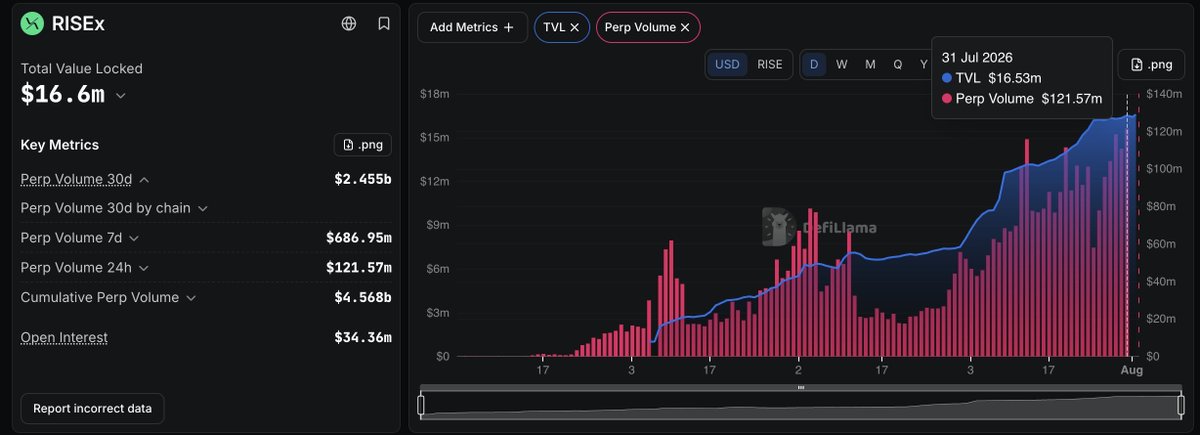
Watching RISEx grow from its early days to $16.5M+ TVL and billions in trading volume has been a reminder that sustainable growth isn't built overnight.
It's built one trader, one trade, and one milestone at a time.
@risextrade
RISEx Keeps Building Momentum as On-Chain Activity Accelerates
@risextrade continues to show why it's becoming one of the standout protocols on RISE Chain. The platform isn't just adding new features its core metrics are improving across the board, suggesting that user adoption and capital efficiency are growing at the same time.
The latest milestone is $16.5M+ in Total Value Locked (TVL), reflecting stronger participation from liquidity providers and increasing confidence in the protocol. Sustained TVL growth often signals that users see long-term value in an ecosystem rather than simply chasing short-term incentives.
Trading activity is telling a similar story. With more than $2B in perpetual trading volume over the past 30 days and over $4B in cumulative perpetual volume, RISEx is proving that traders are actively using the platform. Rising Open Interest above $30M further reinforces this trend, showing that more capital is staying engaged in the market.
Several recent developments have helped drive this momentum. The launch of Season 1: Ignite, the expansion of synthetic trading markets, and the introduction of the XLP Vault have created more opportunities for both traders and liquidity providers while strengthening the overall ecosystem.
Growth in DeFi is rarely defined by a single metric. When TVL, trading volume, and open interest all move upward together, it usually points to genuine network adoption. RISEx appears to be following that path, steadily establishing itself as one of the leading fully on-chain perpetual trading platforms in the RISE ecosystem.
Hype comes and goes.
Metrics don't.
I compared @risextrade and @TxFlow_L1
using publicly available on-chain data to see which protocol is leading today and why.
Read the full article below. 👇 https://t.co/G8UG01jSeD
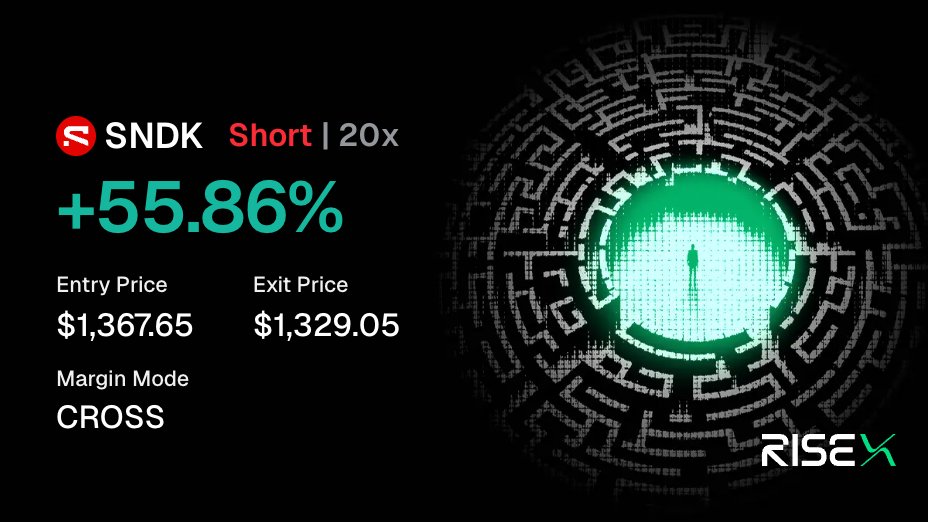
$SNDK went from one of the market's hottest names to losing over 55% from its highs.
Volatility creates fear for some...
...and opportunity for others.
Managed to close my short with a +55.86% return on @risextrade.
If you're looking for a solid perp DEX to trade both sides of the market, give it a try.
https://t.co/QpkINtMDXZ
Referral Code: UFF6SIKK
Over the past few weeks, I've been paying close attention to the growth of perpetual DEXs, and one project that keeps standing out is @risextrade
While many discussions are centered around future FDV estimates and token launches, I think the on-chain metrics deserve just as much attention.
On June 21, RISEx's open interest was sitting around $5M.
As of August 1, that number has climbed to over $34M roughly 7x growth in just six weeks.
That's not the only metric moving:
• 24h Perp Volume: $121.5M
• 7D Volume: $687M
• 30D Volume: $2.45B
• Cumulative Volume: $4.56B
• TVL: $16.6M
Looking at the broader perp ecosystem, liquidity often rotates toward platforms that continue to execute and attract traders. If that trend continues, projects demonstrating consistent growth are likely to capture more attention over time.
Of course, no single metric guarantees future success. Open interest can rise and fall quickly, token launches change market dynamics, and every protocol has different tokenomics.
But one thing is clear:
RISEx isn't just promising growth; it's already showing it.
That's why it's one of the perp DEXs I'm watching most closely over the coming months.
If you're new to @risextrade and want to explore the platform, feel free to use my referral code when creating your account:
https://t.co/QpkINtMDXZ👇
UFF6SIKK
One thing I appreciate about RISEx's points model is that it doesn't appear to reward activity for the sake of activity.
The focus seems to be on real economic contribution:
• Consistency
• Meaningful trading
• Position management
• Genuine referrals
That's a healthier direction than simply chasing volume.
#RISEx @risextrade
Yesterday, Sam, RISEx @risextrade co-founder, published a long post commenting on the points system of the DEX. I showed the post to ChatGPT and asked it to create a strategy to receive as many RISEx points as possible based on the information from Sam's post. ChatGPT did a great summary:
After reading the RISEx Season 0 points breakdown, here are my biggest takeaways for anyone trying to maximize Season 1 points:
1️⃣ Volume alone is NOT the goal
RISEx explicitly says volume is only considered through fees and other economic metrics. Wash trading or churning volume is unlikely to be efficient.
2️⃣ Taker flow is heavily rewarded
They compare a taker to a market maker and state: "Fred's cost will often be over 4x John's per unit volume."
This strongly suggests takers earn significantly more points per dollar of volume because they pay more real costs.
3️⃣ Large taker orders > many tiny orders
Slippage is a scoring factor. Larger market orders that consume liquidity appear to be more valuable than splitting everything into tiny trades (although RISEx notes this metric is monitored for abuse).
4️⃣ Retention matters a lot
The post mentions retention multiple times. Consistent trading across the entire season is likely much more valuable than one massive trading day.
5️⃣ Holding positions matters
Open Interest (OI) Carry is part of the model. Holding exposure instead of opening and closing instantly should improve points efficiency.
6️⃣ Maker trading isn't ignored
Market makers who suffer adverse selection are compensated, rewarding genuine liquidity provision rather than passive volume farming.
7️⃣ Referrals are powerful
You earn 10% of the points your referrals generate—not 10% of their trading volume. Active traders are far more valuable than inactive referrals.
Conclusion
If I wanted to optimize points, I'd prioritize:
• Stay active every week
• Trade consistently (preferably daily)
• Generate real fees
• Hold positions when it makes sense
• Use taker orders where appropriate instead of only passive maker orders
• Refer high-quality active traders
The overall message is clear: RISEx is optimizing for economic contribution, not raw trading volume.
----
In general, all the above aligns with my DN strategy I described in my recent article: https://t.co/JRqs2wt1IM It looks like funding farming will be one of the best strategies to harvest points during Season 1, at least for some time.
#RISEx
My first week on @risextrade
38.7 RISE Points
Ranked #3,491 globally
Happy with the start, but the goal is to keep improving week after week. Excited to see how far consistency can take me.
See you on the leaderboard
https://t.co/55loa5Dp2d
#RISEx#RISEPoints#Web3#Crypto
Next 500 USDC Days of Summer Challenge is live!
Post your 7-day performance against the BTC benchmark to enter your chance to win 50 USDC.
To enter you must:
1. Screenshot your 7-day performance showing you are outperforming BTC and your username
2. Post to X by Midnight on Thursday July 30th
3. Tag @CoinTracer_App in your post
@risextrade has officially completed the first weekly distribution of Season 1: Ignite, marking the beginning of its live RISE Points program.
A total of 200,000 RISE Points have been distributed to 5,886 active accounts that participated during Week 1, representing the first regular weekly reward allocation under the Ignite campaign.
In addition, 25,000 Genesis Pool RISE Points were distributed to 5,120 Season 0 traders. The Genesis Pool is a special bonus for early supporters who traded on RISEx before Season 1 launched, with a total of 100,000 bonus points set to be distributed across the first few weeks of Ignite.
This week, I earned 38.7 RISE Points, placing me at #3,491 on the global leaderboard. It's a solid start, and I'm looking forward to climbing even higher in the weeks ahead.
The RISE Points system rewards more than just trading volume. It also takes into account factors such as open interest, slippage, and overall trading activity, encouraging meaningful participation while strengthening liquidity across the RISEx ecosystem.
With Season 1: Ignite now in full swing, every trading week presents a new opportunity to earn more points, improve your ranking, and be part of the growing RISEx ecosystem.
Join RISEx: https://t.co/KaMaUuob52
@risextrade #RISEx #Ignite #PerpDEX #Crypto #Trading
Week 1 drop is here. 200,000 RISE Points distributed across 5,886 accounts.
Additional 25,000 RISE Points distributed across 5,120 accounts as part of the Genesis Pool to Season 0 users.
Track yours here: https://t.co/s3RKAiUYR2