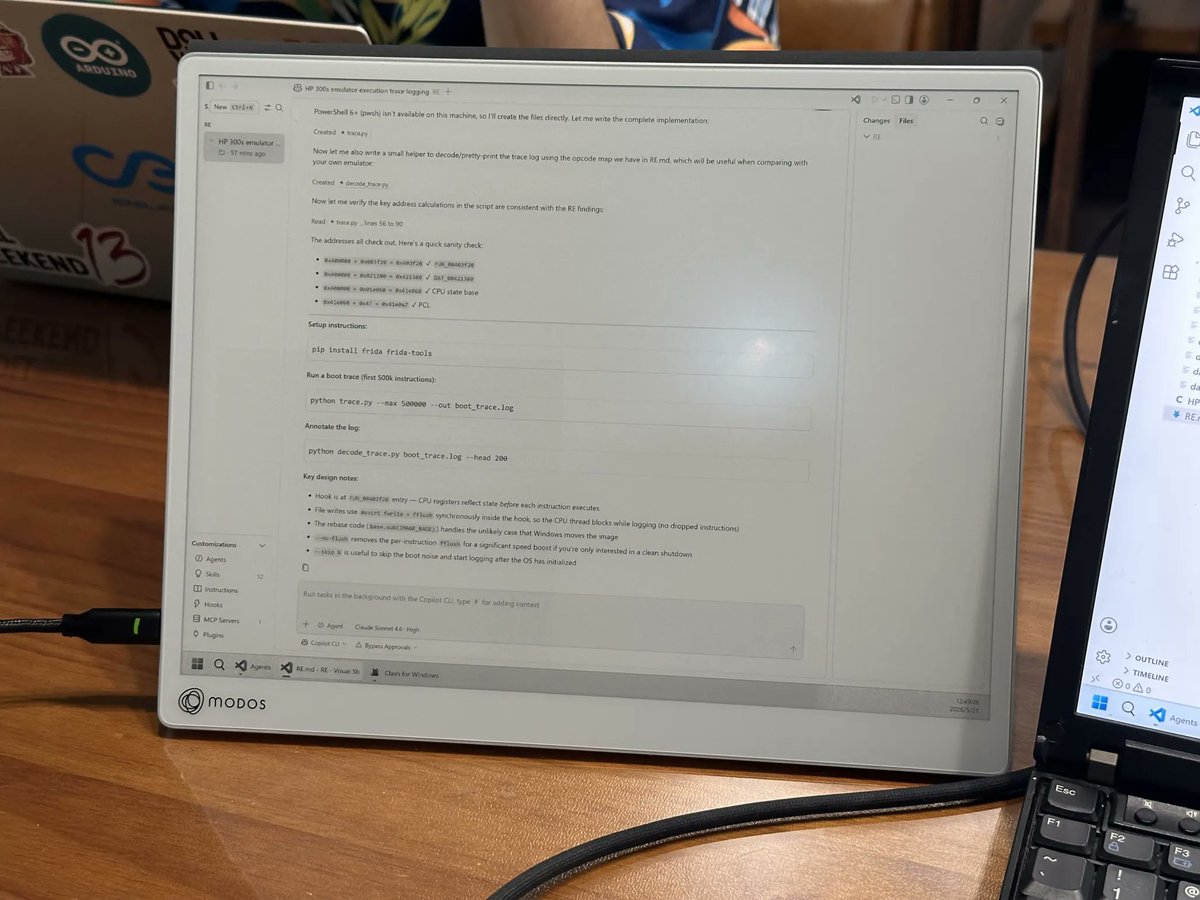
I have just made our latest product (Modos Flow) open-source: https://t.co/FYoKwDrdlN. With complete source code (for both MCU and FPGA) and PCB design source file in KiCAD. It's a 300-ppi Eink portable monitor with 60Hz refresh rate and touch screen:
The Zig project's rationale for their blanket ban on AI-assisted contributions makes a lot of sense to me - for them, time spent reviewing PRs isn't about the code, it's about growing new contributors for the future of the project https://t.co/9DoJqBGphp
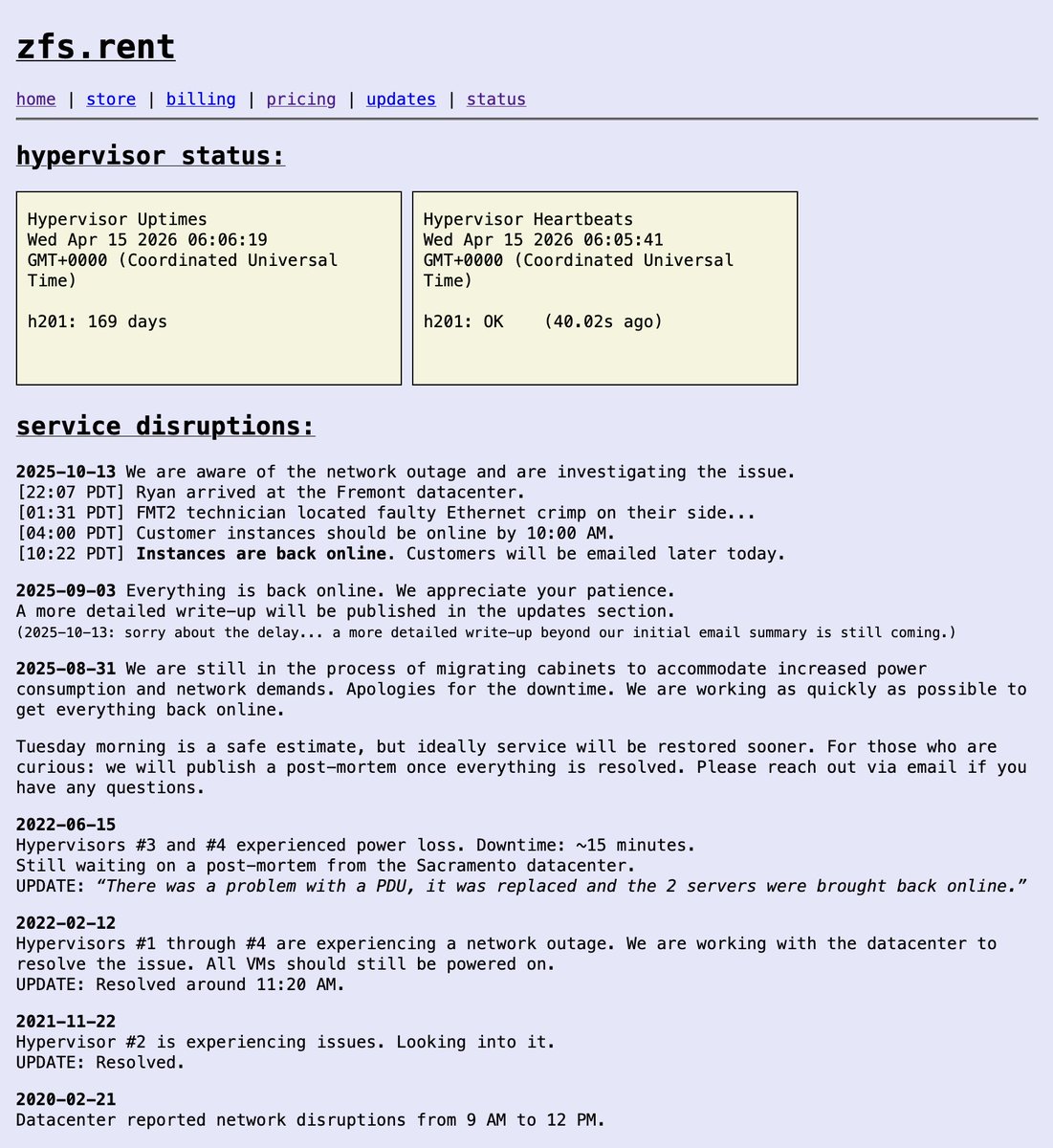
Check out https://t.co/vTlaUjDAr3, ship them a HDD, for $10/mo they host your ZFS filesystem.
Their website is so whimsical! Service disruption section shows a log "22:07 PDT Ryan arrived at Fremont datacenter" followed by "01:31 FMT2 technician located faulty Ethernet crimp on their side..." 💀 haha
⭐ New talk! https://t.co/dhDLxakvrC
Coding agents might help us finally break out of two cages: the app model, which traps computing in one-size-fits-all silos; and programming as a specialization, which has crowded out cultures of imagination and domain insight.
There's so much low-hanging fruit in AI harnesses right now. Seems like everyone I know is making their own harness and trying different ideas and *everything is working*.
@nbbaier@stevekrouse@brian_lovin@bentlegen Sad I didn't get to continue on it! Tbh I remember leaving it in kind of a mess. Send me a message if you have any Qs about it 🙏
Followup to yesterday's post: I'm starting to think as agents and LLM APIs of being a state synchronization problem and that we might look into what the local first folks are doing. Dumped my thoughts here: https://t.co/M66kxMgsyE
the final boss of inputs.
attachments, mentions, slash commands, autocomplete, action menus, sources, apps, tools, suggestions, states, modes, settings and more!
Most of the "90% of code written by AI" claims come from vendors selling AI tools and lack credibility as a result
Armin (creator of Flask, Jinja, Click) is different - when he says 90% of a new infrastructure project he's building was AI generated it's worth paying attention
Talked with the Claude Code team on how they build Claude Code. It feels I get a peek into the future, and I get why Dario said 6 months ago that 90% of code will be written by AI.
This team works SO differently than any eng team I saw. Will share in-depth soon. One example:
Today we're releasing the tldraw SDK 4.0, the fourth major release of our infinite canvas SDK. This release comes with new starter kits, including the Cursor-for-tldraw agent starter, license changes, and a major accessibility milestone.
# Enough AI copilots! We need AI HUDs
IMO, one of the best critiques of modern AI design comes from a 1992 talk by the researcher Mark Weiser, where he ranted against "copilot" as a metaphor for AI.
33 years ago, but still incredibly relevant for anyone designing with AI...
Weiser was speaking at an MIT Media Lab event on "interface agents". They were grappling with many of the same issues we're discussing in 2025: how to make a personal assistant that automates tasks for you and knows your full context. They even had a human "butler" on stage representing an AI agent.
Everyone was super excited about this... except Weiser. He was opposed to the whole idea of agents!
He gave this example: how should a computer help you fly a plane and avoid collisions?
The agentic option is a "copilot" — a virtual human who you talk with to get help flying the plane. If you're about to run into another plane it might yell at you "collision, go right and down!"
Weiser offered a different option: design the cockpit so that the human pilot is naturally aware of their surroundings. In his words: "You’ll no more run into another airplane than you would try to walk through a wall."
Weiser's goal was an "invisible computer"—not an assistant that grabs your attention, but a computer that fades into the background and becomes "an extension of [your] body".
There's a tool in modern planes that I think nicely illustrates Weiser's philosophy: the Head-Up Display (HUD), which overlays flight info like the horizon and altitude on a transparent display directly in the pilot's field of view.
A HUD feels completely different from a copilot! You don't talk to it. It's literally part invisible—you just become naturally aware of more things, as if you had magic eyes.
## designing HUDs
OK enough analogies. What might a HUD feel like in modern software design?
One familiar example is spellcheck. Think about it: spellcheck isn't designed as a "virtual collaborator" talking to you about your spelling. It just instantly adds red squigglies when you misspell something! You now have a new sense you didn't have before. It's a HUD.
(This example comes from Jeff Heer's excellent Agency plus Automation paper. We may not consider spellcheck an AI feature today, but it's still a fuzzy algorithm under the hood.)
Here's another personal example from AI coding. Let's say you wanna fix a bug. The obvious "copilot" way is to open an agent chat and ask it to do the fix.
But there's another approach I've found more powerful at times: use AI to build a *custom debugger UI* which visualizes the behavior of my program. (https://t.co/bzyaI4q5jM)
With the debug view, I have a HUD! I have new senses, I can see how my program runs. The HUD extends beyond the narrow task of fixing the bug. I can ambiently build up my own understanding, spotting new problems and opportunities.
Both the spellchecker and custom debuggers show that automation / "virtual assistant" isn't the only possible UI. We can instead use tech to build better HUDs that enhance our human senses.
## tradeoffs
I don't believe HUDs are universally better than copilots! But I do believe anyone serious about designing for AI should consider non-copilot form factors that more directly extend the human mind.
Hmm so when should we use one or the other? TBH I think it's super tricky, but we can try to use the airplane analogy for some intuition:
When pilots just want the plane to fly straight and level, they delegate that task to a "virtual copilot" autopilot system. But if the plane just hit a flock of birds and needs to land in the Hudson, the pilot is gonna take manual control, and we better hope they have great instruments that help them understand the situation.
In other words: routine predictable work might make sense to delegate to a virtual copilot / assistant. But when you're shooting for extraordinary outcomes, perhaps the best bet is to equip human experts with new superpowers...
The @membraneio dashboard is meant for repetitive admin tasks where you need a simple UI and some logic (e.g. query a Postgres db), like this widget I built to flip "staff picks" in our package registry
New longform @inkandswitch essay! 📜
Malleable Software
by me, Josh Horowitz, @pvh and Todd Matthews.
https://t.co/3Xhk888Uuh
It's about why people need agency over their software tools, and how to make that happen.
Here's the quick tl;dr... 1/





![geoffreylitt's tweet photo. # Enough AI copilots! We need AI HUDs
IMO, one of the best critiques of modern AI design comes from a 1992 talk by the researcher Mark Weiser, where he ranted against "copilot" as a metaphor for AI.
33 years ago, but still incredibly relevant for anyone designing with AI...
Weiser was speaking at an MIT Media Lab event on "interface agents". They were grappling with many of the same issues we're discussing in 2025: how to make a personal assistant that automates tasks for you and knows your full context. They even had a human "butler" on stage representing an AI agent.
Everyone was super excited about this... except Weiser. He was opposed to the whole idea of agents!
He gave this example: how should a computer help you fly a plane and avoid collisions?
The agentic option is a "copilot" — a virtual human who you talk with to get help flying the plane. If you're about to run into another plane it might yell at you "collision, go right and down!"
Weiser offered a different option: design the cockpit so that the human pilot is naturally aware of their surroundings. In his words: "You’ll no more run into another airplane than you would try to walk through a wall."
Weiser's goal was an "invisible computer"—not an assistant that grabs your attention, but a computer that fades into the background and becomes "an extension of [your] body".
There's a tool in modern planes that I think nicely illustrates Weiser's philosophy: the Head-Up Display (HUD), which overlays flight info like the horizon and altitude on a transparent display directly in the pilot's field of view.
A HUD feels completely different from a copilot! You don't talk to it. It's literally part invisible—you just become naturally aware of more things, as if you had magic eyes.
## designing HUDs
OK enough analogies. What might a HUD feel like in modern software design?
One familiar example is spellcheck. Think about it: spellcheck isn't designed as a "virtual collaborator" talking to you about your spelling. It just instantly adds red squigglies when you misspell something! You now have a new sense you didn't have before. It's a HUD.
(This example comes from Jeff Heer's excellent Agency plus Automation paper. We may not consider spellcheck an AI feature today, but it's still a fuzzy algorithm under the hood.)
Here's another personal example from AI coding. Let's say you wanna fix a bug. The obvious "copilot" way is to open an agent chat and ask it to do the fix.
But there's another approach I've found more powerful at times: use AI to build a *custom debugger UI* which visualizes the behavior of my program. (https://t.co/bzyaI4q5jM)
With the debug view, I have a HUD! I have new senses, I can see how my program runs. The HUD extends beyond the narrow task of fixing the bug. I can ambiently build up my own understanding, spotting new problems and opportunities.
Both the spellchecker and custom debuggers show that automation / "virtual assistant" isn't the only possible UI. We can instead use tech to build better HUDs that enhance our human senses.
## tradeoffs
I don't believe HUDs are universally better than copilots! But I do believe anyone serious about designing for AI should consider non-copilot form factors that more directly extend the human mind.
Hmm so when should we use one or the other? TBH I think it's super tricky, but we can try to use the airplane analogy for some intuition:
When pilots just want the plane to fly straight and level, they delegate that task to a "virtual copilot" autopilot system. But if the plane just hit a flock of birds and needs to land in the Hudson, the pilot is gonna take manual control, and we better hope they have great instruments that help them understand the situation.
In other words: routine predictable work might make sense to delegate to a virtual copilot / assistant. But when you're shooting for extraordinary outcomes, perhaps the best bet is to equip human experts with new superpowers...](https://pbs.twimg.com/media/Gw40mIsXsAA0Eyw.jpg)


