@republic stop telling on live TV how Military is s planning search operations and what equipment they are using.
@adgpi please don't allow media to talk to army people and don't show them what you are using
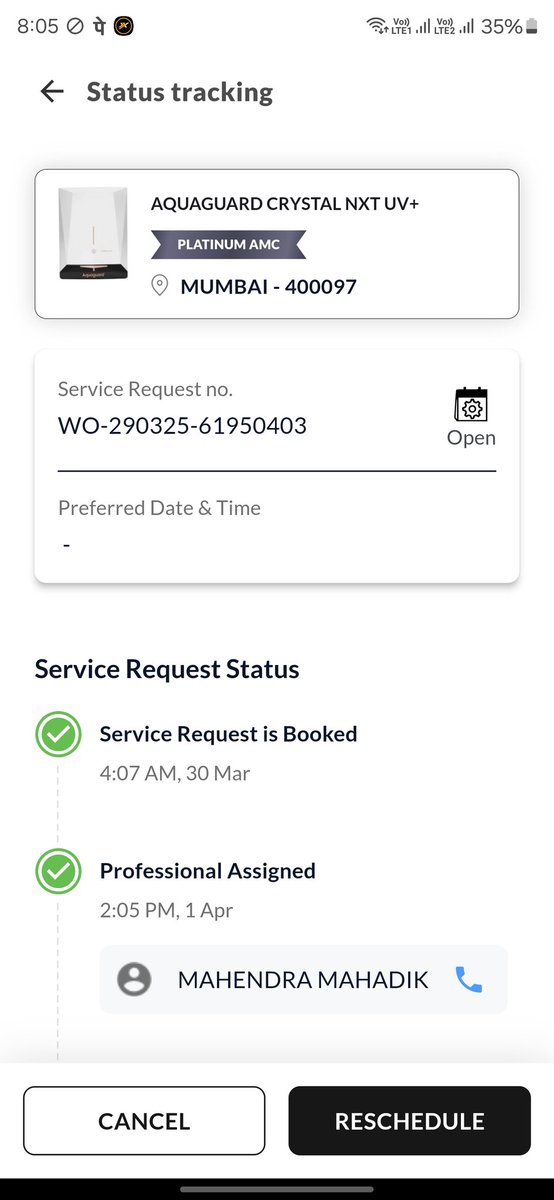
@EurekaForbes AMC service is booked for 1st April. But no one even called for this .
I know it will not change anything at your end but due to pathetic service I am changing the purifier. Just take this as feedback
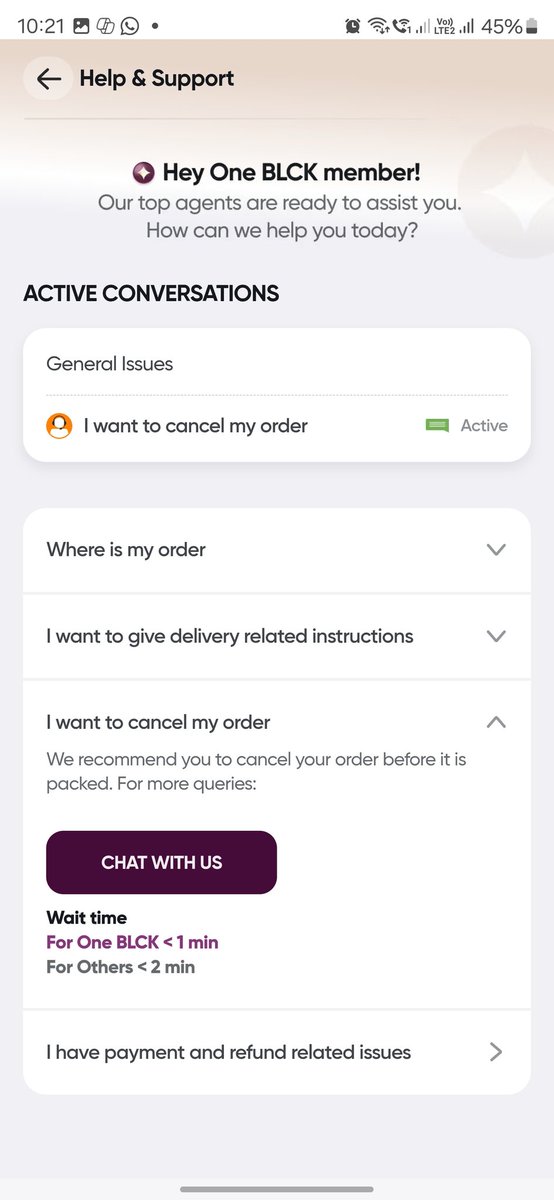
@SwiggyInstamart 1st pic you are claiming less than 1 minute Waiting time for BLCK members. Next 2 pics are proof that I am waiting for more than 5 mins. I want money back that I paid for BLCK premium.
@AshwiniVaishnaw I'll be traveling to my hometown Kudal by train number 20111 from Mumbai, and if it reaches Kudal on schedule, I'll vote for BJP.
My vote for BJP is in your hand.
@tcl_india 1st complaint wasr registered on 5th of September. In response I got TV replaced on 8th of October, That TV again gone blank on very next day so I registered new complaint. Replacement is not delivered till now.
@SwiggyCares@Swiggy I appreciate your predictive algorithm. If I add Butter chicken to the list you suggest tandoori roti. But, If in order you don't deliver tandoori roti ideally my butter chicken is of no use still you only do refund for roti not butter chicken? May i knw Y?
महाराष्ट्र सरकारने आता "लाडका नवरा" योजना काढावी ..
योजने अंतर्गत नवऱ्यांच्या हितासाठी त्यांच्या बायकांना वर्षातून २ वेळा माहेरी जायला सरकारने आर्थिक मदत करावी....
#Maharashtra#LadlaBhaiYojana#eaknathshinde
A lot has been said in recent times about the fiscal management (especially on debt) of our government under PM Modi’s leadership. Many times, absolute numbers have been compared without considering the GDP growth on which we base the debt calculation. I would like to put out a clear picture, unlike @INCIndia, which hides behind lofty promises that are non-transparent and disconnected from reality.
Has @INCIndia considered the cost of the lofty promises made in their manifesto? Have they calculated how much the 'Khata Khat' schemes will cost fiscally? Will they borrow substantially for them, or will they raise taxes to fund them?
How many welfare schemes would @RahulGandhi shut down to accommodate the fiscal cost of the 'Khata Khat' schemes?
Would @RahulGandhi care to answer these real questions and explain how their gigantic schemes of fiscal splurge would work without increasing taxes or borrowing heavily and running down the economy? Here’s a challenge to him to answer these questions for the people of India.
The truth is that our government's fiscal management is much better than that of the UPA despite facing COVID-19 pandemic in which substantial resources were used for relief efforts.
During the UPA rule from FY2004 to FY2014, Central Government Debt, including external debt at current values, grew about 3.2 times, from ₹18.74 lakh crore in March 2004 to ₹58.59 lakh crore in March 2014. This increase was much greater than the 2.9 times growth from ₹58.59 lakh crore in FY 2014 to ₹172.37 lakh crore in FY 2024 (RE). This lower increase between FY 2014 and FY 2024 occurred despite the impact of the COVID-19 pandemic, where the Centre borrowed to provide relief to those in need even as revenues fell.
The Central Government’s debt, which was 52.2% of GDP at the end of FY 2013-14, was reduced to around 48.9% in FY 2018-19 through gradual fiscal consolidation. During this period, the fiscal deficit was lowered from 4.5% in FY 2013-14 to 3.4% in FY 2018-19. However, due to the COVID-19 pandemic and proactive government measures to protect lives and livelihoods, the fiscal deficit surged to 9.2% of GDP in FY 2020-21, increasing the central government’s debt to 61.4% of GDP.
Post-pandemic, our government pursued a balanced approach to fiscal consolidation while sustaining economic growth. This strategy reduced the fiscal deficit from 9.2% of GDP in FY 2020-21 to 5.8% in the Revised Estimates for FY 2023-24.
The Interim Budget projects a further reduction to 5.1% of GDP in FY 2024-25. Similarly, the Central Government's debt-to-GDP ratio fell from 61.4% in FY 2020-21 to 57.1% in FY 2023-24.
Under UPA, for 6 consecutive years between FY 2009 and FY 2014, the ratio of India's Gross Fiscal Deficit (GFD) to Gross Domestic Product (GDP) was at least 4.5%. It was between 4.5% - 5% of GDP in 3 out of the 6 years, between 5% - 6% in one, and more than 6% in 2 years. And there was no COVID-19-like crisis that needed such a quantum of fiscal expansion, showing poor fiscal management by UPA.
The Net Market Borrowings (G-sec) of the Centre had gone up a whopping 4.5 times during the UPA regime. It went up by 2.6 times under our government despite the COVID-19 pandemic. It shows the robust fiscal management of our govt.
During COVID-19, ‘borrow, spend & even print money’ to reboot the economy was the predominant advice given by the so-called “luminaries” of the opposition parties led by Congress. Ironically, the same people are complaining about high debt levels. (1/4)