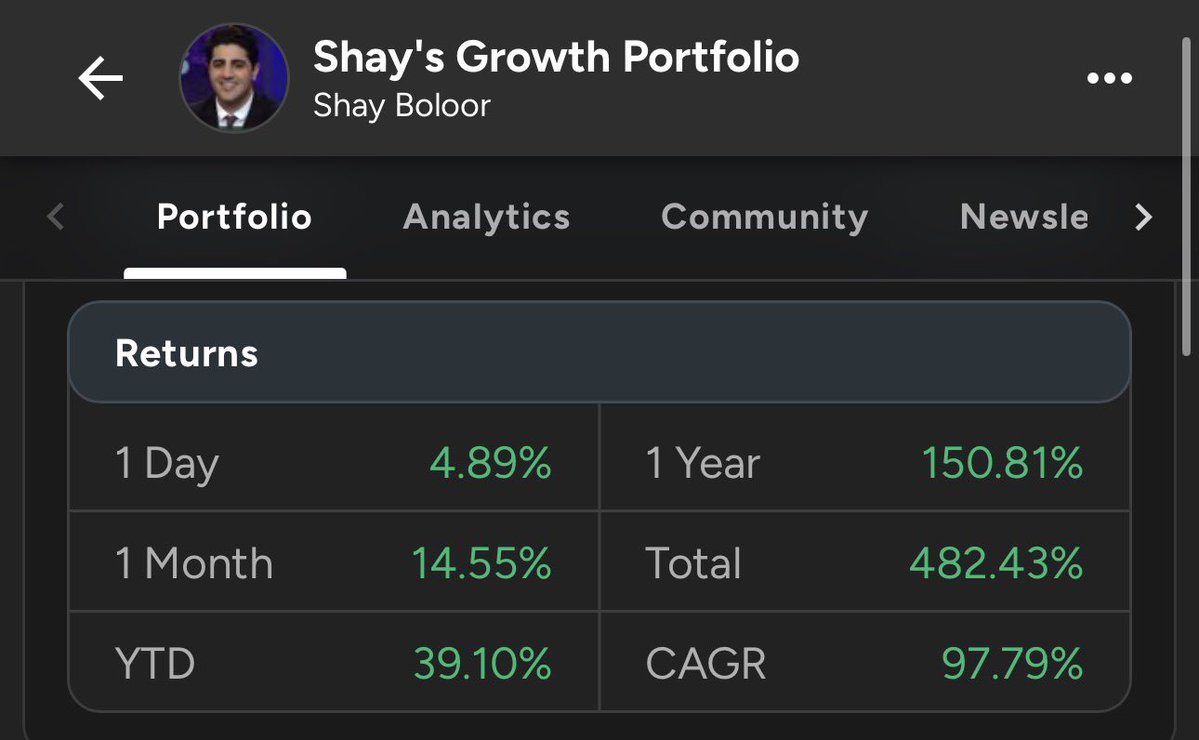
🚨 $NBIS:
11X REVENUE GROWTH
NEARLY 3X EBITDA MARGINS
SAME STOCK PRICE
$NBIS 12 MONTHS AGO:
Stock price: $100/share
ARR: $551 MILLION
Adj. EBITDA Margin: 19%
$NBIS TODAY:
Stock price: $100/share
ARR: $6.4 BILLION
Adj. EBITDA Margin: 53%
Let that sink in
ARR has surged MORE THAN 11X.
EBITDA margins have nearly TRIPLED.
Yet the stock is trading at virtually the SAME price.
The business has transformed. The valuation hasn't reflected it.
Is Wall Street overlooking what could be a massive opportunity in $NBIS ? 👀
If you also own this stock, like, follow, and share to get the latest information first
$ASTS is building its own reusable rocket with Blacklift and I understand why the market is punishing the $1.3B commitment given ~4% dilution and what I think is a very ambitious late 2028 launch target.
But zoom out for a second because existing launch agreements already cover first 100+ BlueBirds so this is more about eventually owning one critical piece of infrastructure AST still has to outsource.
And when one of those launch providers is $SPCX which is also competing directly through Starlink Mobile then having a a rocket that can carry 5 BlueBirds on your own schedule eliminates a risk that matters far more over next decade as the constellation scales.
$ORCL data center supply chain is scaling and capacity + deployments are accelerating. Positive progress in turning on and monetizing OCI more rapidly.
I started investing in $NBIS in January 2025.
Since then, dozens of smaller "neoclouds" have emerged.
Almost every week, someone would ask me why I wasn't investing in one of these smaller players instead.
The argument was almost always the same: Nebius was no longer as cheap as when I built my position, while these smaller companies supposedly offered significantly more upside.
My answer was always consistent.
I wouldn't bet against them. Demand for AI compute was exploding, capital was flowing into the sector, and investor sentiment was overwhelmingly positive. In that environment, even companies with questionable business models could perform exceptionally well.
But I also consistently warned that this was an industry with unproven long-term unit economics and significant risks that, in my view, weren't always being adequately reflected in valuations.
Buying GPUs is relatively easy when capital is abundant. Building a sustainable, differentiated AI cloud business is something entirely different.
It's about having the right team, securing reliable access to power, developing infrastructure at scale, optimizing the total cost of ownership, maintaining access to affordable capital, building the right customer relationships, and ultimately generating attractive returns on invested capital over multiple hardware cycles.
Not all "neoclouds" are created equal.
Some are essentially intermediaries, relying heavily on third-party infrastructure, external financing, and a favorable pricing environment. Others are building vertically integrated platforms, with greater control over their infrastructure, hardware deployments, networking, software, and overall cost structure.
Having a best-in-class engineering team, proprietary technology, established ecosystem relationships, and the ability to execute complex infrastructure projects at scale can create competitive advantages that are much harder to replicate than simply acquiring GPUs and plugging them into a power source.
Of course, vertical integration comes with its own challenges, particularly the capital requirements and execution risks involved. But when executed well, I believe it can provide a meaningful edge through greater operational control, efficiency, and better long-term margins.
The cost of capital is another critical differentiator. In such a capital-intensive industry, even a few percentage points in financing costs can dramatically change the economics of a project.
And we still don't know what those economics will look like once the current supply-demand imbalance eventually normalizes.
Being right about the future of AI compute demand doesn't automatically mean you'll be right about the long-term economics of every company trying to meet that demand.
That's precisely why I chose to focus on the company I believed was best positioned to build a sustainable business over the long term: Nebius.
Its engineering DNA, proven track record of execution, vertically integrated approach, capital allocation strategy, and focus on building a full-stack AI cloud platform were among the key differentiating factors behind my original thesis.
I'm not going to go into detail about everything that differentiates Nebius from its competitors here, as I've been discussing those factors extensively since I first invested. The point of this post is simply to explain why I've always been so selective about where I invest within this sector.
I never argued that every other "neocloud" would fail, or that their stocks couldn't outperform $NBIS in the short term. In fact, I consistently said the opposite.
My point was that not all these companies would emerge as long-term winners, and I preferred owning the business I had the highest conviction in rather than chasing whichever smaller player appeared cheapest or had the most upside on paper.
Now, with growing concerns about the sustainability of the neocloud business model and the availability of financing, the market is beginning to pay more attention to some of those risks.
And frankly, I think that's healthy.
It was never particularly healthy to see companies pivoting from completely unrelated industries into AI infrastructure, without experienced teams, and still managing to raise capital simply to acquire a few GPUs.
If the sector begins to consolidate, I actually believe that could strengthen the position of the best-capitalized and most operationally capable players.
Weaker competitors scaling back could mean less new capacity coming online, a longer-lasting supply-demand imbalance, and potentially better pricing and margins for those able to continue expanding.
Over the long term, I believe the companies with genuine competitive advantages will be in a much stronger position.
And to be clear, Nebius isn't immune to any of these risks. This is something I've emphasized in every single article I've written about the company: $NBIS, and this sector as a whole, isn't suitable for every investor.
We're talking about an industry with significant uncertainties, where execution will be critical and many questions about the long-term economics remain unanswered.
But nothing about the recent debate changes my original investment thesis.
I never invested in Nebius because I believed every "neocloud" would succeed.
I invested because I believed Nebius had the right differentiating factors and long-term vision to become one of the few sustainable winners in this industry.
And I still do.
$NBIS just secured a $3.5B financing facility from Citi to fund GPU purchases and AI data center expansion with borrowing costs starting at SOFR + 2.75%.
Whats great is that the 364-day structure gives Nebius capital to secure GPUs now while its $40B+ in long-term $META and $MSFT contracts could support cheaper financing as capacity comes online.
A lot of growth stocks are getting seriously oversold on the daily RSI right now and could be due for a bounce:
• $RKLB ~29
• $AAOI ~29
• $OPEN ~29
• $VRT ~28
• $ASTS ~28
• $AEHR ~28
• $OKLO ~28
• $CRWV ~27
• $AMAT ~26
• $IREN ~25
• $EOSE ~23
• $TE ~23
• $CIFR ~21
If you want to improve faster as a trader, study your BEST setups again and again.
The 5-STAR setups that can actually move your equity curve.
I added 5 clean examples to the thread below 👇
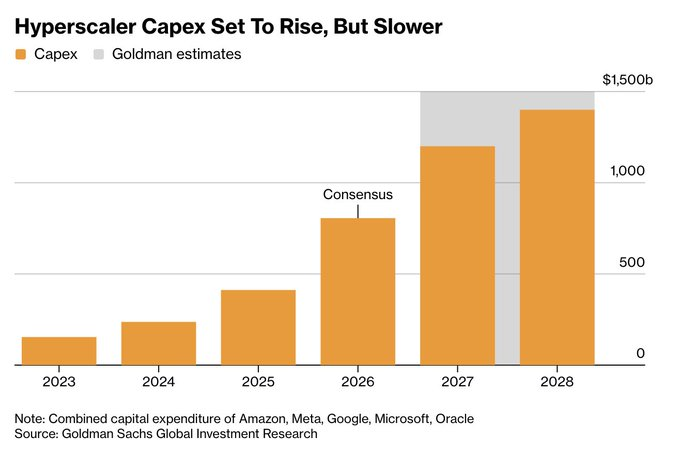
Goldman sees AI infrastructure spending by $AMZN, $META, $GOOGL, $MSFT and $ORCL jumping 50%+ to $1.2T in 2027.
That puts focus on monetization because Goldman says they need ~$300B of annual AI revenue to break even while more than a third of that CapEx may be debt funded.
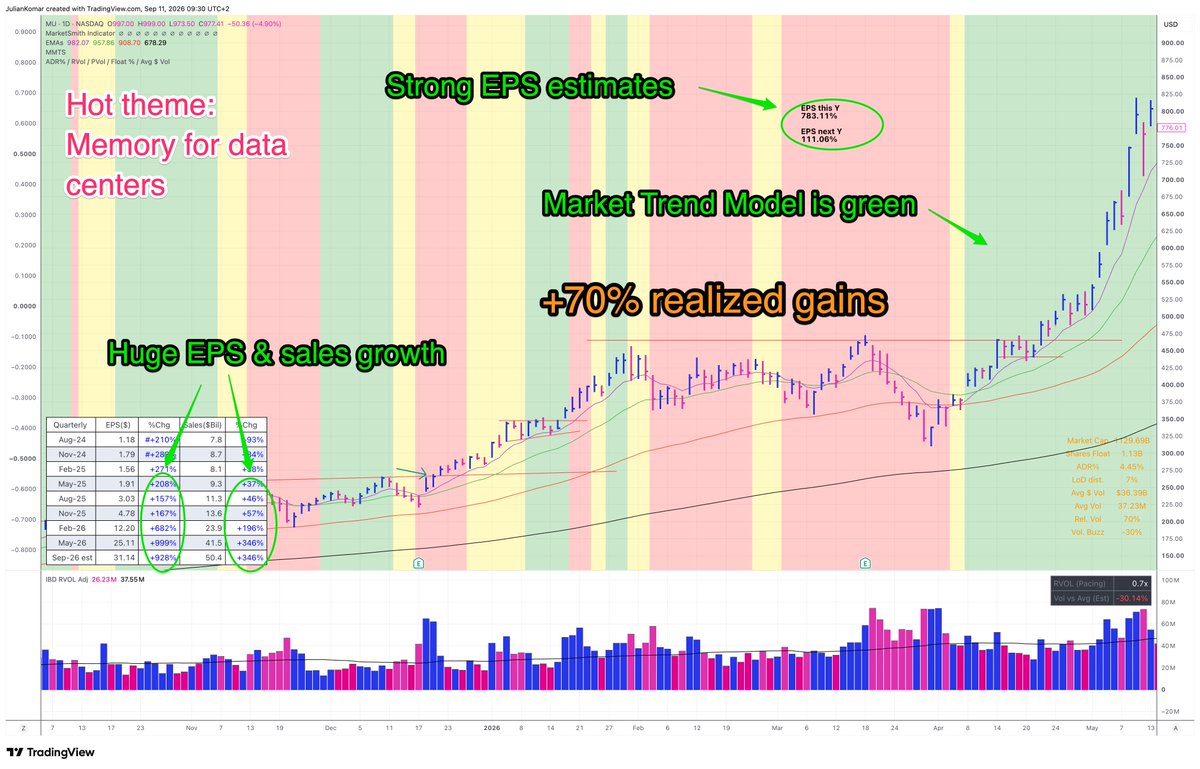
I’ve studied my biggest winners and compared them with trades that made money but never became exceptional.
One thing became very clear:
The difference is rarely just the setup.
A clean breakout can give me a profitable trade. But for a stock to become a huge winner, I usually need several forces working together.
1. A powerful market
Not just an uptrend.
I want a market with real upside momentum—what I classify in my Market Trend Model as a “Moneymaker” or even a “Life-Changing” market.
When the market is moving aggressively higher, leaders have the environment they need to make much larger moves.
Many of my average winners came from markets that were okay, but not exceptional.
2. A hot theme
The biggest winners rarely move in isolation.
They usually belong to a theme attracting a lot of capital.
Rare earth metals and data centers in 2025.
Memory, data center computing and networking stocks in 2026.
Finding the right theme matters. Finding one of the strongest companies inside that theme matters even more.
3. Exceptional growth + a compelling story
This is where I become very demanding.
What I like to see:
• Sales growth: 20%+ minimum, preferably 40%+
• EPS growth: 50%+
• Acceleration in sales and/or earnings
• Strong estimates: e.g. +50% EPS this year and +25% next year
• A compelling story that can drive future growth
• New products, services or business segments creating another growth cycle
The exact numbers will vary from company to company. What matters is that there is something exceptional enough to make institutions want to own the stock.
That's where many average winners are different.
They might have a good chart. They might participate in a strong sector. They might simply rise because the overall market is going up.
But there is nothing truly exceptional about them.
My biggest winners usually had all three:
• Powerful market
• Hot theme
• Exceptional company
A good setup can make money.
But when I’m looking for a stock that can make my year, I want much more than a good setup.
5 LAYERS OF THE 1.6T OPTICAL SUPPLY CHAIN
The move to 1.6T optics is turning every transceiver into a denser semiconductor system with more content flowing into DSPs, lasers, timing, power management and broader network around each module:
1. $MRVL, $AVGO, $CRDO & $ALAB form signal-processing layer behind 1.6T optics supplying DSPs, SerDes, retimers & equalization that push 224G electrical lanes into next-generation transceivers
2. $COHR, $LITE & $AAOI sit at optical front end across lasers, drivers, photodiodes & TIAs with Coherent consuming all of its InP laser output internally, Lumentum demand still running above supply & AAOI already landing a $200M+ volume 1.6T hyperscaler order
3. $SITM is less obvious timing beneficiary supplying precision oscillators inside transceivers on both ends of an optical link so content scales directly with module count as 1.6T deployments ramp
4. $MPWR, $ADI, $TXN, $MCHP & $ON provide power-management layer as higher-speed optics require more voltage regulation, power conversion & thermal control inside every module
5. $APH, $TEL, $GLW, $CIEN, $NOK & $ANET extend the opportunity beyond the transceiver into connectors, fiber & networking infrastructure required to move 1.6T bandwidth across broader AI fabric
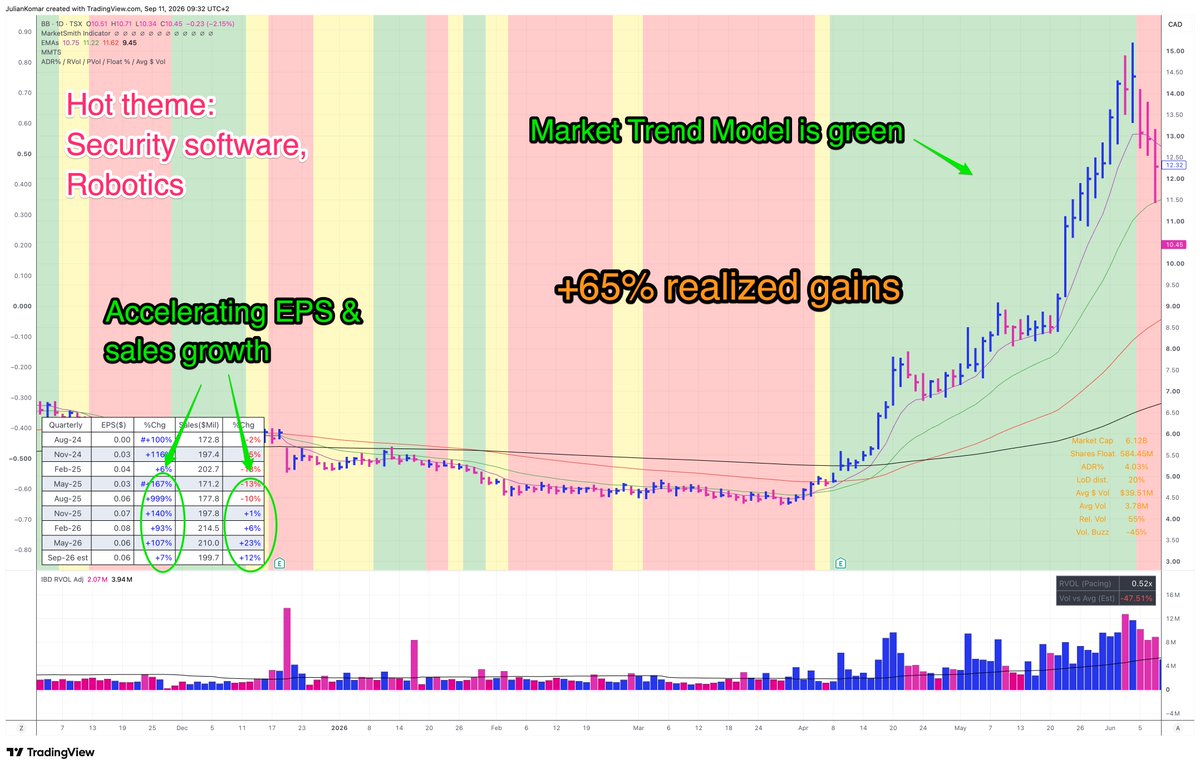
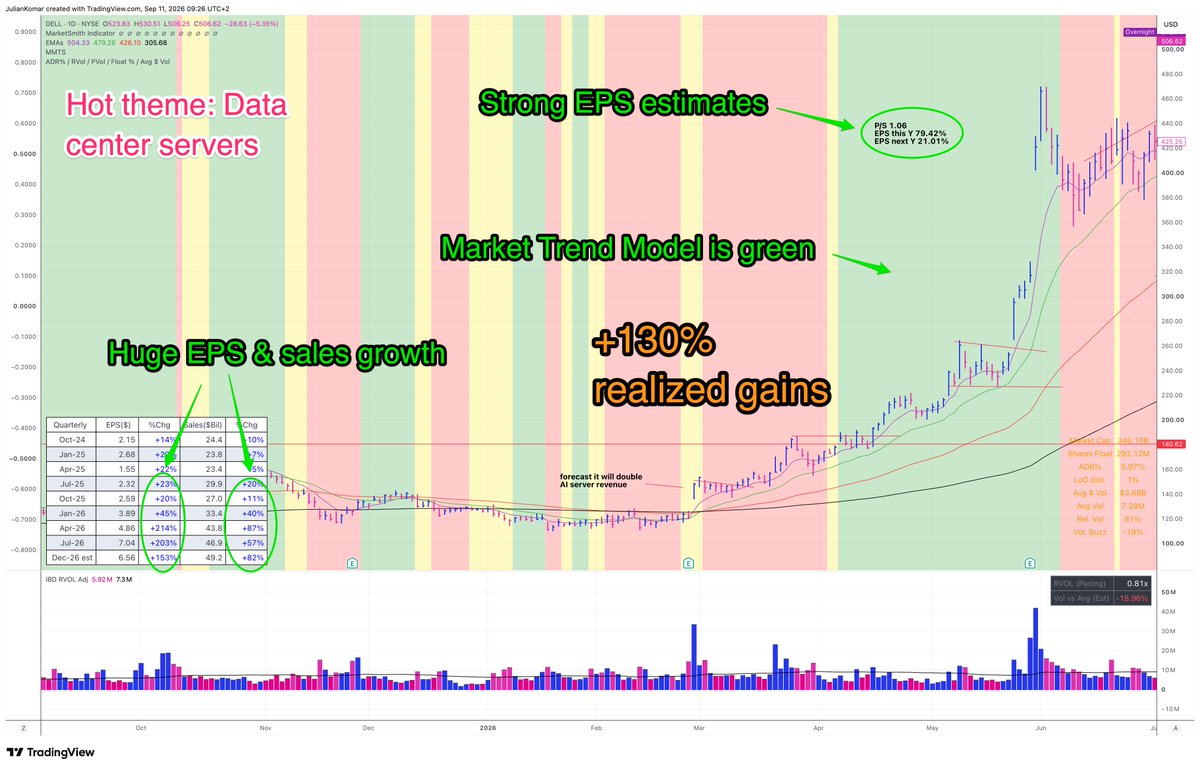
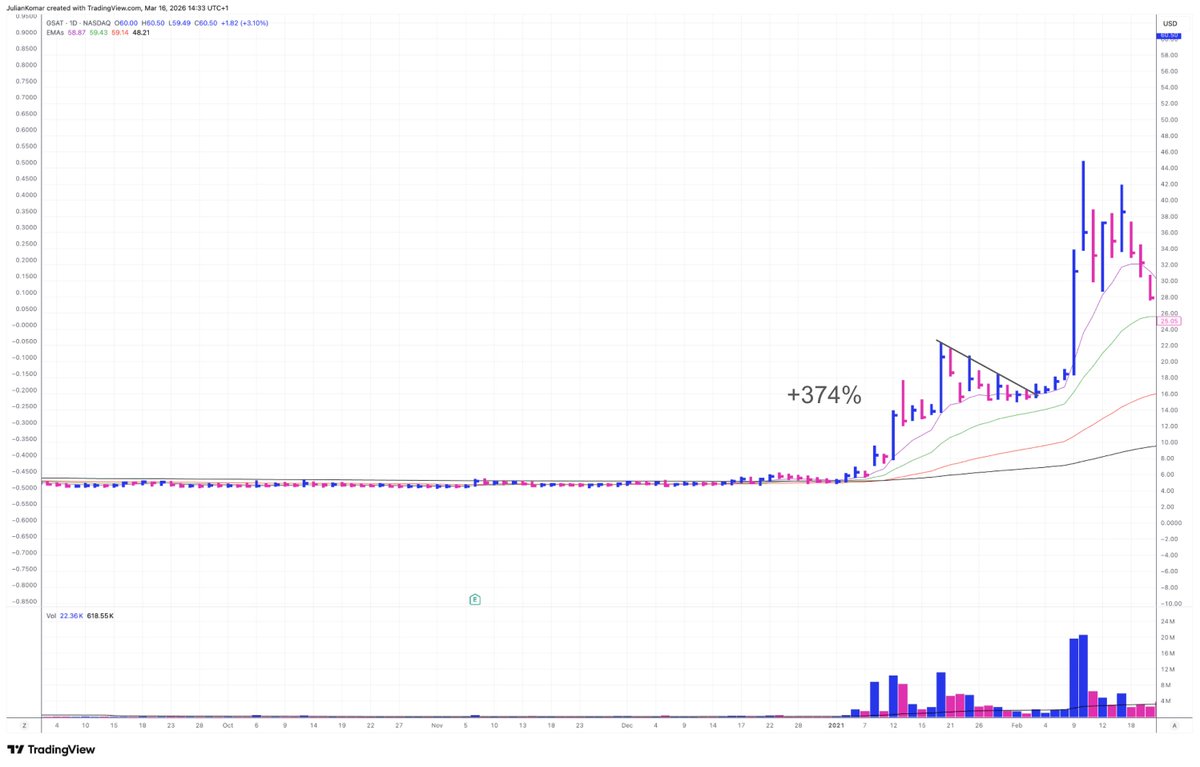
Here are 4 charts from my Blueprint Model Book.
The names are different. The price-action sequence is remarkably similar.
Once you recognize this behavior, you will never look at super-momentum stocks the same way again:
1. The stock makes an explosive move in a very short period.
2. Instead of completely breaking down, it consolidates near its highs.
3. Price begins to respect the EMA 8 and EMA 21.
4. The trading range contracts. Price action becomes extremely tight. Sellers slowly disappear.
5. Then the stock breaks out and makes another explosive move—sometimes doubling or tripling within a short period.
The sequence is simple:
Explosive expansion.
Controlled consolidation.
Extreme tightness.
Another explosive expansion.
But recognizing it in real time requires serious chart study.
A screener can help you find stocks. Rules can help you evaluate them. But only studying hundreds of past winners teaches your eyes what exceptional momentum really looks like.
That is why I created my Blueprint Model Book. I regularly review these charts, add new examples, and share the complete book and my review video with members of my community.
If you want to find exceptional stocks, study exceptional stocks.
$MSFT two years ago:
• ~$420/share
• Azure growing ~30% with $235B commercial RPO
• AI revenue barely measurable
$MSFT today:
• ~$420/share
• Azure re-accelerated to 40% growth with $627B Commercial RPO (+99% YoY)
• $37B AI ARR (+123% YoY) with 20M+ Copilot seats (+250% YoY)
• Maia 200 custom silicon in production
Same stock price two years later but AI business behind it is unrecognizable.
THE PHOTONICS LAYER OF THE AI BUILDOUT
Goldman Sachs says the AI optical networking market growing nearly 10x to $150B+ by 2028 as clusters scale into multi-rack systems like $NVDA Rubin Ultra NVL576.
The AI bottleneck is shifting to the fabric that lets hundreds of GPUs behave like one system driving a massive dollar content expansion across NVLink, co-packaged optics & optical interconnects:
• $AEHR burn-in & reliability test systems for photonics and AI hardware
• $AAOI data center optical transceivers with in-house laser manufacturing
• $LITE high-speed lasers & optical components for data center transceivers
• $VIAV optical testing & measurement tools used to validate high-speed networks
• $COHR lasers, photonic components & materials used across optical networking systems
• $MRVL optical DSPs, custom interconnect silicon & networking chips for AI infrastructure
• $CRDO retimers, DSPs & active electrical cables for rack-level signal integrity in AI clusters
$MU & $SNDK had a great day yesterday!
Let's see how far they can move. Memory stocks are still leading and they offered awesome, easy setups before!
I see people trade a lot of random stocks. Stick to the momentum leaders and your results will improve. Scan for the top 1% or 2% strongest stocks on any timeframe (1, 3, 6, 12 months etc) and look for the ones that obey the rising 10-, 20-, and 50-day moving averages.
The Photonics Ecosystem: Explained
Every segment, group, and notable stock within below. you'll want to bookmark this...
UPSTREAM
- Materials: $GLW $AXTI $ALMU $LWLG
- Wafer: $TSM $GFS $TSEM $SKWT
MIDSTREAM
- Optical Components: $HIMX $LPTH $OPTX $MTSI
- Lasers & Light: $LITE $IPGP $COHR $LASR
- Transceivers: $AAOI (+ others)
- Packaging: $FN $AMKR $POET
DOWNSTREAM
- Switch & Interconnect: $AVGO $MRVL $CRDO $NVDA
- Networking: $JNPR $CIEN $CSCO $ANET
- Testing: $AEHR $ONTO $VIAV $FORM
I made this tool to help me understand the segmentation of the photonics world. I am not a photonics expert. If I missed anything, or need to move something around, let me know!
BREAKING: AI can now analyze any stock like a Wall Street analyst (for free).
Here are 10 insane Claude prompts that replace $2,000/month Bloomberg terminals:(Save for later)