A Persian scholar finished a single math book in 9th century Baghdad that quietly became the foundation for every line of code running on Earth today.
I started reading about him at midnight and could not believe how many things in my daily life trace back to one man.
His name was Muhammad ibn Musa al-Khwarizmi. The book is called The Compendious Book on Calculation by Completion and Balancing.
Every time you say the word algebra, you are saying his book title. Every time someone says the word algorithm, they are saying his name. Both English words come from him. Both are Latin transliterations of Arabic and of his own identity. The man did not just contribute to mathematics. He named it.
Here is the part almost nobody tells you.
Al-Khwarizmi was born around 780 CE in Khwarazm, in what is now Uzbekistan. He moved to Baghdad and worked at a research institution called the House of Wisdom, which during the Islamic Golden Age was the single most important center of learning on the planet. The caliph al-Mamun hired the best mathematicians, astronomers, and philosophers from across three continents and put them in one building with one job. Translate, study, and produce new knowledge.
Al-Khwarizmi finished his book on algebra around 820 CE. The Arabic title contained the word al-jabr, which referred to one of the two operations he used to solve equations. When the book was translated into Latin in the 12th century, the Latin world did not have a word for what he had built. So they kept his Arabic word. Al-jabr became algebra. The discipline was named after a single Arabic word in the title of a single book by a single man.
The deeper insight is what he actually changed about how humans think.
Before al-Khwarizmi, mathematical problems were solved geometrically. You drew shapes. You measured them. You compared areas. The Greeks had built an entire mathematical tradition on visual proofs and physical constructions. It was beautiful and limited. You could not solve a problem you could not draw.
Al-Khwarizmi did something nobody had done before him at this scale. He said you could solve any problem using abstract symbols and rules. You did not need a shape. You needed a procedure. You moved terms across the equation. You cancelled like terms on both sides. You isolated the unknown. He invented the idea that mathematics is a manipulation of symbols according to rules, not a study of physical figures.
That single shift made everything that came afterward possible. Calculus. Differential equations. Linear algebra. Quantum mechanics. None of it works if math is locked inside geometry. He pulled it out.
The second thing he did is the one that changed how the world counted forever. He took the Hindu numeral system from Indian mathematics, refined it, and wrote a book introducing it to the Arab world. That system included the concept of zero as a placeholder, and a positional notation where the value of a digit depends on its location. Roman numerals could not do complex calculation. Hindu-Arabic numerals could.
When his book on numerals was translated into Latin as Algoritmi de numero Indorum, the word Algoritmi was just the Latin spelling of his own name. Europeans started calling the new method "doing algorism," then "running an algorithm." The word for the most important concept in computer science is literally his name in Latin.
The third thing he did is the part that should haunt anyone who works in tech.
His method of solving problems was systematic. Step one, do this. Step two, check that. Step three, if condition A, then do X, otherwise do Y. He wrote down procedures that could be followed by anyone, anywhere, who knew how to read. The procedure did not depend on intuition or genius. It worked because the steps worked.
That is exactly what an algorithm is. A finite, deterministic procedure for solving a problem. He did not just give us the word. He gave us the entire concept of programming a thousand years before there was anything to program.
When Alan Turing built the first abstract model of computation in 1936, when John von Neumann designed the first stored-program computer in 1945, when every engineer at Google, OpenAI, Anthropic, and DeepMind writes code in 2026, they are working in a paradigm that started with one man in Baghdad twelve centuries ago.
The strangest part is what happens when you walk into any tech office in San Francisco or Bangalore or Lahore today. Engineers say the words algebra and algorithm hundreds of times a day. They do not know whose name they are saying. Almost nobody can spell al-Khwarizmi correctly on the first try.
His original Arabic manuscript is preserved at Oxford. His book on Hindu numerals survives only in Latin translation. The Latin version was the textbook that taught medieval Europe how to count.
The man who built the foundation of the AI revolution did not live to see a calculator. He died around 850 CE, a thousand years before the first electric current was sent through a wire. The civilization he built mathematics for collapsed. The library he wrote in burned. His own grave is unmarked.
But every algorithm running on every machine on Earth right now still answers to his name.
Only one chance in this lifetime…
Like watching sunset at the beach from the most foreign seat in the cosmos, I couldn’t resist a cell phone video of Earthset. You can hear the shutter on the Nikon as @Astro_Christina is hammering away on 3-shot brackets and capturing those exceptional Earthset photos through the 400mm lens. @AstroVicGlover was in window 3 watching with @Astro_Jeremy next to him.
I could barely see the Moon through the docking hatch window but the iPhone was the perfect size to catch the view…this is uncropped, uncut with 8x zoom which is quite comparable to the view of the human eye. Enjoy.
FOLLOW & RT TO WIN!
🥌 Signed team jersey
🛋️ $100 gift card https://t.co/deT2r4w7gF
💅 $200 Holo Taco gift card
🧹 Goldline Carbon Fiber Impact Broom
Gift baskets from:
🥚 Egg Farmers of Ontario
💪🏼 BOOST® Protein
🍷 Pillitteri
🐟 Rio Mare
🍺 Lake of Bays Brewing
Big cell therapy news was just published in the New England Journal of Medicine!
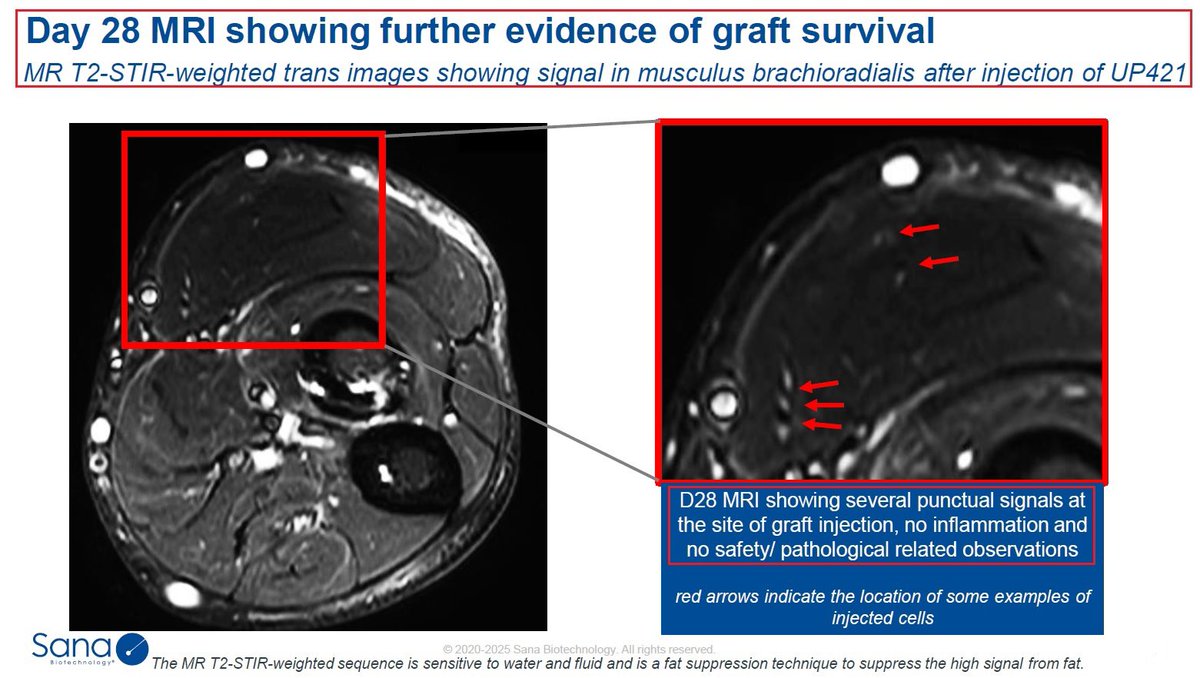
After 12 weeks, Sana Biotechnology's transplanted gene-edited deceased donor islets were still making insulin and were undetected by the immune system.
This exciting news shows the promise of cell therapies, including strategies being pursued by Breakthrough T1D and the T1D Fund. Learn more here: https://t.co/vF1zyQE9mP
Don’t miss your chance to witness the legendary Canadian Forces Snowbirds as they soar over Nanaimo Harbour for the first time in six years! Catch two thrilling performances: Friday, August 15, 7 to 7:45 pm, and Saturday, August 16, 4:15 to 5 pm. #YCD#Nanaimo
1/🚨WOW! $SANA announced initial positive results from its first-in-human study of UP421 - an allogeneic primary islet Cell Therapy engineered with Sana’s proprietary hypoimmune (HIP) technology for patients with type 1 Diabetes, without the use of any immunosuppression $XBI 🧵👇
This packs a punch & is a worthwhile read.
"So it’s our duty as a free press to call out Poilievre’s dangerous lies...Either he’s lying to you and knows it, or he’s just incompetent. And because he’s not a stupid man, it’s not hard to figure out"
https://t.co/vSCgusBX9B
If some of your middle school students missed out on essential literacy instruction, it’s not too late for them to build reading fluency. 📗 @SarahYost1 shares evidence-based practices that can help: https://t.co/BvxFJ9BC47
#WinItForBrock the game 7 pressure is on Oilers.. to not lose vs a #Canucks team missing not one but two all stars. right? so our guys can feel free to go all out, have fun with the moment. not expected to win, just might! 💙💚🏒 #WinIt4Boeser#Boeser
Fun Friday! Curipod's AI or Not AI Literacy Generator shows a series of images. Can students spot which images are human-made and which are generated with AI? After the reveal, if it's AI, Curipod displays the prompt used to generate the image.
https://t.co/xHGNC1x79y
A science and English teacher paired up to develop a grading system that instills content knowledge *and* cultivates lifelong learning skills.
Find their approach and proficiency scales here: https://t.co/AHDKTAdaS0