For the past 9 months, I've been investigating Andrew Tate's empire of sexual exploitation — drawing on thousands of private messages and sealed court files, as well as interviews with the Tates, their associates & more than a dozen alleged victims. Here's what I found: https://t.co/q1L65EVG1O
Bari Weiss saw Scott Pelley's public rebuke of her as a fireable offense. Paramount CEO David Ellison discussed with her how to approach a conversation with the correspondent. What came next depends on who you ask. Our latest on the "60 Minutes' Meltdown. w/@thesimonetti@JBFlint
One of the weirdest conversations I've had recently. Had to cut that at one point he asked me if WIRED runs all my writing through an AI detector. https://t.co/QWvdNxUGIT
@MikeIsaac I've had some success with this approach, but I get paranoid without hard audio to back it up (if someone contested my reporting). Now, with AI transcription, I will write down keywords or small turns of phrase they say that I like and then just Ctrl+F the transcript and pull.
@kevinroose this is perhaps controversial but i dont really record or use trint — i take a notebook to irl interviews and jot things down that stick out and return to them later
or write notes in a doc if a phone interview
Funny story: In 2019, the TV adaptation of my book was up against La Brea for a pilot slot at NBC. When La Brea took the slot and then got green lit, I was like....wtf? (Joke's on me!)
Pleased to say I received the National Magazine Award for reporting for my work on Tigray. However, my heart still grieves for the hundreds of thousands dead, those with wounds both invisible and visible, and those who are still starving.
Their lives matter too.
Last October I met Mako Nishimura, a woman who rose from runaway to juvenile detention, biker gang and, eventually, #yakuza footsoldier.
It almost cost her everything. Now she’s trying to rebuild her life — and family. Read it here @gdnlongread
https://t.co/4DEOVftvGa
In the clip economy, narrative *anything* doesn't hold value. The non-fiction IP market has imploded since the strike, narrative non-fiction books are falling off a cliff, longform podcasts are dead, and once-viral magazine capers don't travel anymore.
https://t.co/7AtGflg9Ae
"You want to play games? I promise you, to my core, I am going to ruin your life."
I wrote about the worst roommate ever, for @verge, a quintessential Los Angeles parable that pits progressive idealism against the hardened thirst for revenge.
https://t.co/mQu7yvFUfp
"You want to play games? I promise you, to my core, I am going to ruin your life."
I wrote about the worst roommate ever, for @verge, a quintessential Los Angeles parable that pits progressive idealism against the hardened thirst for revenge.
https://t.co/mQu7yvFUfp
"You want to play games? I promise you, to my core, I am going to ruin your life."
I wrote about the worst roommate ever, for @verge, a quintessential Los Angeles parable that pits progressive idealism against the hardened thirst for revenge.
https://t.co/mQu7yvFUfp
Thanks, as always, to my editor, @knguyen, who allowed me to write this 5,000-word story completely in-narrative without quoting someone directly. A feat!
@Bernstein This isn't a knock on journalistic instinct, per se, but I think there's an element of misplaced FOMO when it comes to people who magically become everywhere online. (And I say this as someone who enjoyed your article about him!)
Why I was really perplexed when so many flagship publications profiled Clav within a 2-week period. Like, clearly everyone got duped here, conflating ubiquity with legitimacy.
"Reporters and editors who get their ideas from their social-media feeds — which is most of them, most of the time — can mistake a paid simulation of public interest for the real thing and then make it real by covering it. "
https://t.co/jenxweDHCs
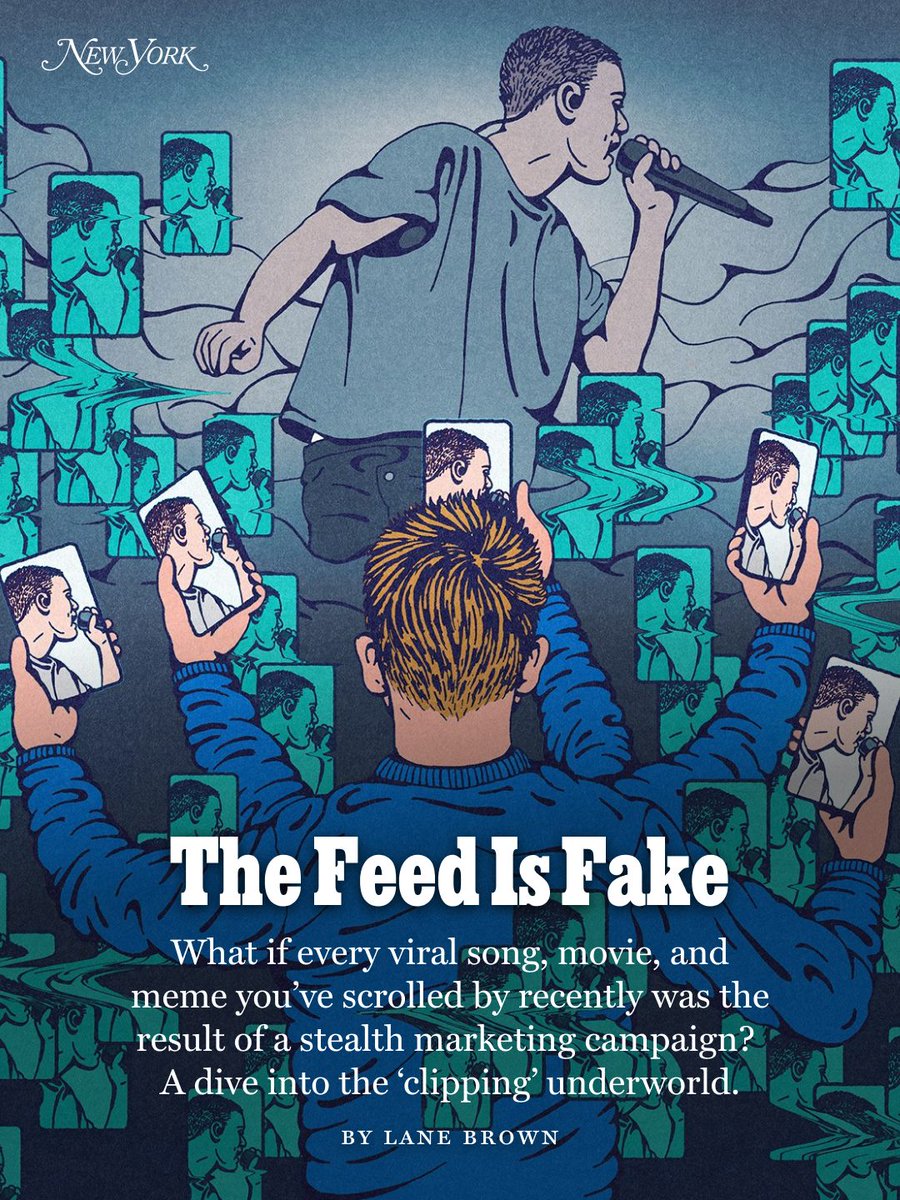
Joe Lim estimates that 90 percent of what you see on the internet is advertising in disguise, and he should know. For three years, Lim ran a company called Floodify, which at its peak operated 65,000 dummy social-media accounts used to drum up attention on behalf of paying clients.
The point of this kind of marketing is that nobody is supposed to notice it. But lately, the machinery has started to show.
In April, Justin Bieber headlined two consecutive weekends at Coachella. Coachella is the biggest stage in pop music save only for the Super Bowl, the kind of event that in theory generates its own attention. And yet on both weekends, a Discord server writer Lane Brown had been monitoring hosted paid campaigns for Bieber’s Coachella performances, offering clippers — people who are hired to turn a song, trailer, interview, stump speech, or whatever into short, social-media-friendly fragments — as much as a dollar per thousand views.
“On social media, popular opinion is being formed, measured, and manipulated all at once, and every signal the platforms produce — a trending song, a backlash, a talking point, the feeling that ‘everybody’ is suddenly talking about the same thing — can now be fabricated by unseen actors with hidden agendas,” writes Brown.
“Everybody is doing this now,” Lim says. “And if you’re not, you’re behind.”
Brown reports on how the same techniques are now being used to fool people on every app they go to in order to find out what other people think, not just in music but across entertainment, politics, consumer products, and celebrity gossip: https://t.co/hlcdfSmzPc
I'm looking for a part-time research assistant, to work on a new book. Looking for someone creative, outgoing and persistent. Some reporting or producing experience required. Apply at [email protected]
After 11 years, thousands of articles, 11 Taylor Swift album releases, one of the biggest trials in music history and more traumatizing deaths than one pop music editor could fathom, I have decided to leave The New York Times.