Billionaire Brunello Cucinelli on his love for books:
"I am in love with books. I love them for the knowledge they bestow, for the fragrance they release, for the rustle of their pages turned, which seems to caress the soul. Like Voltaire, I have a fondness for ancient volumes, and I cherish the words of their authors, whose wisdom is confirmed by the long endurance of their thought. Montesquieu once observed that until we have read all the old books, there is no reason to prefer the new; and sincerely, if I could always decide upon my own time, nothing would delight me more than to walk through the beautiful park of Solomeo in the evening, at sunset, when the air is finer and the Spirit more inclined to wonder, strolling through what, to me, is a kind of paradise whilst reading passages from a beloved book. I cannot truly say which, among the many, is my most loved; yet it matters little, for any good book, as Montaigne believed, is the best provision for the human journey. And so, it is enough for me to hold a book—one that speaks directly to the heart, with simple words—where it is clear at once that the passage from the mind to the pen of the author was authentic."
David MacKay, Cambridge professor:
"Citadel and Jane Street pay $900K for people who get one idea I taught free at Cambridge: information is measurable, and whoever measures it best wins. the casino knew it first. the machines know it now."
this free lecture holds the entire "secret alpha" the funds and the AI gurus sell, and the man teaching it put his whole course and his whole book online for free and never locked a single page.
at the board it's simple. information is just how much a signal cuts your uncertainty, and you can measure it in exact bits. the more an edge shrinks what you don't know, the more it is worth, and Shannon proved there is a hard ceiling on how fast you can compound it into money. that is the whole "edge", and the whole "AI magic", minus the marketing.
MacKay taught it at Cambridge and gave the book away free in 2003. it has been free ever since. same point as the casino piece above: the house wins with a small, measurable edge, repeated and sized right, not with a secret.
the theory is free and every fund and every model already runs on it. what they cannot sell you is the data to feed the machine and the discipline to size the bet. that is the part that actually compounds, and no course can put it in a formula.
Daniel Kahneman, Nobel laureate and author of "Thinking, Fast and Slow":
"You have two minds. one is fast, confident and usually wrong about money. the other is slow, lazy, and the only one that can do the math. I won a Nobel showing the casino lives off the first one, because it shows up before the second one wakes up."
this free lecture holds the entire "trust your instincts" the gurus sell, from the Nobel laureate who proved your instincts are the trap.
at the board it's simple. Kahneman split the mind in two. System 1 is fast, automatic and sure of itself. System 2 is slow, effortful, and the only part that actually computes the odds. the catch is that System 1 answers first and System 2 is lazy, so you act on a feeling and build the reasons afterward. the casino and the market are timed to catch you in that first second. that's the whole "instinct edge", minus the marketing.
Kahneman worked this out over fifty years and put it in one book in 2011. it has been public ever since. same point as my casino piece above: the house wins because your fast mind calls luck skill before your slow mind can check the math.
the science is free and half the world has read the book. what nobody can sell you is the discipline to wake the slow mind up before you click buy. that one pause is the whole edge, and no lecture can force you to take it.
"De nuestros miedos nacen nuestros corajes y en nuestras dudas viven nuestras certezas.
Los sueños anuncian otra realidad posible y los delirios otra razón.
En los extravios nos esperan hallazgos, porque es preciso perderse para volver a encontrarse".
"El libro de los abrazos", Eduardo Galeano
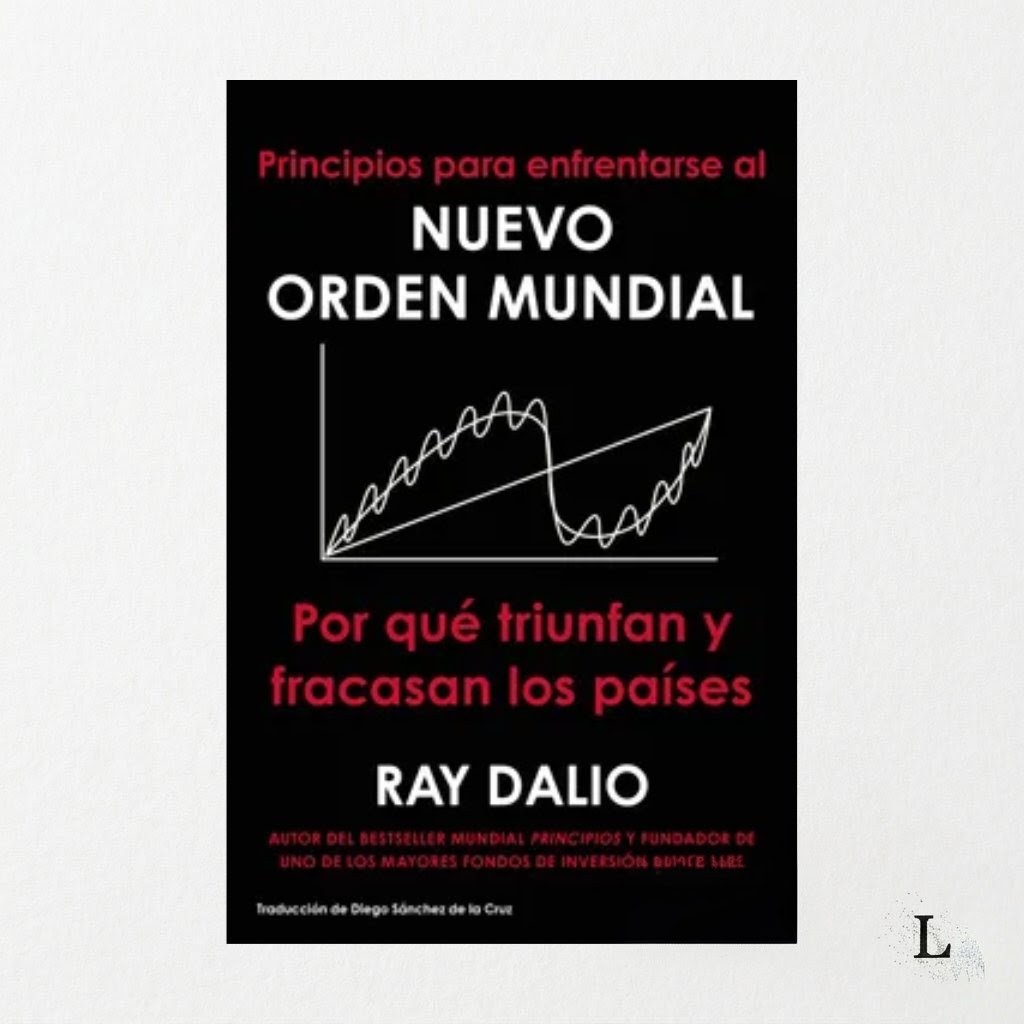
📖 Principios para enfrentarse al nuevo orden mundial — Ray Dalio (2021)
📥 DESCARGA GRATUITA: https://t.co/hQUAjF9o70
Introducción
"Lo más importante que quiero transmitir es que cuando los ciclos se alinean, las placas tectónicas de la historia cambian y la vida de todas las personas se ve alterada de manera significativa. A veces estos cambios son terribles y a veces son muy positivos. Sin duda, aunque muchas personas no anticipan que así vaya a suceder, seguirán ocurriendo en el futuro. Dicho con otras palabras, la oscilación de un extremo a otro del ciclo es la norma, no la excepción. Es muy raro el siglo en que no haya al menos un período de auge/armonía/prosperidad y, al mismo tiempo, una fase de depresión/guerra civil/revolución, de modo que debemos esperar que se produzcan ambas circunstancias."
🧵1/16
Today we share the worldview behind our mission.
Human values don't average out. Local knowledge can't be centralized. The good future has many AIs, raised in different places, shaped by the people they serve, disagreeing with each other the way we do.
https://t.co/A14SurOM2K
CERN Scientist Goes Viral After Exposing the Illusion We Live In
Dr. Bernardo Kastrup worked at CERN. He spent years deep inside the world of high-level science and technology. But something didn’t add up. Today, he’s one of the few respected voices claiming that reality is not made of matter — it’s made of mind.
According to him, everything we experience is a projection of consciousness, and the physical world is just a mental illusion. His ideas are shaking the foundations of science — and revealing truths many still refuse to accept.
"Que me haga fuerte, con la fortaleza del sueño reparador, la fortaleza de la inteligencia, el hueso y el músculo; que aprenda, gracias a esta desesperación, a salir de mí: a saber dónde y a quién dar".
Sylvia Plath