@ebloch I'm not sure - I don't think individual consumers want to manage dozens of agents, though insofar as agents replace apps you could imagine a consumer having more than one.
Regardless I think agents will hire+pay other specialized subagents even if invisible to their consumer.
General Partner at Andreessen Horowitz Anish Acharya (@illscience) says using AI to edit the weights of other models is a bigger deal than people realise and could unlock continuous learning:
"There's actually two huge breakthroughs that have happened in the last few months that I think are under discussed... [One is] the paper that was released on Monday about having models edit the weights of other models, which gives you the sort of continuous learning opportunity."
"It was released and there was enthusiasm and then it was criticised, but I think it's a bigger deal than people appreciate."
"The smartest people I've been talking to have been able to not just replicate, but extend it."
"Now look, there may be some constraints, like there may be opposing ideas and models can't hold both of them in their head. You can't be highly conscientious and highly open, right? Because that sort of implies that the same weights are pointed in different directions."
"But you may be able to do things like get models that are able to have high entropy in non-verifiable domains, like beautiful art and prose, but then high precision in verifiable domains where they can also write great code and be mathematical."
"And we've never been able to reconcile those trade-offs before."
Congratulations to Vincent and the team on a really thoughtful product launch.
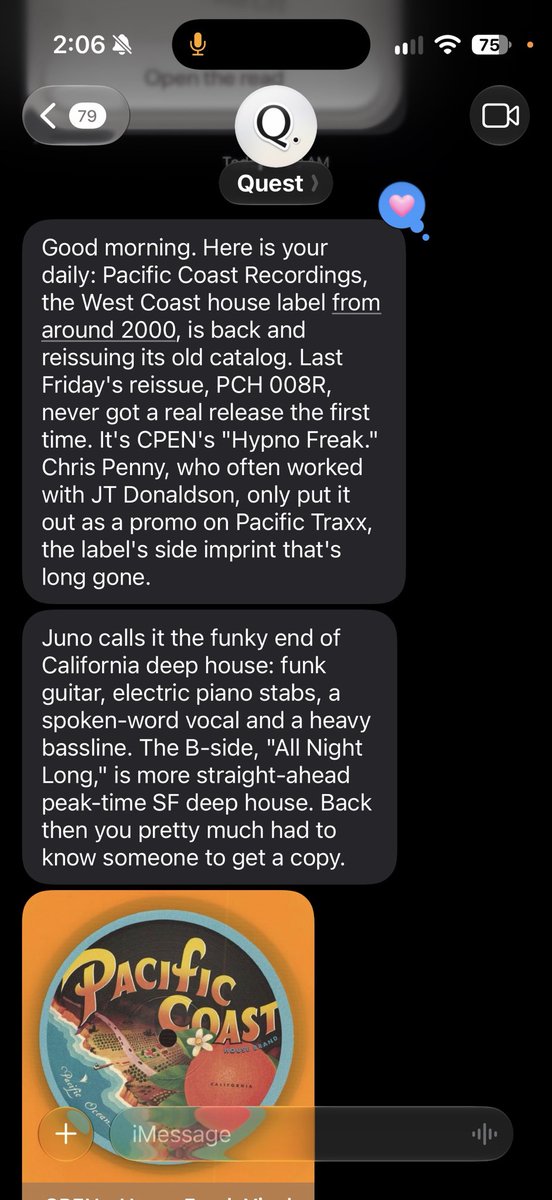
Quest feels like it’s pointed in a different direction than other personal agents, with more of an emphasis on exploring and extending your personal interests. More "personal" than "agent" perhaps.
What’s clear is that personal agents represent a new way of using computers and intelligence that consumers are really into. It feels like there’s a wide product surface to explore, and I’m excited to see more efforts pointed in different directions like this.
Introducing Quest, the personal agent that studies you like a profiler.
Quest is for believers-only. It requires radical transparency: full access to your life so your agent can craft your memory.
If you give it a shot, you’ll unlock a personal advisor, always in your corner, helping you and encouraging you to start your quests.
Quest is built different:
1. Memory from day one: 100+ wiki files created on you, all your relationships mapped.
2. Phone-Use: Quest has its own Android phone, and can control messaging apps like WhatsApp, Instagram or TikTok.
3. Fluid UI: Quest builds tailor-made iOS mini-apps around each of your quests.
4. Mothership of AI Assistants: Quest can manage your Instinct and Muse on your behalf.
5. Self-Improving Proactivity Harness: Quest reacts to anything, not just your email, and its proactivity evolves from your feedback and its own mistakes.
.@illscience General Partner at @a16z was one of our very first guests on the show
(which I am so grateful for).
But his quote on product and marketing, keeps coming back to me which every founder should learn from.
Thank you @illscience for all your support!!
my latest thinking on personal agents (from the pod w @davidpawlan + @joshelman):
winners / losers
- there's so much discussion of structural losers from personal agents (delta / amzn / comcast) and very little about the relative winners
- presumably the long tail of merchants with great products and mediocre marketing benefit a lot
- the idea that agents will perfectly mirror their principals is a fantasy imo... agents will have revealed non-rational preferences (i.e. for clean API surfaces) that are those of an alien mind
- implied is a consumer research / wirecutter product where agents research and share their experiences with each other
agent adoption
- we should be giving agents laws and principles vs rules
- fears of embarrassment will hold more people back than fears of privacy
- agents need to be designed so some implicit preferences stay implicit, so their human can save face
- group chats have an implicit social contract, and agents are only part of that contract if they're present from day one
- agents can create a level of social indirection that actually brings people closer together (i.e. what tomo is doing with groups of humans who share aspirations)
agent networks
- if muse / instinct / wabi is consumer openclaw, what is consumer moltbook?
- what economic exchanges can agents make on behalf of their humans?
- is there a concept of "free" agents that operate within these networks of their own volition?
David Pawlan, creator of Assistant Benchmark, has tracked 147 AI assistants so far, and in his group chats of AI power users, the number one fear is trust. It comes up in 22% of roughly 3,600 messages.
He puts agents through head-to-head tests, like ordering same-day flowers as cheaply as possible or planning a weekend in LA that's both luxurious and cost-efficient, to see which ones can hold competing preferences.
He joins a16z's Anish Acharya and Josh Elman to discuss why the scariest agent failures are the embarrassing ones, why agents are where e-commerce was in 1997, why scale is still a moat, and the "dark agent" that could speak to the parts of ourselves we don't reveal.
0:52 Inside a meetup for 100 agent nerds
2:52 Why we'll all have an army of agents
5:36 Trust is power users' top fear
6:28 Building fences around your agent
10:14 Privacy loses to free pizza
12:41 Can agents balance price and speed?
14:19 How agents define luxury differently
19:44 Migrating from one agent to another
21:06 What your photo roll tells an agent
25:48 Will agents make us more rational?
27:38 Why paternalism kills products
31:43 Gossipy agents as social glue
33:41 Scale is still a software moat
36:55 From OpenClaw to agents hanging out
39:23 Agents that introduce you to people
46:15 Predictions and the dark agent idea
YouTube: https://t.co/uLDJ5ztFWF
@DavidPawlan@illscience@joshelman
The new Oboe app was a lightbulb moment for me in how AI games, movies, etc. get huge
It’s infinite puzzles where the user designs their experience - but curated, so the opposite of a slop feed
It’s one of the only AI mobile apps stealing screen time from incumbents for me 👀
David Pawlan, creator of Assistant Benchmark, has tracked 147 AI assistants so far, and in his group chats of AI power users, the number one fear is trust. It comes up in 22% of roughly 3,600 messages.
He puts agents through head-to-head tests, like ordering same-day flowers as cheaply as possible or planning a weekend in LA that's both luxurious and cost-efficient, to see which ones can hold competing preferences.
He joins a16z's Anish Acharya and Josh Elman to discuss why the scariest agent failures are the embarrassing ones, why agents are where e-commerce was in 1997, why scale is still a moat, and the "dark agent" that could speak to the parts of ourselves we don't reveal.
0:52 Inside a meetup for 100 agent nerds
2:52 Why we'll all have an army of agents
5:36 Trust is power users' top fear
6:28 Building fences around your agent
10:14 Privacy loses to free pizza
12:41 Can agents balance price and speed?
14:19 How agents define luxury differently
19:44 Migrating from one agent to another
21:06 What your photo roll tells an agent
25:48 Will agents make us more rational?
27:38 Why paternalism kills products
31:43 Gossipy agents as social glue
33:41 Scale is still a software moat
36:55 From OpenClaw to agents hanging out
39:23 Agents that introduce you to people
46:15 Predictions and the dark agent idea
YouTube: https://t.co/uLDJ5ztFWF
@DavidPawlan@illscience@joshelman
@NirZicherman This is anti-brain rot. It's the opposite of eating a bag of chips. Somehow, it leaves you feeling intellectually nourished instead of spiritually hungry. Love it!!!
Great convo with @luke10ferrari on his home turf in italy about irrational investor preference for growth over cash, invention vs. optimization, where durability lives after the saaspocalypse, and what happens to the org chart when AI writes 94% of your code.
Some takeaways:
- Investors seem to oddly dislike profit and greatly prefer growth - optimize for compounding free cash flow knowing that this is just a moment in time distortion.
- Invention vs. optimization: pick a camp. Invention has higher peaks but an awful median case. Google is still ~80% search 30 years later.
- Ambition in product, paranoia with debt. Rule #1 of becoming a huge success is not dying in the meantime & credit is a high wire act.
- Software has been cheap to build for a long time. Durability lives in habits, network effects, proprietary data and scale.
- SaaSpocalypse wasn't really about AI. In many cases these were poorly run companies and this cycle gave them an opportunity to improve.
- Bending Spoons went from 0% to 94% of code written by AI in two years. Support managers now look like PMs, data scientists build tooling instead of cleaning CSVs - everyone is both oddly more direct + giving more direction.
- If you're not winning when do you quit? No idea - bureaucracy created Bending Spoons b/c a Danish tax refund that never came killed Luca's first startup and catalyzed Spoons.
02:05 Is every company a bond or an option?
03:40 Why investors overvalue growth
05:15 Why the multiple is just one factor
08:20 Invention vs. optimization: pick a camp
12:20 Customers know the what, not the how
14:05 Hard problems over hot brands (and why AOL excites him)
15:15 Why founders should hate the median case
18:40 The Bending Spoons debt playbook
23:15 SaaSpocalypse wasn't about AI
25:05 Where durability actually lives
29:40 Is your data worth more than your company?
31:05 Inside the Bending Spoons operating system
33:35 The AI agent that ships bug fixes
37:00 From 0% to 94% AI-written code
37:30 Logic over instinct
39:00 When to quit vs. keep pushing
40:35 Advice for the next great tech company
It's extraordinary how code is an abstraction layer for nearly everything and coding agents are the right mechanism for problem solving and creative exploration all the way down.
I suspect the same thing is true of mathematical ability in models, with a much wider aperture.
🚨 Fable 5.5 just made a 66 sec animated short film, with zero image models
every frame + every sound = python it wrote itself
fox, paper birds, clouds, lettering, score, sfx, all of it
> 1920×804 · 24fps · single html file
> no gen images / no stock / no samples / no font files
> ~2h40m of autonomous work
< not ghibli level, and it told me so itself lol >