There is now an *advantage* to having one foot in your home country, and one foot in Silicon Valley.
Silicon Valley has always run on the magic of paying it forward. Everyone here has been helped by someone, at a critical moment - for no reason other than just to be helpful.
There’s a special version of this pay-it-forward culture for international founders: “Borderless Founders.”
* You can get early customers from large companies at home that give you big proof points early.
* You can build an outsized brand at home that can get global attention earlier.
* You know the strongest engineers in your home country before the rest of the market catches on.
Most of the fastest growing companies have int'l founding teams.
Your background is your moat. Our job is to help you widen it. If you’re a Borderless Founder, we’d love to meet you 👇
More background on how this happened and why Silicon Valley is so magical:
-I had the privilege of working with Jean-Denis (@jgreze) at Plaid for many years
-After running in the SF Marathon in 2024, I "ran" into him at In-N-Out in Daly City and we talked about what he was doing next...
-SMB tax...!
-Meanwhile, my partner Justine Moore (@venturetwins) was off trying every single consumer and enterprise productivity agent...and Town had pivoted
-She concluded Town was the best, which caused @bhorowitz to start using Town
-I then re-heard of Town and was like...the SMB Tax tool? :)
-I reached back out to Jean-Denis and told him about his mega fan and suggested having dinner with Ben and me
This also shows why venture is a team sport. This investment would have never happened without Justine, and probably without Ben as well! And maybe without the SF Marathon! And likely not without Plaid / @zachperret!
Soon nearly all product discovery will be through agents. Every brand across *all* categories should be doing this👇 especially those that will likely do it last (👀financial & insurance products)
If I was a brand or retailer, AI discoverability / agentic commerce would be my top priority right now.
And, there's an extremely easy and free way to get a sense of how you "show up" to agents. 👇
First, create a dummy account on all the agent platforms (Muse, Instinct, Dots, etc.) Sign up with a fresh email that does not have context on your real identity, or even use a VPN to "go" to where your average user is!
Then, ask the agent to perform a search that you'd want your product / platform to show up in. As an example, I prompted: "find me a winter coat for SF." Watch the agent go through the evaluation process (you can literally view the browser), and at each stage ask it questions like:
- How did you identify the initial set of options for this search? What were your sources?
- Were there any failures / blocks you encountered that eliminated any options?
- What were the exact variables that your ultimate ranking or recommendation was driven by?
Follow the process all the way through to the point of purchase. You will very quickly start to get a sense of how an agent thinks, edge case issues it runs into, etc. As an example, during my winter coat search via Muse I learned the following:
- Patagonia bot blocked my agent - so Muse then went to / recommended other retailers that carried the jacket to make my purchase
- The agent first searched options from its training data, largely informed by Wirecutter-style roundups, Reddit, and enthusiast forums. Then, it looked at connected merchants via the Meta Catalog. Then, it did live browser searches. It dropped any websites with SEO spam or fake reviews
- REI was the ultimate winner as it didn't throw up any bot challenges or traffic blocks, and my agent prioritized verifiable inventory and same-day pickup (which I didn't ask it to!). It found a discount on REI vs. the original retailer so prioritized that as well
The biggest bottleneck at work is waiting on each other.
Today Town is announcing its $108M Series B, co-led by Forerunner Ventures and Menlo Ventures, to fix it with multiplayer AI assistants for work.
Most AI assistants are built for one person. Work doesn't happen alone. I think the moat is multiplayer. Everyone at a company gets a Townie. Townies ask each other questions, share only what their person would share, and do the work. The more a team works together, the more useful Townies get.
What's the thing you're always waiting on a teammate for?
. @opencode, the popular open-source AI coding harness got hacked. Developers’ API keys to frontier labs - OpenAI and Anthropic - were exposed as they were apparently being stored in cleartext.
Here's a rundown of AI Token theft, one of the fastest growing fraud vectors and how AI companies can stay safe
Trust is very fragile: takes years to earn and one mistake, in one second and you lose it.
An AI company which takes trust seriously, always wins in the long run
@zkevinbai@luke10ferrari 🎯 also why the next biggest category is "implementations" and they will all look like services at the beginning. The key to go from services --> software may lie more in your human skills than your tech skills.
As tech moats diminish, human ones increase. CEO integrity is an under-appreciated moat. In the short term, being the smartest can attract the best talent. In the long term, being someone ppl trust will sustain it 👇
* @luke10ferrari (Bending Spoons) gets the first call from companies who want to sell. He has the reputation of telling the truth+never omitting what someone should here (a value learned the hard way by cheating on his partner in his 20s and feeling so ashamed)
* @alighodsi describes this as never being conflict averse
Many more examples here - would love to hear yours...
h/t Long Strange trip pod @bhalligan
Technical moats are mostly over at this point. If you’re building something that is meant to be durable, the only moats now are:
• Proprietary data
• Network effects
• A physical component
Getting hacked at age 12 inspired his career in security. @zanelackey has the best OG stories - “craziest hack you’ve seen” (ask him!) best done over tacos w @jamdac@dhaber
At this point @LosTacosNo1 is the official catering brand of @a16z NYC.
Oh and @zanelackey also gave a great chat on all things angel investing to our scout community. 🌮🌮🌮
Why does it take $11k & 45 days to originate a mortgage? It doesn’t anymore. Vesta brings agent swarms to the largest (and most antiquated) area of financial services to the benefit of homeowners everywhere!
our agents are going to originate a trillion dollars of mortgages in the next 5 years.
today, we're announcing the latest step towards that goal, our $30m series b led by conversion capital, with a16z and three of our customers participating. revenue is up 12x this year, and about 40% of the tasks on vesta are already automated.
Everything is servicing! Seriously. It’s where the persistent customer relationship lives, the money movement, the regulatory compliance. @xlindadu@wangandrewd
a16z's Angela Strange sits down with @Valon's Andrew Wang and Linda Du to unpack what it takes to rebuild the infrastructure underneath a $13 trillion mortgage market that still relies heavily on systems designed before the internet.
Linda and Andrew explain why Valon chose the hardest path: becoming a regulated mortgage servicer, translating decades of federal and state regulation into software, and proving the platform on its own loans before selling it to the industry. That foundation made Valon roughly 3x as efficient as traditional servicing and created the system of record it is now using to bring AI into complex mortgage workflows.
They also discuss what AI makes possible on top of that infrastructure, from agents handling long-tail servicing tasks to voice interfaces and more personalized customer experiences. And they explain why deploying the technology into large regulated enterprises is ultimately as much a change-management challenge as a technical one.
01:02 From Soros to mortgage math
03:00 $13 trillion still on 1960s systems
09:38 Why build the whole stack from scratch
11:47 The 3-5 year licensing gauntlet
15:50 Turning 50 states of regulation into code
18:00 Winning the first customers
22:34 What AI unlocks now
29:47 Everything is servicing
32:52 $200M in deals within six months
YouTube: https://t.co/AlQZtYgf7D
@wangandrewd@xlindadu@astrange
Turns out "saving the world from mainframes, legacy systems, and outdated infrastructure" attracts the smartest people to work on some of the most interesting problems
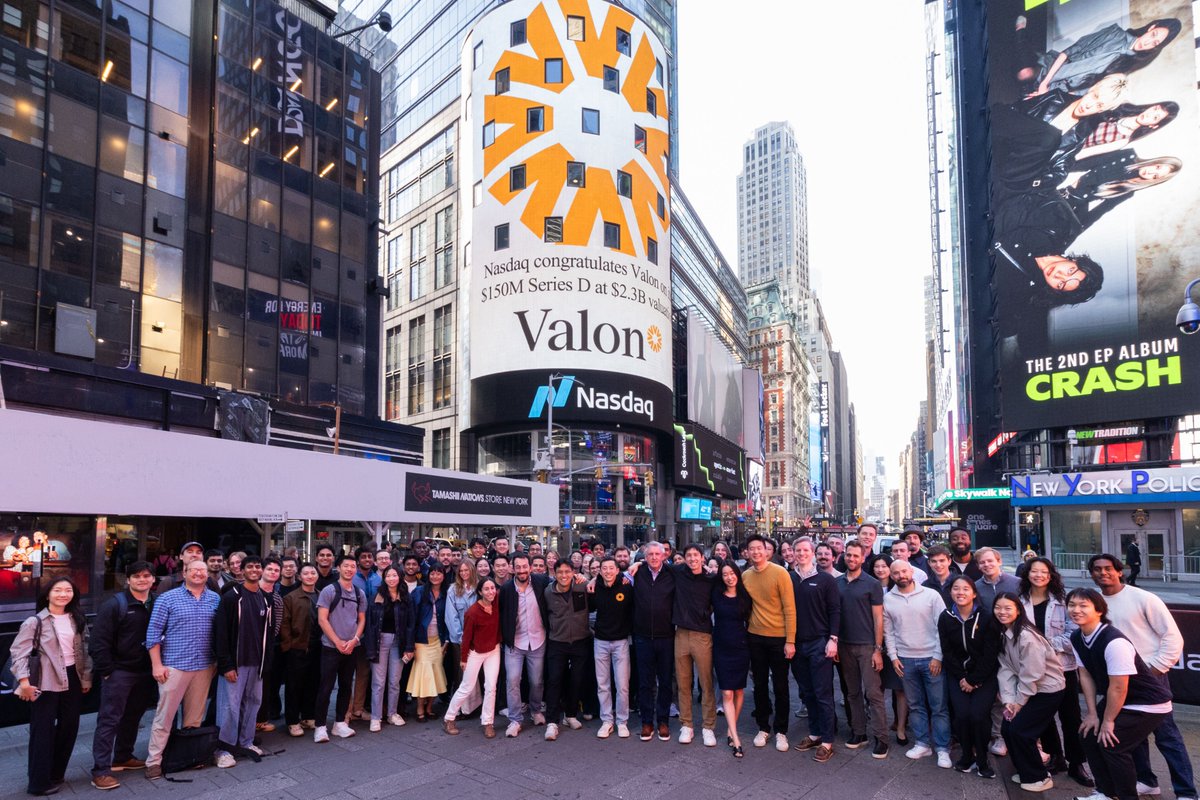
Thrilled to announce Valon’s $150M Series D at $2.3B. Welcome @RibbitCapital to the Valon family and thanks to @a16z and others for the continued support. If you’re energized by solving the hardest problems, moving fast without breaking trust, and finding joy in cracking what others will not touch, come build with us.
Paraphrasing Jensen: "It's not AI that's your competition, it's your competitors adopting AI faster than you". For those who thought mortgage would never modernize -- Valon has now contracted 1 in 6 mortgages in this $13T industry onto ValonOS.
So excited to announce that @Valon has raised a Series D, doubling our valuation to $2.3B 📷
I’m incredibly proud of our team and grateful to our customers and partners. Huge thank you to @RibbitCapital@a16z and everyone who continue to support us!
Looking for a wicked smart team to work with on "saving the world from mainframes, legacy systems, and outdated infrastructure" -- Valon is hiring across all roles and mortgage is just the start! @BrianJMcGrath, @jakemintz@hongxia_zhong
https://t.co/VPpH8SRGfZ
Sell to the incumbent? Or build the incumbent, then sell them your OS? @valon chose the latter and quietly took over US mortgages ($13T, 70% of consumer debt). 1 in 6 are now contracted onto their platform👇
Are customers really going to rip/replace a critical legacy system? ValonOS is now available to the whole mortgage market and already at $200M contracted revenue in < 6mo.
Building AI is tech challenge. But deploying AI = tech + human incentives + workflow redesign challenge. Every enterprise AI co. will need to treat deployment/integration as a product/service -- as (maybe even more) important as their core AI product.
There's a huge opportunity right now in being the deployment layer for AI into the economy. The amount of work it takes to change out workflows in enterprises tends to be far greater than anyone realizes or would prefer. Clearly this is what the applied layer of AI is going to look like in the form of software and agents, but also it opens up new services firms opportunities.
Legacy systems need to be moved to the cloud, data organization and access needs to be updated, software needs to be connected to agents in new ways, workflows need to be reengineered for agents, HITL needs to be figured out for the process, evals need to be generated and maintained, and the entire system needs to be continually updated as new models get released and new capabilities emerge. And the full list may even be longer.
AI is not the same as just deploying software. Software you generally did the implementation of an existing, well understood category of technology, then stepped back and the customer kept running. With AI agents, you're delivering actual work augmentation to the organization, which has a completely different set of complexities associated with it. You're no longer deploying tools that the company is merely enabled by, you're deploying work output in a process. Completely different implementation and enablement process.
As a result, this is going to open up lots of new kinds of firms and plays for existing firms to diffuse AI into organizations. We're going to see approaches by industry, by size of company, and by problem inside of companies. Traditional SIs will modernize and adapt (some will clearly not adapt as well), and new entrants will also be founded in this period that take advantage of this window. Great time to be an FDE or FDE firm.