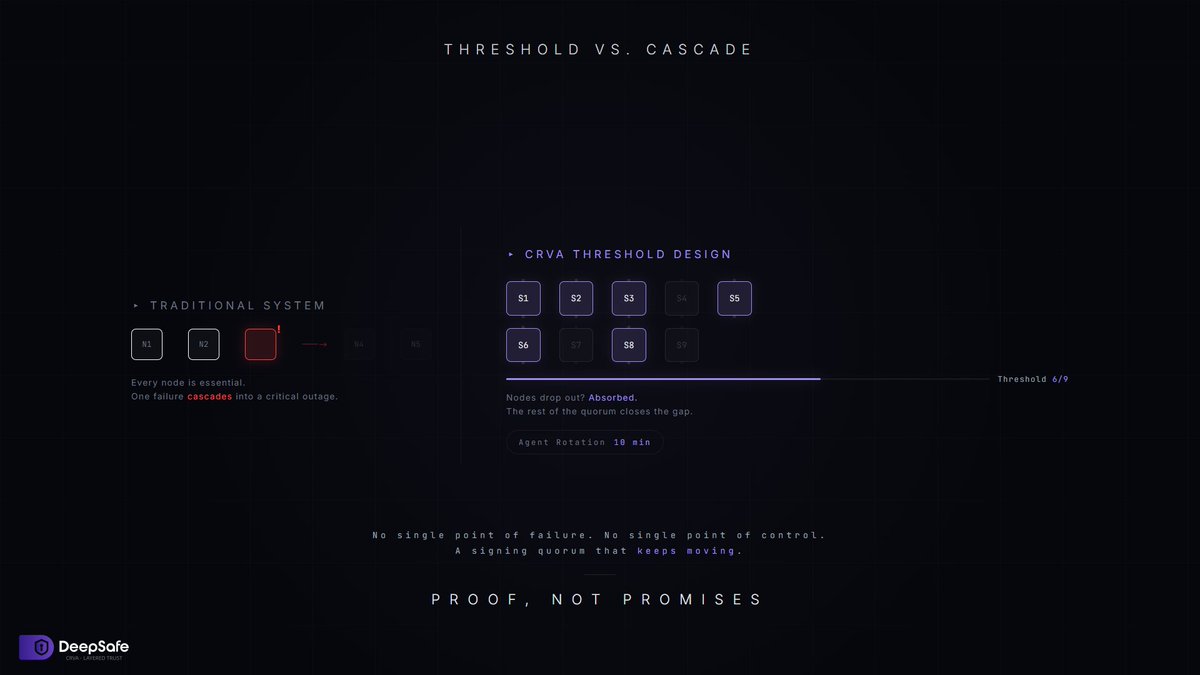
In most distributed systems, the uptime equation is unforgiving: every node you add is another point that can fail, and one critical outage can cascade.
CRVA flips that arithmetic with MPC threshold signatures.
The signing key is split into shards held by independent nodes. The network never waits for every single node — a threshold proportion is enough to assemble a valid signature. A node drops out? Absorbed. Two nodes go silent? Still signing. The rest of the quorum closes the gap.
Systems built on this logic assume partial failure from day one. That's what separates a threshold design from infrastructure that treats every node as essential.
Paired with 10-minute agent rotation, the exposure window for any individual node shrinks further. Nodes cycle before they become long-running targets, and threshold signing ensures no single node was the critical path to begin with.
No single point of failure. No single point of control. A signing quorum that keeps moving.
#DeepSafe #CRVA #AISecurity #MPC #ThresholdSignatures
Hexens(@hexens) researchers spent $3,000 on a server to simulate a cluster of 30+ @Aptos validator nodes. What they found: a stale-cache type-confusion bug in the Move VM that bypassed the type-system guarantees Aptos was built on.
In Move, protocol permissions — minting rights, bridge controls, admin roles — are stored as onchain resources. This bug let attacker-controlled code write into storage belonging to other contracts. The simulated success rate: 17 out of 20 attempts under mainnet-shaped conditions.
Theoretical blast radius: $70B, spanning cross-chain bridges, stablecoin infrastructure (including USDC's CCTP), and exchange deposit pathways. No funds were lost. Hexens filed the report through emergency channels on Feb 25, and a fix deployed within hours.
A patch arrived. The attacker didn't. The difference is one whitehat team that found it first.
This is the architecture argument for decoupling verification from execution. CRVA gives verification its own plane — auditable, enforced by cryptographic proof, separated from the surface where logic gaps hide.
Source:
https://t.co/dN7uziVVNo
#DeepSafe #CRVA #AISecurity #MoveVM #WhiteHat
How BTCFi self-custody works under CRVA:
Taproot Channel
User and CRVA Agents jointly control a shared UTXO. Every operation — transfer, withdrawal, rebalance — requires signatures from both sides. Neither party moves funds alone.
Escape Hatch
A time-locked fallback built into the channel. If CRVA Agents become unresponsive for a preset window, the user can broadcast a unilateral recovery transaction and reclaim assets directly on Bitcoin L1.
Normal operation: shared control.
Failure scenario: sovereign exit.
Trust moves from a party to a protocol.
#DeepSafe #CRVA #AISecurity #BTCFi #SelfCustody
DeepSafe runs on three independent planes:
Service Plane — business integration layer. dApps, bridges, protocols submit verification requests here. No cryptographic logic lives on this plane.
Compute Plane — TEE execution. Intel SGX2 enclaves process workloads in hardware-isolated environments. Operators running these enclaves are unaware whether their node was selected for the current round.
Verification Plane — CRVA supervision loop. ZKP identity attestation, Ring-VRF random selection, MPC collaborative signing, all validated inside TEE. The Verification Plane is the only path from Compute back to Service.
Design principle: the Compute Plane does the work. The Verification Plane decides if the work was honest. The Service Plane never trusts without proof.
#DeepSafe #CRVA #AISecurity #TEE #ZKP
In May, the Verus-Ethereum bridge lost $11.6M.
State roots verified. Merkle proofs valid. Notary signatures genuine.
The only thing the bridge forgot to check: whether depositing $0.01 should really unlock an $11.6M payout.
Every cryptographic step passed. The economic validation simply didn't exist.
This is the gap between partial verification and complete verification. CRVA ensures every condition — cryptographic and economic is validated before assets move.
Sources:
1-https://t.co/0MRiEMNLZh
2-https://t.co/lPVcfycyGM
#DeepSafe #CRVA #Web3Security #BridgeSecurity #CrossChain
Where does your AI Agent's private key actually live?
Most solutions land on one of two answers, and neither is great.
Option 1: stored directly on the project's own servers. A single breach, and the key is gone.
Option 2: a simple TEE setup (the approach used by projects like Phala Network). Better — but still fragile in two ways. The TEE server itself is a single point of failure; if it goes down, service stops. And the team running it usually knows how to decrypt what's inside — nothing stops them from quietly running a modified version of the program, extracting the key, then reverting back before anyone notices.
CRVA takes a different approach: the key is never whole anywhere.
Ring-VRF hides which nodes are holding key shards, so there's no identifiable target to collude against. MPC threshold signing means the key exists only in fragments, reconstructed for a single signature and never stored intact. And even if some nodes go offline, the remaining ones keep the network running.
Not "trust our TEE." Not "trust our team." Just — nothing to trust, because there's nothing whole to steal.
#DeepSafe #CRVA #TEE #AIAgent
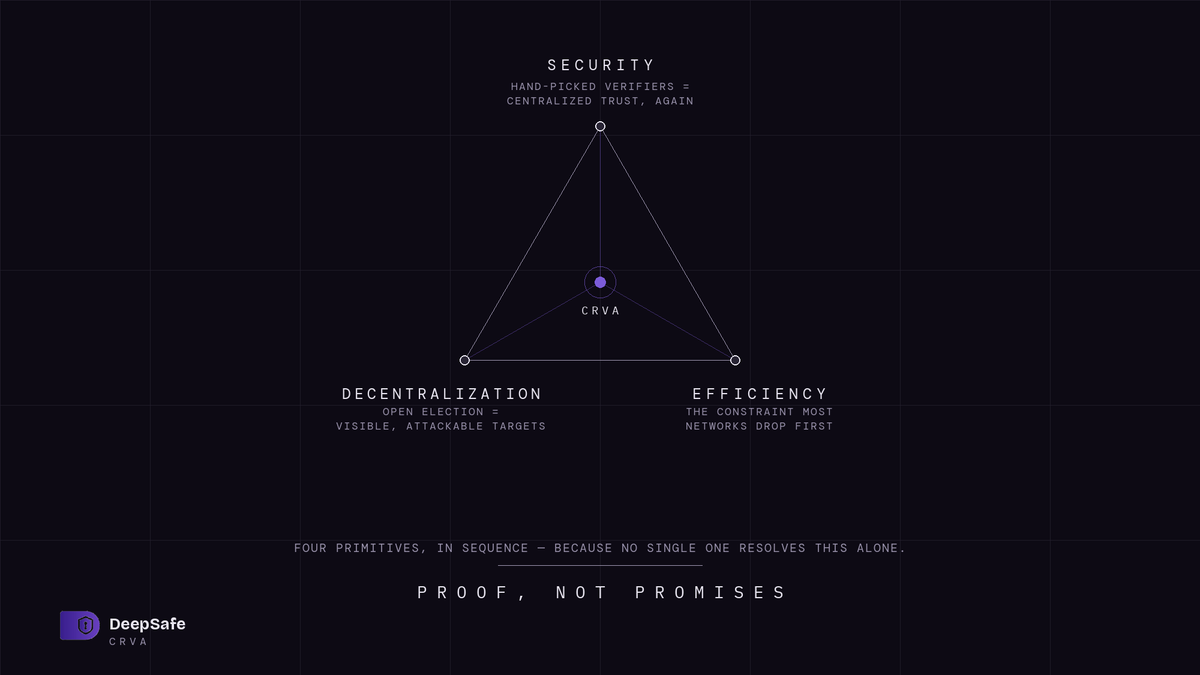
Every decentralized verification network eventually runs into the same wall. Decentralization, security, and efficiency don't come easily as a package deal.
Let verifiers be chosen through open, public election, and you've made them visible — an easy target for bribery, coercion, or coordinated collusion before they ever verify anything.
Let a project hand-pick who verifies instead, and you've solved that problem by creating a bigger one: you're back to trusting a central party's judgment, which is exactly what decentralization was supposed to remove.
Most "verification" networks just pick a side of this tradeoff and call it done.
This tension is the reason CRVA exists at all. Not as one clever trick, but as four cryptographic primitives working in sequence — precisely because no single one of them resolves the trilemma alone.
#DeepSafe #CRVA #Web3Security #Verification #AIAgent
April 18: an attacker drains $292M in rsETH from Kelp DAO's cross-chain bridge. The largest DeFi exploit of 2026 so far.
No smart contract was hacked. No private key was stolen.
The bridge relied on a single verifier to confirm cross-chain messages. Attackers DDoS'd the honest nodes offline, forced a failover to a compromised one, and fed it a message claiming a transaction had happened — when it hadn't. The bridge believed it, and released the funds.
LayerZero has since attributed the attack to North Korea's Lazarus Group.
This is the pattern worth sitting with: the cryptography wasn't broken. The verification step itself had exactly one point of failure, and once that point failed, nothing downstream could tell the difference between a real message and a forged one.
A single verifier isn't verification. It's trust wearing verification's clothes.
Source: https://t.co/GsMt0say7E
#DeepSafe #CRVA #Web3Security
"Verification layer is heating up — won't it just become another crowded field?"
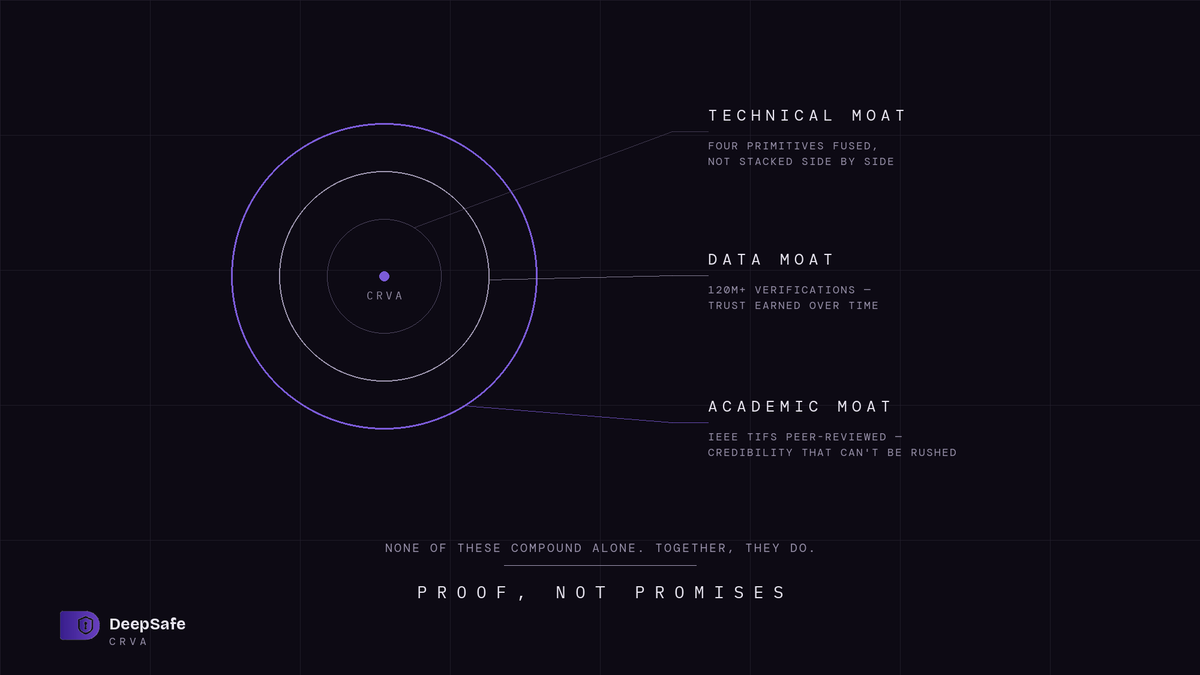
Fair question. Here's why CRVA's lead isn't easy to close.
Technical moat: Ring-VRF, ZKP, MPC, and TEE aren't stacked side by side — they're fused into one sequence where each step depends on the last. Copying one primitive is easy. Rebuilding the entire dependency chain from scratch is not.
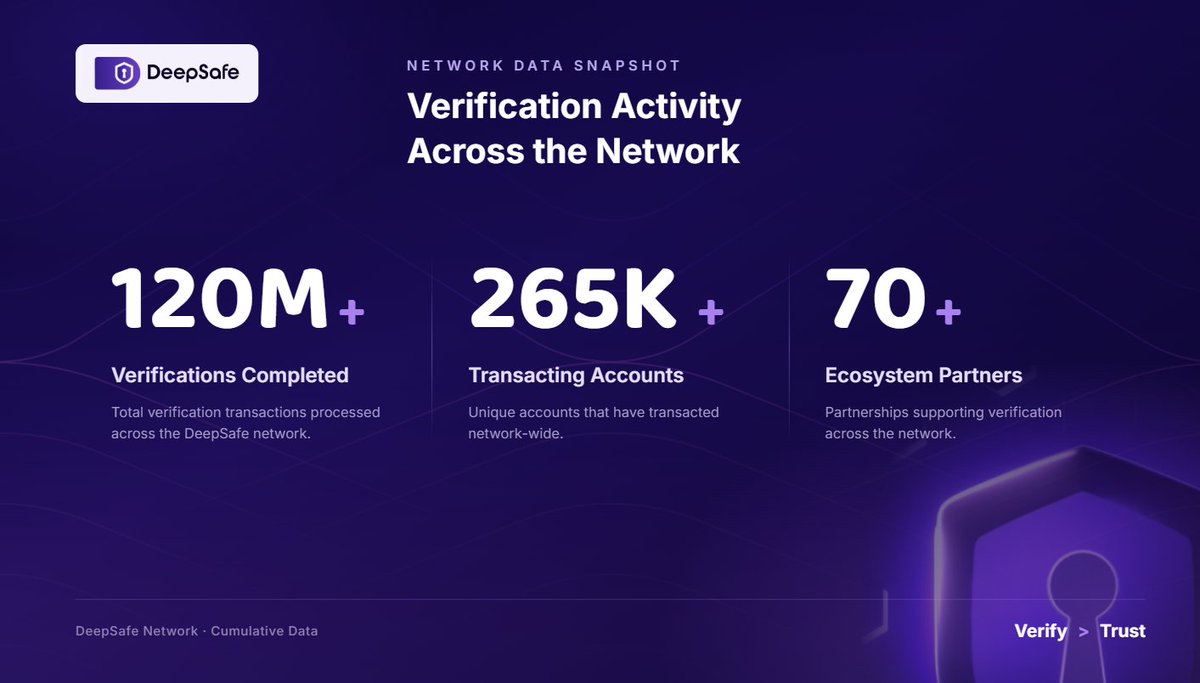
Data moat: 120M+ verifications processed. Verification networks live and die by trust-through-volume — every new entrant starts at zero and has to earn that trust one verification at a time. There's no shortcut to a track record.
Academic moat: Peer-reviewed acceptance into IEEE TIFS. Cryptographic credibility isn't something you announce — it's something outside experts spend months trying to break and failing to. That process can't be fast-tracked by a competitor with more marketing budget.
None of these compound the same way alone. Together, they're what turns "first mover" into "hard to catch."
#DeepSafe #Web3 #AIAgent #VerificationLayer
Every blockchain is secured by money or machines. We called that decentralization for a decade.
Humanode: one human, one node, one vote. Power that can't be bought.
We released a new site that shows the idea behind Humanode thoroughly:
https://t.co/HVpX8QcPyf
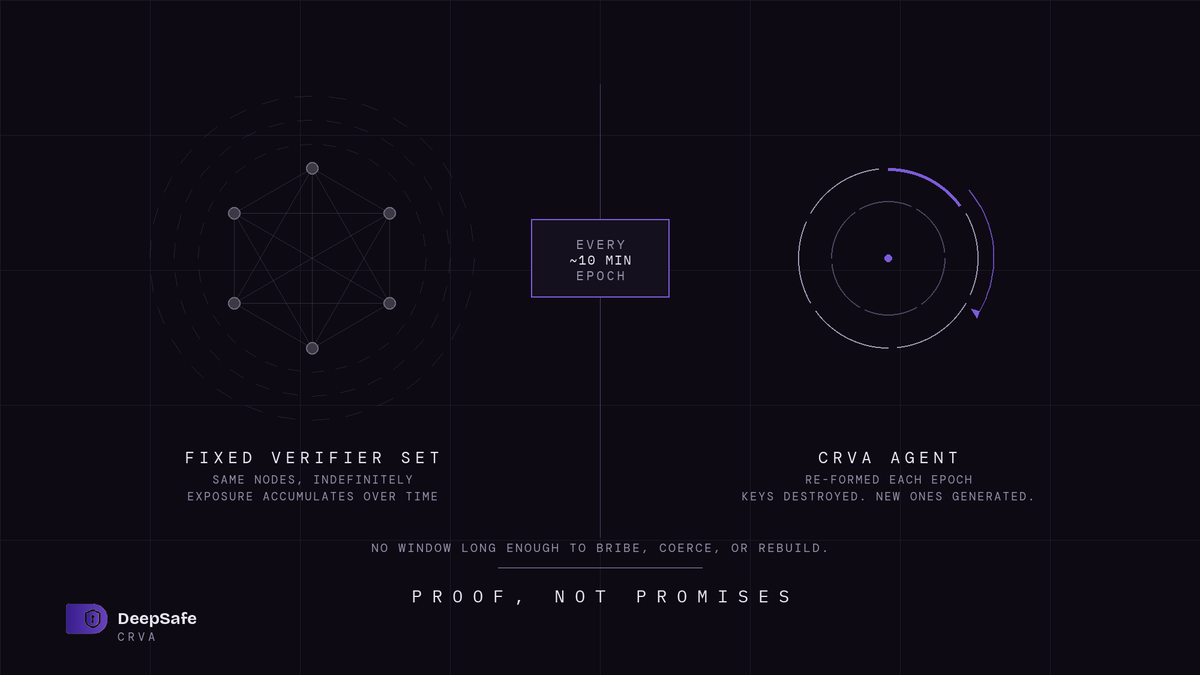
Most "decentralized" verification setups make one same mistake: the group doing the verifying never changes.
Fixed membership means fixed targets. Give an attacker enough time, and bribing or coercing that group stops being a matter of "if", it becomes a matter of "when." CRVA closes that window entirely.
Every epoch — a matter of minutes — the agent is re-formed at random from the node pool. The old virtual keys are destroyed. New nodes generate entirely new ones through the handover protocol. There's no "same group" left to keep attacking.
An attacker doesn't just need to compromise enough nodes. They need to do it, complete every step, and finish — all before the epoch resets and their progress is wiped out.
Static systems fail eventually. Systems that keep rebuilding themselves don't give failure time to happen.
#DeepSafe #CRVA #MPC #Verification #AIAgent
Here's a detail most people miss about CRVA.
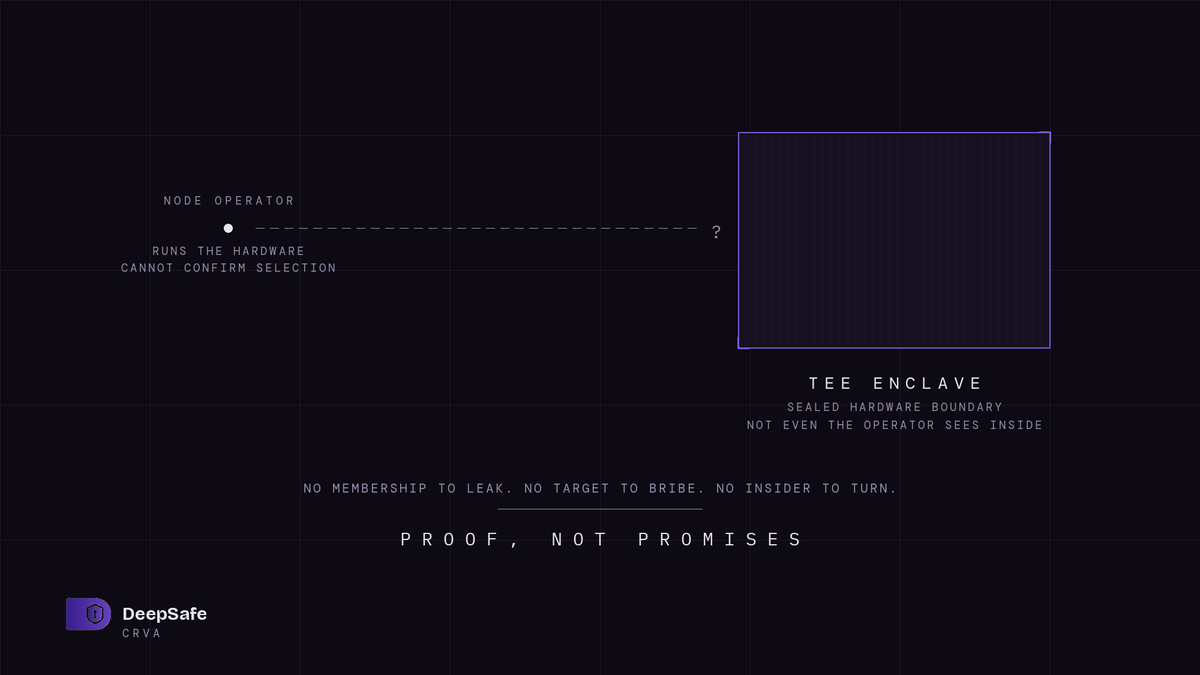
The node operators running DeepSafe's verification infrastructure don't know if their own node has been selected for a given task.
Not "we don't tell them." They structurally cannot know — the TEE hardware enclave keeps that information sealed even from the operator running the machine.
No membership to leak. No target to bribe. No insider to turn, because there's no "inside" a node operator can even access.
Genuine question: does that sound impossible to you, or does it click once you think about it?
#DeepSafe #CRVA #Web3Security #TEE #Verification
Most Web3 projects call their tech "revolutionary."
Very few put it in front of a room that doesn't care about hype.
DeepSafe's core verification technology — the cryptographic foundation behind CRVA — has been accepted by #IEEE Transactions on Information Forensics and Security (TIFS), a flagship journal under IEEE's Signal Processing Society and one of the most rigorous venues in cryptography and security research.
This isn't a journal that publishes claims. It publishes work that survived adversarial scrutiny — reviewers whose entire job is to find the flaw you missed, the edge case your model didn't account for, the assumption that doesn't hold under attack.
What got reviewed wasn't a product pitch. It was the actual cryptographic design underlying Ring VRF, MPC, ZKP, and TEE working together — the same mechanism running CRVA today.
No whitepaper alone gets through that process. No partnership announcement gets through that process. Only math that holds up does.
A partnership can be arranged. A listing can be negotiated. Peer review can't — the only way through is being right.
#DeepSafe #CRVA #Academic #IEEE #Journal
4. TEE — Trust Through Hardware
Cryptographic protocols secure communication. But they cannot stop an operator with physical access to a machine from tampering with its execution.
This is the gap that Trusted Execution Environments are designed to close.
All CRVA Agents operate on Intel SGX2-enabled hardware within a TEE. The environment isolates the verification code from the host operating system — the operator cannot read the signing logic, modify execution, or extract key material.
If tampering is detected, the TEE attestation mechanism invalidates the Agent's participation. A dishonest operator's only option is to shut down the machine, which triggers a forfeiture of staked assets rather than a compromise of the network.
TEE moves the security model from "trust the operator" to "trust the attestation."
Numbers like these don't come from HYPE.
They come from mainnet traffic, real users, and real integrations — accumulated quietly over time while the industry cycles through narratives.
The infrastructure layer doesn't need to shout. It just needs to work.
#DeepSafe#CRVA
If you have been following DeepSafe for a while, you already know these four names: ZKP, Ring-VRF, MPC, TEE.
If you are new — here is what powers the CRVA network.
Four years of cryptographic engineering. One integrated verification flow. Time for a refresher.
A thread on the core primitives behind Crypto Random Verification Agents.
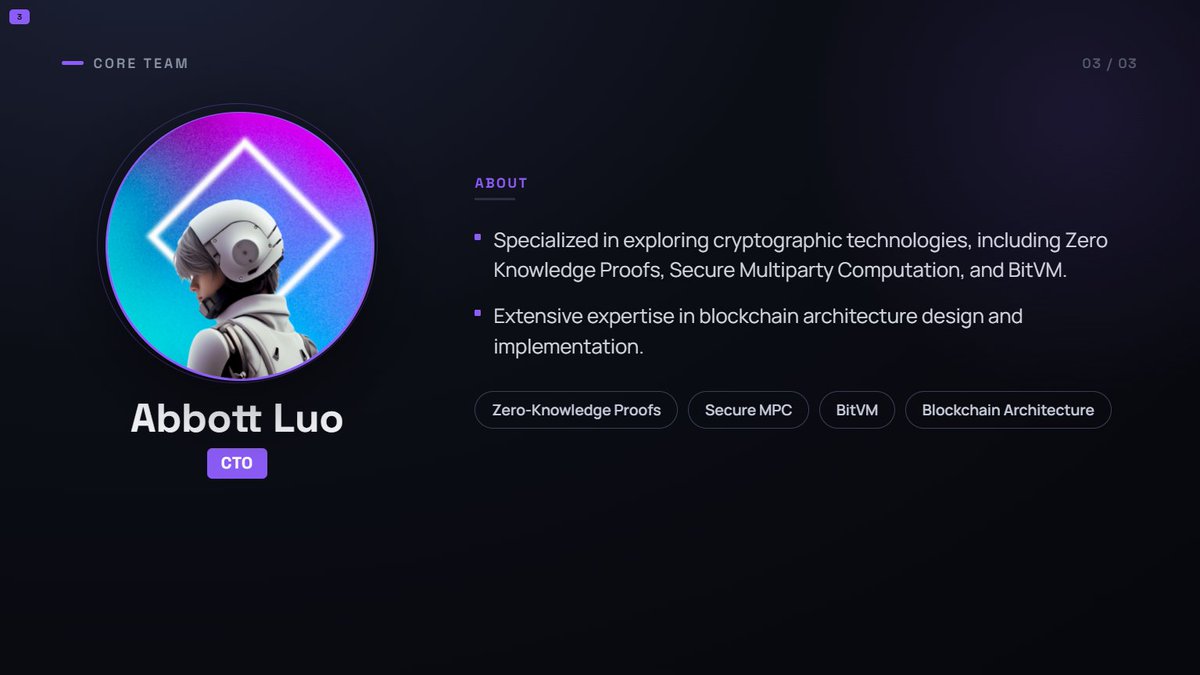
Abbott Luo — CTO.
CRVA isn't a narrative wrapped around buzzwords — it's four cryptographic primitives that have to work together flawlessly, every 10 minutes, with zero room for failure.
Abbott's the one making sure the engineering actually holds up to that standard.
Dr. Victor Saylor — CMO.
A decade building growth and marketing strategy for platforms serving hundreds of millions of real users — not just crypto-native audiences. That's a different playbook than growing a Discord server.
Victor's job: make sure the message travels as far as the technology deserves.