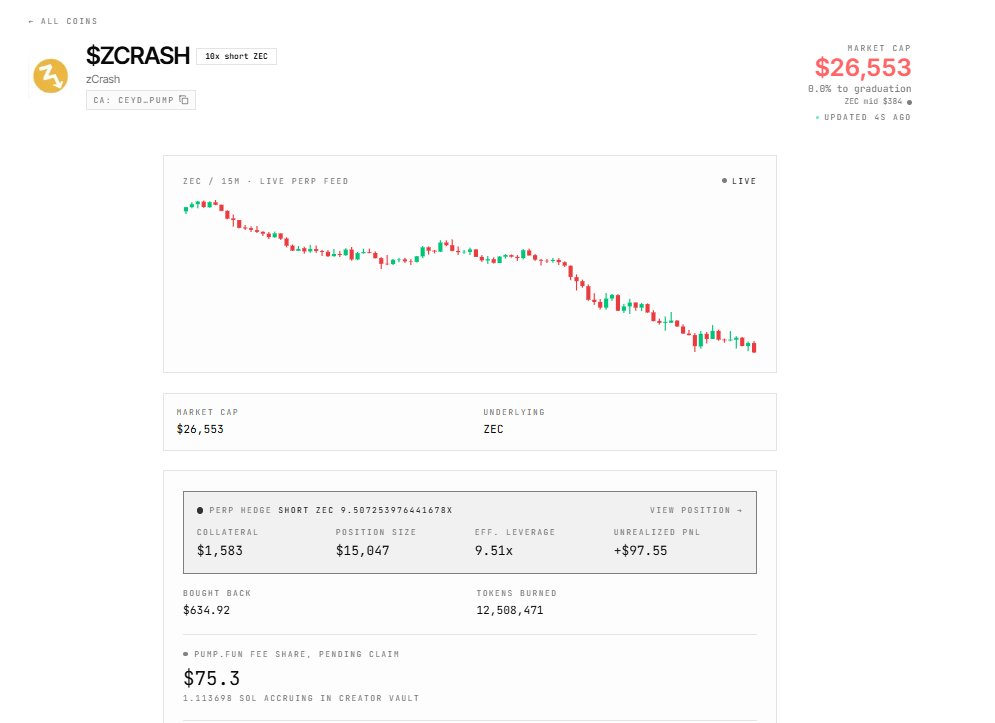
The $ZCRASH thesis is simple.
CA: CeYDoTwBmHkAxoEGj7ViJJ4aPCa24yx7byKoJ4eupump
Zcash just disclosed a critical Orchard vulnerability that was live from May 2022 until the emergency fix in June 2026.
That means for 4 years, anyone sophisticated enough to find it could have created unlimited undetectable counterfeit $ZEC inside Orchard.
Not “maybe a small accounting bug.”
Unlimited counterfeit ZEC.
Undetectable.
Because of Orchard’s privacy design, there is currently no cryptographic way to prove it was never exploited before the patch.
The only way to prove supply integrity is a future network upgrade, likely involving a new shielded pool and turnstile accounting.
That is not happening tomorrow.
It needs design, review, governance, implementation, and activation.
Months.
Meanwhile, the market has to price the possibility that counterfeit ZEC already exists and could be getting sold into liquidity right now.
This is also not just a Zcash story.
It is going to become one of the key AI x crypto security talking points:
AI-assisted audits finding bugs years of cryptographic review missed.
Privacy pools where exploits can be fixed, but historical supply integrity cannot be proven instantly.
DeFi and crypto markets repricing technical tail risk in real time.
Do not get fooled by the ZEC bull posters.
The story is not over because the bug was patched.
The story starts now because proving the past is the hard part.
$ZCRASH is backed by a live 10x ZEC short on @perpadfun.
Creator fees add to the short.
Profits buy back and burn $ZCRASH.
If ZEC aggressively reprices lower, $ZCRASH captures the trade, the narrative, and the mindshare.
This is the play.
$ZCRASH is the next 8 fig runner.
CA: CeYDoTwBmHkAxoEGj7ViJJ4aPCa24yx7byKoJ4eupump
Backed by a live 10x ZEC short on @perpadfun.
- Creator fees add to the short.
- Profits buy back and burn $ZCRASH.
- The more ZEC bleeds, the harder the flywheel hits.
Do not get fooled by the ZEC bull posters.
Orchard pools hold ~4,437,018 $ZEC and right now there is no definitive way to prove the bug was never exploited before the patch.
That means any pre-patch inflated supply could already exist, and could be getting sold into the market right now.
It will take months for them to build anything that can actually prove otherwise.
Markets do not wait months.
They reprice now.
2 digit $ZEC is coming, this becomes one of the biggest crypto talking points of the year, and $ZCRASH captures the mindshare.
No brainer.
https://t.co/ipexezrnVe
Launching $zCrash, backed by a 10x ZEC short on @perpadfun.
CA: CeYDoTwBmHkAxoEGj7ViJJ4aPCa24yx7byKoJ4eupump
Every creator fee strengthens the position.
Every realized profit helps buy back and burn $zCrash.
If this exploit is as big as it looks, ZEC gets nuked and $zCrash becomes the trade.
Trench Tools Fee Audit, Episode 2: Cented.
This one features @Cented7 / @flipski77, a high-volume Solana trader recently at the center of CT attention.
Across 9 wallets shown in the reference, Cented has done about $116M in verified volume and about $10M in realized PnL.
Even with strong realized profits, percentage-based fees still add up. They look small per trade, but become a real drag once volume compounds.
Based on verified wallet volume, here is the rough math:
Total verified volume: $116M
Total PnL: $10M
Estimated fees at 1%: $1.160M
Estimated fees at 0.75%: $870K
Fees as % of PnL at 1%: 11.60%
Fees as % of PnL at 0.75%: 8.70%
The main wallet in this set was funded on Jan 31, 2025.
From Jan 31, 2025 to May 27, 2026, a self-hosted Trench Tools setup at roughly $80 per month would have cost about $1,270 in infrastructure.
So over that same period, using Trench Tools would have saved roughly:
$1.159M versus a 1% fee model
$869K versus a 0.75% fee model
That means his PnL would have been about:
11.59% higher versus a 1% fee model
8.69% higher versus a 0.75% fee model
Trench Tools gives Solana traders the same UX and low-latency execution as fee-based platforms, but with zero platform fees through open-source infrastructure they control.
At a 1% platform fee, the break-even is only about $8,000 in monthly trading volume.
After that, fixed infrastructure cost beats paying a percentage on every trade.
Here’s our submission pitch for the @colosseum Frontier Hackathon.
@TrenchDotTools gives traders open-source, user-owned execution with full configurability and zero platform fees on @solana.
If you support what we’re building, engage and share it around.
Learn more: https://t.co/Ym1RaJK11R