On 6 August 2026, the Superintendent of Police in Islampur, West Bengal, ordered every police station in his district to survey every mosque, idgah, and mazar using a 21 point proforma. The order traces back to a directive from the state Intelligence Branch issued a day earlier.
The memo says it twice, "repeat 09-08-2026 forenoon without fail," as if the urgency itself were the justification.
Now read the attached form with patience—they want the imam's and muezzin's names, home addresses, and mobile numbers. It wants every mosque tagged by sect: Barelvi, Deobandi, Ahle Hadis, Shia. Then it adds JEI-H and JUH, which are not sects at all but lawful organisations. So the state is not just asking where Muslims pray. It is asking whose side they are on.
Authorities are also interested in whether the land is "encroached." If the mosque is "legal" or "illegal." How far it sits from the border. Who funds it. Whether a foreigner has walked in during the last three years; it seems more like a police inquiry than a simple form supposedly distributed to someone before they are accused of anything.
I didn’t find such forms in circulation for temples or gurdwaras. Also, it mentions no purpose, and it says nothing about who keeps this data.
Articles 14 and 15 of India’s Constitution forbid the state from treating citizens differently because of their religion. Articles 25 and 26 protect the right to practise faith and run religious institutions.
Indian officials can argue that border security is the reason, since Islampur is close to the Siliguri Corridor—and the state certainly has a duty to watch for real threats. So why not do it the lawful way? Act on evidence against specific people. Publicly communicate the order and apply the same level of scrutiny to every faith. The data you are collecting looks like a file for every imam in the district, treated as a suspicion element and built on one criterion: being Muslim.
Civil rights groups in Kolkata are already asking the legitimate questions. Association for Protection of Civil Rights (APCR) has asked the government and police to disclose who authorised the forms, why the information is being collected, which law or order governs this practice, and how the data will be accessed, stored and used. Guess what? Nobody has answered.
The imams who received this lead prayers from dawn to dusk, teach children, say the Janaza prayers and give the Friday Khutba. And from now on his phone number will sit in a police dossier next to his sect and his distance from Bangladesh. From now on he will choose his words more carefully on Friday. He will think twice before welcoming a visitor. And will certainly feel low within — and that is the real purpose of this form.
A democracy that sorts its citizens by faith and files them under suspicion has already stopped being one.
احتجاجات واسعة في الهند أثارها قرار السلطات الهندية بإزالة أجزاء من "مسجد الشاهي" التاريخي في مدينة أوجاين بولاية ماديا برديش، لصالح مشروع توسعة طريق يستعد لمهرجان هندوسي لعام 2028. ما رأيك في موقف الأهالي وتصرف السلطات؟
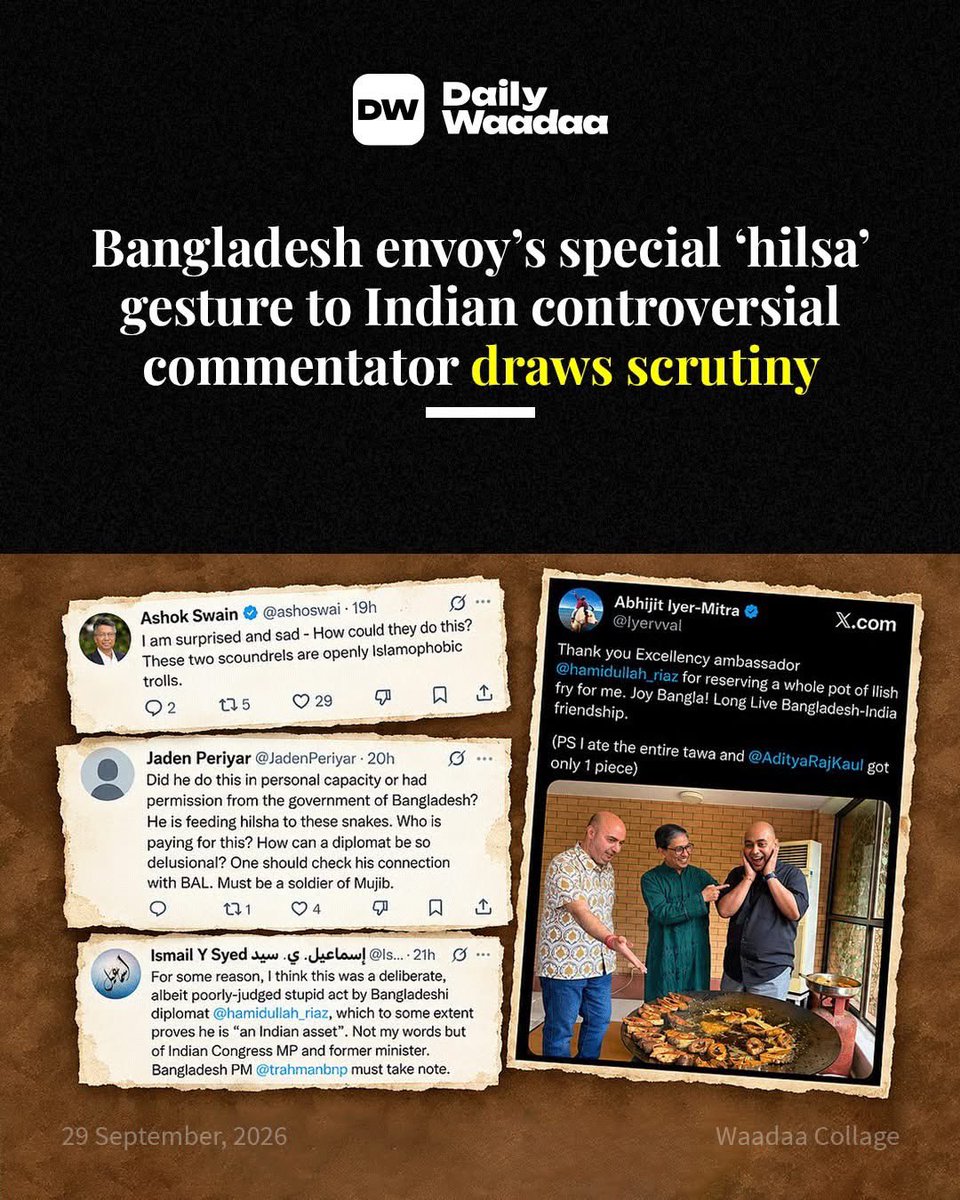
Bangladesh High Commissioner to India Riaz Hamidullah’s decision to extend special hospitality to controversial Indian commentator Abhijit Iyer-Mitra at a hilsa festival in New Delhi has drawn questions over the mission’s choice of guests and the message conveyed by the gesture.
https://t.co/PcWj09D1mp
On 26 September, the Bangladesh High Commission in New Delhi hosted an ‘Ilish Fest’ at its Maitri Auditorium, bringing together Indian politicians, diplomats, academics and journalists.
Outgoing High Commissioner Riaz Hamidullah also found time for a more personal gesture. By Abhijit Iyer Mitra's own account, the envoy ‘reserved a whole pot of Ilish fry’ for him. The attached tweet’s photograph shows Hamidullah at the tawa, laughing and pointing, flanked by Iyer Mitra and NDTV's Aditya Raj Kaul.
@AJEnglish called Iyer Mitra a far-right Hindutva ideologue in 2023, when a US congressman was criticised for meeting him only. He has publicly demanded that India start deporting Bangladeshis and Rohingyas immediately and ‘kick them out’ (check the pinned image below in the comments).
When a post circulated in March 2025 about Chief Adviser Muhammad Yunus's remarks in Beijing, his entire reply was "Baiji'r Bachaa" (বাইজির বাচ্চা) — a Bengali obscenity aimed at Bangladesh's then head of government. And Bangladesh's envoy set aside a pot for him?
Iyer Mitra’s views on Muslims more broadly are not hidden either. In 2020, he called @AltNews co-founder @zoo_bear ‘Jihadi Jabbar’ and posted, then deleted, a tweet about Zubair's mother that fellow Indian journalists read as a threat of sexual abuse.
The courts have also dealt with him. The Delhi High Court found his language about Newslaundry's women journalists impermissible in a civilised society and took his undertaking to delete the posts; this April, a Delhi court ordered an FIR against him for sexually coloured remarks aimed at the same women. Further back, in 2018, Odisha police jailed him in a case that began with his comments on the Konark temple, and he ended up apologising unconditionally before a committee of the state assembly.
Also, the High Commissioner is aware that Dhaka has yet to announce any hilsa export quota for this Durga Puja; the catch is poor and Bangladesh has been importing hilsa from India for the first time. Bangladeshis at home are struggling to afford ilish. On the contrary, a tawa full of it, kept aside for a man who wants Bangladeshis thrown out of India, is not something people would appreciate.
Riaz Hamidullah is a seasoned diplomat, leaving New Delhi early next month to become Bangladesh’s Permanent Representative to the UN in Geneva. He knows the difference between engaging adversaries, which is diplomacy, and personally feting a bigot, which is endorsement. He was not obliged to invite Abhijit Iyer Mitra; having invited him, he was not obliged to single him out; and having done both, he should have known the guest would broadcast it.
A mission that dines with people who demand the expulsion of Bangladeshis, and who vilify Muslims as a class, lends Bangladesh's name to their project.
Next time, vet the guest list. Ask one question: would this photograph embarrass Bangladesh? So that Bangladesh doesn’t sizzle on the tawa next to the fish.
Hundreds of Muslims have gathered in the Indian city of Ujjain to protest the partial demolition of a mosque they say is more than 600 years old.
The BJP-led state government says the action is needed to widen roads ahead of the 2028 Hindu pilgrimage.
In Bengal’s hinterlands, away from media attention, Hindutva outfits are unleashing terror on Christian communities. Churches vandalised, families threatened, prayers disrupted, pastors beaten up.
At least 35 incidents in two-and-a-half months. @onkeyta_ https://t.co/fO6csNZ3F1
A Palestinian woman has been killed after being shot by Israeli forces in the Bureij refugee camp in central Gaza, our colleagues on the ground report, citing Al-Aqsa Martyrs Hospital.
🔴 LIVE updates: https://t.co/MGgoEVBdcj
This is a small report tucked away on an inside page of Prothom Alo. It is a remarkable story of job creation, industrial revival and export growth.
Abul Khair Group has reopened four closed private jute mills in Faridpur and Kushtia, creating employment for around 15,000 workers. The revived mills have already begun exporting to markets such as Turkey and China, and the group has set a target of exporting 80,000 tonnes of jute yarn and jute products annually.
There is a bigger story here as well, the company did not simply build four new factories. Because the jute business is capital-intensive and so many private mills stand idle, it chose to bring existing capacity back into production by taking over closed mills. It has now applied to lease three or four closed state-owned mills as well, and says it intends to move into higher-value jute products.
There is no shortage of discussion and disinformation about factory closures, job losses and economic decline on social media and television talk shows. On the other hand stories like this rarely get the same attention: closed factories reopening, 15,000 people employed, production restarting and products being exported.
I strongly believe Bangladesh will keep moving forward, creating businesses, jobs, investment and export opportunities. Stories like this show that a real economic story is unfolding beneath the noise. The challenge is to identify these stories, present the facts accurately and bring them to a much wider audience.
And those in the @bdbnp78 responsible for highlighting such successes are failing miserably.
https://t.co/fFtp9Fuoee
The protected forest on Maheshkhali, Bangladesh’s only hilly island, could be at risk if construction of a 4.8km paved road continues, Forest Department officials and environmentalists said. Video courtesy - Coastal Forest Division.
At a Kolkata College, a Muslim Vice-Principal Was Forced to Resign. Then, ABVP 'Purified' Her Office
Students ostensibly were against the vice-principle enforcing the attendance rule, writes Joydeep Sarkar
https://t.co/veTuQ17sfr
Rajendra Chauhan Raju was behind the killing of Moni Chakraborty. He was killed over a business money dispute, but the incident was portrayed communally by Indian media, journalists and RW activists.
Just because a homicide victim is Hindu, some Indians portrayed the incident communally, even when the accused was unknown and even when the accused were Hindus.
Today, two accused, including prime accused Rajendra Chauhan Raju, were arrested.
Hindutva propagandist @AdityaRajKaul spread the false narrative, and I bet he won’t correct his post or post an update about the accused.
Antara Mukherjee, wife of deceased Moni Chakraborty, said, “Rajendra Chauhan Raju was running a business with my husband as a business partner. Meanwhile, as my husband was preparing to go to Romania on a work permit visa, he calculated the business’s profit and loss and demanded around Tk 1.2 crore from his business partner Rajendra Chauhan Raju. A dispute arose between them over the repayment of the money.”
I've watched Indian television cover Chinmoy Krishna Das for close to two years now, and I want to say something to the people making those broadcasts.
You are not wrong to cover him. He was picked up at Dhaka airport on 25 November 2024 over a sedition complaint about a saffron flag at a rally in Chattogram, and he has been inside ever since, it's been a while. The case has been messy and politically loaded from day one, and a lawyer, Saiful Islam, was hacked to death in the chaos outside the Chattogram court the day after his arrest. None of that is a small thing, and no one here should pretend otherwise.
But look at what your own correspondents have filed from Dhaka this year. In April he got bail in one case. In August, two more. On 6 September, two more — four cases in which the High Court has now said he can be released. He is still in custody because other cases remain, including the treason case and the murder case, and in January a court ordered that trial to begin against him and thirty-nine others. Argue that the charges are trumped up. Argue the process is too slow. But it is a process. Bail applications are heard and sometimes granted. A trial has been ordered, which suggests things are moving.
Now tell me about Umar Khalid.
Arrested 13 September 2020. This Sunday he completes six years in Tihar. In all that time, not one charge has been formally framed against him. The trial has not started. Nothing can start as the court is still hearing arguments about whether to frame charges at all — six years later. His lawyers told the Supreme Court that the prosecution has listed close to 900 witnesses; the state says only 100 to 150 of them actually matter. Either way, do the arithmetic on when this man is likely to hear a verdict.
Sharjeel Imam has been in custody since late January 2020 — weeks before the Delhi riots he is accused of conspiring to cause. He has been granted bail in the separate speech cases. He is in jail solely because of this one.
On 5 January this year, your Supreme Court granted bail to five of their co-accused. It refused it to these two, saying they were on a different footing and that their continued detention was not constitutionally impermissible. In April it dismissed Khalid's review. In June it let him out for three days — seven in the morning to five in the evening, home and hospital only — so he could be there for his mother's surgery. Then he went back inside.
This machinery isn’t shrouded in mystery. The UAPA law states a court can’t grant bail if the case appears credible on its face not proven, just credible. Police file their case, courts read it, and years go by. Between 2019 and 2023, your government told Parliament that over 10,440 people were arrested under UAPA, with just 335 convictions—roughly three percent. The Home Ministry admits it doesn’t even track how many prisoners are inside or how long they’ve been held.
And the pattern underneath it is not a secret either. Muslims are more than 14% of India's population and were almost 20% of its undertrial prisoners. Three out of four people in Indian jails have not been convicted of anything. Dalits and Adivasis carry the same weight. We are not alleging this about you. It is your NCRB's own data.
The peculiar asymmetry in the legal system is a major concern. Twenty-two months of detention for a monk has sparked daily panel discussions. At the same time, a scholar facing six years in prison without any formal charges in their own capital receives only a news bulletin and a shrug. The same anchor who provides details about a Chattogram FIR cannot explain why FIR 59/2020 has yet to be filed.
A press that only finds injustice on the other side of a border is not doing journalism. It is doing foreign policy with a teleprompter.
Ask your own questions at home this Sunday. Umar Khalid will have been inside for six years. He is still, in the eyes of your own law, an innocent man.
Israeli policewoman instructs Palestinian to walk away — SHOOTS him in the back ‘FOR THE FUN OF IT’
2018 West Bank ‘sponge-tipped bullet’ shooting resurfaces & goes viral
Karam Qawasmi suffered ‘significant injury’ — investigation concluded border officer shot him ‘FOR FUN’
Indian authorities have demolished a mosque in Saharanpur, Uttar Pradesh, following a court ruling. The case was filed by a member of a Hindu nationalist group.
Mosque authorities say the building dates back to 1911. Rights groups are questioning the legality of the decision.
The news is: the accused family planned to sell their land and move to India. (It's not because of any threats, it's for choice)
And see how Hindutvadis changed the news falsely claiming Ganapoti Chakrabarty planned to sell the land and leave for India.
This is completely false. Ganopati bought the land from the accused family not long ago and started building the house after taking a loan and using the money he received after retirement.
The house is still not completed, only the second floor is completed.
The claim that Agami Chakrabarty was being harassed by a Jamaat leader’s son is also fabricated. When the core claim that Ganapoti wanted to sell the land and leave for India is false, the reason given for it is already proven fabricated.
This is how they are making a fabricated narrative.
Bangladesh has contributed $1 million to Nepal’s Prime Minister’s Disaster Relief Fund to support relief, recovery and humanitarian efforts following the devastating floods that swept through northern Nepal last week.
Link in comments
#HumanitarianAid#FloodRelief#NepalFloods
Several social media users, including ISKCON monk Radharaman Das, have FALSELY claimed a communal angle in the sensational murder of four of a Hindu family in Bangladesh's Rangpur. The two accused, who have been arrested, are both Hindus. @onkeyta_
https://t.co/ouPanqPnfM