We have recently launched an updated version of IC4J libraries that greatly enhances the conversion process between Candid and #Java data types. Our objective is to offer effective solutions to connect various systems to #ICP, regardless of the data format being used such as XML, JSON, SQL, among others.
https://t.co/N1CPpDiuwS.
We have made our samples and demos compatible with the latest version of #ICP and IC4J Java libraries and updated them accordingly.
https://t.co/Sm6A4uMajE
Our Medium article provides a comprehensive guide on creating complex business processes using #ICP and IC4J libraries, along with popular Java frameworks such as #Android and #angularjs.
https://t.co/Ew6BDV8rog
CP-compatible Peppol messaging for European business documents: UBL 2.1 and Peppol standardize invoices, orders, and trade flows across systems and borders, while ICP canisters make document exchange tamper-proof and auditable. Apache Camel + IC4J Camel let you compose richer business processes and connect to 300+ integrations.
GitHub: https://t.co/rT0IVUaH7x | https://t.co/6eI4Y1vkG8
Peppol: https://t.co/58ziDQgfWF
ICP: https://t.co/SB3ikE7Pcj
Apache Camel: https://t.co/EWao24SwTM
"Critical."
That's the legal category EU regulators created in November 2025 for AWS, Microsoft Azure, and Google Cloud.
Under DORA - the EU's Digital Operational Resilience Act - the European Banking Authority, ESMA, and EIOPA officially designated all three as Critical third-party providers. Meaning, their failure would constitute systemic risk to the EU financial system.
Banks. Insurers. Investment firms. Payment institutions. Across the EU. Running critical functions on infrastructure regulators now class as a systemic dependency.
So regulators built a new oversight framework. Joint inspection teams. Annual risk analyses. On-site visits.
Not to reduce the dependency. To manage it.
That's not a supervision story. It's an architecture story.
When concentration becomes severe enough that regulators must invent a new legal category to contain the risk - the problem was never regulatory. It was structural.
IC4J Camel 0.8.1 is out.
New in 0.8.1:
split artifacts: ic4j-camel-core and ic4j-camel-mcp
reusable ICP MCP schema builders and processors
new reusable Kamelets: icp-mcp-rest-service and icp-mcp-ws-service
improved MCP sample for Motoko canisters with Camel YAML and Kamelet-based flow
Build MCP servers and call Internet Computer canisters from Apache Camel with less custom glue.
#ApacheCamel #Java #MCP #InternetComputer #ICP
🚀 Exciting news! We have just released version 0.8.0 of the IC4J Agent and the IC4J Apache Camel Component! 🌐🐪
https://t.co/KNnfEN1Orq
https://t.co/6eI4Y1vkG8
What's new? You can now seamlessly integrate the Internet Computer (ICP) with the Model Context Protocol (MCP) using the new Apache Camel MCP Component! 🤖✨
https://t.co/ILi3bEToEG
You can natively execute Motoko smart contracts and expose them as MCP tools and endpoints using pure Camel YAML routes—no custom Java code required!
Check out the new `mcp-icp-motoko` sample to get started! 🛠️
https://t.co/YrK734rw0Z
#InternetComputer #ICP #ApacheCamel #Java #MCP #AIIntegration
@integral_wizard We do have Internet Identity Spring service as a part of our IC4J Spring library. Also Management service for canister lifecycle (deploy, un deploy , start, stop) ICP canister directly from Java Spring application. https://t.co/K7t5ugwS5y
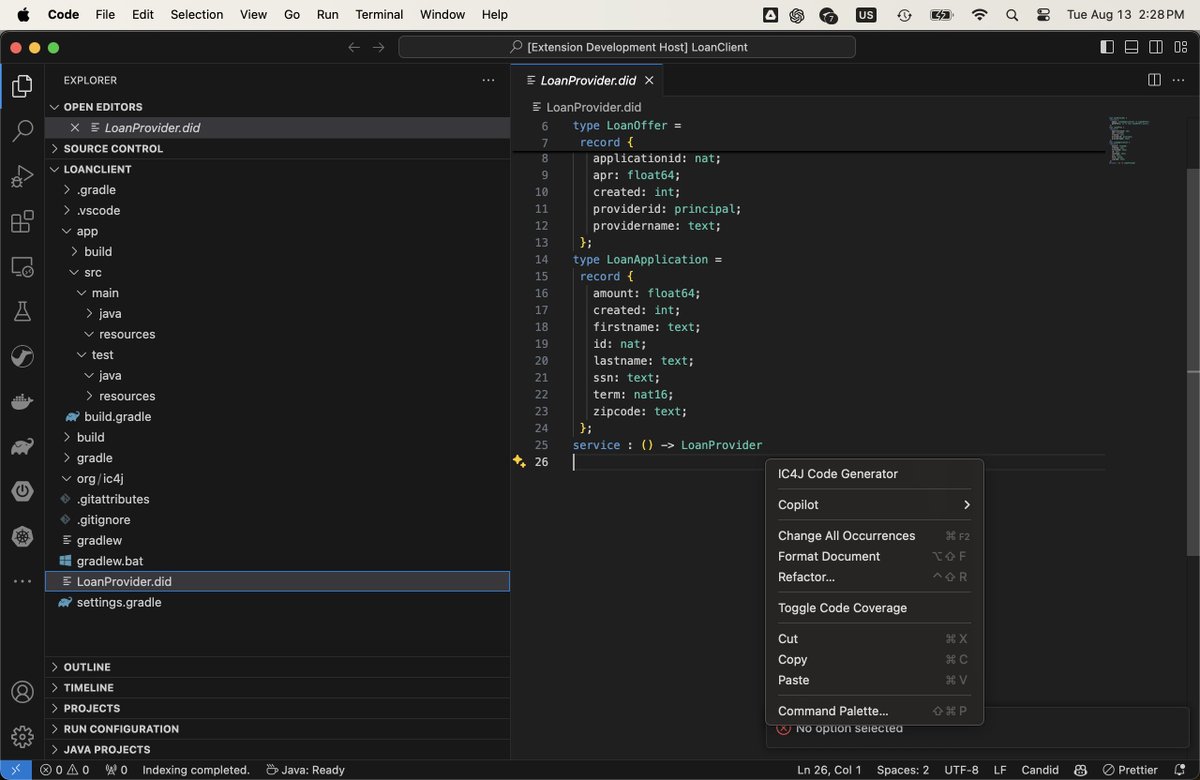
Working on a Visual Studio Code extension for the IC4J Code Generator, which generates Java artifacts from Candid IDL files. This extension supports Java, Spring, and React Native applications that connect to the Internet Computer Protocol (#ICP). An early functional version is already available. #vscode #java @springframework@reactnative
We can now generate #Java Spring @springframework service directly from #ICP Candid file in our Codegen tool https://t.co/JaQ4eS9hkr. Also tested prototype of IntelliJ @intellijidea plugin.
The initial version of the IC4J Java Spring library has been released. Java Spring, a comprehensive framework for building modern, enterprise-level applications, offers robust support for dependency injection, aspect-oriented programming, and web applications. This library enables Java Spring developers to seamlessly integrate ICP canisters into their Spring applications, enhancing functionality and interoperability. Additionally, the library comes with predefined Internet Identity and Management Spring services, further simplifying the development process.
https://t.co/kdRPDu4raW
The HelloWorld sample demonstrates the use of this library.
https://t.co/I0t2k2beLD
#ICP #Java @springframework
The initial version of the IC4J Java Spring library has been released. Java Spring, a comprehensive framework for building modern, enterprise-level applications, offers robust support for dependency injection, aspect-oriented programming, and web applications. This library enables Java Spring developers to seamlessly integrate ICP canisters into their Spring applications, enhancing functionality and interoperability. Additionally, the library comes with predefined Internet Identity and Management Spring services, further simplifying the development process.
https://t.co/kdRPDu4raW
The HelloWorld sample demonstrates the use of this library.
https://t.co/I0t2k2beLD
#ICP #Java @springframework
We are delighted to announce the release of version IC4J Java ICP Agent Phase 2. This release incorporates numerous enhancements across both Candid and Agent packages. Notably, the Candid package now includes support for Jakarta JAXB serialization and deserialization. Additionally, we have integrated the Gson serializer and deserializer library into the core package.
In the Agent library, we've introduced support for Delegated Identity and Prime256v1 Identity. Furthermore, we're now facilitating ICP signed query verification.
We're presently engaged in upgrading and testing our enhancement libraries to handle Internet Identity, ICP Canister lifecycle, Gradle and Apache Maven plugins, React Native package, and Apache Camel component, aligning them with our latest Agent release.
We've commenced work on phase 2 of our IC4J Dfinity grant project, concentrating on some missing Agent features. We've just incorporated support for the Prime256v1 algorithm Identity. Next up is Delegated Identity, which is a bit more complex and will likely take a few days to complete.
We are excited to announce that we have received another grant from the Dfinity Foundation!
In Phase 1 of our project, we developed the initial version of a Java agent enabling remote connectivity from any Java application to the Internet Computer.
We are actively collaborating with developers from prominent ICP projects to gather requirements for integrating Java into the ICP ecosystem. Simultaneously, we are engaging with enterprise application developers across various verticals (insurance, finance, supply chain, etc.) to enhance our understanding of how ICP can be applied in diverse use cases.
Over the past two years, we have incorporated numerous additional features (Internet Identity https://t.co/NjNa0igOvu, Canister Management https://t.co/5BS4UgMJok, WebSockets https://t.co/4EiySoPU3J) and subprojects that facilitate the integration of ICP with popular Java open-source frameworks like React Native https://t.co/Jf5TzRhxmc, Gradle https://t.co/2eaxyU6qVd, Apache Maven https://t.co/VprFDjSDaq, Apache Camel https://t.co/6eI4Y1vkG8. This empowers Java developers to seamlessly incorporate ICP into their applications and development environments.
We also started to work on integration with popular Java Development tools. Currently we have available early version of IC4J code generation tool that enables generate Java Proxy classes from ICP IDL files and vice versa generate Motoko types from existing Java classes https://t.co/vwVsCKwJd9. We also have functional prototype of Android Studio wizard to add such functionality directly to Android Studio.We have initiated efforts to integrate with widely-used Java development tools. Presently, there is an early version of the IC4J code generation tool available. This tool facilitates the generation of Java Proxy classes from ICP IDL files and, conversely, generates Motoko types from existing Java classes. Additionally, a functional prototype of an Android Studio wizard is in place to seamlessly incorporate this functionality directly into Android Studio.
These projects are in different stages of completion from POC to pre-release These projects are at various stages of development, ranging from proof of concept (POC) to pre-release.
In this phase we would like to complete those features and subprojects in development, add additional features like Delegated Identity, update existing documentation, promote on social media.During this phase, our objectives include finalizing the development of ongoing features and subprojects, incorporating additional functionalities such as Delegated Identity, updating existing documentation, and promoting the project on social media.
Released a new version of #ISO20022 Apache Camel Component https://t.co/yAaO27rdFq. This is major update, supporting the latest version (4.4.0) of
@ApacheCamel
.
Released a new version of #ICP Apache Camel Component https://t.co/ylHZV3ExGb.
This is major update, supporting the latest version (4.4.0) of @ApacheCamel.
Enterprise is all about integration with existing systems and environments. Use IC4J open source libraries to connect with existing data sources. Extend existing Spring or Jakarta applications. Test and deploy ICP canisters with Gradle or Maven scripts.
UTOPIA:
Unstoppable
Tamperproof
Open
Platform for
Independent
Autonomy
A private virtual cloud platform that can be spun up over existing clouds, or dedicated hardware, which has game-changing properties.
Corporations, NGOs, governments, militaries etc, who need their data on private hardware, and can't build on the public Internet Computer network, will spin up UTOPIA virtual private clouds that are serverless and stateful to run their systems and services.
Each UTOPIA virtual cloud platforms is tamperproof and unstoppable within fault bounds – and so are the systems and services built there. Owners also get vendor independence, since a UTOPIA can add and remove nodes without being interrupted, and can effectively walk across compute resources 🔥
UTOPIA owners can build their own systems and services on their private clouds, but they will also be able to install ready made dapps...
This is a HUGE opportunity for ICP developers: package your web3 services for UTOPIA use, then sell lucrative support contracts to those installing them in the corporate world 🔥
Developer network effects: web3 developers fed up with being entrepreneurs, can go build for enterprise. Enterprise developers fed up with the corporate world, can go be web3 entrepreneurs.
Organizations running UTOPIAs can make their canister smart contracts interoperable across the networks by registering their networks with the Internet Computer (small ICP token fee).
As always, Blockchain Singularity is the aim.
We want the majority of the world's systems and services running in tamperproof and unstoppable form on next-generation ICP networks – the future of compute...
ICP technology aims to solve some of the grand problems of our time:
Cybersecurity – you no longer need firewalls, intrusion monitoring, anti-virus etc. (Consider that cyber crime is estimated to cost >$10t annually by end of this year, which is 37% of the GDP of America, and AI will make it worse.)
R&D productivity – building with canister smart contracts is much more productive than with using traditional software, and you no longer need platform software like databases, web servers, etc. This year, the world will spend $1.8t on IT personnel, and much of their time is being wasted by complexity. The world will also spend $900b+ on software licenses.
Thus, UTOPIAs will be run by organizations seeking security and resilience, and by those wishing to reduce their R&D and maintenance costs, and their licensing costs.
Plus, UTOPIAs will also be run by governments, NGOs and militaries seeking to create sovereign clouds and systems that do not have foreign backdoors or kill switches – the technology is open source.
It is not unreasonable to say that ICP (Internet Computer Protocol) technology provides without doubt the most advanced next-generation compute platform in existence today – it was developed through a massive multi-year R&D effort that has placed it years ahead of its time.
The public Internet Computer network demonstrates that ICP technology works as described, is mature, and is battle proven.
With the coming UTOPIA initiative, ICP technology will gain full coverage, and tremendous network effects.
🧠 UTOPIAs will also host tamperproof and unstoppable vertical AI models for organizations, including LLMs, which are efficient – directly addressing the pressing emerging need of running AI that is tamperproof and resilient.
Stay tuned – this is just one of the ways that ICP will take its battle to the world as we head into 2024 ⚔️🦾
Launched the inaugural version of the IC4J WebSocket Agent library. This library empowers #Java applications to establish communication with #ICP canisters via the WebSocket protocol. The IC4J library ensures compatibility with the most recent version of the WebSocket Gateway (https://t.co/RHboQzxeZB).
https://t.co/4EiySoPU3J
Released patch for Java ICP Agent (Version: 0.6.19.6). - ICP introduced a new signatures property in the Query Response message. Modified Java code to ignore all unknown properties.
https://t.co/NoTSZeJEwP