One person who was completely vindicated in time was Shiller with his AEA address on narrative economics.
I was there at the time, and thought: cool idea, but no way you can operationalize this.
LLMs have made it much easier to study narratives
https://t.co/FAH3HxpUi5
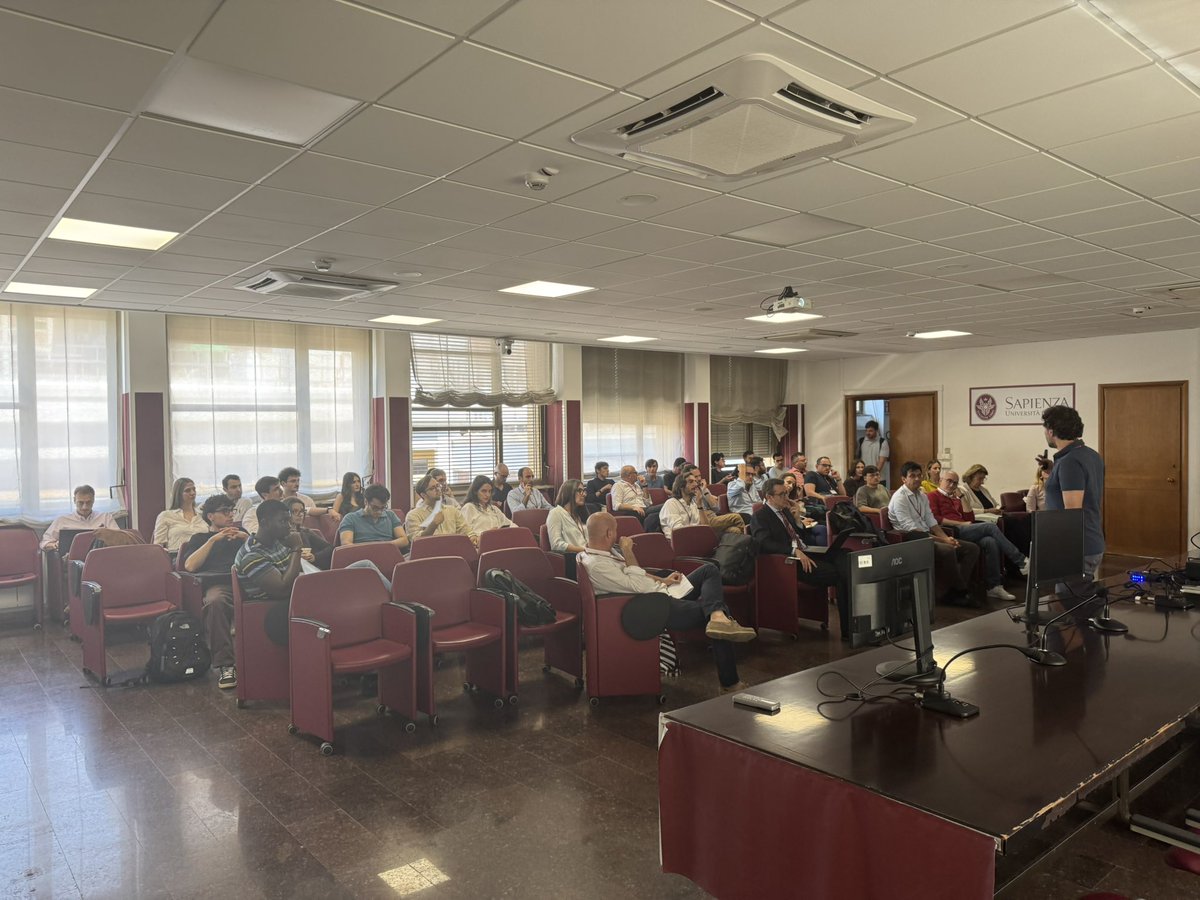
For those interested, here are my slides from yesterday's Cowles Lecture at the Econometric Society Meetings @YaleCowles@econometricsoc
https://t.co/HilQnlxMEG
Thanks so much for listening and for the great discussion and comments!
Excited to FINALLY release toughest+most rewarding paper I've worked on...
….we attack a 150 year old Walras question that's gone unanswered, not for lack of trying (Hicks, Samuelson, Arrow; our chances?😱)...
Q: Is the market equilibrium stable or unstable?¯\_(ツ)_/¯
🧵
Our new paper in the Journal of International Economics lands right in the middle of the recent @lugaricano and @paulkrugman discussion on why Europe is falling behind the US. We model the Baumol cost disease within services that acts as a structural drag on European aggregate productivity, and show why trade won't easily cure it.
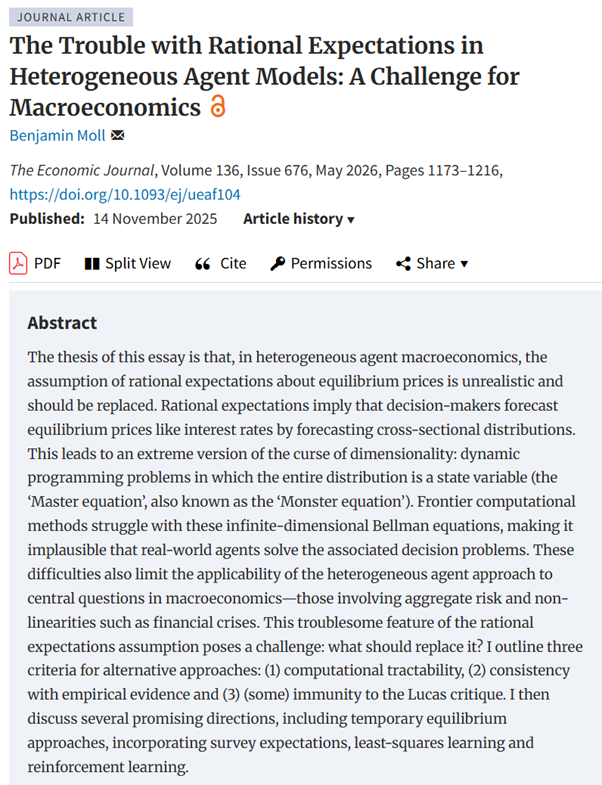
In the May 2026 issue: ‘The Trouble with Rational Expectations in Heterogeneous Agent Models: A Challenge for Macroeconomics,’ by Benjamin Moll https://t.co/RWvehwIsA8 @ben_moll@RoyalEconSoc#EconTwitter
My favourite macro conference of the year just announced its call for papers! It's mainly intended for "juniors" (=PhD students, Assistant and recently Associate profs). Tight deadline, so apply before April 13.
RT if you think someone else might be interested.
📢Only one week left to submit to the 13th Ghent University Workshop on Empirical Macroeconomics.
We look forward to receiving your papers. Submit here: https://t.co/Ev4fENq0LF
Chris Sims changed macroeconomics at least four times: VARs, Bayesian methods, the fiscal theory of the price level, and rational inattention. I wrote about what he built and why it matters.
Link: https://t.co/FyKepJOE4q
During my lectures last week at the ECB and the Bank of Spain on deep learning, I realized that many people in economics and econometrics often overlook the fact that what constitutes a good representation of the data (the topic of my previous post) depends entirely on the task at hand. A classic illustration I always use to make this point is Cover’s Theorem.
Let me start with the intuition.
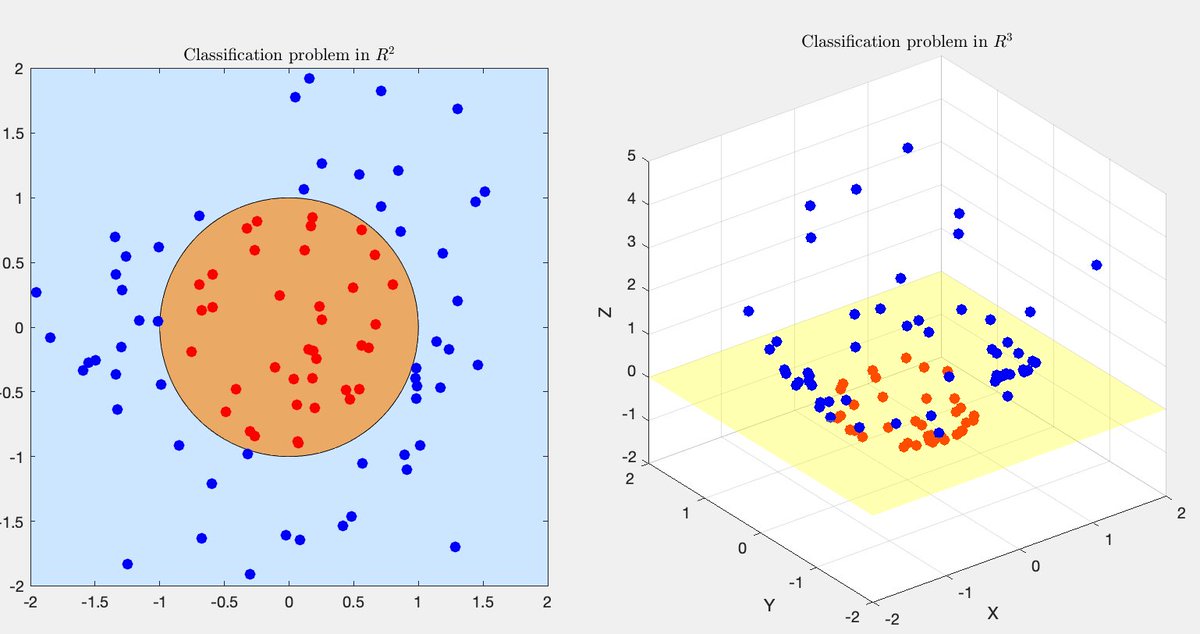
Imagine that you have two-dimensional data (see the left panel of the figure below). The data are already normalized. For example, one dimension may be age, and the other income. The task is to separate individuals inside the unit circle (red dots) from those outside (blue dots). In this toy example, which corresponds to identifying people of middle age and middle income.
This classification problem is (relatively) hard in the original 2D space because the decision boundary is nonlinear: checking whether x^2 + y^2 < 1 is not something a linear classifier can easily encode. And while “costly floating-point operations’’ is not the real issue in practice, the key point is that linear separation is impossible in the original coordinates.
Now do something simple: map (x,y) into (x, y, x^2 + y^2 - 1).
That is, embed the problem from two dimensions into three. The right panel shows the result. In this 3D space, the red points satisfy x^2+y^2 - 1 < 0, so they lie below the plane z = 0, while the blue points lie above it. A single linear cut (the plane z=0) now perfectly separates the two classes. What was nonlinear in 2D becomes linear in 3D.
You may have noticed that this is exactly the kernel trick: instead of struggling with a nonlinear boundary in the original space, map the data through a suitable transformation so that the pattern becomes linear in a higher-dimensional feature space.
You can find the precise statement of the components of Cover’s Theorem in Thomas Cover’s original 1965 paper:
https://t.co/zzFb4gaDFm
But the main message is simple and powerful:
A complex pattern-classification problem, when recast nonlinearly in a higher-dimensional space, is more likely to become linearly separable than in its original low-dimensional space, as long as the higher-dimensional space is not too densely populated.
This has an important implication that many people often misunderstand. Machine learning is not fundamentally about dimensionality reduction. It is about finding the informationally efficient geometric representation of the data for the specific downstream task you are concerned with.
I'm on the Job Market this year 🚀
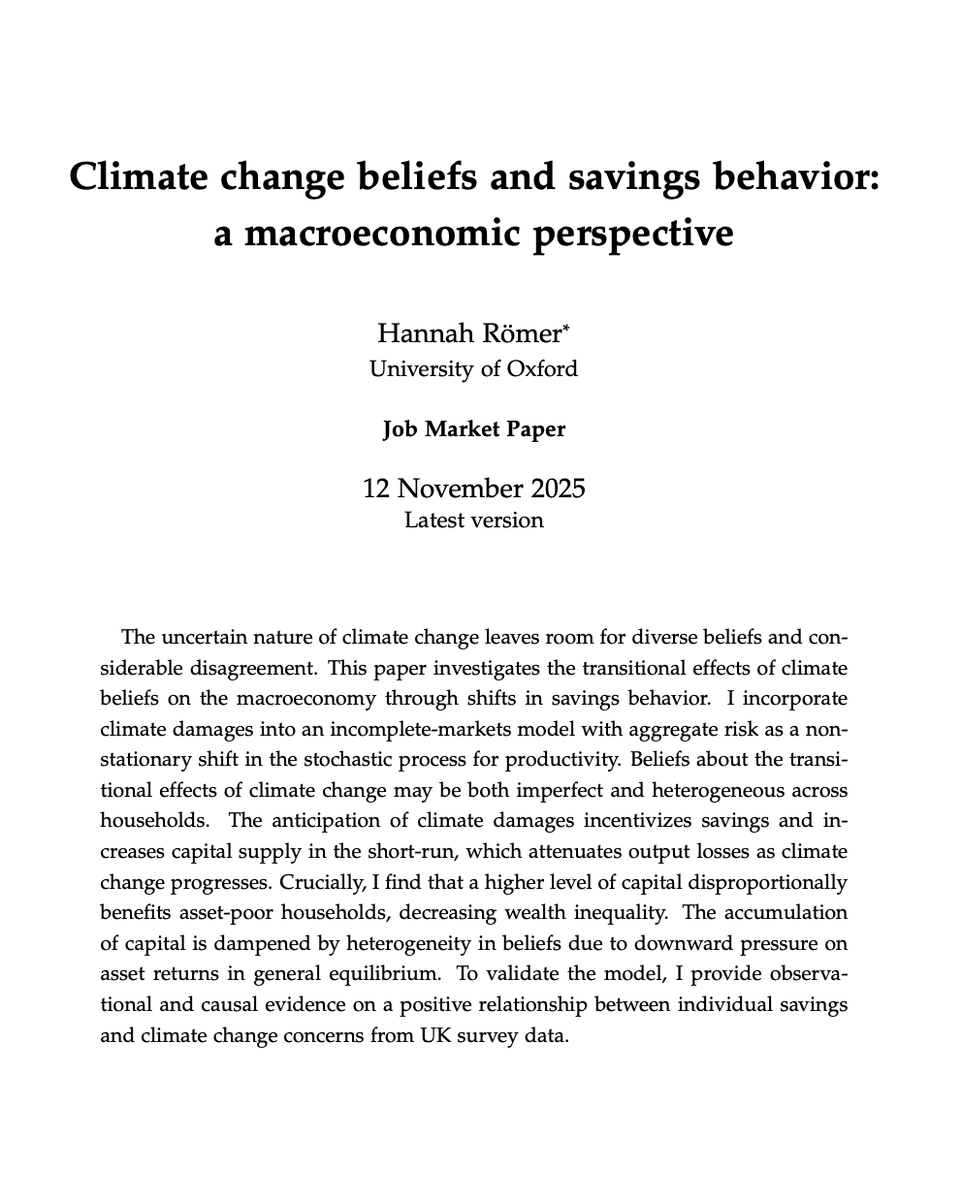
Really happy to share my JMP: "Climate change beliefs and savings behavior: a macroeconomic perspective"
I show how beliefs over structural shifts affect transitional macroeconomic dynamics, using the example of climate change 👇