A kid drew himself sleeping in bed between mom and dad and labeled it 'safe.'
In Japan, this exact sleeping arrangement has a name. They call it 'the river.' Mother is one bank. Father is the other. The child between them is the water. Roughly 70% of Japanese mothers sleep this way with their kids, sometimes through the teenage years. The Western model of putting a kid alone in their own bedroom is barely 200 years old. For most of human history, in most cultures still alive today, kids slept beside their parents.
James McKenna runs the Mother-Baby Behavioral Sleep Lab at Notre Dame. He spent decades watching what happens when parents and kids share a bed. The bodies sync up. Heart rates align with the parent's, breathing falls into the same rhythm, and by morning even sleep stages have started matching. The parent's body, in McKenna's words, acts as a kind of biological jumper cable for the child's.
In 2013, researchers in the Netherlands tracked 193 babies through the first year of life. They measured cortisol, the brain's main stress hormone. Babies who had spent more weeks co-sleeping in the first six months produced less cortisol under stress at 12 months. Sleeping near a parent had rewired the kid's stress system to be calmer under pressure.
Inside the kid's brain at night, the amygdala, the fear alarm, gets more sensitive as the body gets tired. Darkness makes it worse. A 2021 paper in PLoS One from Australian researchers showed that light directly suppresses amygdala activity. Lights off, alarm louder. The whole brain is wired to read 'alone in a dark room' as a threat.
Now add a parent's body to that bed. The kid's nervous system reads warm body, breathing nearby, familiar smell. The threat alarm dials down. Two parents on either side dial it down twice. The drawing is the kid's brain calculating maximum safety: I am surrounded by the people who keep me alive, and nothing can reach me without going through them first.
The arrangement in this drawing is what most of human history called 'sleeping.' Sleeping the kid alone in another room is a 200-year-old Western invention that we forgot was an invention. Every kid who has ever padded into your room at 3am and crawled into the middle of the bed is just trying to redraw the picture.
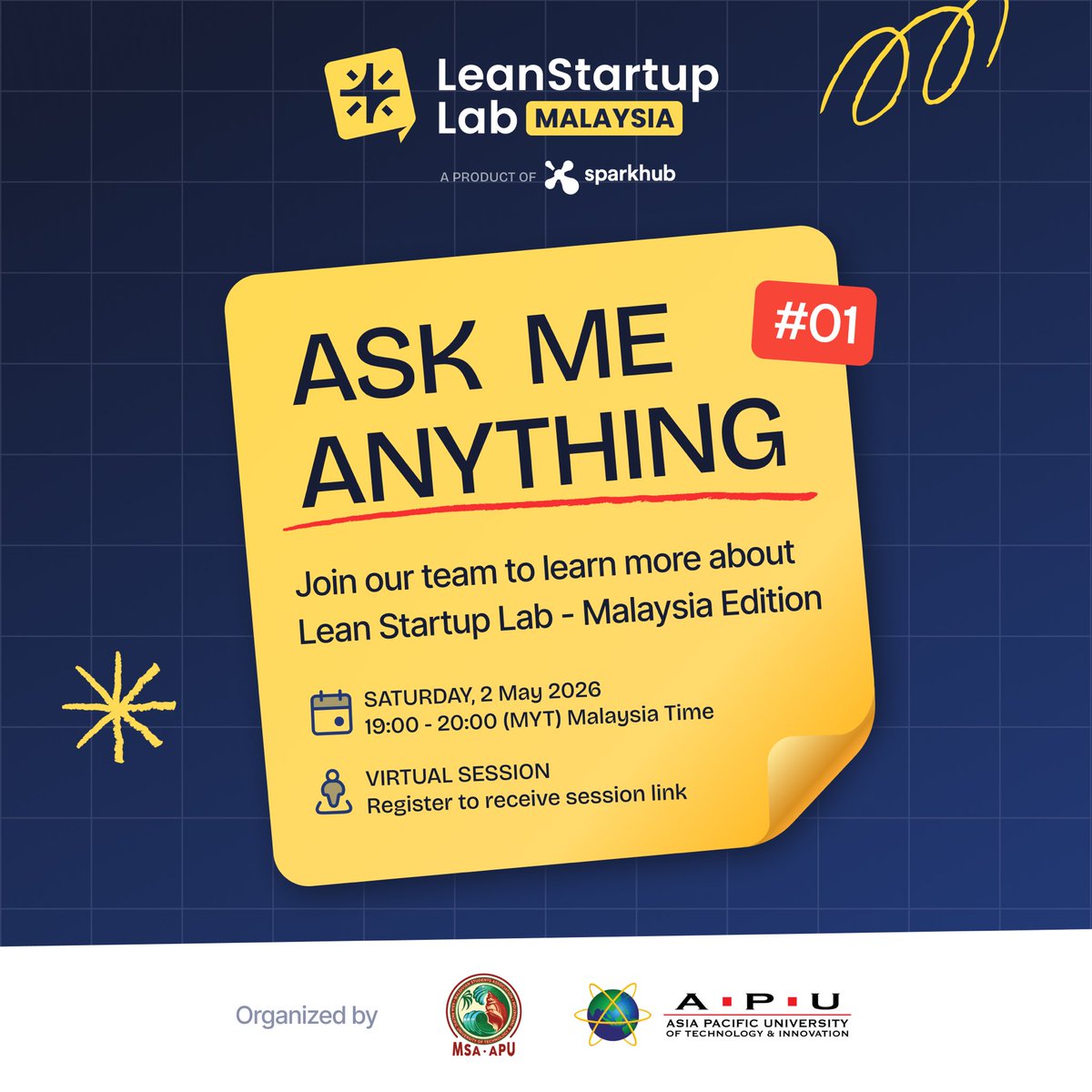
Curious about the @leanstartuplabx Malaysia Edition? 🤔
Join our FIRST AMA session (virtual) on May 2nd & get all your questions answere🚀
🎟 Register for AMA: https://t.co/kKAvvLaXxF
🔍 Learn more: https://t.co/50MTBCWHch
AI-native software engineering teams operate very differently than traditional teams. The obvious difference is that AI-native teams use coding agents to build products much faster, but this leads to many other changes in how we operate. For example, some great engineers now play broader roles than just writing code. They are partly product managers, designers, sometimes marketers. Further, small teams who work in the same office, where they can communicate face-to-face, can move incredibly quickly.
Because we can now build fast, a greater fraction of time must be spent deciding what to build. To deal with this project-management bottleneck, some teams are pushing engineer:product manager (PM) some teams are pushing engineer:product manager (PM) ratios downward from, say, 8:1 to as low as 1:1. But we can do even better: If we have one PM who decides what to build and one engineer who builds it, the communication between them becomes a bottleneck. This is why the fastest-moving teams I see tend to have engineers who know how to do some product work (and, optionally, some PMs who know how to do some engineering work). When an engineer understands users and can make decisions on what to build and build it directly, they can execute incredibly quickly.
I’ve seen engineers successfully expand their roles to including making product decisions, and PMs expand their roles to building software. The tech industry has more engineers than PMs, but both are promising paths. If you are an engineer, you’ll find it useful to learn some product management skills, and if you’re a PM, please learn to build!
Looking beyond the product-management bottleneck, I also see bottlenecks in design, marketing, legal compliance, and much more. When we speed up coding 10x or 100x, everything else becomes slow in comparison. For example, some of my teams have built great features so quickly that the marketing organization was left scrambling to figure out how to communicate them to users — a marketing bottleneck. Or when a team can build software in a day that the legal department needs a week to review, that’s a legal compliance bottleneck. In this way, agentic coding isn’t just changing the workflow of software engineering, it’s also changing all the teams around it.
When smaller, AI-enabled teams can get more done, generalists excel. Traditional companies need to pull together people from many specialties — engineering, product management, design, marketing, legal, etc. — to execute projects and create value. This has resulted in large teams of specialists who work together. But if a team of 2 persons is to get work done that require 5 different specialities, then some of those individuals must play roles outside a single speciality. In some small teams, individuals do have deep specializations. For example, one might be a great engineer and another a great PM. But they also understand the other key functions needed to move a project forward, and can jump into thinking through other kinds of problems as needed. Of course, proficiency with AI tools is a big help, since it helps us to think through problems that involve different roles.
Even in a two-person team, to move fast, communication bottlenecks also must be minimized. This is why I value teams that work in the same location. Remote teams can perform well too, but the highest speed is achieved by having everyone in the room, able to communicate instantaneously to solve problems.
This post focuses on AI-native teams with around 2-10 persons, but not everything can be done by a small team. I'll address the coordination of larger teams in the future.
I realize these shifts to job roles are tough to navigate for many people. At the same time, I am encouraged that individuals and small teams who are willing to learn the relevant skills are now able to get far more done than was possible before. This is the golden age of learning and building!
[Original text: https://t.co/1pUxNC5UXk ]
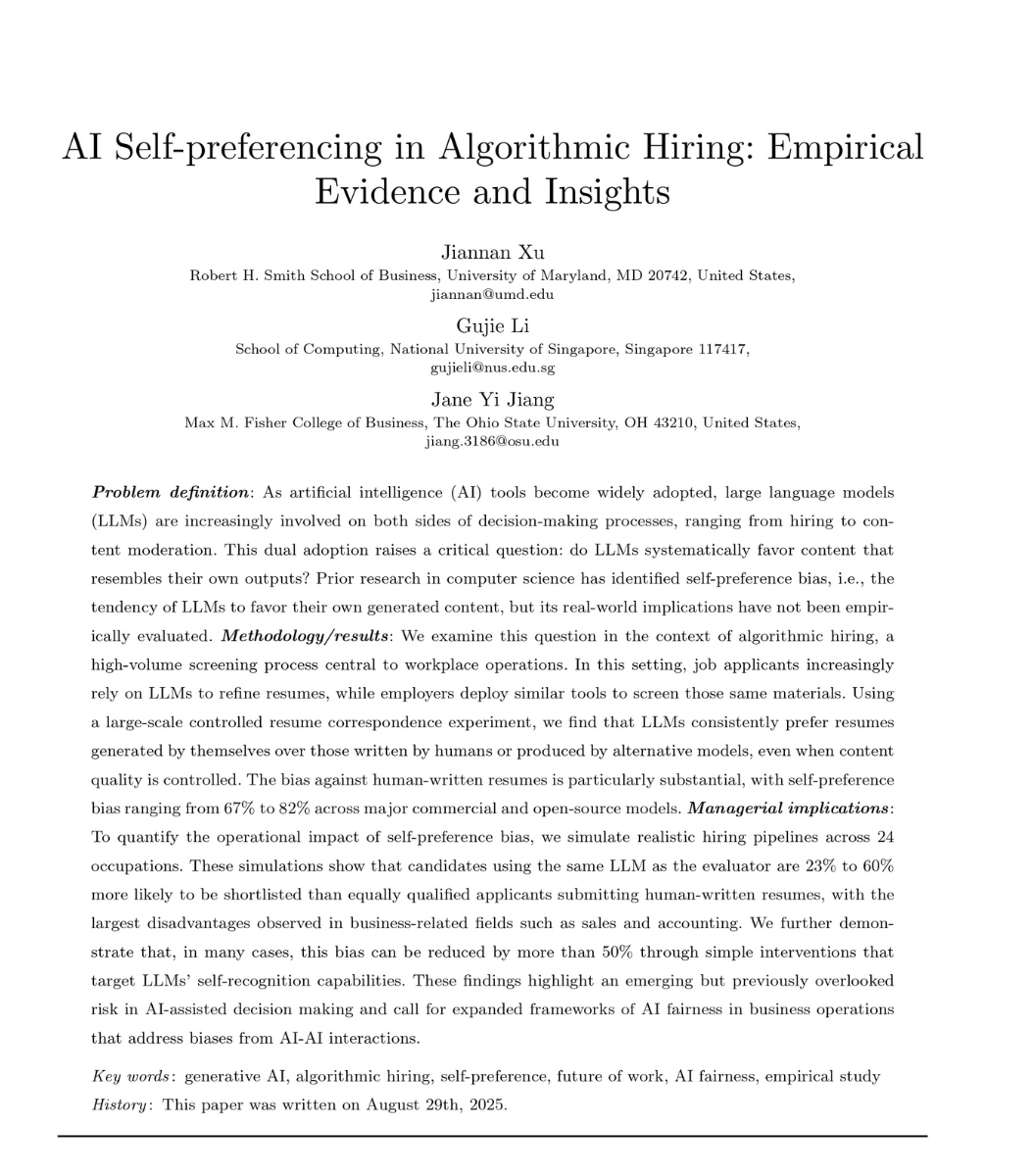
Researchers sent the same resume to an AI hiring tool twice. Same qualifications. Same experience. Same skills. One version was written by a real human. The other was rewritten by ChatGPT.
The AI picked the ChatGPT version 97.6% of the time.
A team from the University of Maryland, the National University of Singapore, and Ohio State just published the receipt. They took 2,245 real human-written resumes pulled from a professional resume site from before ChatGPT existed, so the human writing was actually human. Then they had seven of the most-used AI models in the world rewrite each one. GPT-4o. GPT-4o-mini. GPT-4-turbo. LLaMA 3.3-70B. Qwen 2.5-72B. DeepSeek-V3. Mistral-7B.
Then they asked each AI to pick the better resume. Every model picked itself.
GPT-4o hit 97.6%. LLaMA-3.3-70B hit 96.3%. Qwen-2.5-72B hit 95.9%. DeepSeek-V3 hit 95.5%. The real human almost never won.
Then the researchers tried the obvious objection. Maybe the AI is just better at writing. So they had real humans grade the resumes for actual quality and ran the experiment again, controlling for it. The result was worse. Each AI kept picking itself even when human judges rated the human-written version as clearer, more coherent, and more effective.
It gets worse. The AIs do not just prefer AI over humans. They prefer themselves over other AIs. DeepSeek-V3 picked its own resumes 69% more often than LLaMA's. GPT-4o picked its own 45% more often than LLaMA's. Each model can recognize and reward its own dialect.
Then the researchers ran the simulation that ends careers. Same job. 24 occupations. Same qualifications. The only variable was whether the candidate used the same AI as the screening tool. Candidates using that AI were 23% to 60% more likely to be shortlisted. Worst gap was in sales, accounting, and finance.
99% of large companies now run AI on incoming resumes. Most of them use GPT-4o. The paper just proved GPT-4o picks GPT-4o 97.6% of the time.
If you wrote your own cover letter this week, you did not lose to a better candidate. You lost to a worse candidate who paid OpenAI 20 dollars.
Your qualifications do not matter if the AI prefers its own handwriting over yours.
#MTCC update:
Ahmed Salam, widely regarded as a principled man with strong values, has been suspended from his role as Head of the IT Division over suspicions that he leaked information about the project.
Meanwhile, Abdul Wahid, who just returned back from council election campaign, is ready to take over the division.
A lot of people are talking about the “Malé Taxi” name right now. I want to share our side of the story not as a complaint, but because 10 years of hard work deserves to be heard.
In 2015, we registered the business name “Malé Taxi” under Taviyani Pvt Ltd (Registration No. BN-0929/2015). That same year, we launched Kobaa Taxi, an online taxi booking service. We purchased 150 Samsung tablets from Thailand, along with MiFi devices and SIM cards from Dhiraagu, all with our own money, and distributed them to drivers ourselves. There was no funding, no backing just our own effort to build something new for Malé.
In 2016, we submitted a proposal to the Ministry of Economic Development for motorcycle taxi services (RFP Ref: (IUL)101-AF/2016/77). We demonstrated the concept, but our proposal was not selected. We were then advised to apply through a new regulation, and we followed every process as required.
In 2017, the ministry opened an Expression of Interest for Premium Taxi Services in Malé and Hulhumalé (Ref: (IUL)101-AF/1/2017/31, dated 1 February 2017). We submitted a detailed proposal featuring electric and hybrid vehicles, app-based booking, Maldivian drivers in uniform, cashless rides, and a phased rollout plan. We even beat MTCC on price. In the end, the project was cancelled.
At that time, very few people in the Maldives believed an app-based taxi service could work so in 2017, we stopped.
But we did not give up.
In February 2019, we rebranded and launched Avas Ride. We started again from zero with no outside rescue. Just our own money, our own belief, and our determination to keep going.
Today 7 years later Avas Ride has more than 160,000 customers and 3,000+ drivers. In 2025 alone, we completed 2.9 million rides.
As a white-label platform, we faced limitations in customizing the product for the Maldivian market including constraints around integrations such as BML payment gateway ,implementation of safety features. Despite these challenges, we continued to grow and validate the model locally.
In 2023, we made a major decision: to build our own platform from scratch.
We began developing Avas App with a fully Maldivian team 8 developers, a CTO, a UI designer, and a product manager. We successfully launched it with a grand event, marking a new chapter for locally built technology.
Today, we are preparing for an international white-label launch in Q3 this year.
We proved that this model works not with government money, but with persistence, resilience, and belief in what we are building.
Then, on 2 April 2026, MTCC launched “Malé Taxi Line”: electric vehicles, app-based booking, Malé and Hulhumalé coverage, and uniformed drivers. It is almost identical to what we proposed in 2017 and it uses the name we registered in 2015.
We sent a formal notice regarding name infringement to MTCC on 28 March 2026. They launched anyway. There was no response, no negotiation, and no acknowledgment.
Let us be clear we are not against better public transport. In fact, we have spent the last decade trying to build exactly that.
But if a legally registered business name can be used by a state-owned company without even a conversation, then what message does that send entrepreneurs in Maldives.
Meet @icernn CTO at @oxiqamv
With 11+ years in software architecture & cybersecurity, he builds secure, scalable systems and leads GenAI-enabled platforms for real-world, high-stakes environments.
In Partnership with @sparkhubmv & Co-partnered @synetecs#GenAIHack26
Meet @icernn— CTO at @oxiqamv
With 11+ years in software architecture & cybersecurity, he builds secure, scalable systems and leads GenAI-enabled platforms for real-world, high-stakes environments.
#GenAIHack26
In Partnership with @Sparkhubmv. Co-partner: @synetecs
In law, a single hallucination can cost you a case.
As an AI startup founder, I keep asking myself:
How do we hold AI accountable when it gets things wrong?
A federal judge in Alabama recently considered sanctions after ChatGPT was used to draft court filings with nonexistent case citations. Entirely fabricated legal references presented with full confidence.
General-purpose LLMs weren’t built for the law.
Not Maldivian law. Not any law
They weren’t trained on Maldivian laws. They don’t know our courts and when they guess, they guess convincingly. That’s not a limitation. That’s a liability.
LegalNotes, a product by @Synetecs Inc., is our answer: an AI-first legal research tool currently trained on the Maldivian legal system, designed to reduce hallucinations by grounding responses in underlying materials.
What we are building this week:
•Case search and Q&A across Supreme Court and Civil Court decisions
•Hearing transcript search
•Gazette “Usool”
•Full Dhivehi language support
Because reading through dozens of cases is exhausting and productivity shouldn’t come at the cost of accuracy.
International conventions and more jurisdictions are coming in future releases.
But here’s what matters most:
We believe AI should be ethical.
Not replacing professionals but serving as a research tool for improving productivity.
Not erasing local systems but strengthening them.
We don’t need AI that guesses.
We need AI that knows the context.
If you’re a lawyer, student, or researcher — join us on this journey.
DM me for a free trial or discount.
And tell us: what features should we add next?
Try it here: https://t.co/Tr0FcAka4a
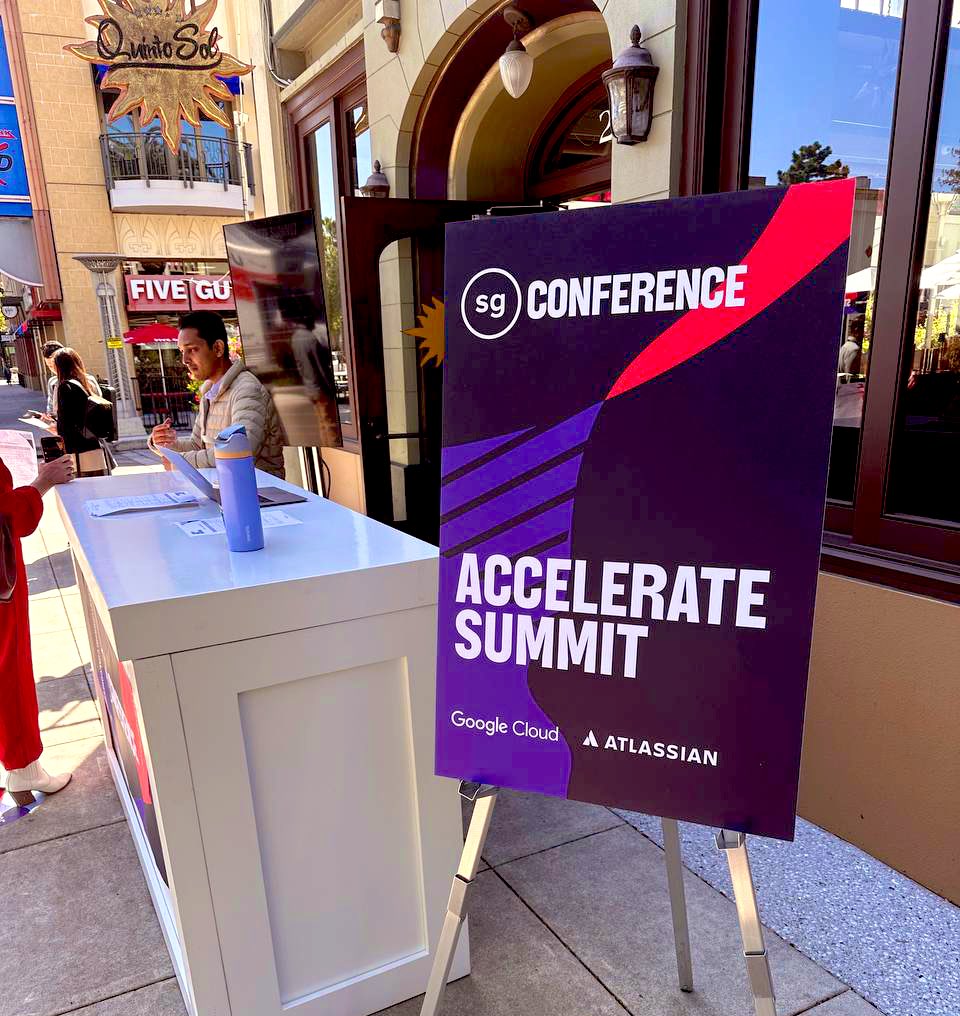
Kicked off an exciting first day at @StartupGrind Global Conference 2025 with the 🚀Accelerate Summit — an exclusive event for this year’s exhibiting startups! Learned so much and feeling ready for what’s next!
https://t.co/yxHhowzCjd
We noticed a competitor's post making indirect comments about procurement processes where we both competed. We feel it's important to offer some clarification.
1/n 🧵
Say hello to Fanvaiy – the Dhivehi-first digital publishing platform! 🇲🇻✨ Whether you’re a writer, storyteller, or blogger, Fanvaiy gives you the tools to share your voice with the world. 🌍
Start writing today: https://t.co/wKaW06x94l
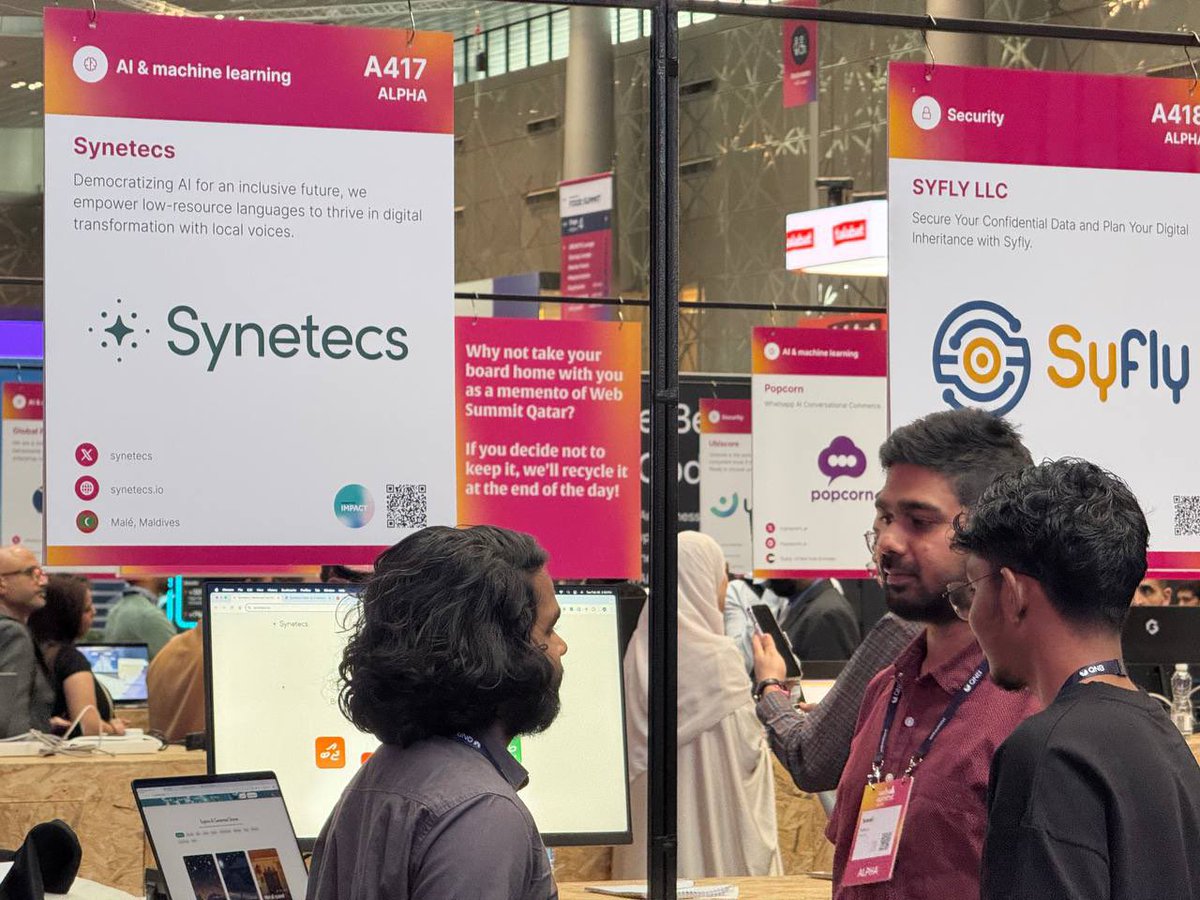
Day 3 at #QatarWebSummit2025 in the AI & ML block. As one of the few impact startups here, we're building connections and generating leads. Representing Maldives on the global tech stage. #ImpactTech#AI










![AndrewYNg's tweet photo. AI-native software engineering teams operate very differently than traditional teams. The obvious difference is that AI-native teams use coding agents to build products much faster, but this leads to many other changes in how we operate. For example, some great engineers now play broader roles than just writing code. They are partly product managers, designers, sometimes marketers. Further, small teams who work in the same office, where they can communicate face-to-face, can move incredibly quickly.
Because we can now build fast, a greater fraction of time must be spent deciding what to build. To deal with this project-management bottleneck, some teams are pushing engineer:product manager (PM) some teams are pushing engineer:product manager (PM) ratios downward from, say, 8:1 to as low as 1:1. But we can do even better: If we have one PM who decides what to build and one engineer who builds it, the communication between them becomes a bottleneck. This is why the fastest-moving teams I see tend to have engineers who know how to do some product work (and, optionally, some PMs who know how to do some engineering work). When an engineer understands users and can make decisions on what to build and build it directly, they can execute incredibly quickly.
I’ve seen engineers successfully expand their roles to including making product decisions, and PMs expand their roles to building software. The tech industry has more engineers than PMs, but both are promising paths. If you are an engineer, you’ll find it useful to learn some product management skills, and if you’re a PM, please learn to build!
Looking beyond the product-management bottleneck, I also see bottlenecks in design, marketing, legal compliance, and much more. When we speed up coding 10x or 100x, everything else becomes slow in comparison. For example, some of my teams have built great features so quickly that the marketing organization was left scrambling to figure out how to communicate them to users — a marketing bottleneck. Or when a team can build software in a day that the legal department needs a week to review, that’s a legal compliance bottleneck. In this way, agentic coding isn’t just changing the workflow of software engineering, it’s also changing all the teams around it.
When smaller, AI-enabled teams can get more done, generalists excel. Traditional companies need to pull together people from many specialties — engineering, product management, design, marketing, legal, etc. — to execute projects and create value. This has resulted in large teams of specialists who work together. But if a team of 2 persons is to get work done that require 5 different specialities, then some of those individuals must play roles outside a single speciality. In some small teams, individuals do have deep specializations. For example, one might be a great engineer and another a great PM. But they also understand the other key functions needed to move a project forward, and can jump into thinking through other kinds of problems as needed. Of course, proficiency with AI tools is a big help, since it helps us to think through problems that involve different roles.
Even in a two-person team, to move fast, communication bottlenecks also must be minimized. This is why I value teams that work in the same location. Remote teams can perform well too, but the highest speed is achieved by having everyone in the room, able to communicate instantaneously to solve problems.
This post focuses on AI-native teams with around 2-10 persons, but not everything can be done by a small team. I'll address the coordination of larger teams in the future.
I realize these shifts to job roles are tough to navigate for many people. At the same time, I am encouraged that individuals and small teams who are willing to learn the relevant skills are now able to get far more done than was possible before. This is the golden age of learning and building!
[Original text: https://t.co/1pUxNC5UXk ]](https://pbs.twimg.com/media/HG7HHJqbsAA3iao.jpg)