Most people assume smart contracts fail because of bad logic, but more often than not, the real weakness is the data feeding them. If the input cannot be verified, the contract's execution is essentially a guess. This is why the work being done by @DIAdata_org is so important for the space.
They have taken a fundamentally different approach to oracles by moving every step of the process onto the ledger.
Through their Lasernet infrastructure, the entire journey of a price feed from the raw source to the final output runs fully on chain. This is a massive shift toward transparency.
With access to over 100 direct data sources and support for 20,000 assets across more than 60 blockchains, developers are no longer forced to just accept a result at face value. Instead, they can actually inspect exactly how that data was formed.
In the current Web3 landscape, we need to move away from trusting black boxes. Security should be auditable by design, and that is exactly what @DIAdata_org is providing.
When you have a verifiable trail for every data point, you build a much stronger foundation for the next generation of decentralized applications.
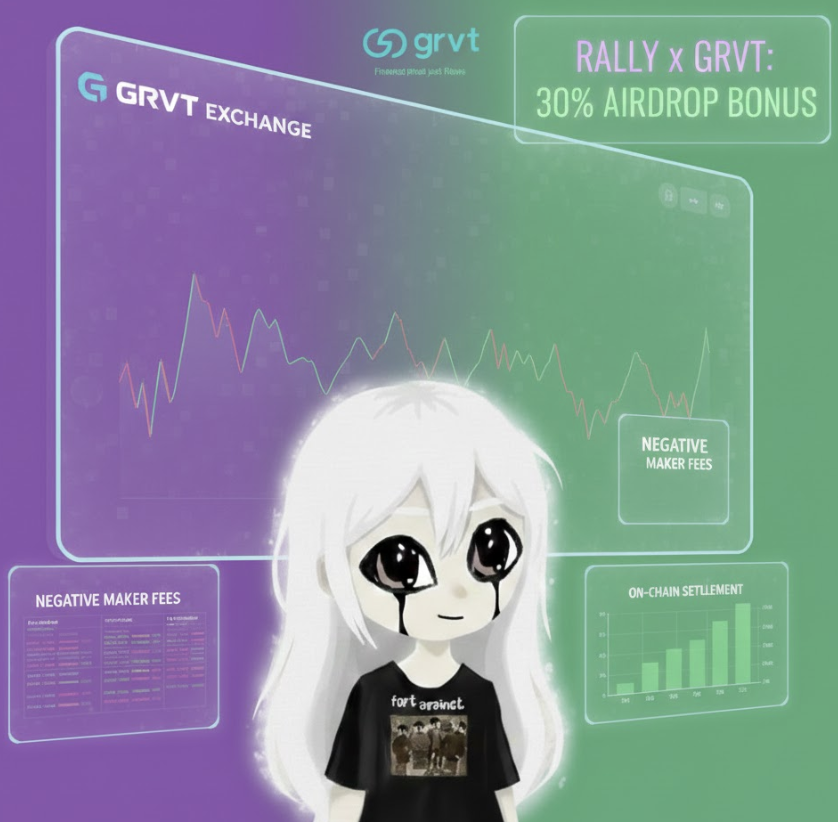
As a trader constantly searching for a market edge, I believe @grvt_io is redefining exchange standards by merging CEX speed with DEX security through their hybrid architecture built on ZK Stack. This platform offers lightning fast execution with an off chain matching engine, yet it strictly upholds the "your keys, your coins" principle because all settlements happen on chain via zkSync. It is the perfect middle ground for those who want professional performance without custodial risks.
The incentive model is what truly catches my eye. GRVT provides negative trading fees for Makers, meaning you actually get paid to provide liquidity, while Takers enjoy highly competitive rates. Furthermore, your idle funds do not just sit there; through the Grvt Liquidity Provider (GLP) strategy, the platform offers targeted annual yields using delta neutral strategies that manage market risk professionally. This creates a dual revenue stream from both trading and passive yield that is hard to find elsewhere.
Right now, @grvt_io is running a massive Rewards Season where they have allocated a significant portion of the total token supply for community airdrops. You can accumulate points through trading volume, maintaining Open Interest, and inviting others. If you want to maximize your potential and get a head start, you can join through my official link here: https://t.co/FYNl2W5CYU (using this link also grants you a 30% bonus on your airdrop points). In a competitive market, moving to an infrastructure that prioritizes privacy, speed, and real returns is a strategic move you should not miss.
If you have been trading for a while, you know the constant trade off between the speed of a CEX and the security of a DEX. Most platforms force you to choose one or the other, but @grvt_io is bridging that gap by building a hybrid exchange model. It is a serious level up for anyone tired of high slippage or the risks associated with custodial platforms.
The reason @grvt_io stands out to me is its architecture. It uses ZK Stack technology to offer off-chain matching with on chain settlement. This means you get the blazing fast execution speeds you expect from a top tier exchange, but you never have to give up custody of your funds. It is the "your keys, your coins" mantra without the performance lag. The experience feels identical to the smooth UI of a traditional exchange, but the underlying mechanics are decentralized, which helps eliminate front-running and provides better privacy.
GRVT is not just another app; it is part of an ecosystem where sophisticated trading strategies can thrive without being hindered by network congestion. If you want to get ahead of the curve and earn extra rewards, you can join through my link: https://t.co/FYNl2W5CYU (using this link also gives you 30% more airdrop points). It is rare to see a project that balances vision with actual trading performance this well.
This is where @DIAdata_org approach is fundamentally different. Instead of hidden data feeds, DIA focuses on absolute verifiability. Every information is validated by the community, ensuring that developers can verify the entire data journey before it ever hits their dApp.
I’ve been looking into how Rally actually works under the hood lately and it’s becoming pretty clear that the project simply wouldn't be possible without GenLayer. Most people see the surface level but the infrastructure is what makes it unique.
The main reason Rally depends on @GenLayer is the need for subjective decision making at scale. In a traditional blockchain, everything has to be deterministicbasically, if a computer can't verify it with a simple math equation, the network breaks. But Rally deals with real-world interactions and social coordination that aren't always black and white.
By using @GenLayer, Rally can tap into AI native validation. This allows the system to process non deterministic consensus, meaning it can "understand" and validate complex human coordination that a standard smart contract would just ignore. GenLayer acts as the bridge that allows Rally to scale these subjective decisions without needing a centralized middleman to oversee every single move.
Essentially, GenLayer provides the mechanical "brain" that lets @RallyOnChain function as a decentralized organism rather than just another rigid database. It’s a massive shift in how we think about on-chain coordination.