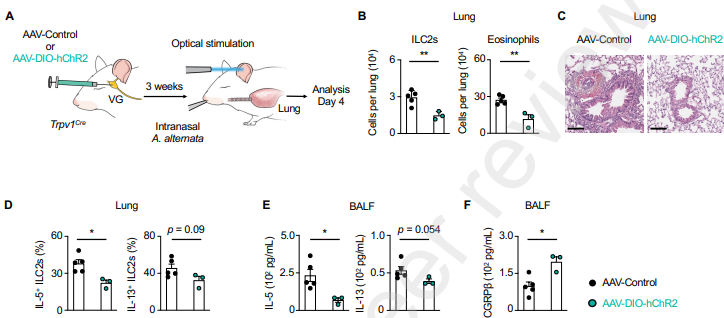
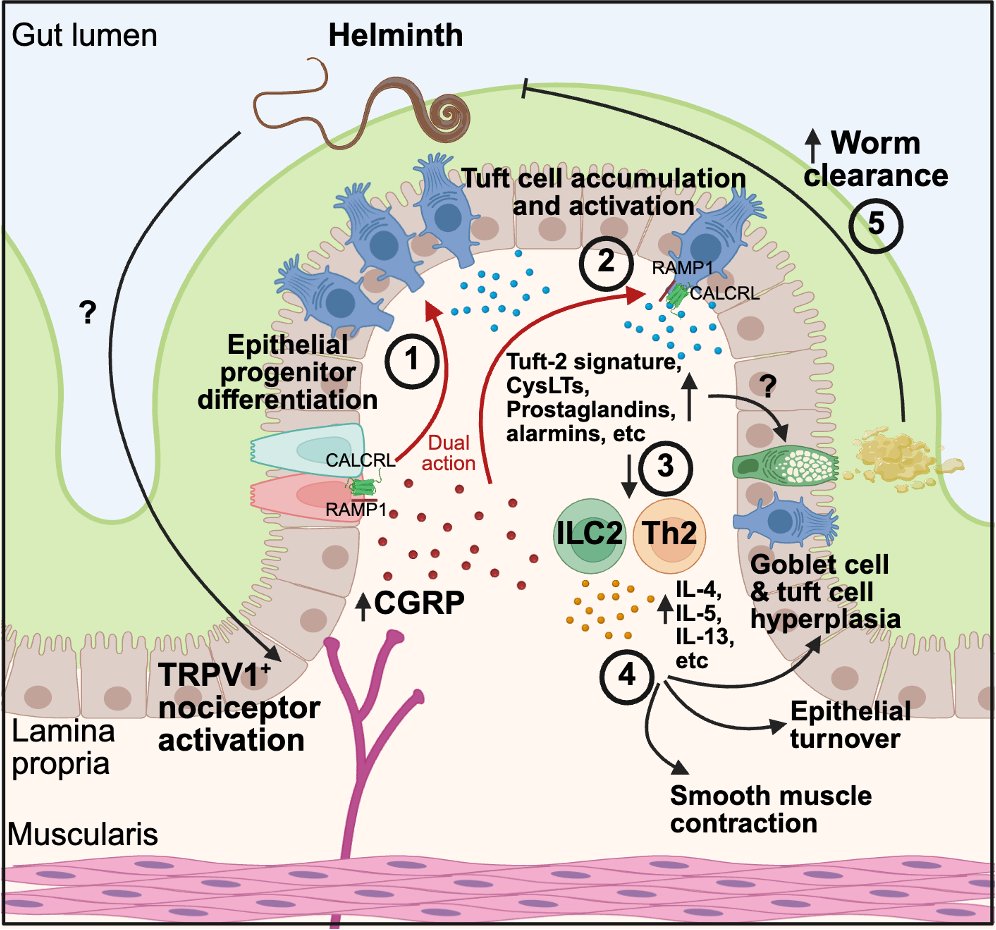
I’m thrilled to share our new @Nature study revealing a previously unrecognized neuro–epithelial circuit that actively regulates intestinal type 2 immunity. If you’re interested in sensory neurons, chemosensory tuft cells and type 2 immunity, this one’s for you. (1/6)
Extremely excited to share my first first-author publication posted today in @nature, a joint effort with co-first author @wenzhang1120 !
Here, we identify a novel neuronal-epithelial circuit as a critical determinant of type 2 immunity.
https://t.co/fsuhWiSIZV
Recovery from deadly influenza infection may hinge on helping the lungs heal in addition to stopping the virus, according to a new Science study in mice.
The results show that pairing modest antiviral therapies with immune modulation can restore damaged tissues and lung function, even after severe infection has taken hold. https://t.co/WnkwiaAm5P
A new study from the Germain lab delivers a stark reality. In a lethal flu mouse model testing 50 regimens, only Tamiflu alone or with IFN I blockade or CD8 depletion improved survival.
#science#Immunology
https://t.co/YvpEHulNjs
I am thrilled to share one of my new research entitled “Rebalancing viral and immune damage versus repair prevents death from lethal influenza infection” now on Science! https://t.co/Fq9EAXrGyX.
Pressure to publish jumps. And researchers have no time to do science.
(New survey from Elsevier)
Survey of 3200 researchers:
1. Only 45% of scientists have sufficient time for actual research.
2. For 68%, the pressure to publish today is greater than 2-3 years ago.
3. 29% of researchers are considering relocating to another country (for better funding, work‐life balance, or greater research freedom).
4. 58% of researchers use AI tools in their work.
5. Reported benefits from AI: saving time (58%), helping with literature summaries (61%), literature reviews (51%), data analysis (38%), drafting proposals (41%), and drafting papers (38%).
Globally, life in academia is getting worse.
For students & postdocs - it’s especially hard to decide on an academic career.
❗️ A few days ago, I gave a lecture on this topic.
“PhD: Dreams, Reality and Consequences”
Watch it here: https://t.co/5IFhcVFwIL
(I’ll appreciate if you ‘like’ this video - you will GREATLY help it reach more students.)
A vasculature-resident ILC3 population in mouse lungs that expands during Pseudomonas aeruginosa infection & produces CCL4 to recruit neutrophils for bacterial clearance
https://t.co/qVbIWHkpXx
Spatial Patterning Analysis of Cellular Ensembles (SPACE) finds complex spatial organization at the cell and tissue levels | PNAS https://t.co/7eOp1RveQ9
The wait is over!! We are thrilled to announce that we have chosen Spatial Proteomics as 2024’s Method of the Year! 🥳
For more on Spatial Proteomics and a road map to this special issue, please see this month’s Editorial or read on in this thread.
https://t.co/phXooJzJda
Please RT. I am currently hiring graduate students and postdoc fellows. Details can be found here: https://t.co/eU2Xk0g07u My lab is dedicated to developing and integrating imaging, AI, and spatial omics technologies to uncover mechanisms driving disease initiation, progression, and therapeutic response, with the ultimate goal of advancing next-generation theragnostics to cure diseases. We are excited to be equipped with cutting-edge spatial omics technologies, including Xenium spatial transcriptomics @10xGenomics and Phenocycler-fusion @AkoyaBio .