The Millennial Silence Problem
Why one of the most experienced generations on the internet stopped talking and what it's costing all of us.
Millennials are online more than ever. Scrolling at 2am, saving posts they'll never revisit, consuming reels endlessly. But they've stopped posting. Stopped writing, stopped making videos, stopped sharing what they know from years of actually doing the work.
An entire generation's worth of lived experience, pattern recognition, and hard won nuance is sitting in people's heads doing nothing for anyone.
In that silence, Gen Z took over the internet.
Not just the trends and aesthetics, the opinions. The frameworks. The "here's how the world works" content.
Career advice, financial advice, relationship advice, industry explainers.
They picked up the mic enthusiastically, confidently, and often without the context that only comes from having lived through enough cycles to know what you don't know.
A 22 year old with 8 months of work experience makes a confident video titled "Why your manager is gaslighting you" and gets 4 million views.
Meanwhile a 37 year old who's managed teams for a decade, navigated three downturns, hired and fired and been fired, has genuine scar tissue from real leadership mistakes, watches the video, thinks "this is so untrue," and says nothing. Posts nothing and does nothing. Everyone loses. The creator never gets a thoughtful counterpoint. What's worse is the audience builds mental models from a sample size of one.
There's a term for what's happening and it's called premature authority. Speaking with the certainty of an expert from the experience base of a beginner.
Financial advice from people who've never lived through a real crash with actual money at stake.
Career advice from people who've had two jobs.
Parenting content from people who don't have children, repackaging attachment theory PDFs as lived wisdom.
The production quality is high. The confidence is high.
What's missing is the depth that only comes from having been wrong enough times.
Algorithms don't measure depth of experience. They measure engagement.
A confident, slightly provocative take from someone with zero context will outperform a nuanced "well, it depends" take from someone who's actually seen both sides every single time. And millennials know this. Which is partly why they don't post. They think "my take is too complicated for a reel." So they say nothing. And the reductive version wins by default.
This isn't theoretical.
People are making career decisions based on LinkedIn posts written by people who've had one job.
Financial decisions based on threads from people who started investing in a bull market and think that's just how it works.
Worldviews about politics, health, business, relationships all shaped disproportionately by people who haven't had the reps yet.
And the people who HAVE had the reps are right there in the audience, rolling their eyes, saying nothing.
Let me be clear, this is a millennial abdication problem.
Somewhere around 2018 to 2019, millennials collectively decided that posting was cringe. That it was for "influencers."
They retreated into group chats and dinner table rants that go nowhere.
They became the generation of "I could write a whole post about this" but never does.
By stepping back, they didn't opt out of the attention economy. They handed the microphone to whoever was willing to pick it up.
Your silence isn't noble. You have lessons, frameworks, stories of failure and recovery that could change how someone navigates a hard decision.
Every day you don't share it, someone else fills that gap with something shinier but thinner.
You don't need to become an influencer.
You don't need to post daily.
Just occasionally write down something you know to be true from experience that you don't see anyone else saying.
The internet doesn't need more content. It needs more lived content.
Varun Agarwal
I agree completely. However, I think that some people are naturally glass-half-empty people. I have learnt not to blame them for their pessimism but also to value the caution they bring. Make I no go cross road without looking right, left and right again. But I must cross o.
It is better to remain relieved for a long time than to experience joy only for a short time and go back to struggling. Investing extends relief while spending creates joy. Humans are typically conditioned to seek joy without thinking of the consequences. Always think first.
When you make a lot of money at once, two feelings come over you. Joy and relief.
Joy makes you want to meet all your cash needs and wants and share it with others who make you happy.
Relief makes you realize that the pressure of poverty is gone or lessened. Choose relief.
I learnt about this in my Business analytics degree and I’m going to break it down for you.
Temu isn’t shipping your order from a factory in Shenzhen the moment you tap “buy.” They moved away from that model a while back. What they run now is a demand forecasting operation: they collect order data by region, figure out which products people in, say, Yaba or Lekki keep buying, then ship bulk quantities of those products to fulfilment warehouses already inside the UK or US. Your order never left the country. It was already sitting in a warehouse 40 miles from you before you even opened the app.
This is standard supply chain logic. Amazon has been doing it for years. What makes Temu interesting is how aggressively they’re applying it at scale. They’re working backwards from purchase history, search behaviour, and even abandoned carts to predict what needs to be stocked where, weeks before the demand actually lands. By the time you order a #5000 phone stand at 11pm on a Saturday, there’s a reasonable chance 200 of those phone stands are already in a depot near you because the data said they would move in your postcode cluster this weekend.
It’s called inventory pre-positioning, and the predictive layer underneath it is machine learning working on millions of rows of transaction data daily.
The “made in China” framing still applies to where the product was manufactured. That part’s accurate. But manufacturing and fulfilment are two completely separate steps, and people keep conflating them.
What Temu figured out is that fast delivery is a conversion driver, so they invested in the forecasting infrastructure to make it possible without eating the cost of next-day air freight on every order. The warehouse does the work. The algorithm fills the warehouse.
I’m @jalaal_tweets, you’ll learn more about Data and Ai fluency if you follow me.
When you're early in your wealth journey buying a house should NOT be high priority.
You need to put your money in places it can compound since you have a lot more time. Locking capital into a house when you can rent and invest the difference is a huge financial mistake.
Especially since maintenance is costly and the home is illiquid.
There's a physicist at Stanford named Safi Bahcall who modeled this exact principle and the math is wild.
He calls it "phase transitions in human networks." When you're stationary, your probability of a lucky event is limited to your existing surface area: the people you already know, the places you already go, the ideas you've already been exposed to. Your opportunity window is fixed.
When you move, your collision rate with new nodes in a network increases nonlinearly. Double your movement (new conversations, new cities, new projects) and your probability of a serendipitous encounter doesn't double. It roughly quadruples. Because each new node connects you to their entire network, not just to them.
Richard Wiseman ran a 10-year study at the University of Hertfordshire tracking self-described "lucky" and "unlucky" people. The single biggest differentiator wasn't IQ, education, or family money. Lucky people scored significantly higher on one trait: openness to experience. They talked to strangers more, varied their routines more, and said yes to invitations at nearly twice the rate.
The "unlucky" group followed the same routes, ate at the same restaurants, and talked to the same 5 people. Their networks were closed loops. No new inputs, no new collisions.
Luck isn't random. Luck is surface area. And surface area is a function of movement.
The lobster emoji is doing more work than most people realize. Lobsters grow by shedding their shell when it gets too tight. The growth requires a period of total vulnerability. No protection, no armor, soft body exposed to the ocean.
That's the cost of movement nobody posts about. You have to be uncomfortable first. The new shell only hardens after you've already moved.
If you want to know the exact visa requirements needed for a place based on where you are flying from and what passport you hold, check here.
Save this website because it is the official tool check-in officers use when deciding if to board you or not.
https://t.co/bVdWVFi7PU
I pay 42% tax every month in Germany but if:
1. I loose my job, the govt pays me 60% of my salary and help to find a new one
2. I have access to 3 years leave if I have a baby with a percentage of my salary and my job will wait for me until I resume.
3. Education is free in govt schools from primary to PhD
4. For every child I have, they get paid €250 monthly until they turn 18
5. I can buy a monthly ticket of €56 monthly and can travel all around the country via train (not high speed) and buses.
6. At any emergency, once you call the ambulance, it arrives within 20 minutes
7. Deffribilators and SOS access are available at every train station and high ways.
8. If I get stock in a country, I call the govt and they come to my support.
Let me stop here.
You that will pay about 30% tax in Nigeria that was copied 90% from the UK tax law, what will you get?
One of the most bizarre things I observed at Shell was how someone would spectacularly fail at a $$$ project, and instead of being demoted or fired, the opposite happens. They get transferred to manage another high-visibility project or even get a promotion!
It took me a long time to understand this but when I did, it changed everything for me.
You see, performance is measured in most companies on two prongs: the what and the how. The “what” is the actual result: did you or did you not strike oil after drilling that well? The “how” is the behavior you displayed during the entire process.
I was too focused on the actual results but I later found out that leaders rate behaviors higher. Hence, a project might fail in that it did not meet its stated objectives and yet the project manager might come out a winner because of how he carried himself through it all.
So what are the behaviors highly cherished by the higher ups?
First is daily updates. Forget weekly reports. Tell your boss and other key stakeholders about how the project is going at least once a day. When I say “tell”, I mean “tell.” Don’t rely solely on an email or a tool. Find a way to get in their face daily even if just for a min or two to verbally articulate the status of things. The pros at this put a standing 5-10 min meeting on their calendars and they come prepared to discuss the highlights and issues that need addressing. Which leads me to the second point.
Second, involve your superiors in solving the problem. Don’t form James Bond or Jackie Chan, trying to do it all alone. Any issue that will lead to a delay or cost overrun or any other wahala should be brought up asap to be discussed. Much easier to do if you talk with them daily. It is hard for them to blame you on the outcome of a project they have been integral to.
Third, conduct a “lessons learned” session where you perform an autopsy on the dead project. Share these lessons far and wide. You will be hailed as a sage. Suddenly you are now the guy helping the company become better by spreading wisdom gained from the school of hard knocks. This act alone has landed many people their promotion.
Bottom line: you can secure victory from defeat. The high flyers in your company do it all the time. If the project succeeds, they win. If the project fails, they win.
Be like them.
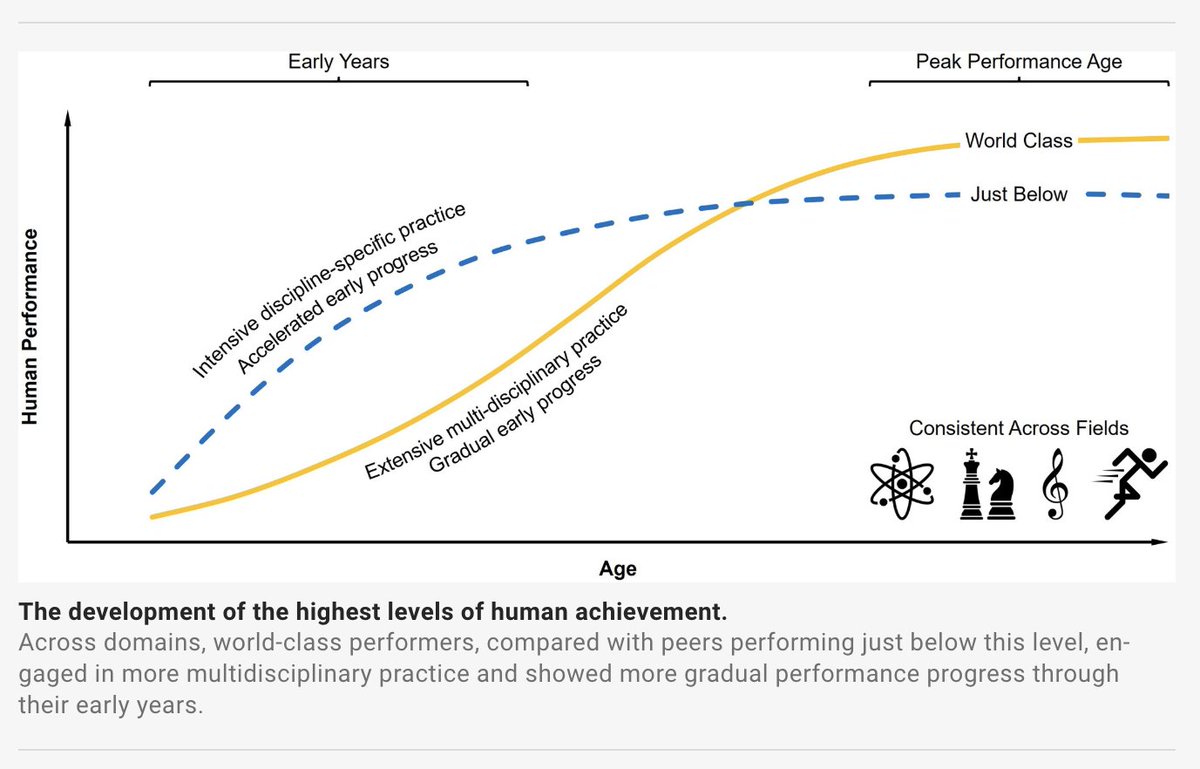
A massive new study on peak performance included 34,000 international top performers: Nobel laureates, renowned classical music composers, Olympic champs, and the world’s best chess players. It shows early specialization is a trap, and the road to greatness is long and varied.
In France, students are given exams that are graded blind (not knowing which student took it) and exams graded by a teacher who knows who took the exam. The exams measure the same knowledge and abilities
It turns out the boys are graded lower when the grader knows they are boys
After spending almost two weeks in China, I’ve found myself, for the first time in my life, thinking deeply about what old age might look like. In Nigeria, where about 70% of the population is under 30, aging doesn’t stare us in the face the way it does in many Asian countries.
In places like Japan, South Korea, Singapore, and China, the percentage of people aged 65 and above is already very high. In Japan it’s close to 30%, while countries like South Korea, Thailand, Singapore, and China range from about 13% to 17%. Seeing societies where aging is a visible, everyday reality naturally forces you to confront your own future.
That’s why it’s imperative to make good choices now such as how you save and invest for retirement, the kind of life partner you choose, and the long-term decisions you make about your health, finances, and overall lifestyle. These choices shape the quality of your later years, even if aging feels distant today.
There are still people that have N150m but don’t own up to N9m car or any car at all.
You are underrating the liquidity of these unlettered & semi-educated traders and even local contractors.
In 2015 or thereabouts, I wanted to buy a distressed-sale house of N5m (owner relocating to village). I was earning decently, riding a decent car, looked “better off”, working in an oil company.
Before I ran around to raise N5m, an unlettered concrete caster that didn’t have a car had dropped money the next day and bought the house. He beat me to it.
N5m in 2015 was decent money, although still far off from N150m we are talking about here. But it was an awakening moment for me. Forget all this our grammar and nice suits, many of us cannot match the liquidity of these men that don’t care about things we care about, including cars.
My lead bricklayer of 11 years doesn’t have a car. Sometimes, I will be owing him up to N5m and he won’t feel anything. Rather than stop work, he would easily use his money to pay his many labourers and bricklayers for many days. He rides a bike. No car.
There are people with N150m that don’t own any car.
I know a sand supplier with four houses. Baba does not have a car.
“African creators earn $1 CPM. American creators earn $30.
Same platform. Same algorithm. Same content quality.
The difference? Geography.
Adetutu Laditan spent 10 years at Google watching this reality. African creators building global audiences but earning local pennies. The math never made sense.
So she left. Not because she failed. Because she saw what everyone else missed.
"The creators making really good money in this market understand the concept of 𝗲𝘅𝗽𝗼𝗿𝘁𝗶𝗻𝗴."
Think about it.
We're the only continent that creates content for ourselves, then wonders why we're broke. Meanwhile, Korean creators understood the assignment. They didn't make content for Korea. They made content the world couldn't ignore.
Adetutu breaks it down: 𝗚𝗮𝗺𝗶𝗳𝗶𝗰𝗮𝘁𝗶𝗼𝗻 𝘄𝗼𝗿𝗸𝘀 𝗴𝗹𝗼𝗯𝗮𝗹𝗹𝘆. 𝗟𝗼𝗰𝗮𝗹 𝗰𝗼𝗺𝗲𝗱𝘆 𝗱𝗼𝗲𝘀𝗻'𝘁.
Mr. Beast doesn't speak Yoruba. His content doesn't need translation. You watch because you need to know who wins the car. That's not American content. That's human psychology packaged for export.
But here's what kills me:
We have 70% of our population under 30. The youngest continent on Earth. More creators per capita than anywhere else. Yet we're still begging for brand deals from companies whose entire marketing budget is what an American creator makes in a week.
𝗧𝗵𝗲 𝗰𝗼𝗻𝘀𝘁𝗿𝗮𝗶𝗻𝘁 𝗶𝘀𝗻'𝘁 𝘁𝗮𝗹𝗲𝗻𝘁. 𝗜𝘁'𝘀 𝘀𝘁𝗿𝗮𝘁𝗲𝗴𝘆.
Adetutu saw creators treating their channels like hobbies while wondering why they're not eating. You're the creative, the accountant, the strategist, the editor. When exactly are you supposed to create?
That's why she built Wolf Studios. Not another agency. Infrastructure.
Because the biggest creators don't check copyright strikes. They create. Someone else handles the business. That's not luxury. That's how you scale.
Here's the uncomfortable truth:
While we're debating whether African content can travel, Asian creators are banking millions from African audiences. They figured out what we're still discussing.
Your Jollof rice recipe? Nobody outside West Africa cares. But turn cooking into a competition, add stakes, create tension? Now you're speaking a universal language.
The platforms won't save us. The CPMs won't magically increase. The brands won't suddenly discover Africa.
We have to build our own economics.
Export or expire. Those are the options.
Watch Adetutu break down the creator economy on the Afropolitan Podcast.
What content are you creating that only your village understands?
If this resonates with you, share with your network.”
Afropolitan
A new set of billionaires will be minted in Nigeria between 2035 and 2040. They will be bigger than the current set. They will do all their investments between 2029 and 2032.
This handle will post these opportunities when it starts and people will laugh.
Mark this.
New Billionaires are created every 10 years in Nigeria primarily because the government changes and a new set of people create new policies to favor a new group of opportunists. There are also true entrepreneurs who take advantage of this change as they see it coming then adapt.
Improve your grooming habits, never stop learning, understand the concepts of delayed gratification and compounding, tap into the power of focus, be kind (but not naive).
Most importantly, take good care of your health. Next of Kin no dey collect change!
Many years ago, a customer walked into our Lekki outlet, visibly very upset. She had ordered a smoothie and angrily complained that she could taste banana in it. The problem? That particular product wasn’t supposed to contain any banana at all.
My team replied, saying there was no way banana could have found its way into that drink. We are very strict about following our standard recipes, but the customer insisted. She demanded a refund and said she would never come back. Then she added that she was actually allergic to bananas and was having reactions already. Allergic to bananas? That was a new one for us.
My team collected the drink, tasted it, and held their ground. We can't taste any banana, ma, and it was simply impossible. We would never add an ingredient that wasn’t listed. But the customer remained firm, insisting she could taste it and was reacting to it. She left the store angrily, never to return.
At that point, they reached out to me. I told them to call her, apologize sincerely for how she was feeling, and deliver a fresh drink right away. Then I spoke to her myself, apologise and reassured her that we would investigate, and promised to find out what really happened and her next smoothie order would also be free.
So, I immediately asked the QA Manager to dig deeper. If the customer insists, I told the team, we owe it to her and to ourselves to find out why. The investigation revealed something we had completely missed: the person who made the smoothie had used the same knife to cut banana for another product few minutes earlier, then used that same knife to cut the fruits for her smoothie. Woah!! The smallest of cross-contamination. A tiny action, but for someone highly sensitive to banana, it was enough to trigger a reaction.
That single complaint led us to introduce major changes in our production process. It changed how we handled tools, tightened our production and hygiene standards, and reinforced a stronger culture of listening.
The best customers aren’t always the happy, smiling ones who never complain. Sometimes, the best customers are the ones who challenge you, who point out what’s wrong, even when it’s uncomfortable to hear.
Never see a complaint as an attack, see it as a gift. The truth is a complaining customer still cares enough to speak up instead of walking away. And if you listen, investigate, and act, you don’t just fix a problem, you make your business better for everyone.
So, the next time a customer comes back to complain, don’t dismiss it. Lean in, listen, and learn. That’s where real growth begins.
Of course, you guessed right, she remained a very loyal customer.