Native Bitcoin DeFi is live on $ICP, and the community taking advantage.
Since ICP went live on Liquidium, users have deposited:
• 22,000 ICP as collateral
→ ~ $16.5k in stablecois have been borrowed against only using ICP as collateral
ICP collateral. Native liquidity. Real DeFi usage on Liquidium.
Hello MULTI/DEX 🔥 Should DFINITY release the most powerful DeFi application the world has ever seen?
What's cool about it? Here are some factoids, the craziest at the end:
1. It runs on an ICP cloud engine (soon everyone can have one) and is 100% network resident and tamperproof.
2. It is genuinely multi-chain, with no bridging hassles for users (users can deposit straight into their accounts, and withdraw directly, from the native chains of tokens).
3. It is order book based, but also provides a traditional swap interface, which swaps arbitrary assets by routing across the underlying markets.
4. It supports both spot trading, and margin trading that lets traders go long and short with leverage.
5. It has an AMM (Automated Market Maker) that uses Internet Computer outcalls to determine outside prices, then delayed matching against AMM limit orders to prevent arbitrageurs draining liquidity, as can occur with traditional DEXs providing swaps.
6. The AMM maintains a unified liquidity vault, and doesn't need two liquidity pools for every trading pair, providing outstanding capital efficiency and liquidity compared with traditional DeFi systems.
7. Users can earn by depositing into the AMM Vault, and into an insurance pool that protects the vault from margin calls that fail to recover all capital (the insurance pool gets 5% of all liquidations).
8. MULTI/DEX runs on the decentralized Internet Computer network, and is 100% open source — unlike HyperLedger, say, which remains closed source, and has an single-purpose architecture closer to federated CEX hosted on a symmetric cluster of federated servers.
9. If we go ahead, we would propose that MULTI/DEX runs as part of the Internet Computer, in the sense it is controlled and updated by the NNS (The Internet Computer's Network Nervous System, the world's largest and most sophisticated DAO, which directly orchestrates and updates the network) providing unparalleled levels of autonomy, transparency, and security.
10.... and this is the BIG ONE... its backend is built using the latest Motoko language framework (soon to be released) that puts AI *inside* of its software. That means, in another seminal inventive step from DFINITY and Caffeine Labs technology teams, that AI can see, browse and query the realtime data inside the app/dapp's persistent memory and can create and execute ad hoc queries and update logic on-the-fly (subject to permissions). So, while for much of the time traders will be using the traditional UX shown in the pic, increasingly, they will be interacting with the exchange through AI chats that have the "Internet Computer Connector" MCP installed (soon to be released). On the one hand, traders will be able to use chat to ask for simple things, like current spot pricing and market depth, and the likely slippage on a spot market order, and for orders to be submitted, but on the other, for much more demanding things that require the AI to execute ad hoc functionality, such as "Look at my positions and margin pools, and rebalance them to give me more blended market exposure, while also adjusting for risks indicated by social media coverage of forthcoming market events, but wait for my approval of your plan before proceeding."
This is a lot to take in, so I'm aiming to get a new demo video out ASAP that will demonstrate what's possible with this AIware, which will include MULTI/DEX — should be about a week!!
Btw. for those wondering what might be the big picture beyond what I just described with MULTI/DEX: At DFINITY, we are in the process of transforming ourselves into an "agentic organization," where all our existing apps/SaaS is replaced by custom on-demand apps/SaaS running on cloud engines that are created and updated by AI. Of course, these on-demand apps/SaaS are being built using the new technology described that automatically puts AI inside and provides users with fluid functionality via chat. The totality of the apps/SaaS represents an enterprise "World Model," which incorporates as much of the enterprise's data as possible, enabling AI to perform incredibly powerful analyses and actions — when you see this is in action, you can't unsee what you saw, because it's clearly a huge leap beyond the status quo of today's tech, which is exactly what the Internet Computer project is about. This wraps up our new technology stack, created by leaning on unique aspects of "The Network is The Cloud" paradigm, and years of work, and what, together with cloud engines, will finally enable the Internet Computer to strike out into the massive mainstream cloud technology market.
🚨 $ICP FIXING HUGE CRYPTO PROBLEM!
Crypto recovery has always been broken, if you lose your passkey or seed phrase and you’re basically finished which is not realistic for mass adoption.
But now @dfinity have added email recovery for identity, making Web3 far more usable!
Crypto media is so deceptive: DFINITY/ICP are censored as usual, probably because our technology threatens vested interests. The industry desperately needs fresh blood to move forwards.
See: https://t.co/Je63kKsRPa
See: https://t.co/cghAgEGyIj
Never lose access to your identity again.
Internet Identity now has email recovery. Lose every device, and you still get back in with a message from your own inbox. II verifies it is really you.
No seed phrase to guard. Set it up at https://t.co/TavUu6G3YW
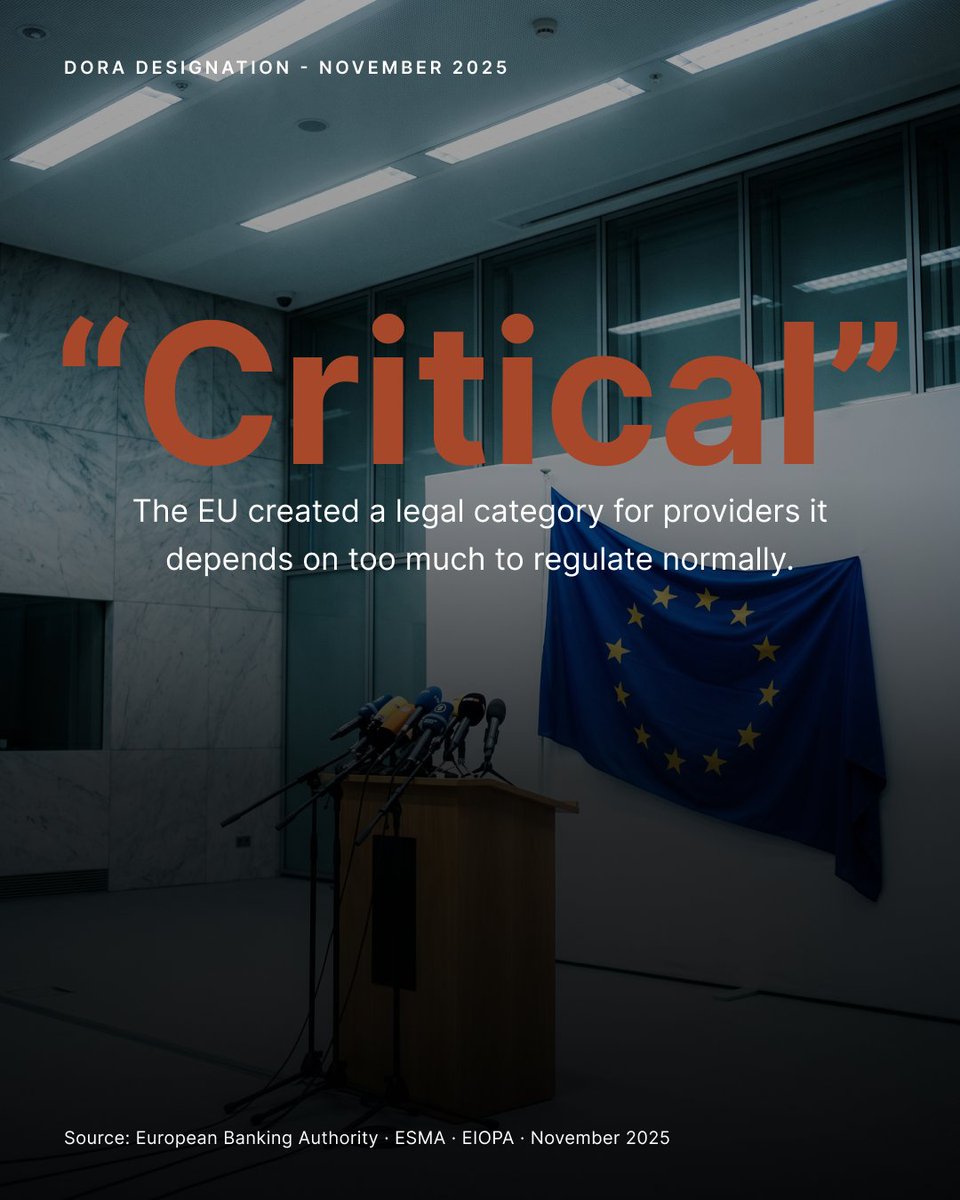
"Critical."
That's the legal category EU regulators created in November 2025 for AWS, Microsoft Azure, and Google Cloud.
Under DORA - the EU's Digital Operational Resilience Act - the European Banking Authority, ESMA, and EIOPA officially designated all three as Critical third-party providers. Meaning, their failure would constitute systemic risk to the EU financial system.
Banks. Insurers. Investment firms. Payment institutions. Across the EU. Running critical functions on infrastructure regulators now class as a systemic dependency.
So regulators built a new oversight framework. Joint inspection teams. Annual risk analyses. On-site visits.
Not to reduce the dependency. To manage it.
That's not a supervision story. It's an architecture story.
When concentration becomes severe enough that regulators must invent a new legal category to contain the risk - the problem was never regulatory. It was structural.
@Zero2HeroZombie Inflation/emissions already down 40% thanks to #Mission70. Cloud engines will now create a serious deflationary pressure. I'm hopeful we can blow past -70% net by EOY, but a lot work ahead